

Periodic bicontinuous structure enhanced steady non-equilibrium chemical sensing for efficient gas discrimination
 0
0 MAIN TEXT
Artificial olfaction holds immense promise for the digitization of gas information and realizing high-precision, real-time detection of gaseous analytes in diverse practical scenarios, from environmental monitoring to clinical disease diagnosis[1,2]. In the past decade, metal oxide semiconductor (MOS) based gas sensors have become the most mainstream platform for artificial olfaction due to their high sensitivity, low cost, and good stability[3,4]. However, conventional MOS sensors typically produce low-dimensional, equilibrium-based signals with weak feature differences, making it difficult to achieve accurate gas discrimination in complex environments. As a result, researchers have long relied on large-scale sensor arrays to improve selectivity, which inevitably increases system complexity, power consumption, and integration difficulty[5,6].
Recently, inspired by the function of periodic bicontinuous structure in organisms, Chen and colleagues offered a paradigm-shifting solution for breaking the above dilemma and advancing the development of single-sensor artificial olfactory intelligence[7]. During mammalian rhythmic breathing, the periodic bicontinuous structure covering alveolar epithelial cells and mitochondria enables ultrafast gas diffusion and efficient gas-solid interfacial reactions by virtue of its interconnected open channels, large specific surface area, and low mass-transfer resistance [Figure 1A]. Drawing on this natural inspiration, the authors rationally designed a steady nonequilibrium gas sensing system based on artificial periodic porous structures and the pulse heating (PH) technique to enrich gas sensing features for high-accuracy gas discrimination [Figure 1B]. The periodic mesoporous tin oxide (P-mSnO2) with a well-defined single primitive cubic bicontinuous architecture was synthesized by using self-assembled block copolymer cubosomes as a soft template. Benefiting from its highly ordered pore structure, large pore size, and abundant surface-active sites, this bioinspired P-mSnO2 significantly accelerates gas transport and strengthens interfacial catalytic reactions, especially during the pH sensing process. Compared with disordered mesoporous tin oxide (D-mSnO2) and commercial SnO2 particles, the P-mSnO2-based sensor proactively generates stable, repeatable nonequilibrium response signals featuring prominent and consistent overshoot peaks, which serve as unique chemical fingerprints for each gas species.
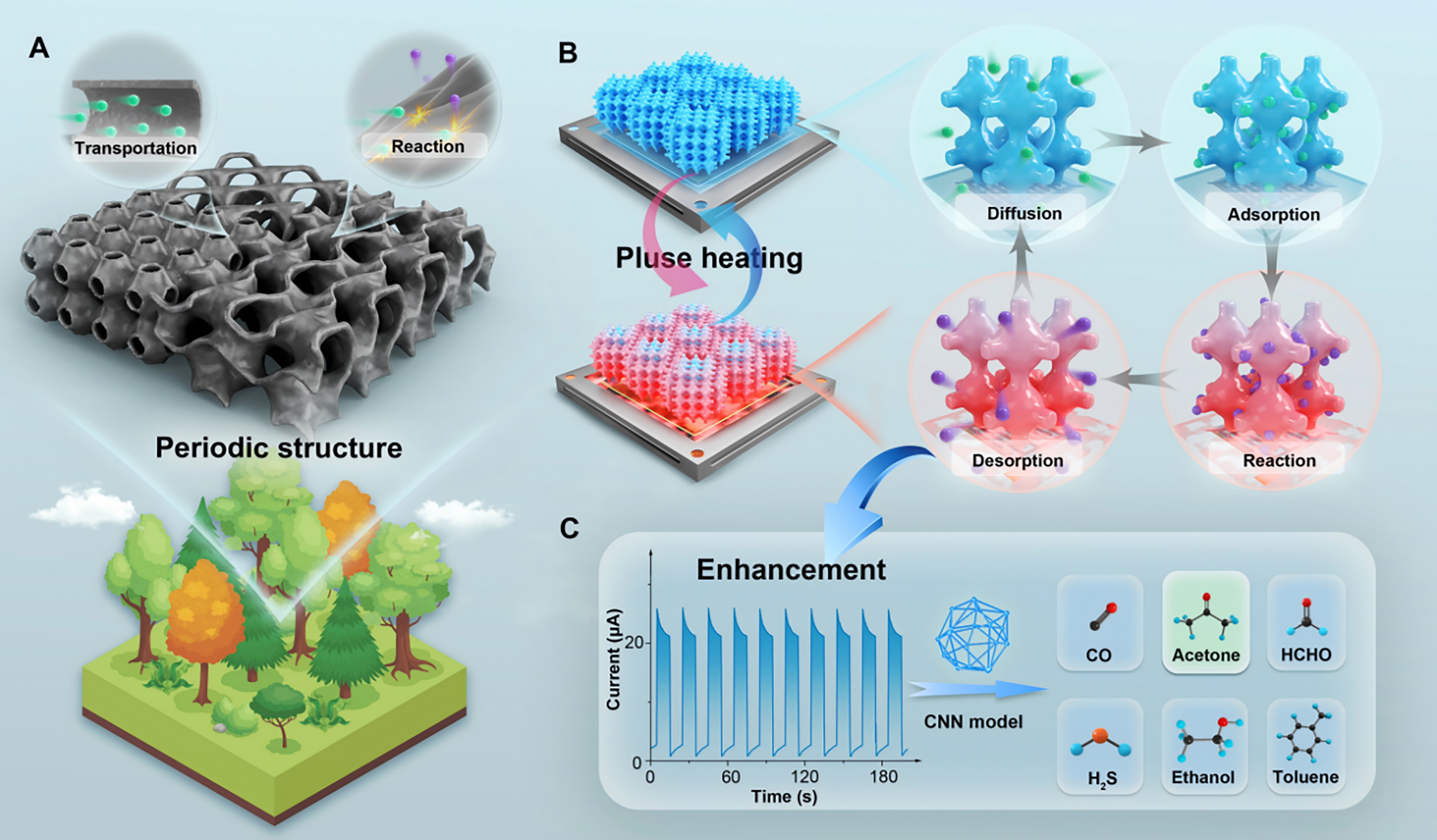
Figure 1. Schematic illustration of the P-mSnO2 sensing system for high-performance single-sensor artificial olfaction. (A) Nature-inspired periodic architecture for efficient gas transport and interfacial reactions; (B) Pulse heating-modulated dynamic sensing process (diffusion, adsorption, reaction, desorption) on the periodic mesoporous SnO2 unit; (C) CNN-assisted high-accuracy discrimination of multiple gases based on enhanced nonequilibrium response signals. This figure is reproduced from reference[7] under the terms of the CC BY-NC-ND 4.0 license. P-mSnO2: periodic mesoporous tin oxide; CNN: convolutional neural network.
With the assistance of a convolutional neural network (CNN) for processing PH gas sensing features, the P-mSnO2-based sensor achieves an exceptional 99.8% discrimination accuracy toward six representative gases at low concentrations (1-5 ppm), including toluene, acetone, ethanol, hydrogen sulfide, formaldehyde, and carbon monoxide, outperforming conventional D-mSnO2 and commercial SnO2 particle sensors [Figure 1C]. More importantly, the authors quantitatively revealed the mechanism governing the distinct PH sensing curves for gas molecules, highlighting the synergistic contributions of gas adsorption capacity, diffusion coefficient, catalytic reaction barrier, and electron transfer number as crucial influencing factors. Therefore, the thermodynamics and kinetics are both important in determining the characteristic features of PH gas sensing signals.
This work elegantly demonstrates how bioinspired periodic bicontinuous structures can fundamentally enhance sensing performance by boosting mass transport and interfacial activity. It not only breaks the long-standing cross-sensitivity bottleneck of MOS gas sensors but also establishes a universal strategy for constructing single-sensor artificial olfactory systems with high precision, miniaturization, and low power consumption. While the current system shows promising performance, the impact of material stability on the long-term recognition accuracy of devices still requires comprehensive investigation and validation. Looking forward, the design principle established here can be readily extended to other metal oxides and even to applications such as pulse electrocatalysis, ion batteries, and photothermal sensing, where coupled thermodynamic and kinetic processes are critical.
In summary, this study represents a major advance in bioinspired sensing materials and nonequilibrium detection strategies, opening a new avenue toward high-performance artificial olfactory intelligence for real-world gas detection. By integrating periodic bicontinuous structures with steady nonequilibrium PH sensing technology, this work is expected to overcome the long-standing bottleneck between sensor simplicity and recognition accuracy, enabling a single sensor to achieve precise, stable, and high-accuracy discrimination of multiple gases without relying on large-scale sensor arrays. In particular, the established PH system leverages structurally enabled active mass transport and enhanced interfacial dynamics under periodic thermal modulation to establish a steady nonequilibrium sensing state, ensuring reliable performance even in complex scenarios. More importantly, the design philosophy that couples bioinspired ordered porous architectures with nonequilibrium dynamic modulation provides a versatile paradigm for next-generation high-performance intelligent sensing and catalytic materials.
DECLARATIONS
Authors’ contributions
Write this highlight article: Haick, H.; Wu, W.
Availability of data and materials
Not applicable.
AI and AI-assisted tools statement
Not applicable.
Financial support and sponsorship
None.
Conflicts of interest
Haick, H. is an Associate Editor of the journal Micro Nano Science. Haick, H. was not involved in any steps of editorial processing, notably including reviewers’ selection, manuscript handling, and decision making. Wu, W. declares that there are no conflicts of interest.
Ethical approval and consent to participate
Not applicable.
Consent for publication
Not applicable.
Copyright
© The Author(s) 2026.
REFERENCES
1. Xiao, X.; Yin, J.; Xu, J.; Tat, T.; Chen, J. Advances in machine learning for wearable sensors. ACS. Nano. 2024, 18, 22734-51.
2. Wu, X.; Shi, S.; Jiang, J.; et al. Bionic olfactory neuron with in-sensor reservoir computing for intelligent gas recognition. Adv. Mater. 2025, 37, 2419159.
3. Jeong, S. Y.; Kim, J. S.; Lee, J. H. Rational design of semiconductor-based chemiresistors and their libraries for next-generation artificial olfaction. Adv. Mater. 2020, 32, 2002075.
4. Qu, D.; Cheng, B.; Shao, X.; et al. Advances in metals and metal hybrids-based gas sensors and their applications. Rare. Metals. 2025, 44, 9363-413.
5. Kang, H.; Cho, S. Y.; Ryu, J.; et al. Multiarray nanopattern electronic nose (E-nose) by high-resolution top-down nanolithography. Adv. Funct. Mater. 2020, 30, 2002486.
6. Guo, L.; Wang, T.; Wu, Z.; et al. Portable food-freshness prediction platform based on colorimetric barcode combinatorics and deep convolutional neural networks. Adv. Mater. 2020, 32, 2004805.
Cite This Article
 Open Access
How to Cite
Download Citation
Export Citation File:
Type of Import
Tips on Downloading Citation
Citation Manager File Format
Type of Import
Direct Import: When the Direct Import option is selected (the default state), a dialogue box will give you the option to Save or Open the downloaded citation data. Choosing Open will either launch your citation manager or give you a choice of applications with which to use the metadata. The Save option saves the file locally for later use.
Indirect Import: When the Indirect Import option is selected, the metadata is displayed and may be copied and pasted as needed.
About This Article
Copyright

Data & Comments
Data
0





Comments
Comments must be written in English. Spam, offensive content, impersonation, and private information will not be permitted. If any comment is reported and identified as inappropriate content by OAE staff, the comment will be removed without notice. If you have any queries or need any help, please contact us at [email protected].