
Microbial genomic scars: a novel paradigm for reconstructing events and behaviors in forensic investigations
 0
0 Abstract
Traditional forensic microbiology treats microbial communities as static “taxonomic labels”, relying on species composition for associative analysis. However, this paradigm struggles to reconstruct the dynamic events underlying criminal activities. This review proposes a new paradigm: recasting microbes as dynamic “environmental sensors” and “event recorders.” Under stressors such as disinfectants or antibiotics, microbes heritably alter their genomes via horizontal gene transfer, phage induction, and adaptive mutations, leaving specific “genomic scars”. These scars can potentially document critical events, such as crime scene sanitization or specific occupational exposures. Decoding these scars through ultra-deep metagenomics, single-cell genomics, and artificial intelligence (AI) offers a new avenue for reconstructing behaviors, individual profiling, and evidence linkage. The article systematically elaborates the biological basis, forensic applications, and technical challenges of this paradigm, propelling microbial evidence from associative to behavioral inference.
Keywords
INTRODUCTION
Over the past decade, forensic microbiology has evolved from a nascent concept into a powerful tool for connecting crime scenes, suspects, and victims[1,2]. Enabled by high-throughput sequencing, researchers can now delineate the microbial “fingerprints” on physical evidence or individuals with unprecedented resolution. By comparing the taxonomic composition and community structure between samples, significant strides have been made in human identification, geographic sourcing, and post-mortem interval estimation[2-8]. The central tenet of this research has been to treat microbial communities primarily as stable, static taxonomic labels. This paradigm presumes that a microbial census, captured at a specific moment, faithfully reflects its origin and thus serves as the core basis for associative evidence.
However, this foundational view of microbes as static taxonomic identifiers fails to fully harness their informational potential. This conventional approach has inherent limitations in reconstructing the specifics of an event. First, while it acknowledges the dynamic responsiveness of organisms to environmental change[9-11], its focus on community-level shifts often provides limited insight into the causal pressures driving these changes. For instance, analyses of taxonomic succession are valuable for estimating the post-mortem interval, but they may not distinguish between different types of stressors that could lead to similar community structures. Consequently, a static species list provides an incomplete record of critical events, such as scene sanitization or body disposal, which impose intense selective pressures sufficient to reshape the microbial genomic landscape within hours to days[12-14]. Second, taxonomic-level comparisons can be confounded by ecological convergence, leading to ambiguity and diminishing the specificity and strength of the evidence[15,16]. Therefore, while this approach is effective at addressing “who was here?”, it is often less equipped to resolve the more granular forensic question: “what happened here?”.
Here, we propose a paradigm shift to transcend these limitations: recasting microbes from passive “taxonomic labels” to active “dynamic environmental sensors” and “event recorders.” The core idea of this paradigm is that the microbial genome is not immutable but is a molecular ledger that responds to environmental stress in real time, leaving heritable alterations[17]. When confronted with specific stimuli - such as the chemical assault of a disinfectant, the selective pressure of antibiotics, or contamination with heavy metals - microbes undergo adaptive evolution at the genomic level through mechanisms such as horizontal gene transfer (HGT), phage activity, or the rapid accumulation of point mutations[18-24]. These genomic alterations, which we term “genomic scars”, are driven by environmental pressures and fixed by natural selection. In principle, these scars can document the specific events a microbial community has endured, offering a dimension of information far richer and more profound than a simple species roster.
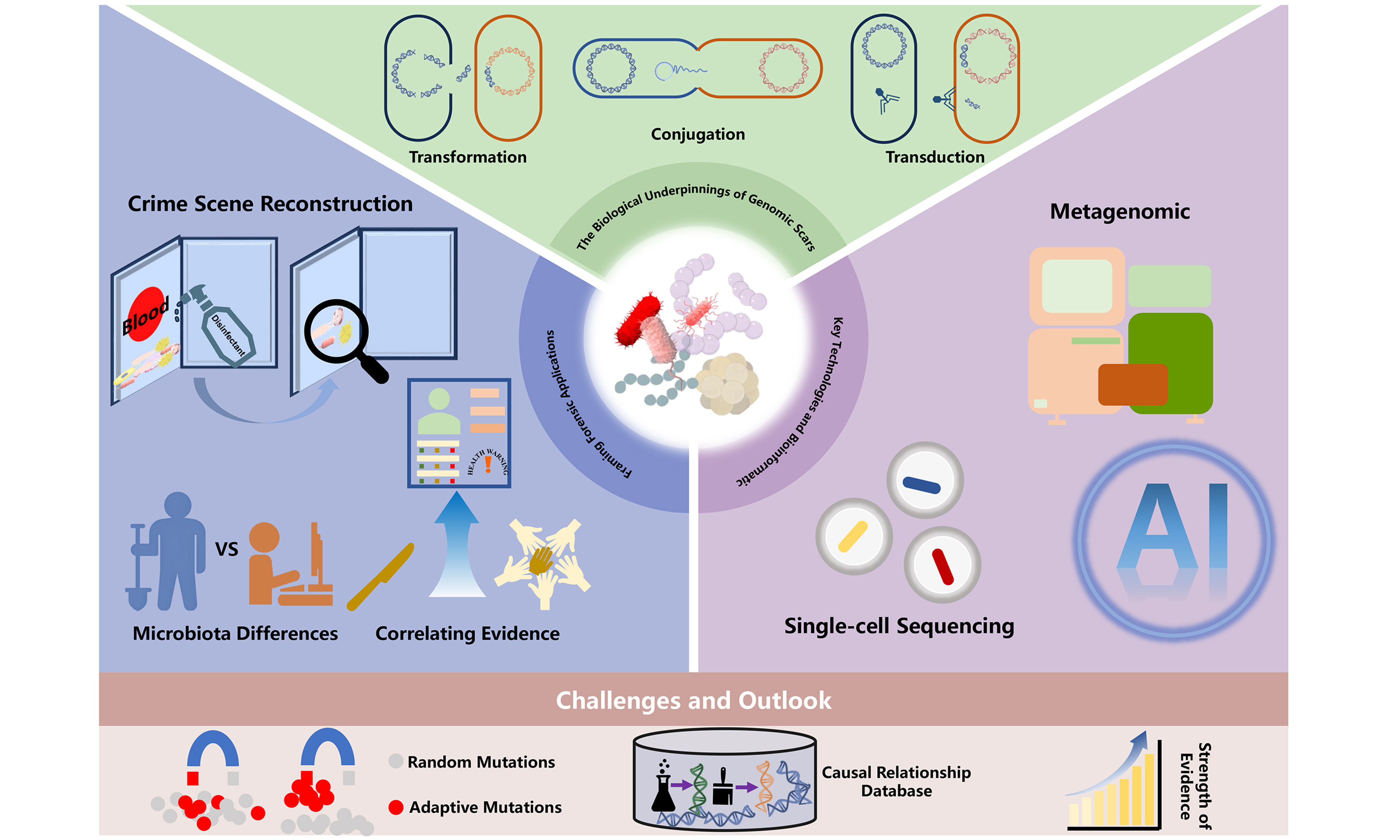
In this Review, we will systematically elucidate this emerging field. We first delve into the key biological mechanisms that forge these “genomic scars”, including the roles of mobile genetic elements (MGEs), phage dynamics, and the accumulation of micro-scale genomic variations. Building on this foundation, we will construct a framework of potential forensic applications, demonstrating how decoding these scars can be used to reconstruct criminal actions, infer an individual’s lifestyle and provenance, and forge novel evidentiary links. Furthermore, we will highlight the key analytical technologies required to achieve these goals and, finally, discuss the challenges and future directions for the field. We contend that this paradigm shift - from taxonomic labels to event recorders - will open a new dimension for forensic science, marking a pivotal step for microbial evidence to evolve from being purely associative to becoming truly behavioral.
THE BIOLOGICAL UNDERPINNINGS OF GENOMIC SCARS
The concept of microbes as dynamic event recorders is scientifically grounded in a suite of rapid genomic adaptation mechanisms that microorganisms have evolved to survive drastic environmental shifts[25-27]. These mechanisms enable microbial populations to transduce external physical or chemical stimuli into stable, heritable genomic alterations - what we define as “genomic scars” - on timescales ranging from hours to a few generations. However, the persistence of these scars is not indefinite, as their maintenance can impose a “fitness cost” on the organism once the stressor is removed. Therefore, understanding this temporal dynamic, or the “half-life” of a specific scar, is essential for accurately reconstructing the timeline of a forensic event and inferring how recently it occurred. These scars are not merely a testament to microbial survival strategies; they provide a layer of high-resolution information crucial for forensic reconstruction.
HGT
HGT serves as a primary conduit for genetic information exchange within the microbial world, enabling the rapid dissemination of genetic material - particularly adaptive functional genes - across species[28,29]. This process is primarily mediated by MGEs, such as plasmids, transposons, and integrons[28-30]. When a microbial community confronts an acute and intense selective pressure - such as the disinfection of a crime scene with biocides [e.g., quaternary ammonium compounds (QACs), bleach], or chronic exposure to specific antibiotics (e.g., in healthcare workers) or heavy metals (e.g., in industrial workers) - MGEs harboring the corresponding resistance genes become critical determinants of survival[30,31]. The few cells that possess these MGEs are thereby selected for, enabling them to survive and proliferate rapidly, which in turn leads to a dramatic increase in the frequency of these resistance genes throughout the entire community[30]. Therefore, the significant enrichment of plasmids encoding specific disinfectant efflux pumps or antibiotic-degrading enzymes, as identified through metagenomic analysis of physical evidence, could provide strong indicators of prior treatment with corresponding chemical agents, potentially enabling the reconstruction of critical activities such as scene cleanup[32-34].
Phage dynamics and the CRISPR-Cas system
Phages, as ubiquitous viruses, are engaged in a perpetual co-evolutionary arms race with their bacterial hosts[35]. This dynamic interplay offers a unique lens for documenting environmental perturbations. Prophages are commonly integrated into bacterial genomes in a dormant, or lysogenic, state. However, a diverse array of internal and external stimuli, such as DNA damage, oxidative stress, nutrient availability, host immune responses, quorum sensing, diet, secondary metabolites, antibiotics, and lifestyle changes, can trigger prophage induction and prompt their switch into the lytic cycle[36]. Consequently, a burst of free virions in the environment or the detection of a high frequency of phage excision sites (att sites) within bacterial genomes can serve as potential indicators of a preceding, specific environmental stimulus. Furthermore, the bacterial clustered regularly interspaced short palindromic repeats and CRISPR-associated proteins (CRISPR-Cas) adaptive immune system provides an even more sophisticated mechanism, acting as a “molecular recorder”. It chronologically captures and archives DNA fragments (known as spacers) from invading phages or plasmids. Upon each new invasion event, a novel spacer sequence is integrated at the leader end of the CRISPR array[37,38]. This implies that the sequential arrangement of spacers within the array constitutes a “molecular fossil record” of the invasion history experienced by that cell lineage.
Adaptive point mutations and indels
Beyond the acquisition or loss of gene cassettes, the adaptive evolution of microbial genomes also manifests at a finer scale: through the rapid accumulation and positive selection of single nucleotide polymorphisms (SNPs) and short insertions/deletions (indels)[39,40]. Under sustained, sub-lethal selective pressures - for instance, long-term exposure to sub-minimum inhibitory concentrations (sub-MIC) of antibiotics or industrial pollutants - microbial populations experience intense directional selection[41]. In this process, stochastic mutations that confer even minor fitness advantages, such as SNPs that reduce drug-target affinity or indels that alter regulatory elements to modulate gene expression, are rapidly selected for, leading to a significant increase in their allele frequencies within the population[42]. This phenomenon of population-level genetic convergence at specific loci constitutes an “evolutionary snapshot” that chronicles the population’s response to a particular chronic stress[43]. In a forensic context, the detection of an identical, non-random profile of adaptive SNPs and indels within the same dominant bacterial strain across different evidence samples provides strong evidence that these samples share a common origin, reflecting their exposure to the same unique selective pressure[44,45]. This provides a novel dimension of evidence for linkage, independent of species composition and HGT.
FRAMING FORENSIC APPLICATIONS
A paradigm shift that views microbial genomes as dynamic information carriers has opened up broad prospects for forensic applications, ranging from behavioral reconstruction to physical evidence association. These deeply embedded “genomic scars”, serving as direct responses to specific environmental stresses and events, can provide higher-dimensional and more targeted evidence compared to traditional species composition analysis. Building upon the robust foundations of existing research in forensic genetics, microbial ecology, evolutionary biology, and clinical microbiology, this chapter systematically elaborates on how to translate these “genomic scars” into actionable forensic practices, constructing three core application scenarios.
Reconstructing crime scene actions
Post-crime scene contamination, particularly through the application of chemical agents for cleanup, represents a common strategy to obstruct forensic investigations. Conventional physicochemical analytical techniques exhibit limited efficacy in detecting such deliberate alterations. In contrast, microbial genomics offers a novel paradigm for forensic breakthrough. The deployment of potent disinfectants imposes a severe chemical bottleneck on indigenous microbial communities, wherein the genomic signatures of surviving microorganisms can bear distinctive imprints of this anthropogenic disturbance. Numerous environmental microbiology studies have confirmed that exposure to disinfectants such as QACs, chlorine-based agents, and phenolics triggers rapid selection and enrichment of tolerant microbial populations within hours to days[46-49]. For example, a global phenomenon observed during the COVID-19 pandemic involved the discharge of excessive amounts of chlorine-based disinfectants (e.g., sodium hypochlorite) into sewer systems. Research revealed that although the microbial community structure gradually recovered after disinfection ceased, the composition of antibiotic resistance genes (ARGs) underwent persistent and irreversible changes. The core mechanism lies in chlorine stress, which strongly selected for and enriched chlorine-tolerant bacteria carrying specific biocide resistance genes (BRGs), such as the chtR subtype. These surviving bacteria then efficiently facilitated the co-selection and stabilization of biocide and antibiotic resistance via plasmids and integrative and conjugative elements[47]. A separate study on QACs revealed a similar pattern. It found that QAC resistance genes prevalent in environmental samples were significantly correlated with multiple ARGs. At environmental concentrations, QACs enhanced bacterial resistance to multiple antibiotics and significantly promoted the conjugation transfer of the RP4 plasmid. This promotion, reaching up to approximately 15-fold, is achieved by increasing bacterial membrane permeability and stimulating reactive oxygen species production[46]. Beyond the direct effects of disinfectants, their unintended by-products also play a critical role. Disinfection by-products (DBPs), such as trichloromethane (TCM) and dichloroacetonitrile (DCAN), are commonly detected in various water environments. A recent study demonstrated that exposure to low concentrations of TCM (25 μg/L) and DCAN (10 μg/L) significantly stimulated the conjugative transfer of the RP4 plasmid in Escherichia coli, resulting in maximum transfer fold changes of approximately 5.5 and 6.0, respectively. Mechanistic investigations revealed that DBPs promote ARG dissemination through intracellular reactive oxygen species generation, SOS response activation, increased membrane permeability, and upregulation of genes and proteins related to pilus generation, adenosine triphosphate (ATP) synthesis, and plasmid transfer[50]. Together, these cases demonstrate that the application of disinfectants such as chlorine-based agents or QACs at a scene constitutes far more than a simple “clean-up”. Instead, it acts as a powerful anthropogenic intervention into the indigenous microbial community, triggering a cascade of stress-selection-enrichment-transfer events that leave a traceable genomic signature. This provides a novel and powerful avenue for forensic microbial traceability.
This biological phenomenon provides a novel molecular basis for the forensic reconstruction of cleaning activities. By performing differential sampling of suspected cleaning areas (e.g., wiped floors) and adjacent undisturbed control areas (e.g., corners or beneath heavy furniture) at a crime scene, followed by deep metagenomic sequencing, researchers can conduct a quantitative comparative analysis of the resistome. If samples from a suspected cleaning site not only reveal the co-localization of qac genes with ARGs (e.g., dfrA/sul1) on a class 1 integron, forming a co-selected genetic cassette, and a marked increase in their overall abundance, but also genomic analysis confirms their location on plasmids prone to HGT, this would constitute a significant molecular signature suggesting a “cleaning event”[51]. Such evidence could offer a higher degree of specificity than taxonomic shifts alone, which can be confounded by a variety of non-specific factors. More importantly, the precision of this approach has the potential to discriminate between the chemical classes of the cleaning agents used. For instance, the enrichment of qac genes could serve as a potential indicator for the use of QAC disinfectants, while an abnormal proliferation of certain BRGs might be associated with exposure to chlorine-based cleaning agents. It is crucial, however, to interpret such signatures with caution, as they could also arise from background environmental contamination or prior selective pressures rather than a single, specific event. This molecular profile, when corroborated by the analysis of cleaning products seized from a suspect, could theoretically form a powerful evidence chain from the act to the physical object, aiming to provide objective and precise evidence for courtroom reconstruction.
It is crucial to acknowledge that natural abiotic stressors, such as extreme temperatures or ultraviolet (UV) radiation common at many crime scenes, can also induce specific genomic adaptations in microbes. Therefore, a key future challenge will be to differentiate these naturally induced signatures from those arising from anthropogenic activities to avoid confounding forensic interpretations.
Inferring individual occupation and lifestyle
An individual’s distinctive profession, lifestyle, and geographical trajectory continually sculpt the genomes of their commensal microbiota. These adaptive genomic features collectively constitute a dynamically updated “microbial passport”, which holds significant promise as a powerful supplementary tool for forensic inference of personal background.
Occupational exposure distinctly shapes an individual's antibiotic resistome. Recent studies demonstrate that intensive care unit (ICU) healthcare workers harbor a gut microbiota with a significantly higher abundance and diversity of ARGs compared to the general population[52]. Furthermore, the hand microbiota of nursing staff is characterized not only by an enrichment of multi-drug resistance ARGs but also by a greater load of potential pathogens, underscoring the profound impact of hospital environmental exposure[53]. The detection of an exceptionally complex resistome from a suspect’s skin swab metagenome, after excluding recent infection or hospitalization, could be indicative of a healthcare or related occupational background. Occupational exposure has been empirically demonstrated to shape the individual microbiome across various industries. In slaughterhouse settings, nasal carriage of Methicillin-Resistant Staphylococcus aureus (MRSA) among workers (3.2%) showed significant association with specific work zones, with the highest risk observed in the lairage and scalding/dehairing areas. Notably, 73% of the isolates were identified as livestock-associated ST398 lineage (LA-MRSA). The decreasing gradient of MRSA concentration in environmental samples along the slaughter line further corroborates the dynamic interplay between occupational exposure and microbial colonization[54]. Additionally, metagenomic analyses revealed distinct oral and gut microbial structures between occupational groups (e.g., students vs. manual laborers). These differences remained stable after controlling for confounders such as sex, smoking, and alcohol consumption, and in this specific study, machine learning models were reported to achieve 100% classification accuracy on the tested cohorts, indicating that specific microbial taxa and functional pathways (e.g., genes related to the “Phagosome” pathway) hold promise as biomarkers for occupational inference[55].
The integration of the CRISPR-Cas system with phage biogeography holds promise for providing high-resolution spatiotemporal markers for both individual geographic origin tracing and behavioral trajectory inference[6,56]. CRISPR typing serves as a complementary tool for genomic source tracking and has been successfully applied in foodborne disease outbreak investigations. For instance, comparing the CRISPR arrays of Salmonella isolates can effectively distinguish outbreak-related strains from unrelated ones, thereby aiding in determining the infection source[57]. This principle can be extended to forensic science, offering a novel conceptual framework for determining an individual’s geographic origin and reconstructing their activity trajectories. Therefore, if shared, recently acquired spacer sequences that are rare in public databases are identified in the same strain isolated from crime scene evidence and a suspect, this provides strong evidence for their recent co-exposure to the same micro-environment containing a specific phage, thereby supporting the establishment of a spatiotemporal association between the suspect and the crime scene. By comparing the “new” and “old” spacers in the CRISPR array, the temporal sequence of the divergence between the two samples can even be inferred, providing key information for reconstructing the event timeline.
Linking physical evidence
The rapid transfer of microorganisms makes them a useful tool for linking physical evidence. A 2014 study revealed that microbial samples from different surfaces within the same household exhibited significantly greater similarity to each other than to samples from the same type of surface across different households[58]. Subsequent research further demonstrated that even brief contact during a conference allows location-specific environmental microbial communities to influence the microbial assemblages associated with the attendees[59]. An individual not only exchanges microorganisms with the environment but also deposits a unique microbial “fingerprint” on contacted items[60]. This transfer dynamic facilitates the establishment of an evidential network interconnecting people, objects, and locations, thereby providing a scientific basis for directly linking a suspect to a specific crime scene or key piece of evidence. Empirical support for this concept is provided by multiple studies: microbial communities recovered from phone surfaces can specifically discriminate between contact with hands and faces, while those from shoe soles exhibit significant geographic variation. However, these investigations remain confined to the taxonomic level, which imposes inherent limitations on their resolution and definitiveness[59,61]. Achieving precise forensic associations necessitates moving beyond taxonomic composition to the resolution of microbial strains and genes. A seminal study on the skin microbiome highlighted the potential superiority of genetic-level analysis for human identification. The research revealed that while identification based solely on species-level profiles achieved a mere 52.5% accuracy, constructing a panel of SNPs from Cutibacterium acnes and applying a machine learning model dramatically increased the accuracy to 97.5%[62]. Further validating this approach, researchers developed the “hidSkinPlex+” panel, which comprises 365 highly discriminatory and reliably detectable SNP loci curated from hand, sternum, and foot samples. In a blind test of 225 samples, this method achieved 96% identification accuracy [Matthews correlation coefficient (MCC) = 0.954]. These findings collectively indicate that SNP-based analysis of bacterial genomes effectively overcomes the instability inherent in community-level profiling, pointing towards a potentially reliable and highly accurate pathway for forensic identification from microbial traces[63].
KEY TECHNOLOGIES AND BIOINFORMATICS
The paradigm shift of redefining microorganisms from mere “taxonomic labels” to “event recorders” imposes exceptionally high demands on analytical technologies. Traditional approaches such as 16S rRNA gene sequencing or shallow metagenomics are no longer sufficient. It is imperative to rely on a progressive technological framework comprising deep metagenomics, microbial single-cell genomics, and artificial intelligence (AI)-driven integrative analysis to transform microscopic “genomic scars” into forensic evidence characterized by high resolution, specificity, and interpretability.
Ultra-deep metagenomics overcomes the technical limitations of traditional metagenomics in detecting low-abundance species (relative abundance < 0.1%), resolving genomes at the strain level, and reconstructing complex microbial community structures by implementing ultra-deep sequencing (typically exceeding 50 Gb per sample) and integrating hybrid assembly strategies that combine long-read and short-read sequencing technologies[64,65]. It not only enables the assembly of a large number of high-quality, nearly complete metagenome-assembled genomes (MAGs), but also systematically uncovers extrachromosomal MGEs (such as plasmids and bacteriophages), thereby providing a foundational framework for understanding the species composition, functional potential, and ecological interactions of microbial communities. Building upon this foundation, microbial single-cell genomics elevates the resolution to the level of individual cells. It not only reveals intercellular heterogeneity in chromosomal genomes but also directly links specific MGEs to their host cells[66]. For example, it can precisely identify which specific strain or single cell harbors an antibiotic resistance plasmid, thereby accurately defining the carrier of functional genes. This is crucial for tracing the transmission pathways of functional genes within complex communities and identifying rare cells with key phenotypes (such as antibiotic resistance or unique metabolic capabilities). It provides direct evidence for enabling a shift from answering “who is there?” to “who is doing what?” However, the application of single-cell genomics to forensic samples, which are often characterized by low biomass and DNA degradation, poses significant challenges for isolating intact single cells. To overcome this limitation, proximity-ligation-based methods, such as meta-Hi-C (metagenomic chromosome conformation capture), offer a powerful complementary or alternative approach. This technology captures the physical proximity of DNA molecules within a cell, enabling the direct association of plasmids and phages with their host chromosomes even in complex samples where single-cell isolation is not feasible[67,68]. Integrating such techniques would significantly enhance the reliability of linking event-specific genomic scars to the responsible microbial actors.
Ultra-deep metagenomics and single-cell genomics generate vast, multidimensional, and highly complex datasets. These data encompass not only multi-layered information such as species, genes, and functional pathways but also structural variations in chromosomes and MGEs, single-cell heterogeneity, and spatiotemporal dynamics. Traditional bioinformatics approaches face significant challenges in processing such high-dimensional, nonlinear, and noise-laden association networks, making it difficult to distinguish biologically meaningful and forensically valuable causal signals from complex correlations[69]. AI technologies, particularly machine learning and deep learning, provide revolutionary tools for addressing the complexity of microbiome data. By constructing unified analytical frameworks that integrate multi-omics data, AI can automatically identify key microbial biomarkers, gene modules, or combinations of MGEs most relevant to specific forensic phenotypes - such as geographic origin, individual characteristics, and more - from vast microbial genomic datasets, thereby achieving dimensionality reduction and feature extraction[55,70-72]. Furthermore, AI constructs potential interaction and transmission networks among microorganisms, between microorganisms and host genes, and of MGEs within communities. This approach moves beyond simple species abundance correlations to reveal the underlying ecological and evolutionary dynamics driving changes in microbial community structure. Ultimately, by applying advanced analytical frameworks such as causal discovery algorithms and structural equation modeling, AI provides critical support for reconstructing the temporal sequence and logical chain of events in forensic science[73,74].
CHALLENGES AND OUTLOOK
The paradigm of “microbial genomic scars” offers a potential pathway for forensic science to transition from identity association to behavioral reconstruction. Furthermore, a holistic approach that integrates the analysis of genomic scars with traditional community-level taxonomic shifts is crucial for building a robust interpretive framework. Genomic adaptations (the “cause”) and subsequent changes in community composition (the “effect”) are two sides of the same coin in a microbial ecosystem’s response to a stressor. For instance, identifying a specific antibiotic resistance plasmid (a genomic scar) within a bacterial strain, and concurrently observing the dramatic rise in that strain's abundance, provides a powerful, two-layered line of evidence. This integrated analysis not only strengthens the causal inference but also creates a more resilient and comprehensive narrative of the forensic event, moving beyond what either data type could reveal in isolation. However, its translation from a theoretical concept into reliable and admissible evidence in court faces three core challenges.
First is the fundamental challenge of signal discrimination. A critical hurdle is distinguishing genuine event-driven genomic signatures from the vast background noise generated by daily living and random genetic drift. This challenge begins at the crime scene itself; standardized pre-analytical protocols - from sampling methods and swab types to DNA preservation buffers - are crucial to ensure that detected genomic signals are true reflections of an event, not artifacts of evidence collection. Furthermore, the intensive sample preparation steps, such as whole-genome amplification and library construction, can introduce their own procedural artifacts, including polymerase chain reaction (PCR)-induced mutations or sequencing errors, which could be mistaken for genuine genomic scars. This risk is magnified in low-biomass or degraded forensic samples. Therefore, ensuring signal integrity requires not only standardized collection but also the implementation of ultra-high-fidelity methods and rigorous controls throughout the analytical process. Subsequently, the “genomic scars” of a forensic event must be robustly distinguishable from the vast background “noise” generated by both daily living and random genetic drift. For instance, individual-specific factors, such as personal hygiene habits (from fastidious to infrequent), diet, or medication use (e.g., a proton pump inhibitor), can introduce significant confounding effects. The strong signal induced by a sterilizer represents one end of a spectrum, while the subtle impact of a brief visit to a new location may be far more difficult to detect. Consequently, a unified statistical model applicable to complex communities is currently lacking to precisely distinguish genotypes driven by specific forensically relevant stimuli from this complex background of variation. This requires capabilities beyond mere variant detection, extending to the analysis of their allele frequency dynamics, genomic distribution patterns, and whether they exhibit signatures of a selective sweep.
Second is the challenge of establishing causality. Current research is largely limited to phenomenological descriptions, whereas the evidentiary value of this approach hinges on the critical leap from correlation to causation. There is an urgent need to construct a rigorously validated causal knowledge base of “stimulus-specific genomic scars” through controlled experiments. This would systematically elucidate the reproducible and predictable adaptive genomic changes induced by different stimuli.
Finally, a significant void exists in standardized evidentiary quantification. Unlike the mature probabilistic frameworks used in traditional DNA fingerprinting, evidence from microbial scars lacks a quantitative assessment system. Consequently, it cannot answer key questions regarding its evidential strength, the probability of its random occurrence, its degree of specificity, or the confidence level of temporal inferences.
To address these challenges, a concerted, multi-pronged effort is required in three key directions. First, developing novel algorithms that integrate evolutionary theory with machine learning. This involves combining population genetics models with deep learning to model mutation and selection processes at the strain level, thereby isolating genuine signatures of directional selection from background noise. Second, launching a large-scale, standardized “Microbial Forensic Stress-omics” initiative. Through international collaboration, this program would systematically chart a comprehensive atlas of “forensic stimulus-genomic response” profiles, establishing an open-access causal association database to provide a robust foundation for interpretation. Third, establishing a likelihood ratio evaluation framework and validation system for microbial evidence. Drawing on best practices from forensic genetics, this would involve building reference databases, developing statistical models to quantify evidential strength, and performing large-scale empirical validation through blind trials and retrospective case studies to establish scientific standards for admissibility in court.
Furthermore, it is imperative to contextualize microbial evidence within the broader ecosystem of forensic investigation. Forensic scenes are inherently complex, and no single piece of evidence, microbial or otherwise, can provide a complete picture. Therefore, the insights derived from genomic scars should not be interpreted in isolation. Instead, they must be integrated with traditional physical evidence (e.g., fingerprints, DNA profiles), chemical analyses, and circumstantial evidence. This multi-modal approach, where microbial findings corroborate or challenge other evidentiary lines, is essential for building a robust and legally defensible case. The ultimate goal is to weave microbial narratives into the larger tapestry of the investigation, using them as a powerful auxiliary tool to enhance, rather than replace, established forensic methodologies.
CONCLUSION
In summary, the ultimate success of this paradigm hinges on a rigorous and systematic resolution of the serial bottlenecks from signal discrimination and causal establishment to evidentiary quantification. Through interdisciplinary integration and methodological innovation, this field holds the promise of providing judicial practice with “microscopic time capsules” and “molecular narrators” capable of reconstructing the sequence of events.
DECLARATIONS
Authors’ contributions
Conceptualization, writing - original draft, visualization, formal analysis, funding acquisition: Dou S
Writing - review & editing, investigation, resources: Ma G
Conceptualization, writing - review & editing, supervision, funding acquisition: Li S
All authors have read and agreed to the published version of the manuscript.
Availability of data and materials
Not applicable.
AI and AI-assisted tools statement
During the preparation of this manuscript, the AI tool Google’s Gemini (version 2.5 Pro) was used solely for language editing. The tool did not influence the study design, data collection, analysis, interpretation, or the scientific content of the work. All authors take full responsibility for the accuracy, integrity, and final content of the manuscript.
Financial support and sponsorship
This work was supported by the National Natural Science Foundation of China (Shujin Li, 82572154), and Hebei Medical University Postdoctoral Fund (Shujie Dou, 30705010060).
Conflicts of interest
Li S is an Editorial Board Member of Legal Medicine Research. Li S was not involved in any steps of editorial processing, including reviewers’ selection, manuscript handling, and decision-making. The other authors declare that they have no conflicts of interest.
Ethical approval and consent to participate
Not applicable.
Consent for publication
Not applicable.
Copyright
© The Author(s) 2026.
REFERENCES
1. Nodari R, Arghittu M, Bailo P, et al. Forensic microbiology: when, where and how. Microorganisms. 2024;12:988.
2. Zhang J, Liu W, Simayijiang H, Hu P, Yan J. Application of microbiome in forensics. Genomics Proteomics Bioinformatics. 2023;21:97-107.
3. Chen L, Wang D, Garmaeva S, et al. The long-term genetic stability and individual specificity of the human gut microbiome. Cell. 2021;184:2302-15.e12.
4. Yang J, Tsukimi T, Yoshikawa M, et al. Cutibacterium acnes (Propionibacterium acnes) 16S rRNA genotyping of microbial samples from possessions contributes to owner identification. mSystems. 2019;4:e00594-19.
5. Schmedes SE, Woerner AE, Novroski NMM, et al. Targeted sequencing of clade-specific markers from skin microbiomes for forensic human identification. Forensic Sci Int Genet. 2018;32:50-61.
6. Danko D, Bezdan D, Afshin EE, et al. A global metagenomic map of urban microbiomes and antimicrobial resistance. Cell. 2021;184:3376-93.e17.
7. Maghini DG, Oduaran OH, Olubayo LAI, et al. ; the AWI-Gen 2 Collaborative Centre. Expanding the human gut microbiome atlas of Africa. Nature. 2025;638:718-28.
8. Dash HR, Das S. Thanatomicrobiome and epinecrotic community signatures for estimation of post-mortem time interval in human cadaver. Appl Microbiol Biotechnol. 2020;104:9497-512.
9. Parizadeh M, Arrieta MC. The global human gut microbiome: genes, lifestyles, and diet. Trends Mol Med. 2023;29:789-801.
10. Gacesa R, Kurilshikov A, Vich Vila A, et al. Environmental factors shaping the gut microbiome in a Dutch population. Nature. 2022;604:732-9.
11. Woelfel S, Silva MS, Stecher B. Intestinal colonization resistance in the context of environmental, host, and microbial determinants. Cell Host Microbe. 2024;32:820-36.
12. Metcalf JL, Wegener Parfrey L, Gonzalez A, et al. A microbial clock provides an accurate estimate of the postmortem interval in a mouse model system. ELife. 2013;2:e01104.
13. Metcalf JL. Estimating the postmortem interval using microbes: knowledge gaps and a path to technology adoption. Forensic Sci Int Genet. 2019;38:211-8.
14. Burcham ZM, Belk AD, Mcgivern BB, et al. A conserved interdomain microbial network underpins cadaver decomposition despite environmental variables. Nat Microbiol. 2024;9:595-613.
15. Valles-Colomer M, Blanco-Míguez A, Manghi P, et al. The person-to-person transmission landscape of the gut and oral microbiomes. Nature. 2023;614:125-35.
16. Zhou Z, Tran PQ, Breister AM, et al. METABOLIC: high-throughput profiling of microbial genomes for functional traits, metabolism, biogeochemistry, and community-scale functional networks. Microbiome. 2022;10:33.
17. Tonkin-Hill G, Ruis C, Bentley SD, Lythgoe KA, Bryant JM. Within-host bacterial evolution and the emergence of pathogenicity. Nat Microbiol. 2025;10:1829-40.
18. Yang QE, Ma X, Li M, et al. Evolution of triclosan resistance modulates bacterial permissiveness to multidrug resistance plasmids and phages. Nat Commun. 2024;15:3654.
19. Sun D, Jeannot K, Xiao Y, Knapp CW. Editorial: horizontal gene transfer mediated bacterial antibiotic resistance. Front Microbiol. 2019;10:1933.
20. Michaelis C, Grohmann E. Horizontal gene transfer of antibiotic resistance genes in biofilms. Antibiotics. 2023;12:328.
21. Schmidt SB, Rodríguez-Rojas A, Rolff J, Schreiber F. Biocides used as material preservatives modify rates of de novo mutation and horizontal gene transfer in bacteria. J Hazard Mater. 2022;437:129280.
22. Molan K, Rahmani R, Krklec D, Brojan M, Stopar D. Phi 6 bacteriophage inactivation by metal salts, metal powders, and metal surfaces. Viruses. 2022;14:204.
23. Kothari A, Kumar P, Gaurav A, et al. Association of antibiotics and heavy metal arsenic to horizontal gene transfer from multidrug-resistant clinical strains to antibiotic-sensitive environmental strains. J Hazard Mater. 2023;443:130260.
24. Zhang S, Wang Y, Song H, Lu J, Yuan Z, Guo J. Copper nanoparticles and copper ions promote horizontal transfer of plasmid-mediated multi-antibiotic resistance genes across bacterial genera. Environ Int. 2019;129:478-87.
25. Frazão N, Gordo I. Shared evolutionary path in social microbiomes. Mol Biol Evol. 2023;40:msad153.
26. Plucain J, Suau A, Cruveiller S, Médigue C, Schneider D, Le Gac M. Contrasting effects of historical contingency on phenotypic and genomic trajectories during a two-step evolution experiment with bacteria. BMC Evol Biol. 2016;16:86.
27. Scanlan PD. Microbial evolution and ecological opportunity in the gut environment. Proc Biol Sci. 2019;286:20191964.
28. Moura de Sousa J, Lourenço M, Gordo I. Horizontal gene transfer among host-associated microbes. Cell Host Microbe. 2023;31:513-27.
29. Brito IL. Examining horizontal gene transfer in microbial communities. Nat Rev Microbiol. 2021;19:442-53.
30. Coyte KZ, Stevenson C, Knight CG, Harrison E, Hall JPJ, Brockhurst MA. Horizontal gene transfer and ecological interactions jointly control microbiome stability. PLoS Biol. 2022;20:e3001847.
31. Allen HK, Donato J, Wang HH, Cloud-Hansen KA, Davies J, Handelsman J. Call of the wild: antibiotic resistance genes in natural environments. Nat Rev Microbiol. 2010;8:251-9.
32. Douglas GM, Langille MGI. Current and promising approaches to identify horizontal gene transfer events in metagenomes. Genome Biol Evol. 2019;11:2750-66.
33. Robinson JM, Pasternak Z, Mason CE, Elhaik E. Forensic applications of microbiomics: a review. Front Microbiol. 2021;11:608101.
34. Han K, Li J, Yang D, et al. Detecting horizontal gene transfer with metagenomics co-barcoding sequencing. Microbiol Spectr. 2024;12:e0360223.
35. Hampton HG, Watson BNJ, Fineran PC. The arms race between bacteria and their phage foes. Nature. 2020;577:327-36.
36. Mahmoud AA, Wang X, Liao X, Zhang S, Ding T, Ahn J. Impact of prophages on gut microbiota and disease associations. Microb Pathog. 2025;204:107642.
37. Lear SK, Shipman SL. Molecular recording: transcriptional data collection into the genome. Curr Opin Biotechnol. 2023;79:102855.
38. Shmakov SA, Sitnik V, Makarova KS, Wolf YI, Severinov KV, Koonin EV. The CRISPR spacer space is dominated by sequences from species-specific mobilomes. mBio. 2017;8:e01397-17.
39. Edwards DJ, Duchene S, Pope B, Holt KE. SNPPar: identifying convergent evolution and other homoplasies from microbial whole-genome alignments. Microb Genom. 2021;7:000694.
40. Barrick JE, Yu DS, Yoon SH, et al. Genome evolution and adaptation in a long-term experiment with Escherichia coli. Nature. 2009;461:1243-7.
41. Andersson DI, Hughes D. Microbiological effects of sublethal levels of antibiotics. Nat Rev Microbiol. 2014;12:465-78.
42. Toprak E, Veres A, Michel JB, Chait R, Hartl DL, Kishony R. Evolutionary paths to antibiotic resistance under dynamically sustained drug selection. Nat Genet. 2011;44:101-5.
43. Lenski RE. Experimental evolution and the dynamics of adaptation and genome evolution in microbial populations. ISME J. 2017;11:2181-94.
44. Hall BG. SNP-associations and phenotype predictions from hundreds of microbial genomes without genome alignments. PLoS One. 2014;9:e90490.
45. Zahavi L, Lavon A, Reicher L, et al. Bacterial SNPs in the human gut microbiome associate with host BMI. Nat Med. 2023;29:2785-92.
46. Han Y, Zhou Z, Zhu L, et al. The impact and mechanism of quaternary ammonium compounds on the transmission of antibiotic resistance genes. Environ Sci Pollut Res. 2019;26:28352-60.
47. Zhang J, Xu Z, Chu W, et al. Residual chlorine persistently changes antibiotic resistance gene composition and increases the risk of antibiotic resistance in sewer systems. Water Res. 2023;245:120635.
48. Tang Y, Zhang H, Yan J, et al. Assessing the efficacy of bleaching powder in disinfecting marine water: insights from the rapid recovery of microbiomes. Water Res. 2023;241:120136.
49. Randall LP, Cooles SW, Piddock LJV, Woodward MJ. Effect of triclosan or a phenolic farm disinfectant on the selection of antibiotic-resistant Salmonella enterica. J Antimicrob Chemother. 2004;54:621-7.
50. He K, Xue B, Yang X, et al. Low-concentration of trichloromethane and dichloroacetonitrile promote the plasmid-mediated horizontal transfer of antibiotic resistance genes. J Hazard Mater. 2022;425:128030.
51. Boyce JM. Quaternary ammonium disinfectants and antiseptics: tolerance, resistance and potential impact on antibiotic resistance. Antimicrob Resist Infect Control. 2023;12:32.
52. Huang L, Li K, Peng C, et al. Elevated antibiotic resistance gene abundance of ICU healthcare workers, a multicentre, cross-sectional study. Crit Care. 2025;29:170.
53. Liu Y, Wang F, Zhou Z, Liu B, Wu Z, Pan X. Profiling and comprehensive analysis of microbiome and ARGs of nurses and nursing workers in China: a cross-sectional study. Sci Rep. 2024;14:31301.
54. Gilbert MJ, Bos MEH, Duim B, et al. Livestock-associated MRSA ST398 carriage in pig slaughterhouse workers related to quantitative environmental exposure. Occup Environ Med. 2012;69:472-8.
55. Dou S, Ma G, Liang Y, et al. Preliminary exploratory research on the application value of oral and intestinal meta-genomics in predicting subjects’ occupations - a case study of the distinction between students and migrant workers. Front Microbiol. 2024;14:1330603.
56. Thurber RV. Current insights into phage biodiversity and biogeography. Curr Opin Microbiol. 2009;12:582-7.
57. Yousfi K, Usongo V, Berry C, et al. Source tracking based on core genome SNV and CRISPR typing of salmonella enterica serovar heidelberg isolates involved in foodborne outbreaks in Québec, 2012. Front Microbiol. 2020;11:1317.
58. Lax S, Smith DP, Hampton-Marcell J, et al. Longitudinal analysis of microbial interaction between humans and the indoor environment. Science. 2014;345:1048-52.
59. Lax S, Hampton-Marcell JT, Gibbons SM, et al. Forensic analysis of the microbiome of phones and shoes. Microbiome. 2015;3:21.
60. Fierer N, Lauber CL, Zhou N, McDonald D, Costello EK, Knight R. Forensic identification using skin bacterial communities. Proc Natl Acad Sci U S A. 2010;107:6477-81.
61. Meadow JF, Altrichter AE, Green JL. Mobile phones carry the personal microbiome of their owners. PeerJ. 2014;2:e447.
62. Huang L, Du J, Ye L, et al. Species level and SNP profiling of skin microbiome improve the specificity in identifying forensic fluid and individual. Forensic Sci Int Genet. 2025;78:103256.
63. Sherier AJ, Woerner AE, Budowle B. Determining Informative Microbial Single Nucleotide Polymorphisms for Human Identification. Appl Environ Microbiol. 2022;88:e0005222.
64. Jin H, You L, Zhao F, et al. Hybrid, ultra-deep metagenomic sequencing enables genomic and functional characterization of low-abundance species in the human gut microbiome. Gut Microbes. 2022;14:2021790.
65. Li C, Luan Z, Zhao Y, et al. Deep insights into the gut microbial community of extreme longevity in south Chinese centenarians by ultra-deep metagenomics and large-scale culturomics. NPJ Biofilms Microbiomes. 2022;8:28.
66. Zhang Y, Xue B, Mao Y, et al. High-throughput single-cell sequencing of activated sludge microbiome. Environ Sci Ecotechnol. 2025;23:100493.
67. Du Y, Fuhrman JA, Sun F. ViralCC retrieves complete viral genomes and virus-host pairs from metagenomic Hi-C data. Nat Commun. 2023;14:502.
68. Marbouty M, Baudry L, Cournac A, Koszul R. Scaffolding bacterial genomes and probing host-virus interactions in gut microbiome by proximity ligation (chromosome capture) assay. Sci Adv. 2017;3:e1602105.
69. Knight R, Vrbanac A, Taylor BC, et al. Best practices for analysing microbiomes. Nat Rev Microbiol. 2018;16:410-22.
70. Liu YX, Qin Y, Chen T, et al. A practical guide to amplicon and metagenomic analysis of microbiome data. Protein Cell. 2020;12:315-30.
71. Liang Y, Dou S, Zhao G, et al. Prediction of BMI traits in the Chinese population based on the gut metagenome. Microb Cell Fact. 2023;22:250.
72. Wu Z, Guo Y, Hayakawa M, et al. Artificial intelligence-driven microbiome data analysis for estimation of postmortem interval and crime location. Front Microbiol. 2024;15:1334703.
73. Runge J, Bathiany S, Bollt E, et al. Inferring causation from time series in Earth system sciences. Nat Commun. 2019;10:2553.
Cite This Article
 Open Access
How to Cite
Download Citation
Export Citation File:
Type of Import
Tips on Downloading Citation
Citation Manager File Format
Type of Import
Direct Import: When the Direct Import option is selected (the default state), a dialogue box will give you the option to Save or Open the downloaded citation data. Choosing Open will either launch your citation manager or give you a choice of applications with which to use the metadata. The Save option saves the file locally for later use.
Indirect Import: When the Indirect Import option is selected, the metadata is displayed and may be copied and pasted as needed.
About This Article
Copyright

Data & Comments
Data
0





Comments
Comments must be written in English. Spam, offensive content, impersonation, and private information will not be permitted. If any comment is reported and identified as inappropriate content by OAE staff, the comment will be removed without notice. If you have any queries or need any help, please contact us at [email protected].