


Chinese geneticists across the Pacific: a century of scientific legacies in genetics and genomics
 0
0 Abstract
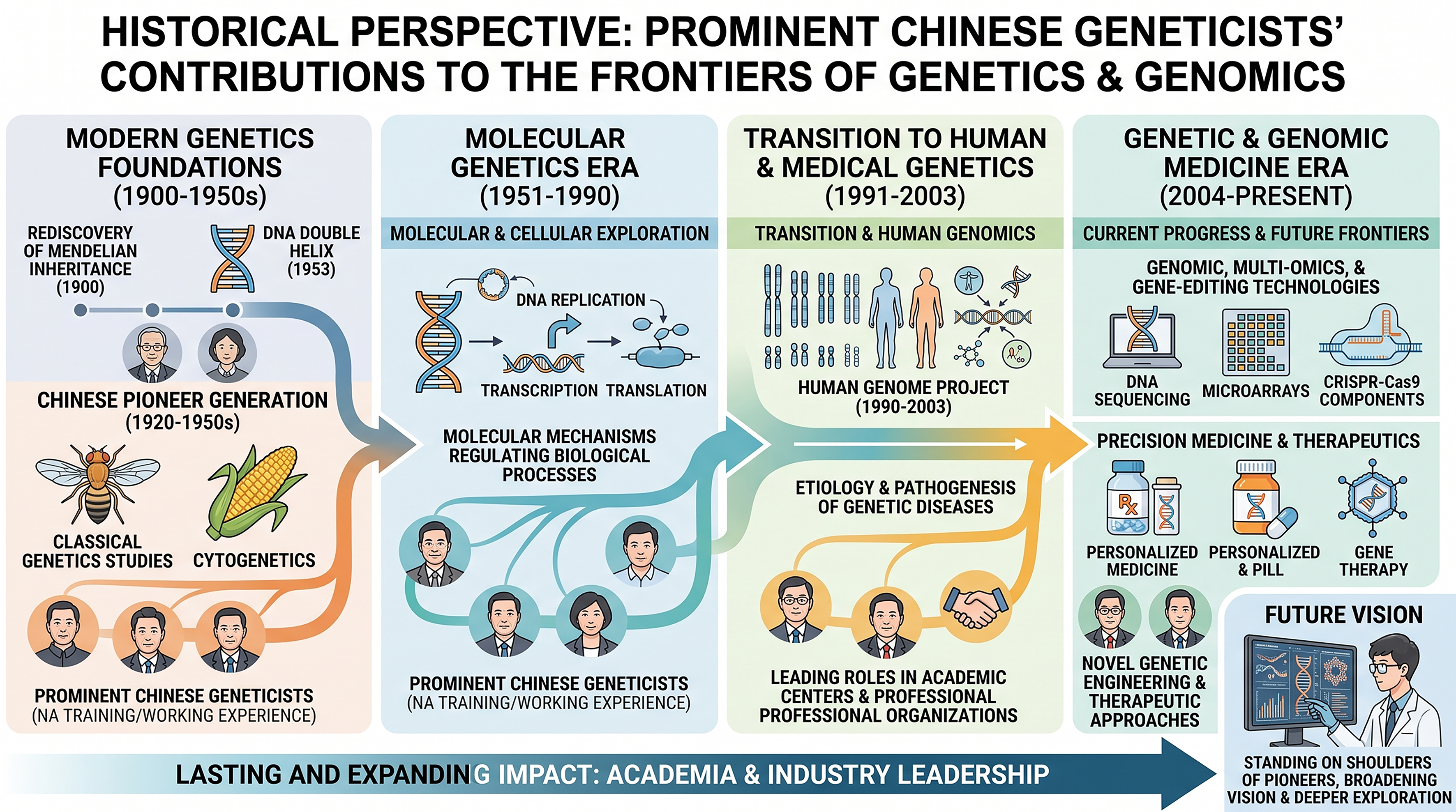
Modern genetics began with the rediscovery of Mendelian inheritance in 1900. The discovery of the DNA double helix in 1953 laid the foundation of molecular genetics. The Human Genome Project from 1990 to 2003 provided a fundamental genetic blueprint of human biology, with a lasting and expanding impact on the development of numerous genomic, multi-omics, and gene-editing technologies for precision medicine. To highlight the contributions of Chinese geneticists with work and training experience across the Pacific, this historical review presents the breakthrough discoveries by prominent Chinese geneticists during the early pioneering generation (1920-1950), the molecular genetics era (1951-1990), the transition to human and medical genetics, and current progress in genetic and genomic medicine (1991-present). These world-renowned geneticists have made significant contributions to understanding the molecular mechanisms that regulate biological processes, the etiology and pathogenesis of genetic diseases, and the development of novel genetic engineering and therapeutic approaches. They also played leading roles in various professional organizations, academic centers, and industry. Standing on the shoulders of these prominent Chinese geneticists, current and future generations of geneticists and researchers could have a broader vision and more deeply explore the frontiers of genetics.
Keywords
INTRODUCTION
Mendelian genetics was established in the 1860s by Gregor Mendel and later rediscovered independently by three botanists in 1900. In the early 1900s, Thomas Hunt Morgan used Drosophila to validate the chromosome theory by showing that genetic information is stored in chromosomes. In 1944, Oswald Avery, Colin Macleod, and Maclyn McCarty demonstrated that DNA is the genetic material responsible for bacterial transformation. The discovery of the double-helical structure of DNA by James Watson and Francis Crick in 1953 led to the uncovering of the molecular mechanisms underlying DNA replication, transcription, and translation, the central dogma of molecular genetics. The development of gene cloning using vectors, sequencing by dideoxy nucleotide termination, and amplification by polymerase chain reaction promoted the Human Genome Project (HGP) during 1990-2003. The founding of the American College of Medical Genetics in 1991 marked the emergence of medical genetics as a medical specialty. In 2012, Jennifer Doudna and Emmanuelle Charpentier reported the CRISPR-Cas9 genome editing tool, which has been widely used in gene editing for gene function analysis and therapeutic gene correction[1]. The application and translation of these advances into medical genetics are highlighted in the Online Mendelian Inheritance in Man (OMIM), a comprehensive, authoritative, and regularly updated database of human genes and genetic disorders that was initiated by Victor McKusick in 1966[2].
Since 1920, pioneering Chinese geneticists have introduced and developed Mendelian genetics in China. Many world-renowned geneticists of Chinese descent in the USA and Canada have made breakthrough discoveries in molecular genetics and significant contributions to human and medical genetics and genomics. Many of the geneticists included in this review were selected from the Best Genetics Scientists 2026 lists of approximately 150 Chinese geneticists in the USA and Canada, and 111 top geneticists in China, drawn from over 2,000 geneticists ranked globally (https://research.com/scientists-rankings/genetics). Following the Mendel-Morgan-McKusick path and considering research impact, recognition by major professional organizations, and leadership roles in institutes and professional societies, this review aims to highlight the contributions of many prominent geneticists of Chinese descent, referred to as Chinese geneticists, who were trained in the United States or Canada and worked on either side of the Pacific Ocean. Their legacies, exemplified in this paper, will continue to inspire and endure among current and future generations of geneticists, fostering broader collaborations and advancing genetics and genomics.
PIONEERING CHINESE GENETICISTS (1920-1950)
Following the rediscovery of Mendelian inheritance in 1900, Thomas Hunt Morgan (1866-1945), using Drosophila melanogaster, demonstrated the genes-in-chromosomes theory. These works laid the foundation for modern genetics. Professor Ruqi Li (1895-1991) was the first Chinese PhD student to graduate from Morgan’s laboratory at Columbia University. His first paper reported the effect of chromosomal aberrations on Drosophila development[3]. Professor Jiazhen Tan (1909-2008) was trained by Professor Li in China and then in Morgan’s lab to study species-differential chromosomes in Drosophila[4] and mosaic dominant inheritance of color pattern in the ladybug beetle[5]. Professors Li and Tan were the pioneers who introduced Mendel-Morgan genetics in China. Both were elected as Academicians of the Chinese Academy of Sciences (CAS)[6].
Professor Ching Chun Li (1912-2003) obtained his PhD in plant breeding and genetics from Cornell University and later became a faculty member at the University of Pittsburgh. He was a master educator and author of the seminal book titled “Population Genetics”[7]. He applied statistical methods to clinical trials of cancer chemotherapy and to population genetics to analyze pedigrees, consanguinity, linkage, and the hereditary risk of human diseases[8]. His work bridged Mendelian principles with statistics to shape human genetics, clinical genetics, and genetic counseling. He was the President of the American Society of Human Genetics (ASHG) in 1960 and received the ASHG Award for Excellence in Education in 1998. Professor Li was considered a world-renowned Chinese geneticist[9]. Since 2004, the University of Pittsburgh’s Department of Human Genetics has hosted the annual C.C. Li Memorial Lecture.
FOUNDATION OF MOLECULAR GENETICS (1951-1990)
In 1952, T.C. Hsu (1917-2003) and Charles Pomerat at the University of Texas Medical Branch reported that the use of a hypotonic solution to treat metaphase cells could separate the clumped chromosomes[10,11]. Three years later, Tjio (1919-2001) and Levan at the University of Lund in Sweden modified Hsu’s technique and reported the correct human diploid number of 46 chromosomes[12]. The contributions from Hsu, Tjio, and colleagues significantly advanced cytogenetics and led to the birth of clinical cytogenetics in the 1960s[13]. Hsu helped establish the American Society of Cell Biology and served as its President in 1974[14].
While working as a postdoctoral fellow with James Bonner at the California Institute of Technology, Professor Ru-Chih C Huang developed techniques for the isolation and quantification of DNA, RNA, histone, and nonhistone proteins. His group observed the inhibition of transcription by histone proteins and isolated RNA polymerase for active DNA-dependent RNA synthesis from pea embryos[15]. Professor Huang joined Johns Hopkins University in 1971 and was the chairman of the Board of Science Counselors of the National Institute on Aging, National Institutes of Health (NIH), from 1980 to 1984.
Professor Ray Wu (1928-2008) started his academic career at Cornell University in 1966. He was a pioneer in DNA sequencing by measuring the incorporation of radioactive nucleotides during a primer extension reaction[16,17]. In the 1980s, Professor Wu and his group reported efficient transformation systems for genetically engineered rice resistant to pests, drought, and salt. Professor Wu founded the China-United States Biochemistry and Molecular Biology Examination and Application program (CUSBEA), which, from 1982 to 1989, brought over 400 top Chinese students to the USA for graduate training and produced more than 100 faculty members at major universities or key members in industry[18]. These scientists, with colleagues from the CAS, formed the Ray Wu Society and, later, the Chinese Biological Investigators Society (CBIS, https://www.cbisociety.org/) to advance the life sciences. Professor Wu was an Academician of Academia Sinica (AS) and a Foreign Member of the Chinese Academy of Engineering (CAE).
Professor Yuet-Wai Kan was appointed as an assistant professor at Harvard University in 1970 and moved to the University of California, San Francisco (UCSF) in 1972. Professor Kan is best known for his work on the discovery of restriction fragment length polymorphism (RFLP) for linkage analysis and prenatal diagnosis of sickle cell anemia[19,20], genetic etiology of thalassemia[21,22], testing for hemoglobinopathy[23], and the identification and application of single-nucleotide polymorphisms for genetic testing and research[20]. His later work focused on the application of gene editing to treat thalassemia, sickle cell disease, and blood cancer[24,25]. Professor Kan was elected as a Fellow of the Royal Society and a member of the US National Academy of Sciences (NAS), the US National Academy of Medicine (NAM), an Academician of Academia Sinica, and a Foreign Member of the Chinese Academy of Sciences. He has won numerous prestigious awards, including the Shaw Prize in Life Science & Medicine, the Albert Lasker Clinical Medical Research Award, and the William Allan Award. He served on the U.S. President’s Committee on the National Medal of Science from 1988 to 1990 and was the President of the American Society of Hematology in 1990. In 1987, he was a co-founder of the Association of Chinese Geneticists in America (ACGA) (https://www.acga-genetics.org/) and served as its President from 1988 to 1989[26].
Professor Louise Chow is a world-renowned biochemist and molecular geneticist. She began her academic career at Cold Spring Harbor Laboratory in 1975, moved to the University of Rochester in 1984, and has been working at the University of Alabama at Birmingham since 1993. In the study of RNA transcription and translation of adenoviruses, she and her colleagues discovered RNA splicing[27]. This finding led to her collaborator, Richard Roberts, receiving the 1993 Nobel Prize in Physiology or Medicine, amid controversy over the lack of recognition of her effort to directly observe the splicing process under an electron microscope. Professor Chow was elected an Academician of AS and a foreign associate of the NAS.
Professor Wen-Hwa Lee at the University of California, San Diego, cloned and sequenced the first tumor suppressor gene RB1 (for retinoblastoma) in 1987[28]. This work confirmed Knudson’s “two-hit hypothesis” for tumorigenesis and provided a framework for further understanding of the recessive mode of inheritance in human cancers. Lee was elected an Academician of AS and a member of the World Academy of Sciences. He was the President of China Medical University in Taiwan from 2014 to 2019.
Professor Lap Chee Tsui was with the Hospital for Sick Children and the University of Toronto from 1981 to 2002. His team was among the first to use genetically linked polymorphic DNA markers to identify the gene coding for cystic fibrosis transmembrane conductance regulator (CFTR)[29,30]. This positional cloning approach was a breakthrough for gene mapping. In 2003, he led the project to complete the comprehensive assembly of DNA sequences of human chromosome 7 as part of the HGP[31]. Professor Tsui received many national and international prizes and was elected as a Fellow of the Royal Society of Canada and the Royal Society of London, an Academician of AS, and a foreign associate of the NAS. He was the President of ACGA from 1990 to 1991 and the President of the Human Genome Organization (HGO) from 2000 to 2002.
Professor Savio L.C. Woo joined Baylor College of Medicine in Houston in 1984 and became the founding director of its Center for Gene Therapy in 1991. In 1996, he moved to the Mount Sinai School of Medicine, where he used eukaryotic and retroviral expression vectors to transfer and express phenylalanine hydroxylase in NIH 3T3 and hepatoma cells as a model for somatic gene therapy for phenylketonuria[32,33]. This gene therapy approach was assessed in primary mouse hepatocytes[34,35]. He served as President of ACGA from 1989 to 1990 and of the American Society for Gene & Cell Therapy from 1999 to 2000.
Professor Yitao Zeng was a prominent geneticist who played a leading role in advancing genetic diagnostics, gene therapy research, and transgenic animal technology in China. Trained in genetics under Professor Jiazhen Tan at Fudan University, he later served as a visiting scientist at the Center for Blood Disorders at the Medical College of Georgia and at the U.S. NIH in the 1980s. His research made significant contributions to the understanding and diagnosis of hemoglobinopathies and to the correction of mutations by gene editing[36]. Professors Zeng and Sue-Zhen Huang, along with their colleagues, were pioneers in transgenic animal and cloning research, leading efforts that produced some of China’s first genetically modified livestock, including transgenic goats and cows[37-39]. Professor Zeng is the founding director of the Shanghai Institute of Medical Genetics at Shanghai Jiao Tong University and an Academician of the CAE.
TRANSITION TO HUMAN AND MEDICAL GENETICS (1991-PRESENT)
Professor Tian Xu joined the Yale University Department of Genetics in 1993 and was recruited as a chair professor and the founding vice president at Westlake University in 2018. He developed genetic mosaic analysis using a genetically engineered FLP/FRT system to identify tumor suppressor genes in Drosophila[40,41]. His research provided a genetic dissection of growth control by identifying key growth regulators and pathways, including PTEN/TSC/mTOR and Lats/Hippo[42-45]. Professor Xu was an investigator of the Howard Hughes Medical Institute from 1997 to 2018 and the President of the CBIS from 2002 to 2005.
Dr. Chen is a physician-scientist and molecular geneticist. He started his academic career at Duke University in 1993. He developed recombinant enzyme replacement therapy for Pompe disease, a rare inherited metabolic disorder caused by a deficiency of acid alpha-glucosidase[46]. A story of an affected family searching for treatment and the development of Myozyme was adapted into the film titled “Extraordinary Measure”. Dr. Chen’s research extended to the pharmacogenetics of adverse drug reactions by identifying genetic markers for Stevens-Johnson syndrome and severe cutaneous reactions caused by allopurinol[47,48]. Dr. Chen is an Academician of AS and was the director of the Institute of Biomedical Sciences from 2001 to 2010. Dr. Chen and his wife, Alice, have generously supported medical genetics research with an endowment for professorship, fellowship, and the Dr. Chen and Alice Pediatric Genetics and Genomics Research Center at Duke University. The Chen Award, presented annually by HGO, recognizes distinguished achievements in human genetics and genomics that significantly impact the Asia-Pacific region. Dr. Chen served as the President of ACGA from 1995 to 1996.
Professor Haifan Lin joined Duke University School of Medicine in 1994 and moved to Yale University of Medicine in 2006 as the founder and director of the Yale Stem Cell Center. Professor Lin discovered the Argonaute/Piwi (AGO) gene family and Piwi-interacting RNAs (piRNAs) and demonstrated their roles in stem cell self-renewal[49,50]. His recent studies further demonstrated that the Piwi-piRNA pathway plays crucial roles in genome-wide epigenetic programming and in the post-transcriptional regulation of mRNA, retrotransposon DNA, lncRNA, pseudogene RNAs, and centromeric/pericentromeric RNAs[51,52]. Professor Lin has played numerous leadership roles in many advisory boards and committees in the stem cell community. He was the President of the International Society for Stem Cell Research in 2022-2023. Professor Lin received numerous awards and was elected as a Member of the American Academy of Arts and Sciences (AAAS), the NAS, the NAM, and a Foreign Member of the CAS.
Professor Hongyu Zhao has been in the faculty of the Departments of Biostatistics, Genetics, and Statistics and Data Science at Yale University since 1996. He served as the Chair of Biostatistics from 2011 to 2021. His research spans multiple fields with extensive publications. His genetics-focused research includes gene map functions[53], transmission/disequilibrium tests using multiple tightly linked markers[54], estimation of genetic covariance via genome-wide association statistics[55], a statistical framework for cross-tissue transcriptome-wide analysis[56], and a polygenic risk score method for cross-population prediction of complex traits[57]. Professor Zhao was elected as a Fellow of the AAAS, the American Statistical Association, the International Society of Computational Biology, and other societies. He received numerous professional awards and served as the ACGA President from 2010 to 2011.
Dr. Xue-Zhong Liu is an internationally renowned surgeon-geneticist at the University of Miami with a research focus on genetic hearing loss. He is the director of the Center for Hereditary Deafness and the Miami Otogenetic Program. Dr. Liu’s research focuses on the identification of gene defects causing hearing loss[58-60] and the application of gene therapy and genomic editing for the treatment of deafness[61,62]. Much of Dr. Liu’s work has been cited in entries on autosomal recessive, autosomal dominant, and X-linked deafness in OMIM. Dr. Liu is a fellow of the American College of Surgeons and the AAAS and served as the ACGA President from 2013 to 2015.
Dr. Brendan H. Lee is an internationally recognized physician-scientist and medical geneticist. He completed residency training in Pediatrics and Medical Genetics at Baylor College of Medicine in 1998 and later joined the faculty and recently became Chair of the Department of Molecular and Human Genetics. His research has transformed the understanding of skeletal dysplasias, connective tissue disorders, and inborn errors of metabolism. Dr. Lee identified key disease genes and molecular pathways underlying disorders such as dwarfism, osteogenesis imperfecta, Marfan syndrome, and urea cycle disorders, leading to novel diagnostic and therapeutic approaches[63-66]. He is the founder of the Skeletal Dysplasia Clinic at Texas Children’s Hospital and the Director of the Center for Skeletal Medicine and Biology. He has been elected a member of the NAM and AAAS and has received numerous professional awards.
Professor Peng Jin has been a faculty member in the Department of Human Genetics at Emory University School of Medicine since 2004 and now serves as the Chair of the Department. Professor Jin has made pioneering contributions to elucidating the molecular and epigenetic mechanisms of neurological diseases. His work on fragile X-associated conditions and other CGG repeat expansion disorders advanced the concept of RNA-mediated neurodegeneration and identified genetic modifiers of disease risk and progression[67-71]. His transformational studies in neuroepigenetics established new paradigms for how DNA and RNA modifications regulate brain function and drive disease pathogenesis, supported by innovative genome-wide tools that are now widely adopted[72-75]. Earlier discoveries of small-molecule modulators of RNA interference pathways helped catalyze translational efforts, including a clinical trial in amyotrophic lateral sclerosis[76]. In parallel, he provides national leadership in shaping research priorities and collaborative frameworks in human genetics and fragile X-related conditions. Professor Jin has received multiple professional awards, was elected as a Fellow of the AAAS, and served as the ACGA President from 2015 to 2017.
Professor Feng Zhang at the Massachusetts Institute of Technology has made numerous innovations in and applications of novel genomic technologies, including the application of CRISPR-Cas9 for genome engineering[77] and knockout screening in human cells[78], DNA microscopy for spatio-genetic imaging[79], specific high-sensitivity enzymatic reporter unlocking (SHERLOCK) in the diagnosis of fusion-driven leukemias[80]. Professor Zhang received many national and international awards, including the National Medal of Technology and Innovation. He is a member of the NAS, the AAAS, and the NAM. Professor Zhang cofounded Editas Medicine, Arbor Biotechnologies, Sherlock Biosciences, and Beam Therapeutics to promote diagnostic and therapeutic applications.
Other outstanding Chinese geneticists include Professor Lilian Y Hsu (1932-2020) at New York University in prenatal cytogenetics, Professor Fa-Ten Kao at Eleanor Roosevelt Institute for cancer research in somatic cell genetics and chromosome mapping, Dr. Ethylin Wang Jabs at Icahn School of Medicine at Mount Sinai for gene defects in craniofacial disorders, Dr. Jin-Xiong She at Jinfiniti Precision Medicine for type 1 diabetes and longevity genetics, Professor Bai-Lin Wu at Harvard University for molecular testing of autism spectrum disorders, Professor Henry Heng at Wayne State University for somatic aberrations in cancers, Professor Pui-Yan Kwok at University of California San Fransisco for genomic analysis of complex human traits, Professor Hong-Wen Deng at Tulane University for genetic dissection of human complex diseases, Dr. Yong-Hui Jiang at Yale University for molecular mechanisms underlying autism spectrum disorders and targeted therapies for epigenetic diseases, Professor Pengfei Liu at Baylor College of Medicine for clinical transcriptome sequencing in genetic diagnosis, and Dr. Stephen TS Lam in the practice and training of clinical genetics and the founding Chairman of the Hong Kong Society of Medical Genetics.
HUMAN AND MEDICAL GENETICS AND GENOMICS IN CHINA
Since the 1980s, many visiting Chinese scholars have been trained and have collaborated with geneticists in the USA and Canada. Many of them returned to Taiwan, Hong Kong, and Mainland China. Professor Jin Li is a leader in human population genetics. He and his team have made significant contributions to the understanding of migration and diversification of Chinese populations and the genetics of human phenotypes[81]. Jin is an Academician of the CAS and currently serves as the President of Fudan University. Professor Wai-Yee Chan was a principal investigator and a co-founder of the clinical genomics laboratory at the National Institute of Child Health and Human Development (NICHD). He returned to Hong Kong in 2009 to become the founding director of the School of Biomedical Sciences, with ongoing research in male gonad development, human endocrine disorders, and developmental genetics[82]. Professor Min-Xin Guan is a prominent molecular geneticist with research interests in human mitochondrial diseases[83]. He joined Zhejiang University in 2011 and served as the Director of its Genetics Research Institute and Dean of Life Science College. Professor Zemin Zhang received his graduate education through the CUSBEA program and had his postdoctoral training in Yuet-Wai Kan’s laboratory before working at Genentech as a principal scientist in bioinformatics and multi-omics[84]. He joined Peking University in 2014 and has made many discoveries in single-cell and spatial genomics for various cancers. Zhang is an Academician of the CAS and currently serves as the President of Chongqing Medical University.
Since its founding in 1987, ACGA has promoted interaction among global Chinese geneticists through its annual gatherings held alongside the ASHG annual meeting. From 2004 to 2021, ACGA co-organized several regional and international conferences in mainland China, Hong Kong, and Taiwan through collaboration with Peking University, Fudan University, and Zhejiang University[26]. From 2013 to 2020, ACGA worked with colleagues in China to develop a professional training system for medical genetics and genetic counseling, and clinical practice guidelines for medical genetics and genomics[85,86].
Starting in 2018, ACGA has presented professional awards to recognize outstanding Chinese geneticists in the categories of lifetime achievement and excellence in genetics research, service, and education. The inaugural Lifetime Achievement Award honored Professor Yeut Wai Kan, and the Excellence in Genetics Research Award was presented to Dr. Dennis Lo for his contribution to cell-free fetal DNA analysis for non-invasive prenatal testing[87]. The Excellence in Genetic Education Award was presented to Dr. Harold Chen for his classic book titled “Atlas of Genetic Diagnosis and Counseling”.
In 2019, the ACGA Lifetime Achievement Award was presented to Professor Lap-Chee Tsui. The Excellence in Genetic Service Award was presented to Professor Lee-Jun Wong (1948-2021) for her contributions to the molecular diagnosis of mitochondrial diseases[88]. The Excellence in Genetic Education Award was presented to Professor Lin He for the genetic counseling program in China[89].
In 2020, Dr. Yuan-Tsong Chen received the Lifetime Achievement Award; Professor Bing Ren at the University of California, San Diego, received the Excellence in Genetics Research Award for his research in epigenomics using single-cell multimodal omics[90,91]. In 2021, Professor Yitao Zeng at Shanghai Jiao Tong University received the Lifetime Achievement Award. Professor Marilyn M Li of the University of Pennsylvania received the Excellence in Genetic Service Award in recognition of her leadership role in the US Cancer Genomics Consortium and in establishing global guidelines for the interpretation and reporting of sequence variants in cancer[92]. The Lifetime Achievement Award was presented to Professor Huanming Yang at the University of the Chinese Academy of Sciences for his contributions to the HGP. Professor Yang is an Academician of CAS and played a critical role in establishing and leading Beijing Genomics Institute (BGI) China[93]. Dr. Richard Kwong Wai Choy at the Chinese University of Hong Kong received the Excellence in Genetics Education Award for his role in developing a Master of Science program in Medical Genetics, and Dr. Brian Hong-Yin Chung at the University of Hong Kong received the Excellence in Genetics Service Award for his work on population-scale genomic medicine through the Hong Kong Genome Project[94].
In 2024, the Excellence in Genetics Research Award was presented to Dr. Taosheng Huang. Drs. Taosheng Huang and John Zhang reported the first “three-parent baby” using mitochondrial replacement therapy to prevent transmission of a fatal neurological disorder, Leigh syndrome[95]. The Excellence in Genetic Education Award was presented to Professor Yun-Fai Chris Lau of UCSF for developing shuttle cosmid vectors for human genomic library construction and expression in the 1980s[96,97], his lifelong research on Y chromosome genes in health and disease, and his efforts in training graduate students and postdoctoral fellows. He co-edited, with Professor Wai-Yee Chan, the book “The Y Chromosome and Male Germ Cell Biology in Health and Diseases” and currently serves as the editor-in-chief of the journal Cell & Bioscience. In 2025, the Lifetime Achievement Award was presented to Professor Sau Wai Cheung at Baylor College of Medicine for her leadership in introducing chromosome microarray analysis to clinical testing[98,99]. The Excellence in Genetic Research Award was presented to Professor Sidi Chen at the Yale Department of Genetics, whose research focuses on cancer immunotherapy by gene editing[100]. Dr. Yao-Shan Fan at Mayo Clinic Florida received the Excellence in Genetics Education Award for his book on “Molecular Cytogenetics: Protocols and Applications”; and Professor Wuh-Liang Hwu at National Taiwan University received the Excellence in Genetics Service Award for his work in newborn screening programs and rare disease treatments[101].
CONCLUSIONS
This historical review highlights milestone contributions by prominent Chinese geneticists across the Pacific Ocean, following the Mendel-Morgan-McKusick path from molecular genetics to precision genomic medicine. Discoveries of RNA polymerase, RNA splicing, and pi-RNAs have revealed molecular mechanisms that regulate gene expression and epigenomic modification. Improvements in cell culture techniques and the development of DNA sequencing, single-nucleotide polymorphism testing, and cell-free fetal DNA analysis have had profound impacts on clinical cytogenetics, molecular genetic diagnosis, and non-invasive prenatal screening and somatic cancer screening. The identification of genetic defects in various constitutional and somatic diseases, along with the introduction of novel enzyme replacement therapy, mitochondrial replacement therapy, and gene therapy using genome editing, has revolutionized medical practice, shifting it toward precision medicine.
Regrettably, we may have omitted many prominent Chinese biochemists, molecular and cell biologists, and others who have contributed to genetics. We sincerely apologize for any omissions of prominent Chinese geneticists due to page limitations. We hope the overview reflects the extraordinary contributions of Chinese geneticists, especially those originating from China and Asia, over the past century. Their legacies, exemplified in this paper, will continue to inspire current and future generations of geneticists, fostering broader collaborations and advancing genetics and genomics.
DECLARATIONS
Authors’ contributions
Conceived the idea and prepared the first draft: Li P, Bao L
Reviewed and edited the manuscript: Li P, Bao L, Lau YFC, Jiang YH
Worked on revisions and the final version: Li P, Bao L, Lau YFC
All authors approved the final version.
Availability of data and materials
Not applicable.
AI and AI-assisted tools statement
During the preparation of this manuscript, the AI tool SciSpace’s Visual Abstract Maker (accessed 2026-07-15) was used solely for generate the Graphic Abstract. The authors reviewed and edited the final version. The tool did not influence the study design, data collection, analysis, interpretation, or the scientific content of the work. All authors take full responsibility for the accuracy, integrity, and final content of the manuscript.
Financial support and sponsorship
None.
Conflicts of interest
Bao L is Section Editor of the Journal of Translational Genetics and Genomics. Bao L was not involved in any steps of editorial processing, including reviewer selection, manuscript handling, and decision-making. Lau YFC is included in the paper regarding the 2024 ACGA Excellence in Genetic Education Award. Jiang YH is also mentioned. To minimize potential bias, the other co-authors reviewed and edited the relevant sections to ensure that the information is presented factually and in a balanced manner. Li P declares that there are no conflicts of interest.
Ethical approval and consent to participate
Not applicable.
Consent for publication
Not applicable.
Copyright
© The Author(s) 2026.
REFERENCES
1. Durmaz AA, Karaca E, Demkow U, Toruner G, Schoumans J, Cogulu O. Evolution of genetic techniques: past, present, and beyond. Biomed Res Int. 2015;2015:461524.
2. Hamosh A, Scott AF, Amberger JS, Bocchini CA, McKusick VA. Online Mendelian Inheritance in Man (OMIM), a knowledgebase of human genes and genetic disorders. Nucleic Acids Res. 2005;33:D514-7.
4. Tan C. The nature of the race-differential chromosomes in Drosophila montium De Meijere. Sci Rec 1942:178-87.
5. Tan CC. Mosaic dominance in the inheritance of color patterns in the lady-bird beetle, harmonia axyridis. Genetics. 1946;31:195-210.
10. Hsu TC, Pomerat CM. Mammalian chromosomes in vitro: II. A method for spreading the chromosomes of cells in tissue culture. J Hered. 1953;44:23-30.
13. Hsu TC. Human and mammalian cytogenetics: an historical perspective. New York: Spring-Verlag; 1979.
15. Huang RC, Bonner J. Histone, a suppressor of chromosomal RNA synthesis. Proc Natl Acad Sci U S A. 1962;48:1216-22.
16. Wu R. Nucleotide sequence analysis of DNA. I. Partial sequence of the cohesive ends of bacteriophage lambda and 186 DNA. J Mol Biol. 1970;51:501-21.
19. Cheung MC, Goldberg JD, Kan YW. Prenatal diagnosis of sickle cell anaemia and thalassaemia by analysis of fetal cells in maternal blood. Nat Genet. 1996;14:264-8.
20. Kan YW, Dozy AM. Polymorphism of DNA sequence adjacent to human beta-globin structural gene: relationship to sickle mutation. Proc Natl Acad Sci U S A. 1978;75:5631-5.
21. Taylor JM, Dozy A, Kan YW, et al. Genetic lesion in homozygous alpha thalassaemia (hydrops fetalis). Nature. 1974;251:392-3.
22. Kan YW, Dozy AM, Varmus HE, et al. Deletion of alpha-globin genes in haemoglobin-H disease demonstrates multiple alpha-globin structural loci. Nature. 1975;255:255-6.
23. Wong V, Ma HK, Todd D, Golbus MS, Dozy AM, Kan YW. Diagnosis of homozygous alpha-thalassemia in cultured amniotic-fluid fibroblasts. N Engl J Med. 1978;298:669-70.
24. Ye L, Wang J, Tan Y, et al. Genome editing using CRISPR-Cas9 to create the HPFH genotype in HSPCs: an approach for treating sickle cell disease and β-thalassemia. Proc Natl Acad Sci U S A. 2016;113:10661-5.
25. Tan YT, Ye L, Xie F, et al. CRISPR/Cas9-mediated gene deletion efficiently retards the progression of Philadelphia-positive acute lymphoblastic leukemia in a p210 BCR-ABL1T315I mutation mouse model. Haematologica. 2020;105:e232-6.
26. Chen TL, Yang H. History of the Association of Chinese Geneticists in America (ACGA). N Am J Med Sci 2013;6:171-2. Available from: https://najms.com/index.php/najms/article/view/197. [Last accessed on 14 Aug 2026].
27. Chow LT, Gelinas RE, Broker TR, Roberts RJ. An amazing sequence arrangement at the 5’ ends of adenovirus 2 messenger RNA. Cell. 1977;12:1-8.
28. Lee WH, Bookstein R, Hong F, Young LJ, Shew JY, Lee EY. Human retinoblastoma susceptibility gene: cloning, identification, and sequence. Science. 1987;235:1394-9.
29. Tsui LC, Buchwald M, Barker D, et al. Cystic fibrosis locus defined by a genetically linked polymorphic DNA marker. Science. 1985;230:1054-7.
30. Rommens JM, Iannuzzi MC, Kerem B, et al. Identification of the cystic fibrosis gene: chromosome walking and jumping. Science. 1989;245:1059-65.
31. Scherer SW, Cheung J, MacDonald JR, et al. Human chromosome 7: DNA sequence and biology. Science. 2003;300:767-72.
32. Ledley FD, Grenett HE, McGinnis-Shelnutt M, Woo SL. Retroviral-mediated gene transfer of human phenylalanine hydroxylase into NIH 3T3 and hepatoma cells. Proc Natl Acad Sci U S A. 1986;83:409-13.
33. Ledley FD, Grenett HE, DiLella AG, Kwok SC, Woo SL. Gene transfer and expression of human phenylalanine hydroxylase. Science. 1985;228:77-9.
34. Peng H, Armentano D, MacKenzie-Graham L, et al. Retroviral-mediated gene transfer and expression of human phenylalanine hydroxylase in primary mouse hepatocytes. Proc Natl Acad Sci U S A. 1988;85:8146-50.
35. Cristiano RJ, Smith LC, Kay MA, Brinkley BR, Woo SL. Hepatic gene therapy: efficient gene delivery and expression in primary hepatocytes utilizing a conjugated adenovirus-DNA complex. Proc Natl Acad Sci U S A. 1993;90:11548-52.
36. Lu D, Gong X, Fang Y, et al. Correction of RNA splicing defect in β654-thalassemia mice using CRISPR/Cas9 gene-editing technology. Haematologica. 2022;107:1427-37.
37. Huang SZ, Huang Y, Chen MJ, Zeng FY, Ren ZR, Zeng YT. Selection of in vitro produced, transgenic embryos by nested PCR for efficient production of transgenic goats. Theriogenology. 2001;56:545-56.
38. Yang XY, Li H, Ma QW, et al. Improved efficiency of bovine cloning by autologous somatic cell nuclear transfer. Reproduction. 2006;132:733-9.
39. Huang SZ, Huang YA, Chen MJ, et al. A study of transgenic IVF cattle integrated with the human serum albumin gene. Acta Genetica Sinica. 2000;27:573-9.
40. Xu T, Rubin GM. Analysis of genetic mosaics in developing and adult Drosophila tissues. Development. 1993;117:1223-37.
41. Xu T, Wang W, Zhang S, Stewart RA, Yu W. Identifying tumor suppressors in genetic mosaics: the Drosophila lats gene encodes a putative protein kinase. Development. 1995;121:1053-63.
42. Huang H, Potter CJ, Tao W, et al. PTEN affects cell size, cell proliferation and apoptosis during Drosophila eye development. Development. 1999;126:5365-72.
43. Tao W, Zhang S, Turenchalk GS, et al. Human homologue of the Drosophila melanogaster lats tumour suppressor modulates CDC2 activity. Nat Genet. 1999;21:177-81.
44. Potter CJ, Huang H, Xu T. Drosophila Tsc1 functions with Tsc2 to antagonize insulin signaling in regulating cell growth, cell proliferation, and organ size. Cell. 2001;105:357-68.
45. Potter CJ, Pedraza LG, Xu T. Akt regulates growth by directly phosphorylating Tsc2. Nat Cell Biol. 2002;4:658-65.
46. Kikuchi T, Yang HW, Pennybacker M, et al. Clinical and metabolic correction of pompe disease by enzyme therapy in acid maltase-deficient quail. J Clin Invest. 1998;101:827-33.
47. Chung WH, Hung SI, Hong HS, et al. Medical genetics: a marker for Stevens-Johnson syndrome. Nature. 2004;428:486.
48. Hung SI, Chung WH, Liou LB, et al. HLA-B*5801 allele as a genetic marker for severe cutaneous adverse reactions caused by allopurinol. Proc Natl Acad Sci U S A. 2005;102:4134-9.
49. Cox DN, Chao A, Baker J, Chang L, Qiao D, Lin H. A novel class of evolutionarily conserved genes defined by piwi are essential for stem cell self-renewal. Genes Dev. 1998;12:3715-27.
50. Grivna ST, Beyret E, Wang Z, Lin H. A novel class of small RNAs in mouse spermatogenic cells. Genes Dev. 2006;20:1709-14.
51. Huang XA, Yin H, Sweeney S, Raha D, Snyder M, Lin H. A major epigenetic programming mechanism guided by piRNAs. Dev Cell. 2013;24:502-16.
52. Juliano CE, Reich A, Liu N, et al. PIWI proteins and PIWI-interacting RNAs function in Hydra somatic stem cells. Proc Natl Acad Sci U S A. 2014;111:337-42.
54. Zhao H, Zhang S, Merikangas KR, et al. Transmission/disequilibrium tests using multiple tightly linked markers. Am J Hum Genet. 2000;67:936-46.
55. Lu Q, Li B, Ou D, et al. A powerful approach to estimating annotation-stratified genetic covariance via GWAS summary statistics. Am J Hum Genet. 2017;101:939-64.
56. Hu Y, Li M, Lu Q, et al. ; Alzheimer’s Disease Genetics Consortium. A statistical framework for cross-tissue transcriptome-wide association analysis. Nat Genet. 2019;51:568-76.
57. Zhou G, Chen T, Zhao H. SDPRX: a statistical method for cross-population prediction of complex traits. Am J Hum Genet. 2023;110:13-22.
58. Liu XZ, Walsh J, Mburu P, et al. Mutations in the myosin VIIA gene cause non-syndromic recessive deafness. Nat Genet. 1997;16:188-90.
59. Liu X, Han D, Li J, et al. Loss-of-function mutations in the PRPS1 gene cause a type of nonsyndromic X-linked sensorineural deafness, DFN2. Am J Hum Genet. 2010;86:65-71.
60. Yan D, Zhu Y, Walsh T, et al. Mutation of the ATP-gated P2X2 receptor leads to progressive hearing loss and increased susceptibility to noise. Proc Natl Acad Sci U S A. 2013;110:2228-33.
61. Du W, Ergin V, Loeb C, et al. Rescue of auditory function by a single administration of AAV-TMPRSS3 gene therapy in aged mice of human recessive deafness DFNB8. Mol Ther. 2023;31:2796-810.
62. Wei W, Zhu W, Silver S, et al. Single-dose genome editing therapy rescues auditory and vestibular functions in adult mice with DFNA41 deafness. J Clin Invest. 2025;135:e187872.
63. Marom R, Song IW, Busse EC, et al. The IFITM5 mutation in osteogenesis imperfecta type V is associated with an ERK/SOX9-dependent osteoprogenitor differentiation defect. J Clin Invest. 2024;134:e170369.
64. Chen YT, Jiang MM, Leynes C, et al. ATRX silences Cartpt expression in osteoblastic cells during skeletal development. J Clin Invest. 2025;135:e163587.
65. Lee B, Godfrey M, Vitale E, et al. Linkage of Marfan syndrome and a phenotypically related disorder to two different fibrillin genes. Nature. 1991;352:330-4.
66. Lee B, Diaz GA, Rhead W, et al. ; UCD Consortium. Blood ammonia and glutamine as predictors of hyperammonemic crises in patients with urea cycle disorder. Genet Med. 2015;17:561-8.
67. Jin P, Zarnescu DC, Zhang F, et al. RNA-mediated neurodegeneration caused by the fragile X premutation rCGG repeats in Drosophila. Neuron. 2003;39:739-47.
68. Jin P, Zarnescu DC, Ceman S, et al. Biochemical and genetic interaction between the fragile X mental retardation protein and the microRNA pathway. Nat Neurosci. 2004;7:113-7.
69. Kang Y, Zhou Y, Li Y, et al. A human forebrain organoid model of fragile X syndrome exhibits altered neurogenesis and highlights new treatment strategies. Nat Neurosci. 2021;24:1377-91.
70. Kong HE, Lim J, Linsalata A, et al. Identification of PSMB5 as a genetic modifier of fragile X-associated tremor/ataxia syndrome. Proc Natl Acad Sci U S A. 2022;119:e2118124119.
71. Jin Y, Cao Y, Ma W, et al. Integrative transcriptome-wide association analyses reveal PRKCG-linked GABAergic dysfunction in Fragile X-associated tremor/ataxia syndrome. Nat Commun. 2026;17:1418.
72. Szulwach KE, Li X, Li Y, et al. 5-hmC-mediated epigenetic dynamics during postnatal neurodevelopment and aging. Nat Neurosci. 2011;14:1607-16.
73. Yu M, Hon GC, Szulwach KE, et al. Base-resolution analysis of 5-hydroxymethylcytosine in the mammalian genome. Cell. 2012;149:1368-80.
74. Song CX, Szulwach KE, Dai Q, et al. Genome-wide profiling of 5-formylcytosine reveals its roles in epigenetic priming. Cell. 2013;153:678-91.
75. Shafik AM, Peng Y, Zhang Z, et al. Multi-region m6A epitranscriptome profiling of the human brain reveals spatial and temporal variation and enrichment of disease-associated loci. Nat Neurosci. 2026;29:195-205.
76. Shan G, Li Y, Zhang J, et al. A small molecule enhances RNA interference and promotes microRNA processing. Nat Biotechnol. 2008;26:933-40.
77. Hsu PD, Lander ES, Zhang F. Development and applications of CRISPR-Cas9 for genome engineering. Cell. 2014;157:1262-78.
78. Shalem O, Sanjana NE, Hartenian E, et al. Genome-scale CRISPR-Cas9 knockout screening in human cells. Science. 2014;343:84-7.
79. Weinstein JA, Regev A, Zhang F. DNA microscopy: optics-free spatio-genetic imaging by a stand-alone chemical reaction. Cell. 2019;178:229-41.e16.
80. Vedula RS, Karp HQ, Koob J, et al. CRISPR-based rapid molecular diagnostic tests for fusion-driven leukemias. Blood. 2024;144:1290-9.
81. Chu JY, Huang W, Kuang SQ, et al. Genetic relationship of populations in China. Proc Natl Acad Sci U S A. 1998;95:11763-8.
82. Tian Y, Wang W, Lautrup S, et al. WRN promotes bone development and growth by unwinding SHOX-G-quadruplexes via its helicase activity in Werner Syndrome. Nat Commun. 2022;13:5456.
83. Li Q, Gao Z, Chen Y, Guan MX. The role of mitochondria in osteogenic, adipogenic and chondrogenic differentiation of mesenchymal stem cells. Protein Cell. 2017;8:439-45.
84. Wang J, Ye F, Chai H, et al. Advances and applications in single-cell and spatial genomics. Sci China Life Sci. 2025;68:1226-82.
85. Shu W, Zhou Q, Zhang H, et al. Medical genetics specialty and allied professional systems in North America and Europe and its impacts on healthcare - a report of the Association of Chinese Geneticists in America. Chin J Med Genet. 2016;33:396-401.
86. Li P, Zhang HZ, Li M, et al. Progress and perspective for professional training in medical genetics and genomics: a report of the Association of Chinese Geneticists in America. N Am J Med Sci 2013;6:173-80. Available from: https://distantreader.org/stacks/journals-ojs/najms/najms-198.pdf. [Last accessed on 14 Aug 2026].
87. Lo YM, Corbetta N, Chamberlain PF, et al. Presence of fetal DNA in maternal plasma and serum. Lancet. 1997;350:485-7.
88. Wong LC, Chen T, Wang J, et al. Interpretation of mitochondrial tRNA variants. Genet Med. 2020;22:917-26.
89. Sun L, Liang B, Zhu L, Shen Y, He L. The rise of the genetic counseling profession in China. Am J Med Genet C Semin Med Genet. 2019;181:170-6.
90. Gorkin DU, Barozzi I, Zhao Y, et al. An atlas of dynamic chromatin landscapes in mouse fetal development. Nature. 2020;583:744-51.
91. Zhu C, Preissl S, Ren B. Single-cell multimodal omics: the power of many. Nat Methods. 2020;17:11-4.
92. Li MM, Datto M, Duncavage EJ, et al. Standards and Guidelines for the Interpretation and Reporting of Sequence Variants in Cancer: a joint consensus recommendation of the Association for Molecular Pathology, American Society of Clinical Oncology, and College of American Pathologists. J Mol Diagn. 2017;19:4-23.
93. Cen X, Zou J, Tong Y, Zhao Y, Li Y, Yang H. Redefining imaging genomics for the next decade. Sci Bull. 2025;70:3720-3.
94. Ying D, Cheung CL, O CK, et al. ; Hong Kong Genome Project. Population-scale genomic medicine with the Hong Kong Genome Project. Nat Med. 2026;32:2277-87.
95. Zhang J, Liu H, Luo S, et al. Live birth derived from oocyte spindle transfer to prevent mitochondrial disease. Reprod Biomed Online. 2017;34:361-8.
96. Lau YF, Kan YW. Versatile cosmid vectors for the isolation, expression, and rescue of gene sequences: studies with the human alpha-globin gene cluster. Proc Natl Acad Sci U S A. 1983;80:5225-9.
97. Lau YF, Kan YW. Direct isolation of the functional human thymidine kinase gene with a cosmid shuttle vector. Proc Natl Acad Sci U S A. 1984;81:414-8.
98. Roa BB, Pulliam J, Eng CM, Cheung SW. Evolution of prenatal genetics: from point mutation testing to chromosomal microarray analysis. Expert Rev Mol Diagn. 2005;5:883-92.
99. Bi W, Borgan C, Pursley AN, et al. Comparison of chromosome analysis and chromosomal microarray analysis: what is the value of chromosome analysis in today’s genomic array era? Genet Med. 2013;15:450-7.
100. Yang L, Renauer PA, Tang K, et al. OR7A10 GPCR engineering boosts CAR-NK therapy against solid tumours. Nature. 2026;652:740-51.
Cite This Article
 Open Access
How to Cite
Download Citation
Export Citation File:
Type of Import
Tips on Downloading Citation
Citation Manager File Format
Type of Import
Direct Import: When the Direct Import option is selected (the default state), a dialogue box will give you the option to Save or Open the downloaded citation data. Choosing Open will either launch your citation manager or give you a choice of applications with which to use the metadata. The Save option saves the file locally for later use.
Indirect Import: When the Indirect Import option is selected, the metadata is displayed and may be copied and pasted as needed.
About This Article
Copyright

Data & Comments
Data
0









Comments
Comments must be written in English. Spam, offensive content, impersonation, and private information will not be permitted. If any comment is reported and identified as inappropriate content by OAE staff, the comment will be removed without notice. If you have any queries or need any help, please contact us at [email protected].