

Artificial intelligence for toxicokinetic parameterization in environmental exposure assessment
 0
0 
Graphical Abstract
Abstract
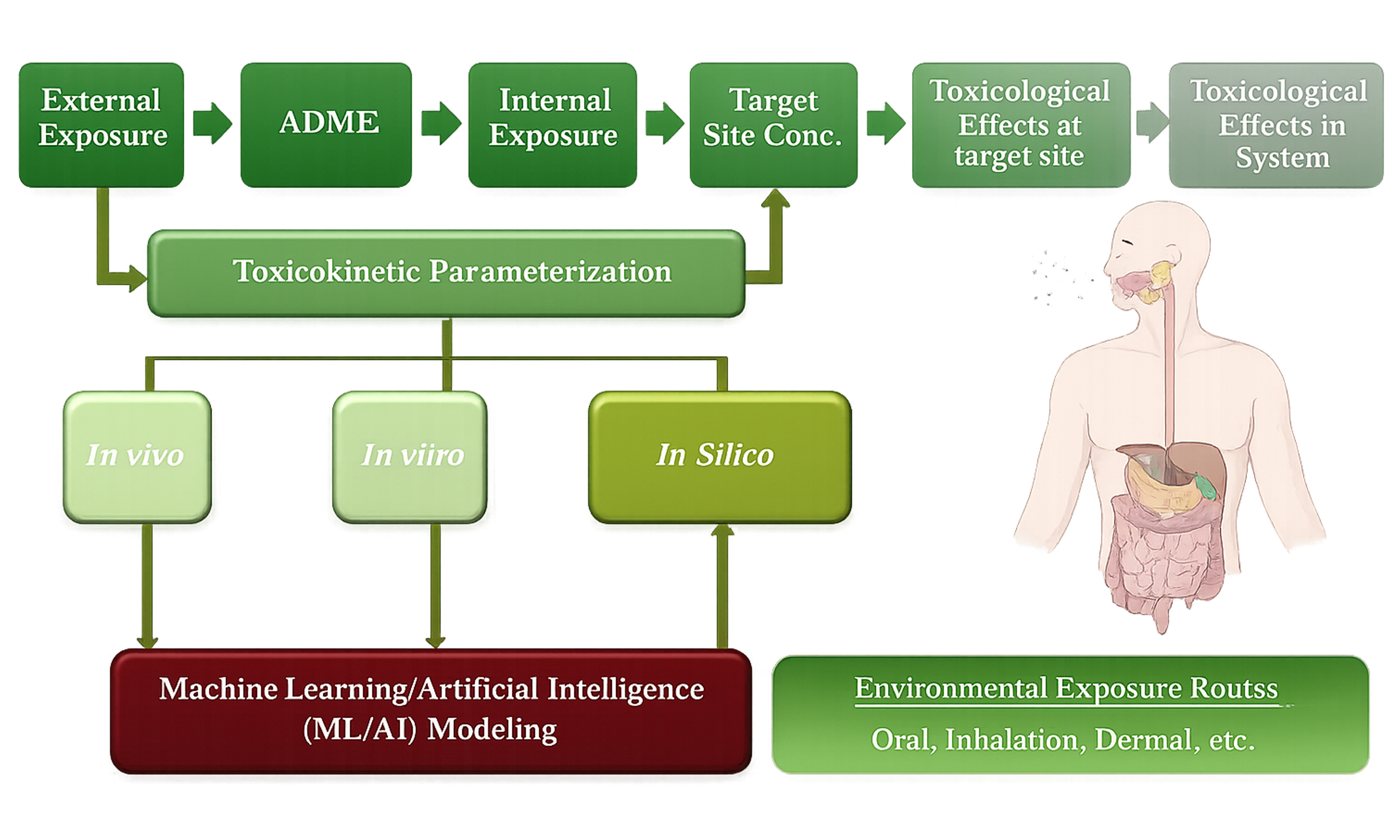
Toxicokinetics (TK) characterizes the absorption, distribution, metabolism, and excretion (ADME) of chemicals in the body and connects exposure with internal dose and potential toxicity. Because in vivo and in vitro TK assays are costly and low-throughput, and demand for emerging chemicals is growing, artificial intelligence and machine learning (AI/ML) offer alternative tools to predict ADME profiles for data-poor chemicals. This review examines recent developments in AI-based TK parameterization with relevance to environmental exposure assessment. First, we outline the essential elements of AI-based TK parameterization paradigms, including data sources, molecular representations, and commonly used ML algorithms. Second, the recent applications of AI/ML models across four ADME processes are introduced. Third, we discuss current limitations and future perspectives, including model reliability, interpretability, data availability for environmental chemicals, and integrating AI-predicted TK parameters into mechanistic models, such as physiologically based pharmacokinetic (PBPK) models and other downstream modeling frameworks. Although many existing studies rely on pharmaceutical or mixed chemical datasets, these approaches could support TK parameterization and exposure assessment for environmental chemicals. Further progress will depend on improved data quality, broader environmental chemical coverage, and more rigorous model validation and uncertainty evaluation.
Keywords


 Download PDF
REFERENCES
1. National Research Council. Toxicity testing in the 21st century: a vision and a strategy. National Academies Press; 2007.
2. Chen, Q.; Chou, W. C.; Lin, Z. Integration of toxicogenomics and physiologically based pharmacokinetic modeling in human health risk assessment of perfluorooctane sulfonate. Environ. Sci. Technol. 2022, 56, 3623-33.
3. Wambaugh, J. F.; Hughes, M. F.; Ring, C. L.; et al. Evaluating in vitro-in vivo extrapolation of toxicokinetics. Toxicol. Sci. 2018, 163, 152-69.
5. U.S. EPA. TSCA chemical substance inventory. https://www.epa.gov/tsca-inventory. (accessed 2026-09-21).
6. Wambaugh, J. F.; Wetmore, B. A.; Pearce, R.; et al. Toxicokinetic triage for environmental chemicals. Toxicol. Sci. 2015, 147, 55-67.
7. Breen, M.; Ring, C. L.; Kreutz, A.; Goldsmith, M. R.; Wambaugh, J. F. High-throughput PBTK models for in vitro to in vivo extrapolation. Expert. Opin. Drug. Metab. Toxicol. 2021, 17, 903-21.
8. Isaacs, K. K.; Egeghy, P.; Dionisio, K. L.; et al. The chemical landscape of high-throughput new approach methodologies for exposure. J. Expo. Sci. Environ. Epidemiol. 2022, 32, 820-32.
9. Vamathevan, J.; Clark, D.; Czodrowski, P.; et al. Applications of machine learning in drug discovery and development. Nat. Rev. Drug. Discov. 2019, 18, 463-77.
10. Koirala, M.; Yan, L.; Mohamed, Z.; DiPaola, M. AI-integrated QSAR modeling for enhanced drug discovery: from classical approaches to deep learning and structural insight. Int. J. Mol. Sci. 2025, 26, 9384.
11. Chou, W. C.; Li, M.; Lin, Z. Chapter 4 - Application of machine learning and artificial intelligence methods in physiologically based pharmacokinetic modeling. In Machine learning and artificial intelligence in toxicology and environmental health. Elsevier; 2026. pp. 99-138.
12. Ajisafe, O. M.; Adekunle, Y. A.; Egbon, E.; Ogbonna, C. E.; Olawade, D. B. The role of machine learning in predictive toxicology: a review of current trends and future perspectives. Life. Sci. 2025, 378, 123821.
14. Wang, H.; Chen, J.; Liu, W.; et al. Using machine learning for green substitution of industrial chemicals: integrating functionality, hazard, and life cycle impact. Chem. Rev. 2026, 126, 841-94.
15. Fu, X.; Wojak, A.; Neagu, D.; Ridley, M.; Travis, K. Data governance in predictive toxicology: a review. J. Cheminform. 2011, 3, 24.
16. Deepika, D.; Kumar, V. The role of “physiologically based pharmacokinetic model (pbpk)” new approach methodology (nam) in pharmaceuticals and environmental chemical risk assessment. Int. J. Environ. Res. Public. Health. 2023, 20, 3473.
17. Claire, T.; Sean, H. Integrating toxicokinetics into toxicology studies and the human health risk assessment process for chemicals: Reduced uncertainty, better health protection. Regul. Toxicol. Pharmacol. 2022, 128, 105092.
18. Kim, S. J.; Heo, S. H.; Lee, D. S.; Hwang, I. G.; Lee, Y. B.; Cho, H. Y. Gender differences in pharmacokinetics and tissue distribution of 3 perfluoroalkyl and polyfluoroalkyl substances in rats. Food. Chem. Toxicol. 2016, 97, 243-55.
19. Karmaus, A. L.; Kreutz, A. L.; Oyetade, O.; et al. Perspectives on variability of in vivo toxicology studies: considerations for next-generation toxicology. Front. Toxicol. 2026, 8, 1778353.
20. Napoli, J. A.; Reutlinger, M.; Brandl, P.; Wang, W.; Hert, J.; Desai, P. Multitask deep learning models of combined industrial absorption, distribution, metabolism, and excretion datasets to improve generalization. Mol. Pharm. 2025, 22, 1892-900.
21. Kreutz, A.; Chang, X.; Hogberg, H. T.; Wetmore, B. A. Advancing understanding of human variability through toxicokinetic modeling, in vitro-in vivo extrapolation, and new approach methodologies. Hum. Genomics. 2024, 18, 129.
22. Alves, V. M.; Auerbach, S. S.; Kleinstreuer, N.; et al. Curated data in - trustworthy in silico models out: the impact of data quality on the reliability of artificial intelligence models as alternatives to animal testing. Altern. Lab. Anim. 2021, 49, 73-82.
23. Pearce, R. G.; Setzer, R. W.; Strope, C. L.; Wambaugh, J. F.; Sipes, N. S. httk: R package for high-throughput toxicokinetics. J. Stat. Softw. 2017, 79, 1-26.
24. Wambaugh, J. F.; Wetmore, B. A.; Ring, C. L.; et al. Assessing toxicokinetic uncertainty and variability in risk prioritization. Toxicol. Sci. 2019, 172, 235-51.
25. Mansouri, K.; Martin, T.; Chang, X.; Williams, A. J.; Allen, D.; Kleinstreuer, N. 4.18.T-01 - OPERA: open-source QSAR models for regulatory support. 2023. https://studio.m-anage.com/setac/sna2023/meetingapp.cgi/Paper/17094. (accessed 2026-09-21).
26. Chakraborty, S.; Boyina, H. K.; Mitta, R.; Nayaka, R. , In silico toxicokinetics. In Computer simulations in the pharmaceutical industry. CRC Press; 2026. pp. 199-220.
27. Chen, C. Y.; Lin, Z. Exploring the potential and challenges of developing physiologically-based toxicokinetic models to support human health risk assessment of microplastic and nanoplastic particles. Environ. Int. 2024, 186, 108617.
28. Wilhelm, S.; Tavares, A. J.; Dai, Q.; et al. Analysis of nanoparticle delivery to tumours. Nat. Rev. Mater. 2016, 1, 16014.
29. Chen, Q.; Yuan, L.; Chou, W. C.; et al. Meta-analysis of nanoparticle distribution in tumors and major organs in tumor-bearing mice. ACS. Nano. 2023, 17, 19810-31.
30. Mi, K.; Chen, Q.; Yuan, L.; et al. Analysis of pharmacokinetic-pharmacodynamic relationships of nanoparticles against tumors. ACS. Nano. 2026, 20, 22485-504.
31. Alexandropoulos, S. A. N.; Kotsiantis, S. B.; Vrahatis, M. N. Data preprocessing in predictive data mining. Knowl. Eng. Rev. 2019, 34, e1.
32. Cabello-Solorzano, K.; Ortigosa de Araujo, I.; Peña, M.; Correia, L.; Tallón-Ballesteros, A. J. The impact of data normalization on the accuracy of machine learning algorithms: a comparative analysis. In 18th International Conference on Soft Computing Models in Industrial and Environmental Applications (SOCO 2023). Springer, Cham; 2023. pp. 344-53.
33. David, L.; Thakkar, A.; Mercado, R.; Engkvist, O. Molecular representations in AI-driven drug discovery: a review and practical guide. J. Cheminform. 2020, 12, 56.
34. Deng, J.; Yang, Z.; Wang, H.; Ojima, I.; Samaras, D.; Wang, F. A systematic study of key elements underlying molecular property prediction. Nat. Commun. 2023, 14, 6395.
35. Handa, K.; Hirano, M.; Kageyama, M.; Bender, A. Computational approaches to DMPK: a realistic assessment of current methods and their practical impact. Part I: Physicochemical and in vitro properties. Drug. Discov. Today. 2025, 30, 104422.
36. Ryu, J. Y.; Jang, W. D.; Jang, J.; Oh, K. S. PredAOT: a computational framework for prediction of acute oral toxicity based on multiple random forest models. BMC. Bioinformatics. 2023, 24, 66.
37. Xu, Y.; Pei, J.; Lai, L. Deep learning based regression and multiclass models for acute oral toxicity prediction with automatic chemical feature extraction. J. Chem. Inf. Model. 2017, 57, 2672-85.
38. Jiang, J.; Wang, R.; Wei, G. W. GGL-Tox: geometric graph learning for toxicity prediction. J. Chem. Inf. Model. 2021, 61, 1691-700.
39. Noga, M.; Jurowski, K. Preliminary prediction of toxicologically relevant physicochemical properties of Novichoks: the first comparative in silico studies. Chem. Biol. Interact. 2025, 419, 111644.
40. Li, T.; Chen, X.; Tong, W. Bridging organ transcriptomics for advancing multiple organ toxicity assessment with a generative AI approach. NPJ. Digit. Med. 2024, 7, 310.
41. Führer, F.; Gruber, A.; Diedam, H.; Göller, A. H.; Menz, S.; Schneckener, S. A deep neural network: mechanistic hybrid model to predict pharmacokinetics in rat. J. Comput. Aided. Mol. Des. 2024, 38, 7.
42. Wu, X.; Wu, P. Y.; Chou, W. C.; Tell, L. A.; Lin, Z. A machine learning-empowered quantitative structure-activity relationship model for predicting the plasma half-life of drugs in dogs. AAPS. J. 2025, 28, 22.
43. Fan, N.; Chen, J.; Wang, J.; Chen, Z. S.; Yang, Y. Bridging data and drug development: machine learning approaches for next-generation ADMET prediction. Drug. Discov. Today. 2025, 30, 104487.
44. Ng, S. S. S.; Lu, Y. Evaluating the use of graph neural networks and transfer learning for oral bioavailability prediction. J. Chem. Inf. Model. 2023, 63, 5035-44.
45. Chou, W. C.; Lin, Z. Machine learning and artificial intelligence in physiologically based pharmacokinetic modeling. Toxicol. Sci. 2023, 191, 1-14.
46. Svetnik, V.; Liaw, A.; Tong, C.; Culberson, J. C.; Sheridan, R. P.; Feuston, B. P. Random forest: a classification and regression tool for compound classification and QSAR modeling. J. Chem. Inf. Comput. Sci. 2003, 43, 1947-58.
47. Chen, T.; Guestrin, C. XGBoost: a scalable tree boosting system. arXiv 2016, arXiv:1603.02754. Available online: https://doi.org/10.48550/arXiv.1603.02754. (accessed 2026-09-21).
48. Rodríguez-Pérez, R.; Bajorath, J. Evolution of support vector machine and regression modeling in chemoinformatics and drug discovery. J. Comput. Aided. Mol. Des. 2022, 36, 355-62.
49. Sakiyama, Y. The use of machine learning and nonlinear statistical tools for ADME prediction. Expert. Opin. Drug. Metab. Toxicol. 2009, 5, 149-69.
50. Mansouri, K.; Grulke, C. M.; Judson, R. S.; Williams, A. J. OPERA models for predicting physicochemical properties and environmental fate endpoints. J. Cheminform. 2018, 10, 10.
51. Venkataraman, M.; Rao, G. C.; Madavareddi, J. K.; Maddi, S. R. Leveraging machine learning models in evaluating ADMET properties for drug discovery and development. ADMET. DMPK. 2025, 13, 2772.
52. Pantic, I.; Paunovic, J.; Cumic, J.; Valjarevic, S.; Petroianu, G. A.; Corridon, P. R. Artificial neural networks in contemporary toxicology research. Chem. Biol. Interact. 2023, 369, 110269.
53. Gilmer, J.; Schoenholz, S. S.; Riley, P. F.; Vinyals, O.; Dahl, G. E. Neural message passing for quantum chemistry. arXiv 2017, arXiv:1704.01212. Available online: https://doi.org/10.48550/arXiv.1704.01212. (accessed 2026-09-21).
54. Zhang, Z.; Tell, L. A.; Lin, Z. Development of machine learning and chemical language model-based QSAR models for predicting drug residue depletion half-lives in plasma and tissues of cattle across various administration routes. J. Vet. Pharmacol. Ther. 2026, 49, 150-71.
55. Umer, M. S.; Nabeel, M.; Athar, U.; et al. Large language models meet molecules: a systematic review of advances and challenges in AI-driven cheminformatics. Arch. Computat. Methods. Eng. 2026, 33, 4867-908.
56. Limbu, S.; Zakka, C.; Dakshanamurthy, S. Predicting dose-range chemical toxicity using novel hybrid deep machine-learning method. Toxics 2022, 10, 706.
57. Zhang, J.; Li, H.; Zhang, Y.; et al. Computational toxicology in drug discovery: applications of artificial intelligence in ADMET and toxicity prediction. Brief. Bioinform. 2025, 26, bbaf533.
58. Tropsha, A. Best practices for QSAR model development, validation, and exploitation. Mol. Inform. 2010, 29, 476-88.
59. Wallach, I.; Heifets, A. Most ligand-based classification benchmarks reward memorization rather than generalization. J. Chem. Inf. Model. 2018, 58, 916-32.
60. Sheridan, R. P. Time-split cross-validation as a method for estimating the goodness of prospective prediction. J. Chem. Inf. Model. 2013, 53, 783-90.
61. OECD. Guidance document on the validation of (quantitative) structure-activity relationship [(Q)SAR] models. 2014. https://www.oecd.org/en/publications/guidance-document-on-the-validation-of-quantitative-structure-activity-relationship-q-sar-models_9789264085442-en.html. (accessed 2026-09-21).
62. Kar, S.; Roy, K.; Leszczynski, J. Applicability domain: a step toward confident predictions and decidability for QSAR modeling. Methods. Mol. Biol. 2018, 1800, 141-69.
63. Alqahtani, S. Improving on in-silico prediction of oral drug bioavailability. Expert. Opin. Drug. Metab. Toxicol. 2023, 19, 665-70.
64. Kumar, R.; Sharma, A.; Siddiqui, M. H.; Tiwari, R. K. Prediction of human intestinal absorption of compounds using artificial intelligence techniques. Curr. Drug. Discov. Technol. 2017, 14, 244-54.
65. Kamiya, Y.; Omura, A.; Hayasaka, R.; et al. Prediction of permeability across intestinal cell monolayers for 219 disparate chemicals using in vitro experimental coefficients in a pH gradient system and in silico analyses by trivariate linear regressions and machine learning. Biochem. Pharmacol. 2021, 192, 114749.
66. Wang, D.; Jin, J.; Shi, G.; et al. ADMET evaluation in drug discovery: 21. Application and industrial validation of machine learning algorithms for Caco-2 permeability prediction. J. Cheminform. 2025, 17, 3.
67. Rácz, A.; Vincze, A.; Volk, B.; Balogh, G. T. Extending the limitations in the prediction of PAMPA permeability with machine learning algorithms. Eur. J. Pharm. Sci. 2023, 188, 106514.
68. Narita, I.; Todo, H.; Fujiwara, C.; et al. In silico model to predict dermal absorption of chemicals in finite dose conditions. J. Toxicol. Sci. 2025, 50, 171-86.
69. Sarti, D.; Wagner, J.; Palma, F.; et al. Interpretable machine learning unveils key predictors and default values in an expanded database of human in vitro dermal absorption studies with pesticides. Regul. Toxicol. Pharmacol. 2025, 159, 105801.
70. Chiu, Y. W.; Tung, C. W.; Wang, C. C. Multitask learning for predicting pulmonary absorption of chemicals. Food. Chem. Toxicol. 2024, 185, 114453.
71. Simon, L. Advancing exposure science through artificial intelligence: neural ordinary differential equations for predicting blood concentrations of volatile organic compounds. Ecotoxicol. Environ. Saf. 2025, 292, 117928.
72. Feschuk, A. M.; Law, R. M.; Maibach, H. I. Comparative efficacy of reactive skin decontamination lotion (RSDL): a systematic review. Toxicol. Lett. 2021, 349, 109-14.
73. Dawson, D. E.; Ingle, B. L.; Phillips, K. A.; Nichols, J. W.; Wambaugh, J. F.; Tornero-Velez, R. Designing QSARs for parameters of high-throughput toxicokinetic models using open-source descriptors. Environ. Sci. Technol. 2021, 55, 6505-17.
74. Mi, K.; Chou, W. C.; Chen, Q.; et al. Predicting tissue distribution and tumor delivery of nanoparticles in mice using machine learning models. J. Control. Release. 2024, 374, 219-29.
75. Liu, L.; Zhang, L.; Feng, H.; et al. Prediction of the blood-brain barrier (BBB) permeability of chemicals based on machine-learning and ensemble methods. Chem. Res. Toxicol. 2021, 34, 1456-67.
76. Nguyen, T.; Rana, M. M.; Mukta, F. T.; Zhan, C.; Nguyen, D. D. Geometric multi-color message passing graph neural networks for blood–brain barrier permeability prediction. Mol. Syst. Des. Eng. 2026, 11, 436-46.
77. Huang, E. T. C.; Yang, J. S.; Liao, K. Y. K.; et al. Predicting blood-brain barrier permeability of molecules with a large language model and machine learning. Sci. Rep. 2024, 14, 15844.
78. Li, J.; Sun, X.; Xu, J.; Tan, H.; Zeng, E. Y.; Chen, D. Transplacental transfer of environmental chemicals: roles of molecular descriptors and placental transporters. Environ. Sci. Technol. 2021, 55, 519-28.
79. Chen, X.; Yao, J.; Ma, Y.; et al. Rapid screening of chemicals with placental transfer risk using interpretable machine learning. Environ. Sci. Technol. Lett. 2024, 11, 798-804.
80. Guan, R.; Cai, R.; Guo, B.; Wang, Y.; Zhao, C. A data-driven computational framework for assessing the risk of placental exposure to environmental chemicals. Environ. Sci. Technol. 2024, 58, 7770-81.
81. Edbert Duru, C. Forever chemicals could expose the human fetus to xenobiotics by binding to placental enzymes: prescience from molecular docking, DFT, and machine learning. Comput. Toxicol. 2023, 26, 100274.
82. Huang, X.; Chen, J.; Liu, P. Assessing chemical exposure risk in breastfeeding infants: an explainable machine learning model for human milk transfer prediction. Ecotoxicol. Environ. Saf. 2025, 289, 117707.
83. Maeshima, T.; Yoshida, S.; Watanabe, M.; Itagaki, F. Prediction model for milk transfer of drugs by primarily evaluating the area under the curve using QSAR/QSPR. Pharm. Res. 2023, 40, 711-9.
84. Zhao, C.; Zhang, H.; Zhang, X.; et al. Prediction of milk/plasma drug concentration (M/P) ratio using support vector machine (SVM) method. Pharm. Res. 2006, 23, 41-8.
85. Grant, N.; Machado Reyes, D.; Yang, Z.; Wan, L.; Wang, C.; Yan, P. Blood brain barrier permeability prediction with artificial intelligence and machine learning: a meta-review and future directions. Discov. Artif. Intell. 2025, 5, 494.
86. Nabi, A. E.; Pouladvand, P.; Liu, L.; Hua, N.; Ayubcha, C. Machine learning in drug development for neurological diseases: a review of blood brain barrier permeability prediction models. Mol. Inform. 2025, 44, e202400325.
87. Agudelo-Pérez, S.; Botero-Rosas, D.; Rodríguez-Alvarado, L.; Espitia-Angel, J.; Raigoso-Díaz, L. Artificial intelligence applied to the study of human milk and breastfeeding: a scoping review. Int. Breastfeed. J. 2024, 19, 79.
88. Lai, Y.; Chu, X.; Di, L.; et al. Recent advances in the translation of drug metabolism and pharmacokinetics science for drug discovery and development. Acta. Pharm. Sin. B. 2022, 12, 2751-77.
89. Sun, H.; Veith, H.; Xia, M.; Austin, C. P.; Tice, R. R.; Huang, R. Prediction of cytochrome P450 profiles of environmental chemicals with QSAR models built from drug-like molecules. Mol. Inform. 2012, 31, 783-92.
90. Tyzack, J. D.; Mussa, H. Y.; Williamson, M. J.; Kirchmair, J.; Glen, R. C. Cytochrome P450 site of metabolism prediction from 2D topological fingerprints using GPU accelerated probabilistic classifiers. J. Cheminform. 2014, 6, 29.
91. Yang, H.; Liu, J.; Chen, K.; et al. D-CyPre: a machine learning-based tool for accurate prediction of human CYP450 enzyme metabolic sites. PeerJ. Comput. Sci. 2024, 10, e2040.
92. Ryu, J. Y.; Lee, J. H.; Lee, B. H.; Song, J. S.; Ahn, S.; Oh, K. S. PredMS: a random forest model for predicting metabolic stability of drug candidates in human liver microsomes. Bioinformatics 2022, 38, 364-8.
93. Sasahara, K.; Shibata, M.; Sasabe, H.; et al. Predicting drug metabolism and pharmacokinetics features of in-house compounds by a hybrid machine-learning model. Drug. Metab. Pharmacokinet. 2021, 39, 100395.
94. Kamiya, Y.; Handa, K.; Miura, T.; et al. Machine learning prediction of the three main input parameters of a simplified physiologically based pharmacokinetic model subsequently used to generate time-dependent plasma concentration data in humans after oral doses of 212 disparate chemicals. Biol. Pharm. Bull. 2022, 45, 124-8.
95. Litsa, E. E.; Das, P.; Kavraki, L. E. Machine learning models in the prediction of drug metabolism: challenges and future perspectives. Expert. Opin. Drug. Metab. Toxicol. 2021, 17, 1245-7.
96. Tyzack, J. D.; Kirchmair, J. Computational methods and tools to predict cytochrome P450 metabolism for drug discovery. Chem. Biol. Drug. Des. 2019, 93, 377-86.
97. Wang, D.; Liu, W.; Shen, Z.; et al. Deep learning based drug metabolites prediction. Front. Pharmacol. 2019, 10, 1586.
98. Chao, P.; Uss, A. S.; Cheng, K. C. Use of intrinsic clearance for prediction of human hepatic clearance. Expert. Opin. Drug. Metab. Toxicol. 2010, 6, 189-98.
99. Tran, T. T. V.; Tayara, H.; Chong, K. T. Artificial intelligence in drug metabolism and excretion prediction: recent advances, challenges, and future perspectives. Pharmaceutics 2023, 15, 1260.
100. Bois, F. Y.; Jamei, M.; Clewell, H. J. PBPK modelling of inter-individual variability in the pharmacokinetics of environmental chemicals. Toxicology 2010, 278, 256-67.
101. Tucker, G. T. Measurement of the renal clearance of drugs. Br. J. Clin. Pharmacol. 1981, 12, 761-70.
102. Lee, W.; Kim, R. B. Transporters and renal drug elimination. Annu. Rev. Pharmacol. Toxicol. 2004, 44, 137-66.
103. Wang, Z. J.; Yin, O. Q.; Tomlinson, B.; Chow, M. S. OCT2 polymorphisms and in-vivo renal functional consequence: studies with metformin and cimetidine. Pharmacogenet. Genomics. 2008, 18, 637-45.
104. Ryu, S.; Yamaguchi, E.; Sadegh Modaresi, S. M.; et al. Evaluation of 14 PFAS for permeability and organic anion transporter interactions: implications for renal clearance in humans. Chemosphere 2024, 361, 142390.
105. Sharifi, M.; Ghafourian, T. Estimation of biliary excretion of foreign compounds using properties of molecular structure. AAPS. J. 2014, 16, 65-78.
106. Tátrai, P.; Erdő, F.; Krajcsi, P. Role of hepatocyte transporters in drug-induced liver injury (DILI)-in vitro testing. Pharmaceutics 2022, 15, 29.
107. Nakanishi, T.; Tamai, I. Interaction of drug or food with drug transporters in intestine and liver. Curr. Drug. Metab. 2015, 16, 753-64.
108. Baker, M.; Parton, T. Kinetic determinants of hepatic clearance: plasma protein binding and hepatic uptake. Xenobiotica 2007, 37, 1110-34.
109. Paine, S. W.; Barton, P.; Bird, J.; et al. A rapid computational filter for predicting the rate of human renal clearance. J. Mol. Graph. Model. 2010, 29, 529-37.
110. Watanabe, R.; Ohashi, R.; Esaki, T.; et al. Development of an in silico prediction system of human renal excretion and clearance from chemical structure information incorporating fraction unbound in plasma as a descriptor. Sci. Rep. 2019, 9, 18782.
111. Hosey, C. M.; Broccatelli, F.; Benet, L. Z. Predicting when biliary excretion of parent drug is a major route of elimination in humans. AAPS. J. 2014, 16, 1085-96.
112. Chou, W. C.; Chen, Q.; Yuan, L.; et al. An artificial intelligence-assisted physiologically-based pharmacokinetic model to predict nanoparticle delivery to tumors in mice. J. Control. Release. 2023, 361, 53-63.
113. Obrezanova, O.; Martinsson, A.; Whitehead, T.; et al. Prediction of in vivo pharmacokinetic parameters and time-exposure curves in rats using machine learning from the chemical structure. Mol. Pharm. 2022, 19, 1488-504.
114. Jia, X.; Wang, T.; Zhu, H. Advancing computational toxicology by interpretable machine learning. Environ. Sci. Technol. 2023, 57, 17690-706.
115. Tjoa, E.; Guan, C. A survey on explainable artificial intelligence (XAI): toward medical XAI. IEEE. Trans. Neural. Netw. Learn. Syst. 2021, 32, 4793-813.
116. Hassija, V.; Chamola, V.; Mahapatra, A.; et al. Interpreting black-box models: a review on explainable artificial intelligence. Cogn. Comput. 2024, 16, 45-74.
117. Wu, K.; Li, X.; Zhou, Z.; et al. Predicting pharmacodynamic effects through early drug discovery with artificial intelligence-physiologically based pharmacokinetic (AI-PBPK) modelling. Front. Pharmacol. 2024, 15, 1330855.
118. Wang, W.; Wang, N.; Wu, Y.; et al. An integrated AI-PBPK platform for predicting drug in vivo fate and tissue distribution in human and inter-species extrapolation. Clin. Pharmacol. Ther. 2025, 118, 865-75.
Cite This Article
 Open Access
How to Cite
Wu, X.; Zhang, Z.; Mi, K.; Chen, Q. Artificial intelligence for toxicokinetic parameterization in environmental exposure assessment. J. Environ. Expo. Assess. 2026, 5, 32. https://dx.doi.org/10.20517/jeea.2026.34
Download Citation
If you have the appropriate software installed, you can download article citation data to the citation manager of your choice. Simply select your manager software from the list below and click on download.
Export Citation File
Type of Import
Tips on Downloading Citation
Citation Manager File Format
Type of Import
Direct Import: When the Direct Import option is selected (the default state), a dialogue box will give you the option to Save or Open the downloaded citation data. Choosing Open will either launch your citation manager or give you a choice of applications with which to use the metadata. The Save option saves the file locally for later use.
Indirect Import: When the Indirect Import option is selected, the metadata is displayed and may be copied and pasted as needed.
About This Article
Special Topic
Copyright

Data & Comments
Data
0









Comments
Comments must be written in English. Spam, offensive content, impersonation, and private information will not be permitted. If any comment is reported and identified as inappropriate content by OAE staff, the comment will be removed without notice. If you have any queries or need any help, please contact us at [email protected].