Access, identity and pedagogical accountability: teaching for complexity and diversity
 0



 Download PDF
INTRODUCTION
Classroom complexity is not new, but educational institutions have increasingly sought to recognise and respond to diversity and inequality. Yet diversity is often made administratively manageable through categories of learner needs and addressed primarily through accessibility and accommodation. Although essential, such responses do not, by themselves, constitute inclusive pedagogy. Here, diversity encompasses learners’ backgrounds and experiences alongside teachers’ social and cultural positioning. Complexity arises through the interactions of these identities and experiences with pedagogical relationships, institutional structures and power relations, shaping opportunities for participation and belonging. As Hosseini et al. (2026)[1] demonstrate, efforts to address structural inequalities in teacher education involve tensions between inclusive intentions and pedagogical practices that may inadvertently reproduce inequity, requiring critical judgement about how educators recognise and respond to difference.
From a pedagogical perspective, inclusion also requires teachers to examine how their identities, assumptions and authority shape what they recognise as participation, ability, respect and appropriate behaviour. Scholarship on inclusive pedagogy (e.g., Florian and Black-Hawkins, 2011)[2] has long challenged approaches that treat learner differences as problems requiring individualised responses, emphasising instead the responsibility of teachers to extend meaningful learning opportunities to everyone. Engaging with these debates, the present analysis focuses on how teacher education can make the relationship between identity, pedagogical judgement and the conditions of participation an explicit object of critical reflection.
Freire (1970)[3] argues that reflection cannot be separated from action: people critically interpret their relationship with the world to transform it. His proposition that human beings can “name the world” and change it (p. 88) positions learning as a humanising and dialogical practice, informing teachers’ beliefs about learners, knowledge and learning. In teacher education, this means that reflection on identity should not end with self-description. It should enable future teachers to recognise how their positioning shapes pedagogical action and how those actions affect learners.
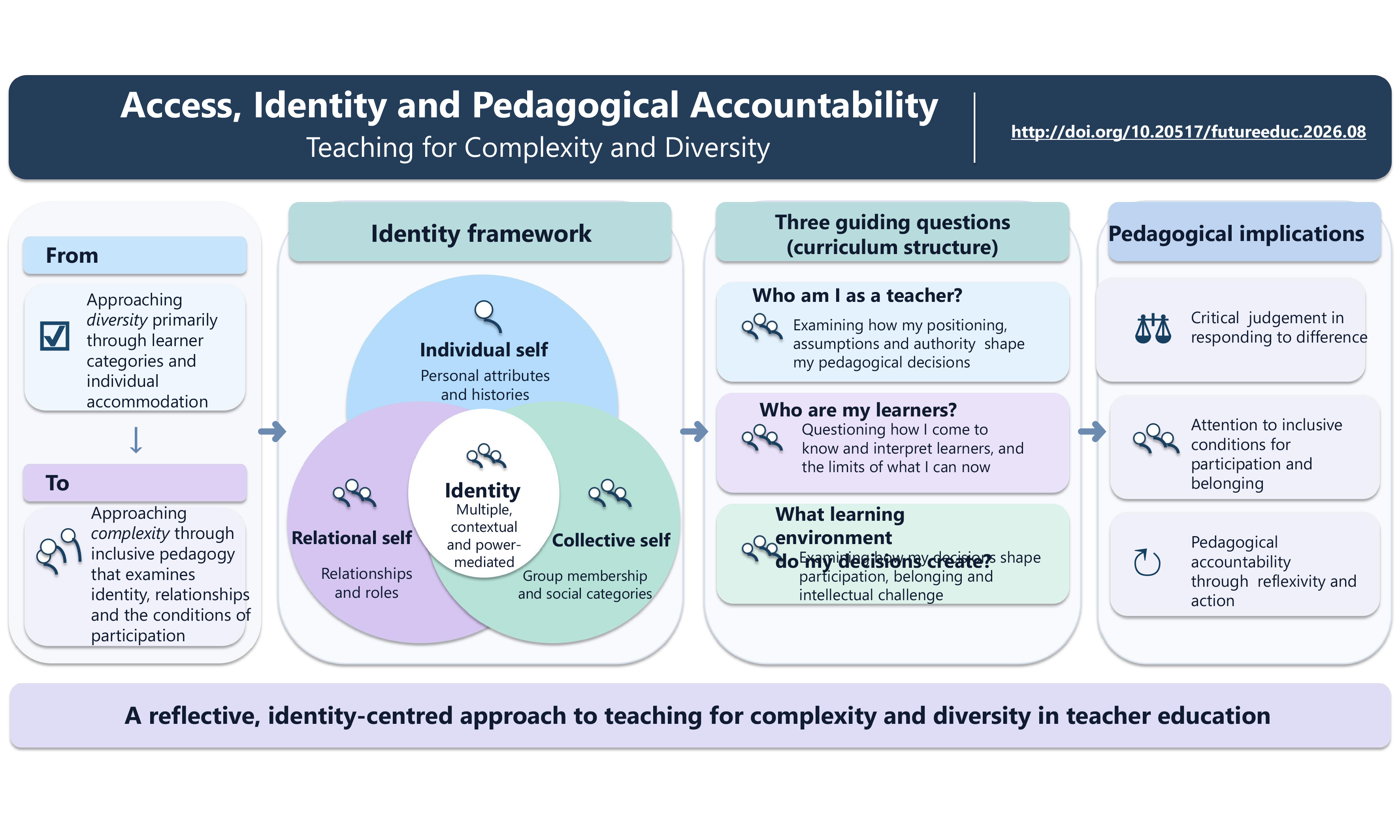
I examine my redesign of a subject focused on teaching for complexity and diversity, taught within a Master of Education program for preservice teachers at an Australian university. The redesign moved beyond an emphasis on responding to individual learner needs and categories towards examining how teachers come to know learners and create inclusive learning environments. I organised the curriculum around three connected questions: Who am I as a teacher? Who are my learners? What learning environment do my decisions create?
This Perspective article examines how three connected questions provide a pedagogical structure for translating identity reflection into critical examination of teaching decisions and their consequences for participation, belonging and intellectual challenge. The anonymised incidents are examined as opportunities to question my curriculum decisions and pedagogical accountability, rather than to evaluate individual students.
POSITIONING THE IDENTITY FRAMEWORK
Identity is theorised across disciplinary traditions with differing ontological and epistemological assumptions. Alfrey et al. (2023)[4] highlight the importance of recognising the multiplicity of social and self-identities, rather than treating identity as a singular or loosely defined construct.
For the purposes of this pedagogical reflection, I draw on the individual-relational-collective dimensions of cultural identity as an analytical lens for examining how teachers understand themselves and their learners within educational contexts. Sedikides and Brewer (2001)[5] distinguish between the individual self, defined through personal attributes; the relational self, constituted through significant relationships and roles; and the collective self, constructed through identification with groups and social categories. Owens et al. (2010)[6] similarly locate identity processes within self-structures, social situations and broader sociopolitical contexts. These dimensions informed my curriculum design and were explicitly introduced to students to encourage them to examine how their personal histories and assumptions, their relationships with learners, and wider social and institutional expectations influence pedagogical decisions and what becomes recognised as appropriate participation and learning.
Castells’ (2006)[7] emphasis on identity as the construction of meaning through cultural attributes extends this framework by drawing attention to the social and institutional relations of power within which identities are formed and negotiated. In this paper, cultural identity therefore refers to the meanings through which people understand themselves in relation to their histories, relationships, communities, languages, places and social positions. For teacher education, this Perspective also raises questions about how teachers’ own cultural positioning and institutional authority influence whose identities, knowledge and ways of participating are recognised and valued within educational settings, particularly the classroom.
This framework allowed identity to function as a bridge between accessibility and pedagogy, connecting the recognition of learner differences with an examination of the relationships, assumptions and institutional conditions that shape participation. The three guiding questions translated this framework into a progression from examining teachers’ positioning, to questioning assumptions about learners, to evaluating the pedagogical consequences of teaching decisions.
CONTEXT AND REFLECTIVE APPROACH
The redesign took place within a postgraduate teacher education program at an Australian university. The cohort included preservice secondary teachers from different disciplinary backgrounds and with varying levels of school-based teaching experience.
As the subject coordinator, I was responsible for redesigning and delivering this subject. My positioning combined an interdisciplinary background in medical sciences, linguistics and the sociology of higher education with extensive experience of studying and working across national and linguistic contexts. These experiences informed my attention to language, identity and belonging, while my institutional authority positioned me to select the conceptual framework, establish learning expectations and evaluate students’ teaching. My commitment to dialogue shaped the opportunities I designed, while my interpretation of productive participation influenced what I initially recognised as effective teaching. The incidents examined below prompted me to reconsider these expectations, particularly whether my curriculum and scaffolding had sufficiently prepared students to distinguish visible participation from meaningful learning and inclusion.
The subject combines educator-led conceptual input with student-led tutorials. I designed the curriculum sequence, learning outcomes and scaffolding, while groups of preservice teachers designed and facilitated tutorials in response to the weekly themes. This structure created a valuable and demanding site for reflection, where student-led tutorials made pedagogical decisions observable, exposing tensions between inclusive intentions and the consequences of everyday classroom practices.
This Perspective article adopts a critical, practice-based reflective approach to examining my own curriculum design and pedagogical decisions. My reflection draws on subject learning outcomes, teaching activities, lesson plans, observations of student-led tutorials and the formative feedback I provided. I selected incidents that exposed tensions between inclusive intentions and the consequences of everyday pedagogical decisions. I revisited these incidents in relation to the intended learning outcomes, the subject’s conceptual framework and relevant educational scholarship to reconsider my teaching decisions and identify areas for curriculum refinement. The incidents provide opportunities for critical reflection on my own pedagogical practice, with attention to the curriculum decisions and scaffolding that shaped students’ teaching.
As a retrospective reflection on my own teaching practice, this article was not originally designed or conducted as research involving students as participants. Student identities and potentially identifying contextual details have been omitted or generalised to minimise the risk of identification. Ethical approval was therefore not required.
1. From “Who am I?” to “What does who I am do?”
The first module invited preservice teachers to consider Who am I? Yet identity reflection can remain descriptive, listing backgrounds, experiences or personal characteristics without examining their pedagogical consequences. I therefore reframed the question as: What does who I am mean for how I teach? Students were invited to consider what knowledge, values and expectations they brought into the classroom and how these might shape their use of authority, approaches to classroom management and relationships with learners. They also examined what they were likely to recognise as engagement, respect, ability or disruption, and why different learners might experience the same teacher differently.
The change moved reflection from identity as biography towards identity as positioning. For example, a teacher’s understanding of “respectful participation” may appear neutral but can privilege particular ways of speaking, interacting or demonstrating attention. Similarly, classroom management practices communicate assumptions about authority, appropriate behaviour and whose ways of participating are recognised.
A useful reflective prompt became:
As a teacher, I bring ________. This is likely to shape how I ________. Some learners may experience this as ________, so I need to remain attentive to ________.
During an identity-reflection activity, a preservice teacher connected their personal and linguistic experiences with their understanding of classroom diversity. In a subsequent student-led tutorial, they helped facilitate a Find Someone Who... Housey-Housey game, inviting learners to identify peers whose experiences matched prompts on a worksheet. When one learner expressed unfamiliarity with the activity, the facilitators continued without further clarification. The game concluded without a discussion connecting the interactions to the intended learning. The learner’s expressed unfamiliarity provided sufficient grounds for a teaching response, without requiring assumptions about their cultural or linguistic background. In my feedback, I emphasised the importance of recognising unfamiliarity, checking understanding and making the learning purpose explicit. This prompted me to strengthen my scaffolding around activity instructions and reflective debriefing, with greater attention to how preservice teachers’ own experiences and assumptions shape their pedagogical decisions and responsiveness to learners. The incident connected the preservice teacher’s individual experiences with their relational responsibility towards learners and the collective expectation that classroom activities would be familiar to everyone.
Teacher identity thus became a resource for examining reflexively how positioning and authority shape pedagogical relationships (Brookfield, 2017)[8], moving beyond self-knowledge towards its consequences for teaching.
2. From “Who are my learners?” to “What do I know, assume and still need to learn about my learners?”
The second module addressed Who are my learners? In an initial scenario, preservice teachers interpreted a learner’s refusal to join group work, suggesting anxiety, disengagement, cultural discomfort, unfamiliarity with peers or diminished belonging.
The range of responses initially appeared to demonstrate attention to learner complexity. On reflection, however, many explanations were unsupported assumptions. The activity had inadvertently invited students to invent a learner around a single observed behaviour. In attempting to avoid deficit judgement, students risked replacing one judgement with a more sympathetic but equally unsubstantiated story. This reflection resonates with Florian and Black-Hawkins’ (2011)[2] challenge to deficit-oriented approaches to learner difference, reinforcing the importance of examining the assumptions underpinning pedagogical decisions.
This became a critical point in my own redesign. Because some preservice teachers had limited classroom experience, asking them to generate possible explanations consumed time and risked encouraging speculation or stereotypes. I therefore revised the scenarios to distinguish between what the teacher observed and what the learner communicated. Students then examined what remained unknown, what the teacher risked assuming, and what an immediate and longer-term response might involve.
The revised group-work scenario stated that the learner remained seated when groups were formed and had previously produced thoughtful individual work. The learner communicated that discussions often moved too quickly for them to contribute and that they would prefer to work independently. The pedagogical problem was no longer Why is this learner refusing? Instead, it became:
how can the teacher respond to what the learner has communicated while preserving dignity, participation and any learning outcome requiring collaboration?
This required preservice teachers to consider learner agency alongside the teacher’s responsibility for the intended learning outcomes. Respecting the learner’s expressed preference required considering alternative ways of participating while maintaining the collaborative learning outcome. The pedagogical challenge was to consider how the learner might contribute meaningfully through different arrangements, while preserving the collaborative purpose of the activity. Such decisions require dialogue and professional judgement rather than assuming that either independent or group work is inherently more inclusive. The revised scenario brought individual learner preferences into dialogue with teacher-learner relationships and the collective expectations of collaborative learning, making the three dimensions of identity relevant to pedagogical judgement.
The shift was from categorising learners towards inquiry, listening and responsiveness: distinguishing evidence from interpretation, recognising what remained unknown and enabling learners to communicate without repeatedly justifying personal circumstances.
3. From inclusive activities to inclusive environments
The third movement emerged from observing creative and engaging student-led tutorials in which apparently minor incidents complicated the assumption that engagement necessarily produces inclusive learning. Returning to the interactive activity introduced earlier, the focus here shifts from the preservice teacher’s identity reflection to the learning environment created through the tutorial. One learner indicated unfamiliarity with the activity, but the facilitators continued without clarifying the instructions or checking understanding. The activity subsequently concluded without a debrief connecting it to the intended learning.
Other moments raised similar questions. Students who arrived late were not always reoriented to the activity. Facilitators sometimes remained behind the teaching desk while groups worked, limiting their ability to hear discussions or notice who required support. Activities generated visible participation, but participation was sometimes treated as evidence that learning had occurred.
My first response was to frame these moments as areas for improving the students’ facilitation. Critical reflection, however, also required me to examine my own curriculum design. Had I made the difference between an engaging activity and evidence of learning sufficiently explicit? Had I adequately modelled how to pause, clarify, monitor participation and debrief an activity? Student-led teaching made their decisions visible, but it also exposed the assumptions embedded in the scaffolding I had provided.
I subsequently framed the analysis through two questions:
What did this activity enable you to learn about your students?
What kind of learning environment did this teaching decision produce, and for whom?
The learner’s expressed unfamiliarity made an assumption of shared knowledge visible. Without further information, this unfamiliarity could not be attributed to their cultural background, previous schooling, language or other personal circumstances.
Their communication of uncertainty was sufficient to warrant clarification. What I could examine was the relationship created through the teaching response: the learner had communicated uncertainty, while the student-facilitators retained control over the instructions, pace and conclusion. Continuing without clarification left the expectation of shared familiarity intact. The incident therefore brought together individual experiences of familiarity and uncertainty, the relational positioning of student-facilitators and learners, and collective expectations about what participants were presumed to know. My responsibility was also implicated, because I had designed the scaffolding through which the student-facilitators understood inclusive teaching.
The incident redirected my attention from designing engaging activities towards examining how instructions, responses to uncertainty and debriefing shape opportunities for participation and learning.
TOWARDS AN IDENTITY-CENTRED ACCOUNT OF INCLUSIVE PEDAGOGY
Across the three modules, the redesign moved through a connected sequence:
From describing teacher identity to examining its pedagogical effects; from categorising learners to investigating what is known and assumed; and from delivering inclusive activities to analysing the environments those activities produce.
Accessibility remains indispensable to inclusive pedagogy. An identity-centred lens extends this concern by examining how teachers’ assumptions, relationships and pedagogical decisions shape the conditions of access and participation, including barriers that may emerge through everyday teaching practices. It asks how teachers, learners, relationships and institutions participate in producing the conditions under which particular ways of knowing, behaving and belonging become possible.
Teaching for complexity requires reflexive judgement: recognising the limits of one’s knowledge, listening without diagnosing and examining how pedagogical decisions distribute opportunities to participate, belong and learn.
REFLEXIVITY AS PEDAGOGICAL RESPONSIBILITY
What began as curriculum redesign became an examination of my own pedagogical decisions. Initially, I interpreted unsupported assumptions, unclear instructions and missing debriefs as weaknesses in students’ facilitation. Yet locating responsibility solely in their practice would reproduce the individualising logic this paper critiques. Their decisions were also shaped by what I had modelled, scaffolded or left implicit. This resonates with Magill’s (2021)[9] examination of identity, critical reflexivity and agency within the social relations of teaching. The questions I designed for preservice teachers therefore returned to me: What did I know about these learners? What was I assuming? What had my curriculum enabled them to understand, and what had I expected them to infer? These questions made my pedagogical authority and responsibility more visible.
Reflection consequently became action. I revised the learner scenarios to distinguish observation from interpretation and made the relationship between activities and intended learning more explicit. I also strengthened peer observation to focus on the pedagogical consequences of teaching decisions rather than presentation performance. These modifications represent changes to my teaching practice, although their effectiveness has not been systematically evaluated. They remain open to further refinement through continued attention to what learners can access, contribute, question and learn.
As a practice-based reflection situated within one postgraduate teacher education subject, this account offers an interpretation of selected pedagogical incidents rather than a systematic evaluation of the redesign’s effectiveness. The incidents illuminate tensions between inclusive intentions and teaching decisions, but do not establish how preservice teachers’ subsequent practice or learners’ experiences may have changed. For other teacher educators, the three guiding questions offer a possible structure for examining how identity, assumptions and pedagogical authority become consequential in everyday teaching, while recognising that their application will depend on disciplinary, institutional and learner contexts.
The movement from access to identity was therefore also a movement in my own practice: from designing for an imagined learner towards designing responsively while remaining accountable for the assumptions embedded in my choices. Teaching for complexity requires educators to subject their own decisions to the critical scrutiny they ask of learners, remaining willing to be changed by the environments they create.
DECLARATIONS
Authors’ contributions
The author contributed solely to the article.
Availability of data and materials
Not applicable.
AI and AI-assisted tools statement
During the preparation of this manuscript, the AI tools, including the institutional Clarivate’s Primo Research Assistant (accessed via the UTS Library Catalogue), the library’s Research Assistant tool (released 2024-12-02) and OpenAI’s ChatGPT (version GPT-6, released 2026-09-04), were used to support the consolidation of ideas, language refinement, and structural organisation. Specifically, the balance scale, walking person, and curved arrow icons in the graphical abstract (GA) were generated using OpenAI’s ChatGPT and subsequently reconstructed and edited in PowerPoint by the author. The conceptual framework, pedagogical experiences, critical interpretations, and conclusions remain the author’s own. The author has reviewed the entire manuscript and takes full responsibility for the accuracy, integrity, and final content of the manuscript.
Financial support and sponsorship
None.
Conflicts of interest
The author declared that there are no conflicts of interest.
Ethical approval and consent to participate
This article is a retrospective critical reflection on my own teaching practice, rather than a study originally designed or conducted involving students as research participants. The classroom observations and student-related descriptions presented in the article are used solely for reflecting on my own teaching practice and were not collected or analysed as student participant data for formal research purposes. The teaching activities, student names, academic disciplines, and university names mentioned in the article have all been anonymised or generalised to minimise the risk of identification. Any information that could potentially identify individual students has also been anonymised or presented in generalised form. Therefore, ethical approval was not required.
Consent for publication
Not applicable.
Copyright
© The Author(s) 2026.
REFERENCES
1. Hosseini, N., Leijgraaf, M., Gaikhorst, L., & Volman, M. (2026). Navigating challenges and tensions in social justice-oriented teacher education: a review of the literature. Review of Educational Research, 96(3), 870–912. https://doi.org/10.3102/00346543251325572.
2. Florian, L., & Black-Hawkins, K. (2011). Exploring inclusive pedagogy. British Educational Research Journal, 37(5), 813–828. https://doi.org/10.1080/01411926.2010.501096.
3. Freire, P. (1970). Pedagogy of the Oppressed. New York, NY: Seabury Press.
4. Alfrey, K., Waters, K. M., Condie, M., & Rebar, A. L. (2023). The role of identity in human behavior research: a systematic scoping review. Identity, 23(3), 208–223. https://doi.org/10.1080/15283488.2023.2209586.
5. (2001). Individual Self, Relational Self, Collective Self. Psychology Press. https://doi.org/10.4324/9781315783024.
6. Owens, T. J., Robinson, D. T., & Smith-Lovin, L. (2010). Three faces of identity. Annual Review of Sociology, 36, 477–499. https://doi.org/10.1146/annurev.soc.34.040507.134725.
7. Castells, M. (2006). Globalisation and identity: a comparative perspective. Transfer: Journal of Contemporary Culture, 1, 56–67. https://docs.llull.cat/IMAGES_175/transfer01-foc01.pdf.
8. Brookfield, S. D. (2017). Becoming a critically reflective teacher (2nd ed.). Jossey-Bass.
9. Magill, K. R. (2021). Identity, consciousness, and agency: critically reflexive social studies praxis and the social relations of teaching. Teaching and Teacher Education, 104, 103382. https://doi.org/10.1016/j.tate.2021.103382.
Cite This Article
 Open Access
How to Cite
Eiras, P. R. S. (2026). Access, identity and pedagogical accountability: Teaching for complexity and diversity. Future Education, 1(1), 2. https://doi.org/10.20517/futureeduc.2026.08
Download Citation
If you have the appropriate software installed, you can download article citation data to the citation manager of your choice. Simply select your manager software from the list below and click on download.
Export Citation File
Type of Import
Tips on Downloading Citation
Citation Manager File Format
Type of Import
Direct Import: When the Direct Import option is selected (the default state), a dialogue box will give you the option to Save or Open the downloaded citation data. Choosing Open will either launch your citation manager or give you a choice of applications with which to use the metadata. The Save option saves the file locally for later use.
Indirect Import: When the Indirect Import option is selected, the metadata is displayed and may be copied and pasted as needed.
About This Article
Copyright

Data & Comments
Data
0








Comments
Comments must be written in English. Spam, offensive content, impersonation, and private information will not be permitted. If any comment is reported and identified as inappropriate content by OAE staff, the comment will be removed without notice. If you have any queries or need any help, please contact us at [email protected].