

Dynamically adaptive molecular design via resonance variation
 0
0 
INTRODUCTION
Advanced materials are gradually expected to perform sensing[1,2], data encryption[3,4], and self-regulation[5,6], driving the pursuit of molecular intelligence[7]. Unlike conventional static materials, these advanced smart materials require an intrinsic ability to adapt their properties in real time[8-11], which demands a deep understanding of how molecular-level dynamic processes govern macroscopic properties under fluctuating environments[12-15]. However, traditional molecular design strategies have long been grounded in static Lewis structures, which struggle to capture the dynamic changes occurring during the fabrication and operation of materials[16,17]. Therefore, it is essential to transcend conventional static molecular design principles and adopt an intelligent design perspective that fully accounts for electron delocalization and subtle bond reorganizations within molecular frameworks.
Introducing resonance structures directly addresses this need. By describing delocalized electrons beyond a single Lewis formula, resonance structures overcome the limitations of static representations, providing a theoretical foundation for dynamic molecular intelligence[18,19]. Among various resonance material systems, resonance variation-based dynamically adaptive (RVDA) materials stand out due to their unique dynamic tunability[20].
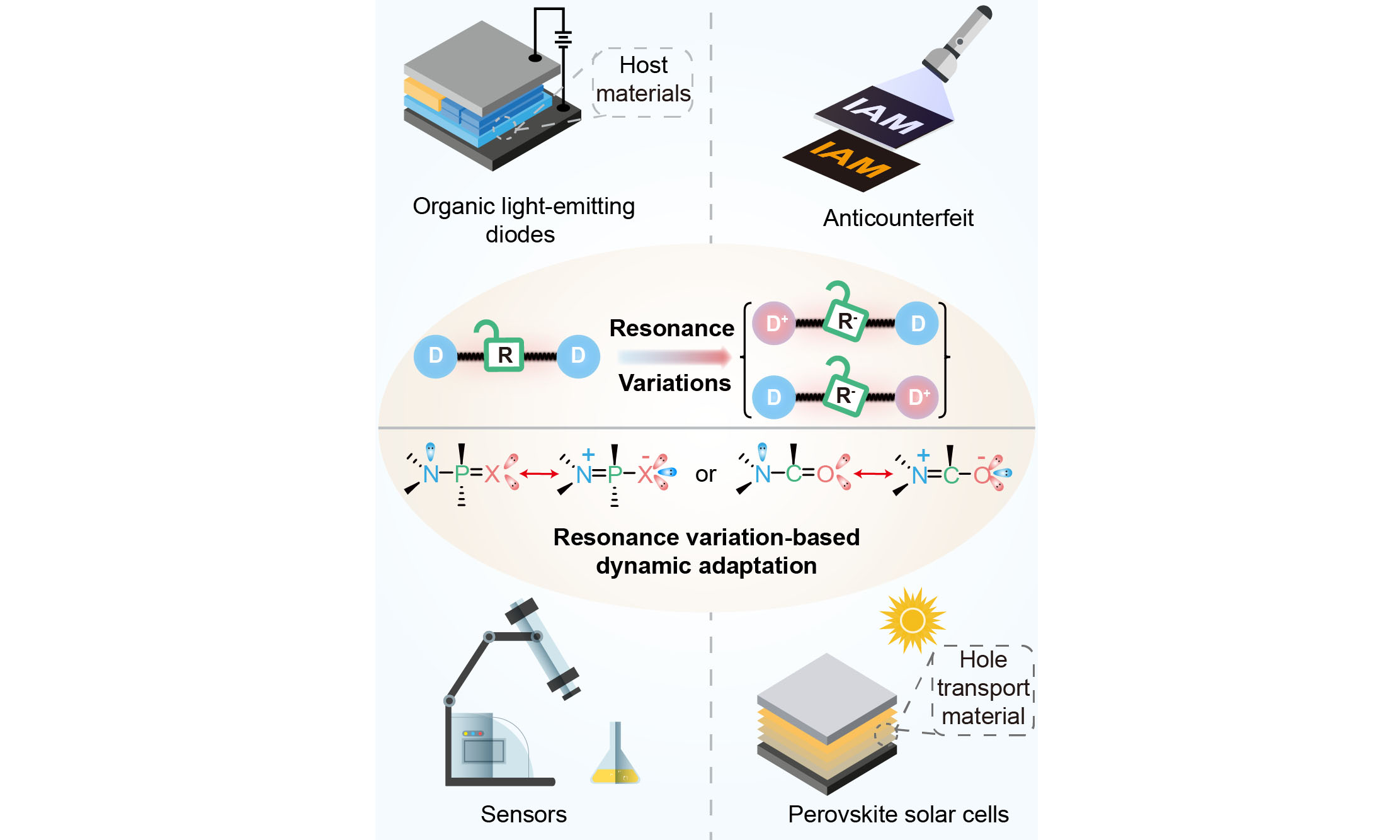
In RVDA molecules, heteroatom-containing linkages (e.g., N-P=O, N-P=S and N-C=O) exhibit low energy barriers for resonance interconversion, enabling rapid and efficient transitions[21]. Consequently, by constructing donor-resonance-donor (D-R-D) or donor-resonance-acceptor (D-R-A) structures through such resonance linkages, RVDA molecules achieve dynamic interconversion among multiple canonical forms [Figure 1A]. This inherent dynamic variation overcomes the limitations of static molecular systems, enabling the modulation of charge distribution, energy levels, spin-orbit coupling, and charge transport, thereby unlocking a wide range of applications including organic light-emitting diodes (OLEDs), perovskite solar cells (PSCs), anti-counterfeiting, and sensors [Figure 1B and C][22].
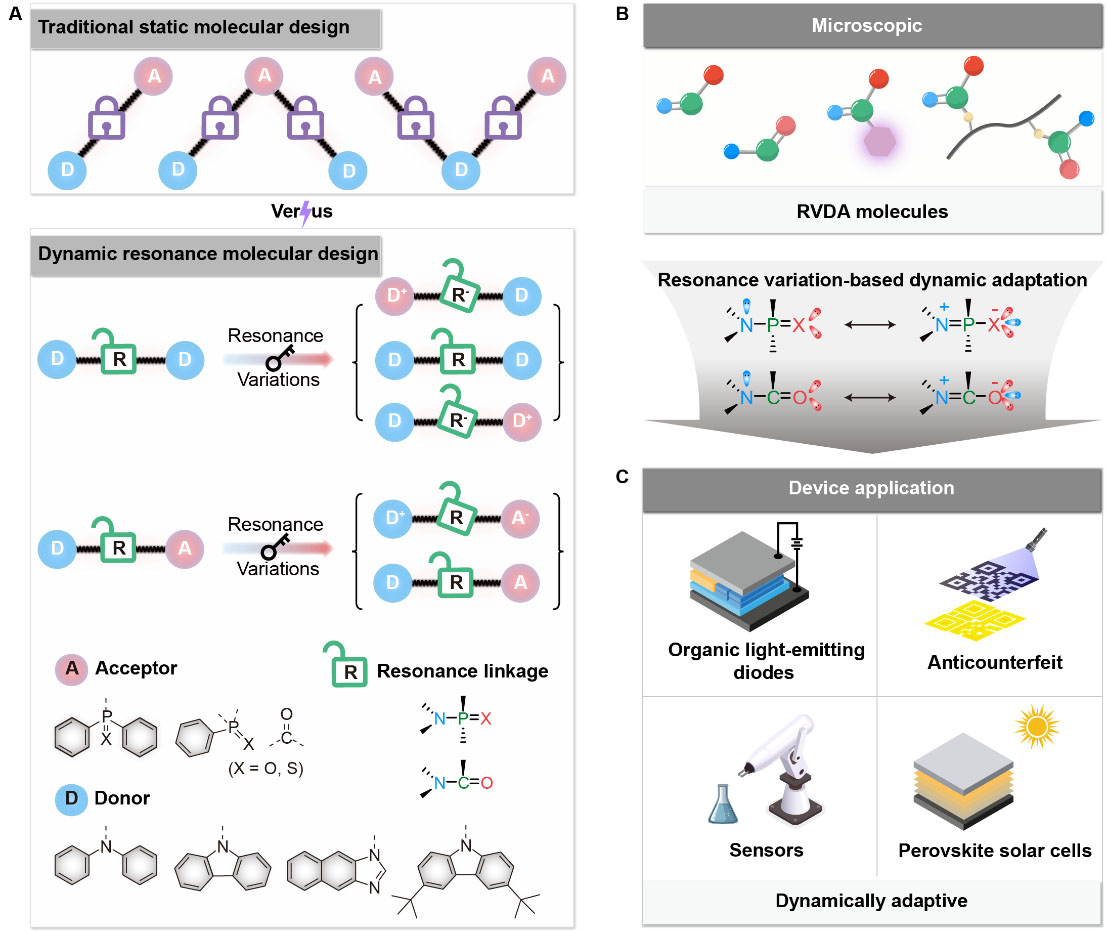
Figure 1. (A) Schematic comparison between the RVDA design strategy and conventional static molecular design strategies; (B) Schematic diagram of RVDA molecules and their resonance variation; (C) Schematic diagram of the dynamically adaptive device application based on RVDA molecules. This figure is adapted from Ref.[22] Copyright © 2026 American Chemical Society. RVDA: Resonance variation-based dynamically adaptive.
MICROSCOPIC ADAPTIVE RESONANCE INTERCONVERSION
Principles of resonance variation
The dynamically adaptive RVDA materials originate from the delocalized electron distribution across multiple canonical forms, which enables reversible, stimulus-responsive transitions between distinct electronic states. By overcoming a relatively low energy barrier, RVDA molecules undergo reversible interconversion between the neutral state (e.g., N-P=O, N-P=S, N-C=O) and the charged state (e.g., N+=P-O-, N+=P-S-, and N+=C-O-) [Figure 1B][23]. This phenomenon has been directly confirmed in single-crystal structures, where the dynamic equilibrium induces significant structural redistributions, characterized by the structural shortening of N-P (or N-C) bonds and the lengthening of P=O (or P=S, C=O) bonds, which imparts partial double- and single-bond characters, respectively[24]. Furthermore, the insulating nature of the resonance linkage suppresses electronic communication between conjugated moieties, thereby preserving the inherent optical properties of the functional groups while selectively modulating their electrical properties[25].
RVDA materials at the molecular level lead to remarkably enhanced macroscopic device performance, typically manifesting as stimulus-responsive self-adaptivity[26]. In practical application scenarios, RVDA molecules enable a reversible transition from the neutral state to the charged state by crossing the energy barrier after being activated by energy sources such as electrical, optical, or thermal energy, thereby unlocking the self-adaptive regulation of multiple optoelectronic properties.
Regulation of resonance variation
To quantitatively describe resonance interconversion, the resonance variation energy (ERV) is introduced. ERV is defined as the energy difference between the most stable neutral state and the charge redistributed state, as shown in Equations (1)-(3):
In the above equations, E is the molecular energy of the neutral state, E1 and E2 are the energies of two different canonical forms, and ΔERV is the energy difference between them.
ERV plays a decisive role in regulating the molecular resonance interconversion capability[27], thereby determining the response rate and magnitude of the adaptive variation in macroscopic material properties. A lower ERV implies a lower energy barrier for resonance variation, facilitating rapid interconversion between neutral and charged resonance states. The resonance variation energy can be effectively tuned by modifying the composition of the resonance linkage. For example, the N-P=S resonance linkage typically exhibits a lower ERV than N-P=O, due to the weaker back-bonding from sulfur to phosphorus resulting from the longer 3p-2p bond length [Figure 2A]. Notably, extending the number of resonance units enables the development of systems from mono- to di- and even tri-substituted architectures, which exhibit progressively enhanced dynamic self-adaptivity and improved optoelectronic properties [Figure 2B]. More importantly, integrating resonance units with other functional groups enables more complex multifunctional synergistic modulation.
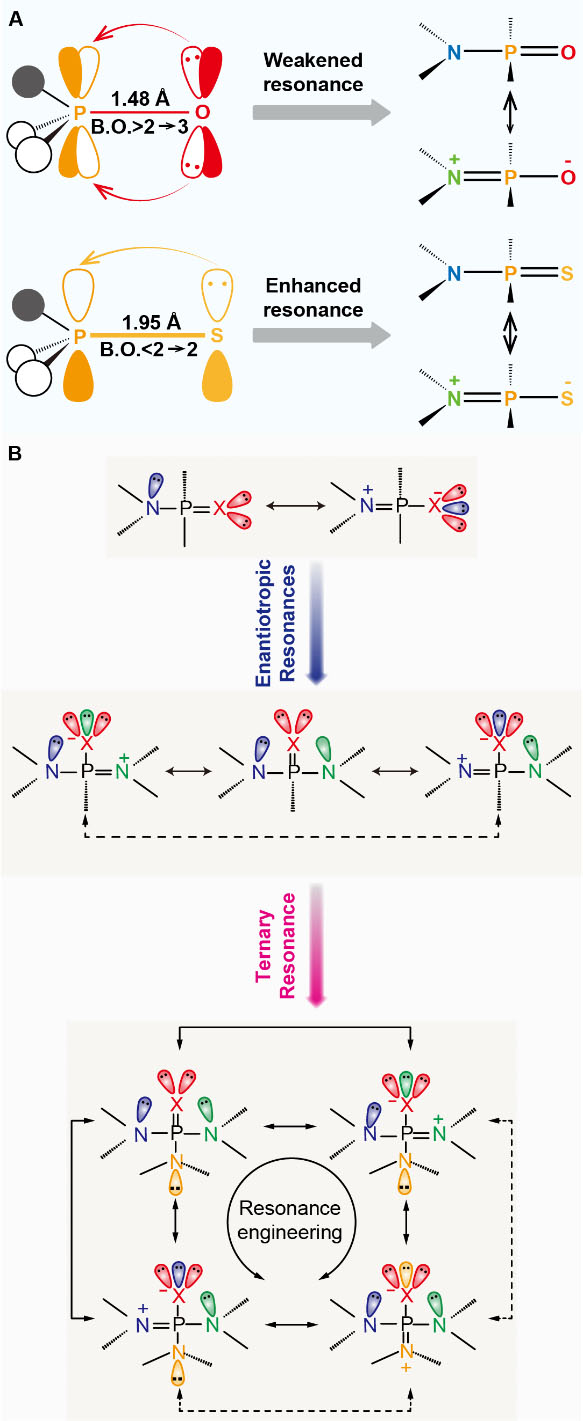
Figure 2. (A) Bond order variation as evidence for enhanced resonance capability; (B) Development of mono-, di-, and tri-substituted resonance structures by extending the resonance units (X = O/S). This figure is adapted from Ref.[27] Copyright © 2016 American Chemical Society.
DECISIVE INFLUENCE ON MACROSCOPIC PROPERTIES
Dynamic balanced carrier transport for organic light-emitting diodes
Introducing the RVDA molecule as the host material for OLEDs can achieve balanced bipolar transport. Crucially, the dynamic transition from the neutral to the charged canonical form redistributes the electron density across the molecular framework; while the neutral state governs traditional hole transport, the emergence of the polarized, charged state facilitates efficient electron injection, thereby achieving continuous and balanced migration of both carriers.
For instance, compared to the monosubstituted RVDA derivatives (NDPhPO and NCzPO), the enantiotropic N-P=O resonances in DNCzPO and DNDPhPO significantly enhance electron transport from the polarized carbazole or diphenylamine groups, leading to superior device performance [Figure 3A][28]. For the N-P=S system, DNCzPS exhibits a significantly reduced ERV of 0.72 eV, which leads to a lower barrier for self-adaptive interconversion, thereby achieving more balanced and efficient carrier transport performance [Figure 3B][27]. The N-C=O-based DCzCO exhibits an even lower resonance variation energy of 0.40 eV, rendering the resonance variation nearly barrier-free. The carbazole units thereby efficiently transport both holes and electrons, realizing bipolar transport and boosting the EQE of blue PhOLEDs to 31.2% [Figure 3C and D][21]. These findings demonstrate that resonance variation promotes efficient and balanced carrier transport, thereby significantly enhancing the macroscopic electroluminescence performance of OLEDs.
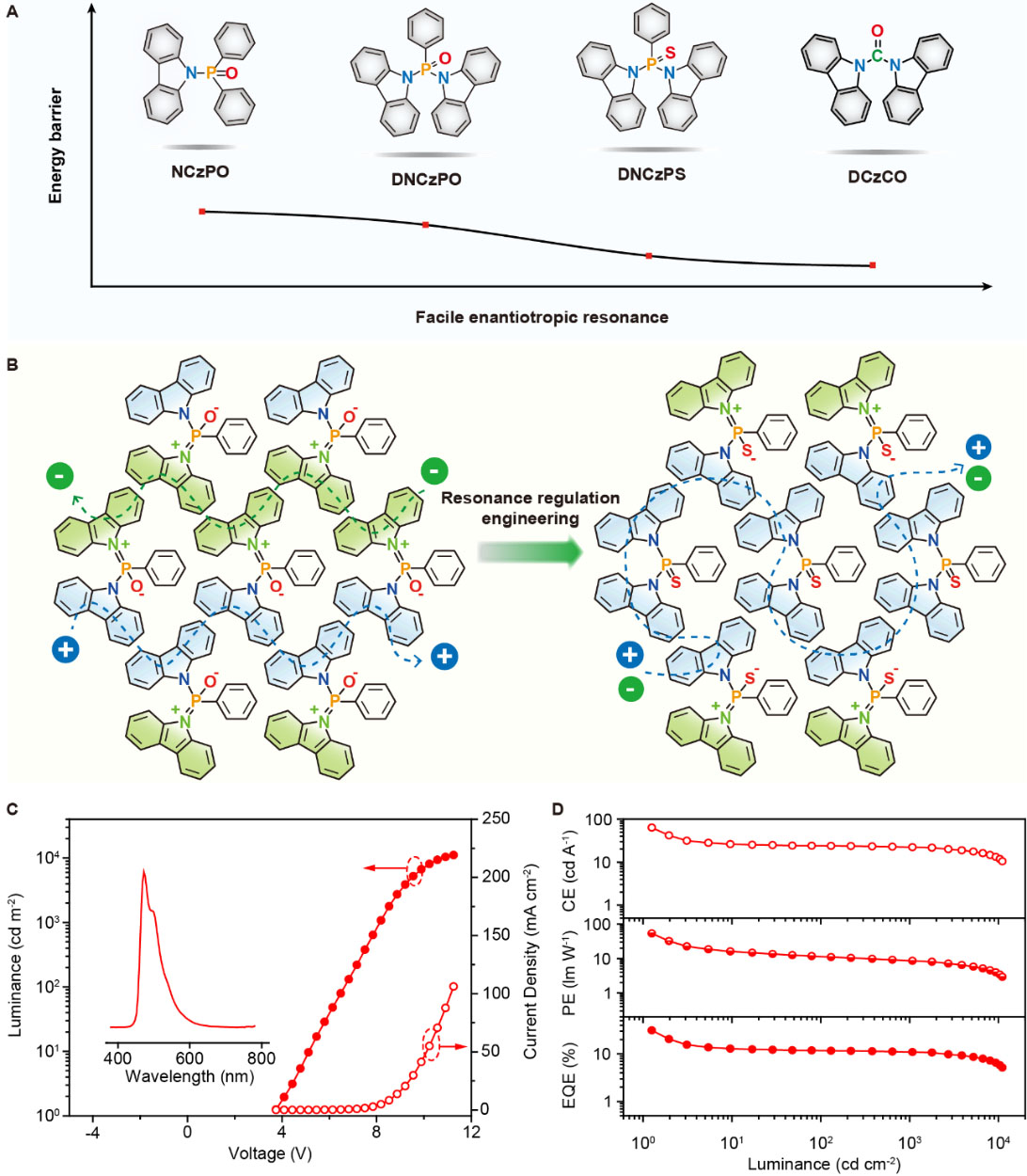
Figure 3. (A) RVDA molecules with progressively lower resonance variation energies developed through iterative tuning of resonance structures; (B) Resonance engineering lowers the resonance energy barrier, thus facilitating resonance interconversion and consequently enabling more balanced and efficient carrier transport. Figure 3B is adapted from Ref.[27] Copyright © 2016 American Chemical Society; (C and D) Current density-luminance-voltage (C) and efficiency-luminance (D) curves of the blue PhOLEDs based on DCzCO. Inset is the electroluminescence spectrum. Figure 3C and D is adapted from Ref.[21] Copyright © 2020 The Royal Society of Chemistry. RVDA: Resonance variation-based dynamically adaptive.
Dynamic interface transport enhancement for perovskite solar cells
RVDA hole-transport materials (HTMs) dynamically reduce interfacial defects and enhance charge transport via resonance interconversion. [29]. In response to undercoordinated Pb2+ ions, RVDA molecules undergo resonance interconversion to form strong coordination bonds, thereby enabling in situ passivation of interfacial defects and promoting perovskite crystallization. Moreover, owing to the D-R-D or D-R-A architectures essential for constructing RVDA molecules, the strong donor-acceptor (D-A) interactions combined with extensive conjugation facilitate efficient electron delocalization, facilitating efficient hole extraction and rapid charge transport [Figure 4A and B].
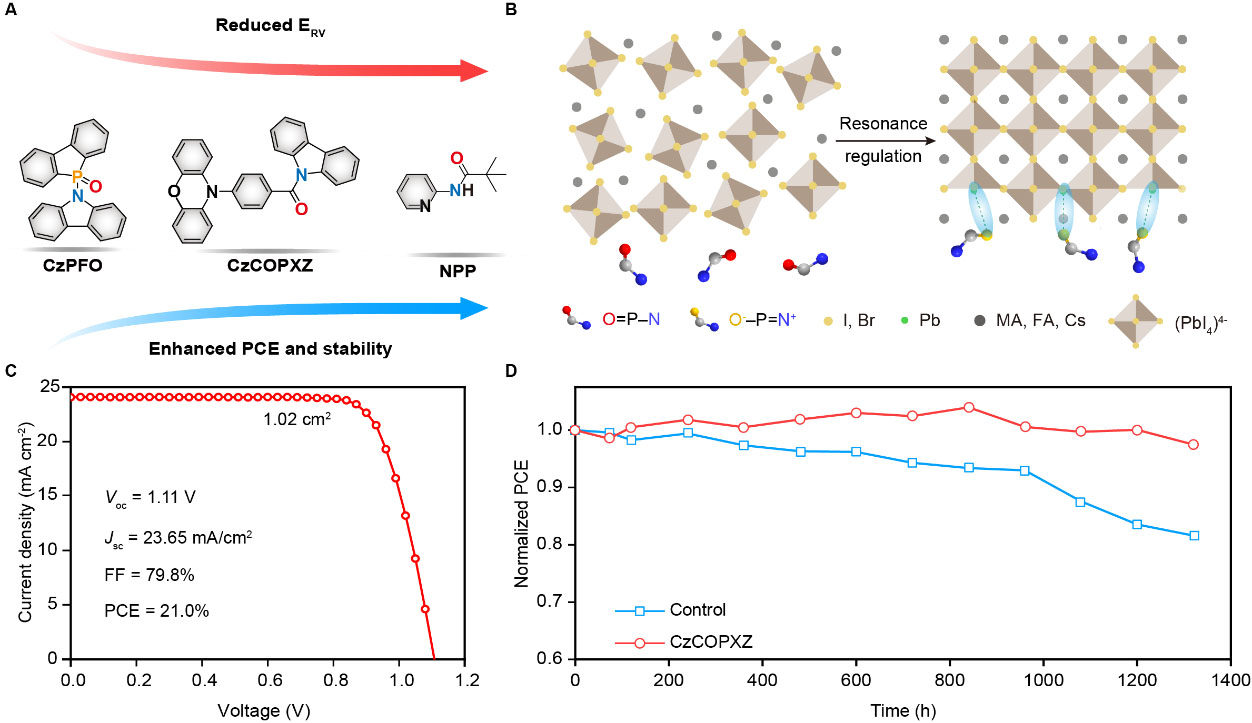
Figure 4. (A) Molecular structures of RVDA materials developed as HTMs of PSCs. (B) Schematic drawing of resonance variations-induced dynamic passivation of perovskite defects in situ and manipulation of perovskite crystallization; (C) Current density-voltage curves of CzCOPXZ-based PSCs; (D) Photothermal stability. Figure 4B-D is adapted from Ref.[30] Copyright © 2023 WILEY. FF: Fill factor; VOC: open-circuit voltage; JSC: short-circuit current density; PCE: power conversion efficiency; RVDA: resonance variation-based dynamically adaptive; HTM: hole-transport material; PSC: perovskite solar cell.
Initially, the N-P=O based RVDA molecule CzPFO was employed as HTM, achieving a power conversion efficiency (PCE) of 21.9%[29]. Subsequently, the N-C=O based CzCOPXZ and NPP, featuring a lower resonance energy, enabled faster resonance interconversion and stronger Pb-O interactions[30,31]. Large-area devices (1.02 cm2) based on CzCOPXZ reached a PCE of 21.0% and retained 97.4% of their initial efficiency after 1,300 h of continuous 1-sun illumination at 65 °C [Figure 4C and D]. These advances demonstrate that resonance interconversion is highly effective for passivating interfacial defects and enhancing carrier extraction efficiency, which is crucial for improving film quality and enabling the fabrication of large-area inverted PSCs, thereby ensuring both high PCE and long-term stability.
Dynamic triplet exciton modulation for anti-counterfeiting
RVDA molecules also modulate excited states, enabling organic ultralong room-temperature phosphorescence (OURTP) for anti-counterfeiting. Specifically, the resonance variation of RVDA molecules from the neutral state to the charged state reduces the singlet-triplet energy gap (ΔEST) in real time, while the redistribution of lone-pair electrons during the resonance process significantly enhances spin-orbit coupling (SOC) [Figure 5A and B]. Consequently, the intersystem crossing (ISC) efficiency is improved, promoting efficient triplet exciton generation, which is the core of OURTP.
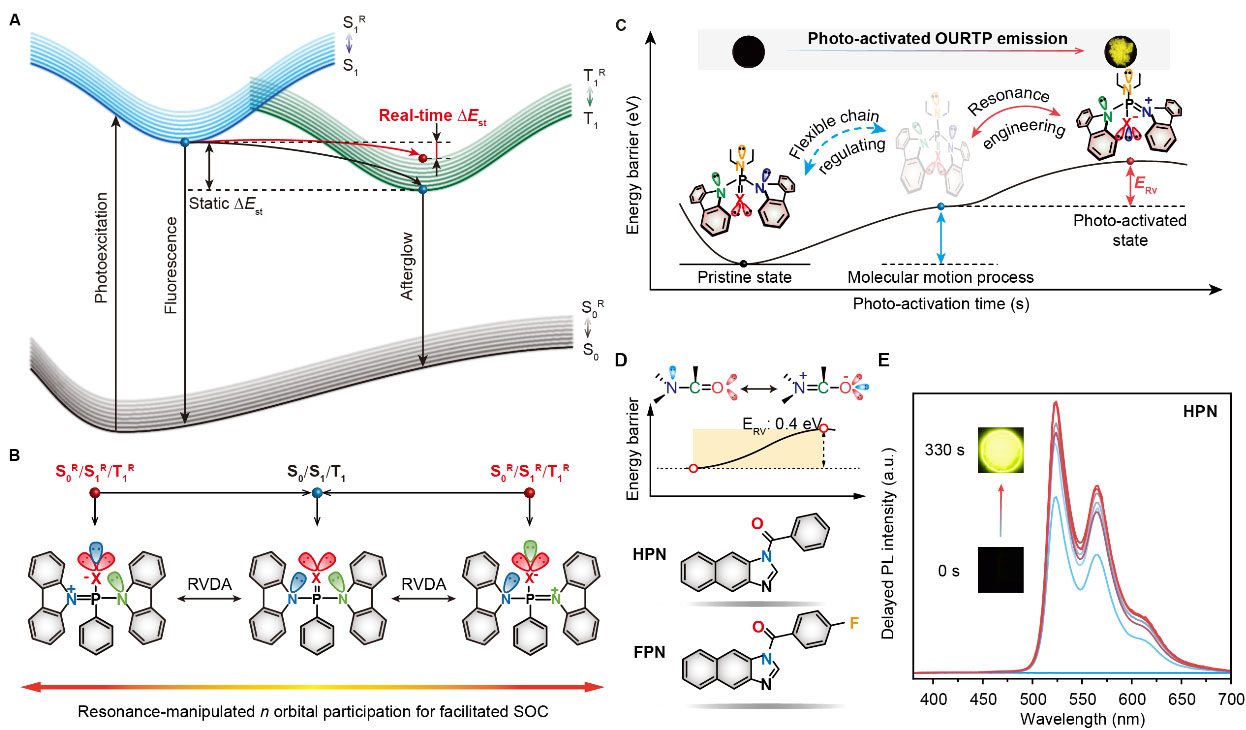
Figure 5. (A) Resonance-enhanced intersystem crossing (ISC) by reducing singlet-triplet splitting (ΔEST). Resonance variation induces shifts in the lowest singlet (S1) and triplet (T1) excited states, denoted as S1R and T1R; (B) Schematic illustration of the mechanism by which resonance variation manipulates n-orbital participation to enhance the SOC process. Figure 5A and B is adapted from Ref.[32] Copyright © 2018 WILEY; (C) Photoactivated mechanism mediated by chain flexibility and resonance modulation of DECzPO (X=O) and DECzPS (X=S); Figure 5C is adapted from Ref.[33] Copyright © 2022 American Chemical Society; (D and E) ΔERV values, molecular structures (D) and delayed PL spectra (E) of RVDA molecules HPN and FPN. Figure 5D and E is adapted from Ref.[34] Copyright © 2024 American Chemical Society. RVDA: Resonance variation-based dynamically adaptive; SOC: spin-orbit coupling.
The disubstituted RVDA molecules DNCzPO and DNCzPS exhibit significantly enhanced ISC rates and OURTP performance compared to non-RVDA reference molecules[32]. Trisubstituted molecules DECzPO and DECzPS further amplify this effect, assisted by chain flexibility, enabling rewritable smart paper for multi-level encryption [Figure 5C][33]. Furthermore, the N-C=O based RVDA molecules HPN and FPN possess an extremely low resonance energy barrier (0.4 eV) and achieve photoactivated OURTP lifetimes up to 508 ms, suitable for time-resolved information encryption [Figure 5D and E]. Thus, photoinduced resonance interconversion effectively regulates triplet excitons, thereby manipulating OURTP performance[34].
Dynamic electron transfer regulation for fluorescent probes
In addition to regulating intramolecular excited states for persistent emission, the stimulus-responsive charge redistribution of RVDA systems can be further utilized to orchestrate intermolecular electronic interactions. Jiang et al. integrated aggregation-induced emission (AIE) moieties with RVDA functional groups to achieve efficient fluorescence emission and sensitive detection of picric acid [Figure 6A][35]. Specifically, during the dynamic interconversion between the neutral and charged states, the interaction between the molecule and the analyte is significantly enhanced, promoting electron transfer from the the lowest unoccupied molecular orbital (LUMO) of the RVDA molecule to the LUMO of the analyte and resulting in fluorescence quenching [Figure 6B and C][35]. The dynamic characteristics of resonance variation govern the response speed and detection limit of sensors, offering a new paradigm for intelligent sensing.
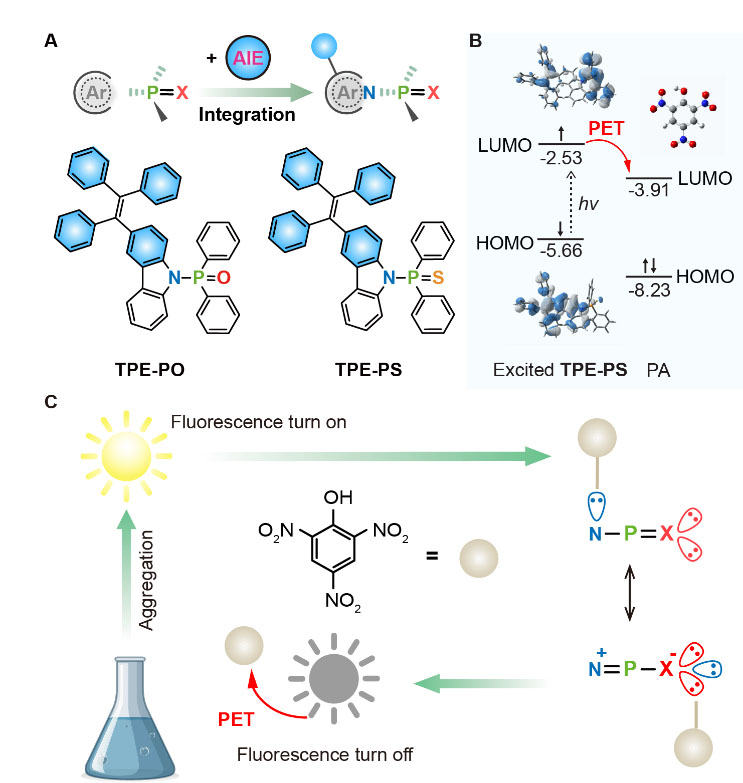
Figure 6. (A) Schematic illustration of the design and molecular structures of the RVDA molecules TPE-PO and TPE-PS; (B) Frontier molecular orbitals of TPE-PS and picric acid; (C) Dynamic sensing mechanism. This figure is adapted from Ref.[35] Copyright © 2022 The Royal Society of Chemistry. PET: Photo-induced electron transfer; LUMO:the lowest unoccupied molecular orbital; HOMO: the highest occupied molecular orbital; AIE: aggregation-induced emission; RVDA: resonance variation-based dynamically adaptive.
CONCLUSION
In conclusion, RVDA materials represent a fundamental shift from traditional static frameworks to an intelligence-oriented molecular design paradigm by harnessing resonance variation as an intrinsic, stimulus-responsive switching mechanism. The reversible interconversion between neutral and charged states, quantitatively governed by the resonance variation energy (ERV), enables the real-time, selective modulation of electronic properties without sacrificing intrinsic optical characteristics. By precisely managing the ERV to facilitate this intelligent adaptivity, researchers have successfully demonstrated self-adaptive regulation across balanced carrier transport, enhanced interfacial hole extraction, dynamic triplet exciton generation, and efficient electron transfer, thereby unlocking widespread applications in multi-functional organic optoelectronics. Despite challenges such as fatigue resistance and uniformity, this resonance-driving perspective opens new avenues for designing intelligent materials. Future research should also prioritize exploring new resonance linkages with minimized resonance variation energy to maximize dynamic responsiveness. We anticipate that continued molecular resonance engineering will drive the commercial advancement of dynamically adaptive organic optoelectronics, establishing a cornerstone for future flexible electronics, smart encryption, and bioelectronics.
DECLARATIONS
Authors’ contributions
Made substantial contributions to conception and design of the study and performed data analysis and interpretation: Chen, S.; Tao, Y.
Conducted proofreading of the manuscript and provided constructive suggestions: Jia, F.; Wang, H.; Tao, Y.
Provided administrative, technical, and material support: Tao, Y.
Availability of data and materials
Not applicable.
AI and AI-assisted tools statement
Not applicable.
Financial support and sponsorship
This study was supported in part by the National Natural Science Foundation of China (22322106, 22305126, and 62288102), Basic Research Program of Jiangsu (BK20243057), U35 Strong Foundation Program of Nanjing, and the Hua Li Talents Program of Nanjing University of Posts and Telecommunications.
Conflicts of interest
Tao, Y. is the Editorial Board Member of the Engin Future journal. He had no involvement in the review or editorial process of this manuscript, including but not limited to reviewer selection, evaluation, or the final decision, while the other authors have declared that they have no conflicts of interest.
Ethical approval and consent to participate
Not applicable.
Consent for publication
Not applicable.
Copyright
© The Author(s) 2026.
REFERENCES
1. Su, P.; Song, F.; Cao, J.; Yan, C. H.; Tang, Y. Rare earth complex-based functional materials: from molecular design and performance regulation to unique applications. Acc. Chem. Res. 2025, 58, 218-30.
2. Zhu, Z.; Pang, Y.; Li, Y.; et al. The rising of flexible organic electrochemical transistors in sensors and intelligent circuits. ACS. Nano. 2025, 19, 4084-120.
3. Khalilzadeh, R.; Babazadeh-Mamaqani, M.; Mohammadi-Jorjafki, M.; Roghani-Mamaqani, H.; Hoogenboom, R. Advanced anticounterfeiting polymer inks for high-level encryption and authentication technologies. Prog. Mater. Sci. 2025, 153, 101487.
4. Huang, J.; Jiang, Y.; Chen, Q.; Xie, H.; Zhou, S. Bioinspired thermadapt shape-memory polymer with light-induced reversible fluorescence for rewritable 2D/3D-encoding information carriers. Nat. Commun. 2023, 14, 7131.
5. Lian, H.; Dou, Z.; Qin, Z.; et al. A polychromatic neuromorphic visual system inspired by biomimetics for miniature insect robots. Adv. Mater. 2025, 37, e2416649.
6. Zhao, X.; Lin, X.; Yao, Z.; Li, Y.; Li, Y.; Gong, N. Plant growth monitoring, prediction, and self-regulation utilizing MXene/CNTs/TPU flexible strain sensors integrated with deep learning algorithms and soft actuators. Sci. China. Mater. 2025, 68, 3715-27.
7. Yang, T.; Tang, Y.; Wei, Y.; Xie, L.; Huang, W. Molecular gridization of organic semiconducting π backbones. Acc. Chem. Res. 2025, 58, 1982-96.
8. Li, C.; Wu, M.; Zhao, Z.; Lam, J. W.; Xu, B.; Tang, B. Z. Suppressing molecular motions: a pathway to enhanced organic room-temperature phosphorescence. Chem 2025, 11, 102654.
9. Khudozhitkov, A. E.; Ogiwara, N.; Donoshita, M.; et al. Dynamics of linkers in metal-organic framework glasses. J. Am. Chem. Soc. 2024, 146, 12950-7.
10. Zhu, M.; Ishaq, M. W.; Li, L. Advances in experimental studies of internal motions of non-linear macromolecular systems in solutions. Polymer 2022, 253, 124966.
11. Chen, S.; Liu, Y.; Zhang, Y.; et al. Ultralong room-temperature phosphorescence achieved by microcapsule rupture-triggered in-situ polymerization for high-contrast damage visualization and advanced anti-counterfeiting. Adv. Mater. 2026, 38, e14584.
12. Xu, F.; Feringa, B. L. Photoresponsive supramolecular polymers: from light-controlled small molecules to smart materials. Adv. Mater. 2023, 35, e2204413.
13. Li, N.; Pang, J.; Lang, F.; Bu, X. H. Flexible metal-organic frameworks: from local structural design to functional realization. Acc. Chem. Res. 2024, 57, 2279-92.
14. Ju, X.; Chen, C.; Oral, C. M.; et al. Technology roadmap of micro/nanorobots. ACS. Nano. 2025, 19, 24174-334.
15. Wang, H.; Ma, H.; Gan, N.; et al. Abnormal thermally-stimulated dynamic organic phosphorescence. Nat. Commun. 2024, 15, 2134.
16. Ji, C.; Kang, C.; Patra, Bidhan. C.; Zhao, D. Flexible covalent organic frameworks: design, synthesis, and applications. CCS. Chem. 2024, 6, 856-81.
17. Zhang, Z.; Liu, G.; Wu, J.; Jiang, X.; Liu, H.; Li, Z. High-strength dual-network hydrogels with chain-growth enhancement for multifunctional flexible sensors, triboelectric nanogenerators, and EMI shielding. Chem. Eng. J. 2025, 519, 165710.
18. Xu, H.; Yin, K.; Huang, W. Comparison of the electrochemical and luminescence properties of two carbazole-based phosphine oxide Eu(III) complexes: effect of different bipolar ligand structures. Chemphyschem 2008, 9, 1752-60.
19. Anjos, I. C.; Vasconcellos, M. L. A. A.; Rocha, G. B. A DFT and natural resonance theory investigation of the electronic structure of mesoionic compounds. Theor. Chem. Acc. 2012, 131, 1294.
20. Jiang, H.; Cao, Y.; Yang, Q.; et al. Organic resonance materials: molecular design, photophysical properties, and optoelectronic applications. J. Phys. Chem. Lett. 2020, 11, 7739-54.
21. Jiang, H.; Tao, Y.; Jin, J.; et al. Resonance-driven dynamically bipolar organic semiconductors for high-performance optoelectronic applications. Mater. Horiz. 2020, 7, 3298-304.
22. Chen, S.; Chen, S.; Tao, Y.; Chen, R.; Huang, W. Resonance variation-based dynamically adaptive organic optoelectronic materials. Acc. Chem. Res. 2026, 59, 875-88.
23. Tao, Y.; Guo, X.; Hao, L.; et al. A solution-processed resonance host for highly efficient electrophosphorescent devices with extremely low efficiency roll-off. Adv. Mater. 2015, 27, 6939-44.
24. Li, H.; Liu, C.; Wang, X.; et al. Achieving balanced electrical performance of host material through dual N-P=O resonance linkage for efficient electroluminescence. ACS. Appl. Mater. Interfaces. 2022, 14, 25834-41.
25. Jiang, H.; Jin, J.; Wang, Z.; et al. Constructing donor-resonance-donor molecules for acceptor-free bipolar organic semiconductors. Research 2021, 2021, 9525802.
26. Jiang, H.; Jia, L.; Li, Y.; et al. Selenide-containing organic resonance molecules as turn-on fluorescent probes for the selective detection of hypochlorous acid. Chem. Commun. (Camb). 2018, 54, 2926-9.
27. Tao, Y.; Xu, L.; Zhang, Z.; et al. Achieving optimal self-adaptivity for dynamic tuning of organic semiconductors through resonance engineering. J. Am. Chem. Soc. 2016, 138, 9655-62.
28. Tao, Y.; Xiao, J.; Zheng, C.; et al. Dynamically adaptive characteristics of resonance variation for selectively enhancing electrical performance of organic semiconductors. Angew. Chem. Int. Ed. Engl. 2013, 52, 10491-5.
29. Xu, L.; Wu, D.; Lv, W.; et al. Resonance-mediated dynamic modulation of perovskite crystallization for efficient and stable solar cells. Adv. Mater. 2022, 34, e2107111.
30. Xu, L.; Ji, H.; Qiu, W.; et al. Enhanced resonance for facilitated modulation of large-area perovskite films with stable photovoltaics. Adv. Mater. 2023, 35, e2301752.
31. Xu, L.; Qiu, W.; Feng, M.; et al. Multifunctional resonance bridge-mediated dynamic modulation of perovskite films for enhanced intrinsic stability of photovoltaics. Small 2023, 19, e2207226.
32. Tao, Y.; Chen, R.; Li, H.; et al. Resonance-activated spin-flipping for efficient organic ultralong room-temperature phosphorescence. Adv. Mater. 2018, 30, e1803856.
33. Tao, Y.; Liu, C.; Xiang, Y.; et al. Resonance-induced stimuli-responsive capacity modulation of organic ultralong room temperature phosphorescence. J. Am. Chem. Soc. 2022, 144, 6946-53.
34. Xie, G.; Guo, N.; Xue, X.; et al. Resonance-induced dynamic triplet exciton population for photoactivated organic ultralong room temperature phosphorescence. J. Am. Chem. Soc. 2024, 146, 20449-57.
Cite This Article
 Open Access
How to Cite
Download Citation
Export Citation File:
Type of Import
Tips on Downloading Citation
Citation Manager File Format
Type of Import
Direct Import: When the Direct Import option is selected (the default state), a dialogue box will give you the option to Save or Open the downloaded citation data. Choosing Open will either launch your citation manager or give you a choice of applications with which to use the metadata. The Save option saves the file locally for later use.
Indirect Import: When the Indirect Import option is selected, the metadata is displayed and may be copied and pasted as needed.
About This Article
Copyright

Data & Comments
Data
0





Comments
Comments must be written in English. Spam, offensive content, impersonation, and private information will not be permitted. If any comment is reported and identified as inappropriate content by OAE staff, the comment will be removed without notice. If you have any queries or need any help, please contact us at [email protected].