
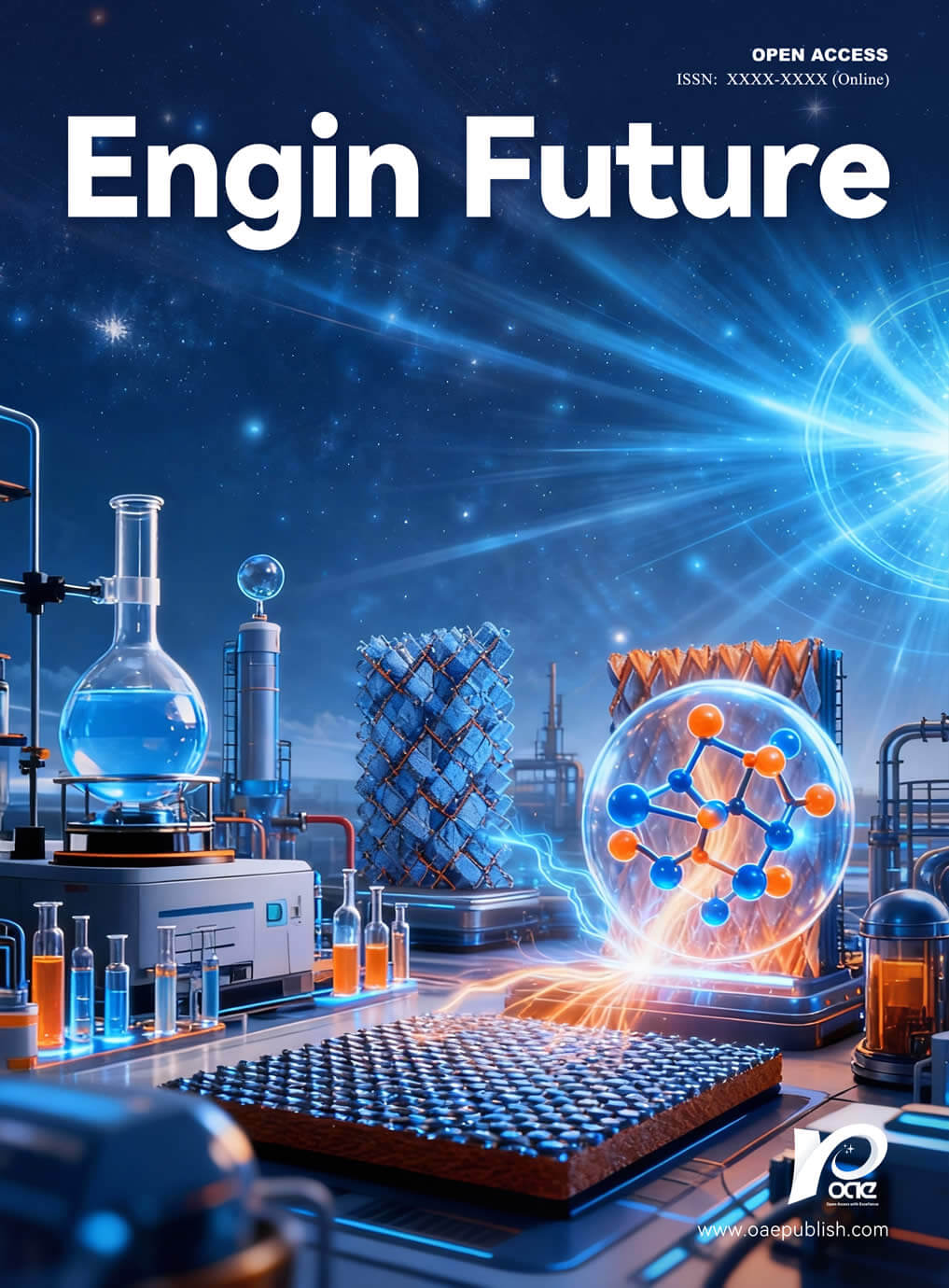
New journal: Engin Future
 0
0 
Engin Future is an open-access, peer-reviewed journal dedicated to publishing original research, reviews, perspectives, and news & views across all fields of engineering. The journal aims to serve as a premier resource for seminal and insightful engineering research, including cutting-edge studies in energy utilization and materials science innovation, as well as a showcase for researchers, engineers, and practitioners from both academia and industry. Our mission is to provide a platform of inspiration that defines the future of engineering. Engin Future intends to serve as the preeminent international engineering journal, with the ambition of becoming the first choice for researchers to publish their transformative discoveries and innovations.
At its core, Engin Future is dedicated to the integration of fundamental engineering principles with emerging technologies across the physical, biological, and digital worlds. We focus on works that demonstrate not only technical excellence but also long-term impact on global sustainability, energy systems, and planetary exploration. Engineering is the bridge between basic science and real-world applications. It remains the foundation of aerospace development, environmental protection, intelligent manufacturing, and advanced infrastructure.
However, the future of engineering is being fundamentally reshaped by the Digital Transformation. To reflect this, Engin Future places a special emphasis on artificial intelligence (AI)-driven engineering (AI for Engineering) and the implementation of Digital Twins. We seek research that leverages machine learning and deep learning to accelerate materials discovery, optimize complex industrial processes, and enhance the predictive maintenance of infrastructure. By integrating Digital Twins - virtual replicas of physical systems - engineering can now achieve unprecedented levels of precision, safety, and efficiency through real-time simulation and data-driven feedback loops. This synergy between “bits” and “atoms” is the cornerstone of the next industrial revolution.
The interdisciplinary integration of engineering with physics, biology, computer science, and social sciences is critical in addressing global challenges such as climate change, resource scarcity, and public health crises. Engineering does not merely optimize existing modes of living; it creates entirely new technical systems and material forms.
Engin Future embraces all significant advances across eight core engineering pillars:
• Frontier & Aerospace Engineering: Beyond Earth exploration and next-generation propulsion.
• Geo-resources & Environmental Engineering: Sustainable mining and carbon-neutral ecosystems.
• Intelligent & Digital Transformation: AI-driven design, Digital Twins, and cyber-physical systems.
• Sustainable Energy & Chemical Processes: Advanced energy conversion and circular economy frameworks.
• Life Science & Bio-Engineering: Synthetic biology and neural-engineering interfaces.
• Civil & Infrastructure Engineering: Smart cities and climate-resilient construction.
• Materials & Mechanics: From 2D materials to multi-scale structural mechanics.
• Engineering Management & Education: Future-ready pedagogy and optimized project lifecycles.
Engin Future is led by a team of globally renowned and enthusiastic editors who are active leaders in their respective fields. We are committed to maintaining the highest academic quality and international influence, ensuring that every published work contributes to the sustainable development of human civilization.
DECLARATIONS
Authors’ contributions
The authors contributed equally to the Editorial.
Availability of data and materials
Not applicable.
AI and AI-assisted tools statement
Not applicable.
Financial support and sponsorship
None.
Conflicts of interest
Pang, H. serves as the Editor-in-Chief of Engin Future, and Ding, J. serves as an Editorial Board Member of Engin Future. This article is an Editorial introducing the journal and was not subject to external peer review.
Ethical approval and consent to participate
Not applicable.
Consent for publication
Not applicable.
Copyright
© The Author(s) 2026.
Cite This Article
 Open Access
How to Cite
Download Citation
Export Citation File:
Type of Import
Tips on Downloading Citation
Citation Manager File Format
Type of Import
Direct Import: When the Direct Import option is selected (the default state), a dialogue box will give you the option to Save or Open the downloaded citation data. Choosing Open will either launch your citation manager or give you a choice of applications with which to use the metadata. The Save option saves the file locally for later use.
Indirect Import: When the Indirect Import option is selected, the metadata is displayed and may be copied and pasted as needed.
About This Article
Copyright

Data & Comments
Data
0





Comments
Comments must be written in English. Spam, offensive content, impersonation, and private information will not be permitted. If any comment is reported and identified as inappropriate content by OAE staff, the comment will be removed without notice. If you have any queries or need any help, please contact us at [email protected].