
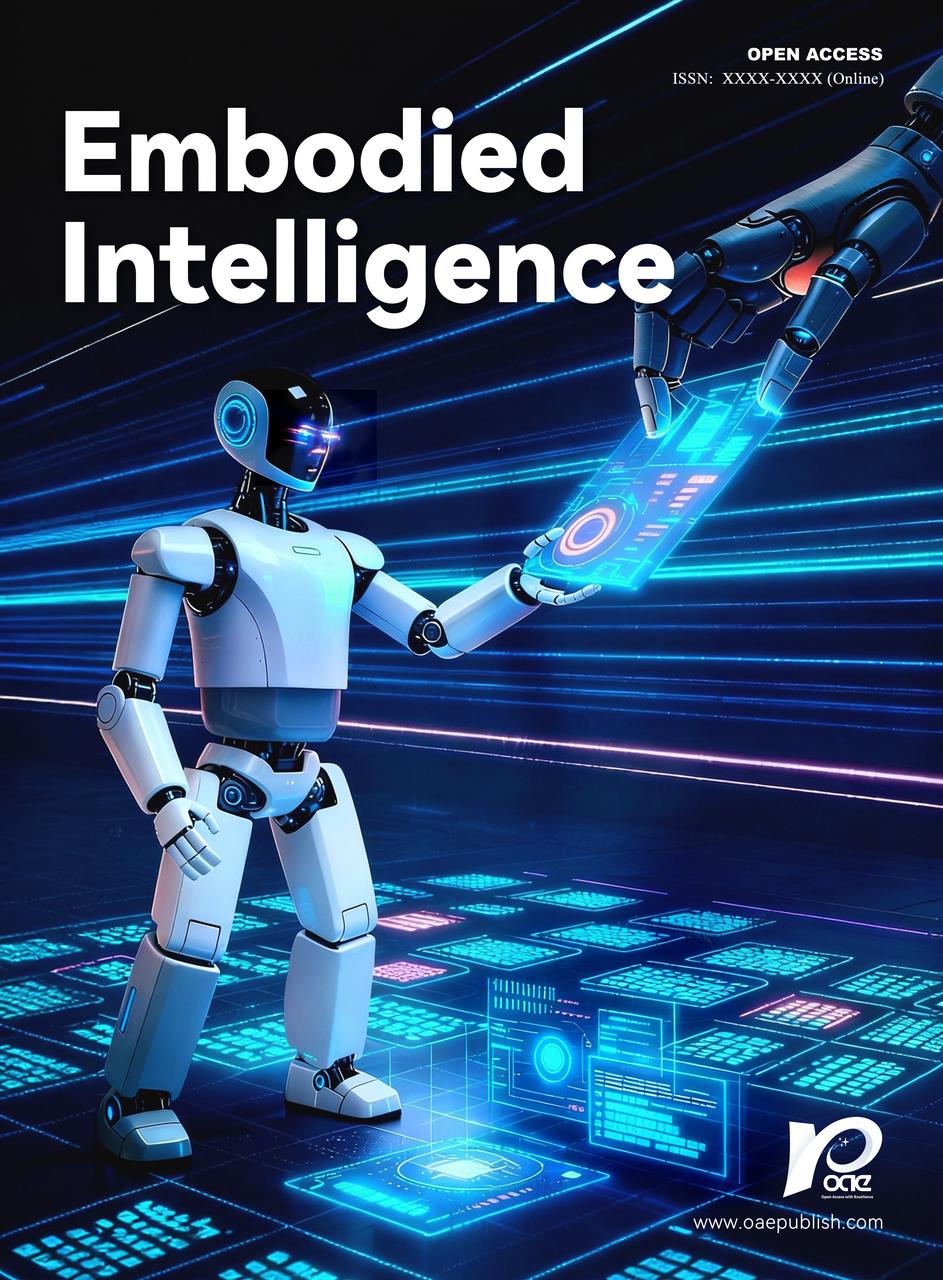
Embodied Intelligence - where control meets cognition in the physical world
 0
0 Embodied intelligence is rapidly becoming a unifying scientific frontier. As learning, sensing, and computation continue to advance, the central question is no longer whether we can build intelligent algorithms in isolation, but whether we can endow physical agents with autonomy that is safe, robust, and generalizable in the real world. Achieving this goal requires more than scaling data and models: it demands principled control, rigorous modeling, and systematic real-world validation under the hard constraints of physics - contact, uncertainty, limited actuation, partial observability, and interaction with humans and complex environments.
Yet many of the most consequential ideas arise precisely where established disciplines meet: control theory, robotics, artificial intelligence, neuroscience, and human-centered systems. In these boundary regions, the appropriate standards for evaluation, reproducibility, and dissemination can be unclear - especially for work that simultaneously contributes theory, algorithms, hardware, and integrated systems. Embodied Intelligence is launched to serve as a dedicated scholarly forum for this cross-disciplinary community. Our aim is to promote research that integrates theoretical depth with embodied grounding, and that accelerates reproducible progress from fundamental principles to deployed systems.
What we publish
Embodied Intelligence welcomes submissions in the following article types: Research Article, Review/Mini-review, Communication, Editorial, Commentary, Opinion, Research Highlight, and Perspective. We publish these formats across (but not limited to) the areas below.
1. Foundations: modeling, control, and optimization for embodied agents
(1) Nonlinear, hybrid, and stochastic control for complex embodied systems and contact-rich interactions
(2) Optimal control, model predictive control (MPC), and real-time trajectory optimization
(3) System identification and learning-based modeling with guarantees of stability and robustness
(4) Safety, constraints, and formal verification (e.g., barrier functions, reachability, and certified control)
2. Learning for embodiment: from data to skills with guarantees
(1) Reinforcement learning and imitation learning for continuous control and interaction
(2) Sim-to-real transfer, domain adaptation, and generalization under distribution shift
(3) Representation learning for dynamics, contact modeling, and morphology-aware policies
(4) Safe and robust learning: uncertainty quantification, risk-sensitive analysis, and policy certification
3. Perception, state estimation, and sensorimotor integration
(1) Multimodal perception (vision, tactile sensing, proprioception, and audio) for embodied interaction
(2) State estimation, simultaneous localization and mapping (SLAM), and contact-aware localization and manipulation
(3) World modeling: scene understanding, affordance learning, and physics-informed perception
(4) Closed-loop sensorimotor architectures that tightly integrate perception and control
4. Systems, platforms, and real-world impact
(1) Novel robot designs and embodied hardware (soft robotics, dexterous manipulation, and bio-inspired systems)
(2) Human-robot interaction, shared autonomy, and assistive/medical/rehabilitation applications
(3) Swarm and multi-agent embodied intelligence, addressing coordination, resilience, and communication constraints
(4) Benchmarking, reproducibility, datasets, and field deployments in industrial, service, and extreme environments
(5) A shared home for rigorous, grounded, and reproducible progress
We view embodied intelligence as a scientific endeavor that must connect models and mechanisms with measurement and deployment. Accordingly, the journal encourages submissions with clear problem formulations, transparent experimental protocols, and credible evaluation - whether the contribution is a theoretical result, a learning framework with guarantees, a perception-and-control architecture, a system platform, or a field deployment. We particularly welcome work that clarifies the relationship between guarantees and empirical performance, and that strengthens community standards for benchmarking and reproducibility in physical autonomy.
The launch of Embodied Intelligence is an invitation to the community: to bring together ideas that bridge control and learning, perception and action, and theory and systems. We look forward to publishing research that not only advances capability, but also deepens understanding - so that embodied agents can operate reliably in the physical world, alongside people, and in service of society.
DECLARATIONS
Authors’ contributions
The author contributed solely to the article.
Availability of data and materials
Not applicable.
Financial support and sponsorship
None.
Conflicts of interest
He, X. is the Editor-in-Chief of Embodied Intelligence. This Editorial was not externally peer reviewed and was accepted directly by the publisher. He, X. was not involved in the handling or decision-making for this manuscript.
Ethical approval and consent to participate
Not applicable.
Consent for publication
Not applicable.
Copyright
© The Author(s) 2026.
Cite This Article
 Open Access
How to Cite
Download Citation
Export Citation File:
Type of Import
Tips on Downloading Citation
Citation Manager File Format
Type of Import
Direct Import: When the Direct Import option is selected (the default state), a dialogue box will give you the option to Save or Open the downloaded citation data. Choosing Open will either launch your citation manager or give you a choice of applications with which to use the metadata. The Save option saves the file locally for later use.
Indirect Import: When the Indirect Import option is selected, the metadata is displayed and may be copied and pasted as needed.
About This Article
Copyright

Data & Comments
Data
0





Comments
Comments must be written in English. Spam, offensive content, impersonation, and private information will not be permitted. If any comment is reported and identified as inappropriate content by OAE staff, the comment will be removed without notice. If you have any queries or need any help, please contact us at [email protected].