

Correction: Use of a fluorescent molecular rotor probe for nanoplastics assessment in epiphytic biofilms growing on submerged vegetation of Lake Saint Pierre (St. Lawrence River)
 0


 Download PDF
This is a Correction to the article: Use of a fluorescent molecular rotor probe for nanoplastics assessment in epiphytic biofilms growing on submerged vegetation of Lake Saint Pierre (St. Lawrence River)
An incorrect version of Figure 2 was published in the article. Seven sampling stations were assigned incorrect colors (corresponding to water masses) in the graphical representation. This resulted in the presentation of erroneous box plots for these stations. Specifically:
• S1, A5 and A7 were displayed in brown;
• A4, A6 and S2 were displayed in green;
• N2 was displayed in lilac.
The corrected Figure 2, with the appropriate graphical representation, is provided below. Specifically:
• S1, A5 and A7 are now displayed in green;
• A4 and A6 are now displayed in brown;
• S2 is now displayed in lilac;
• N2 is now displayed in brown.
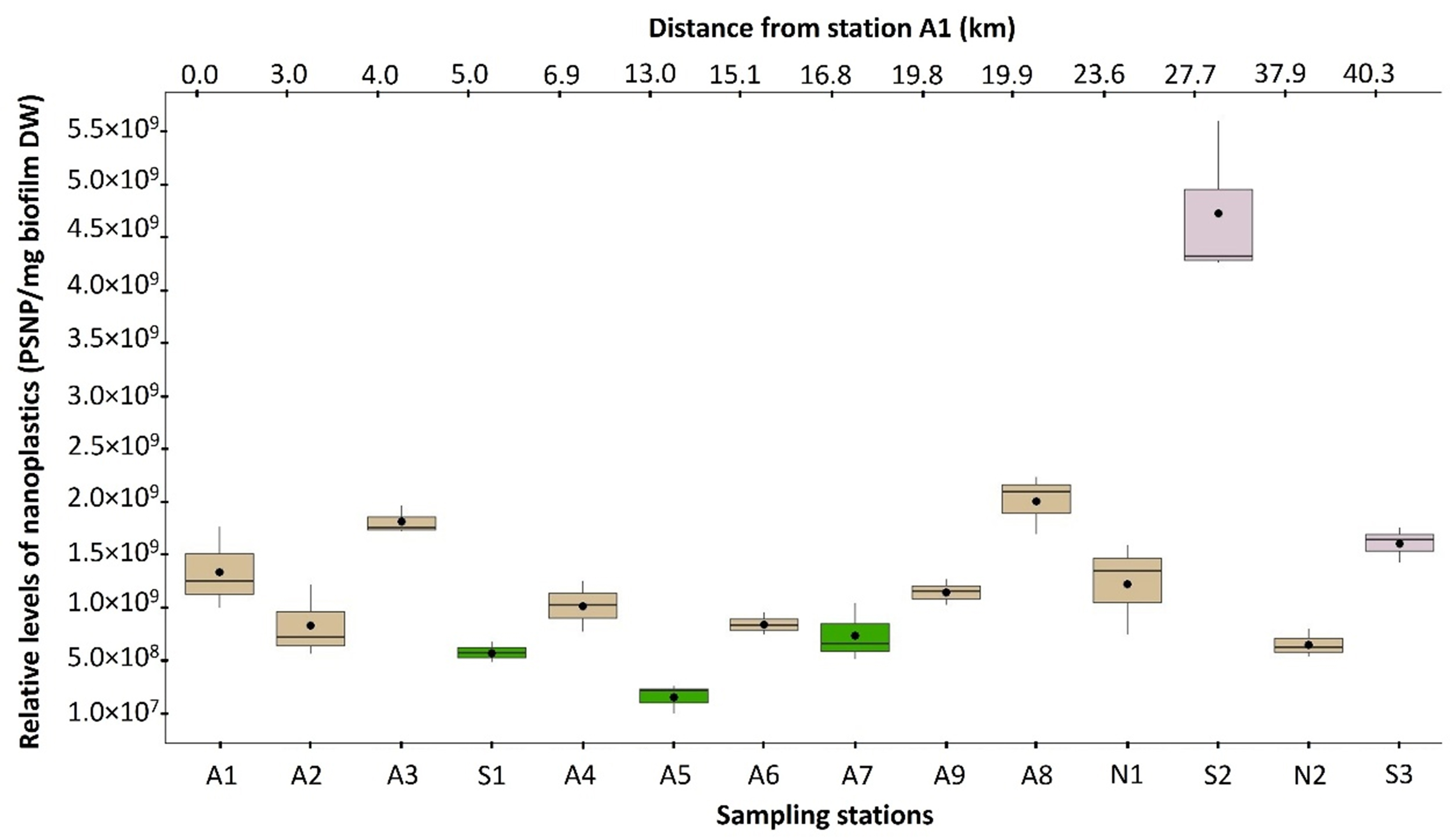
Figure 2. Estimated concentrations of nanoplastic (PSNP/mg DW) in the biofilm samples collected across the 14 stations (× 3 sampling points) visited at Lake St-Pierre. Codes on the X-axis represent station location, where A = archipelago, N = north shore, S = south shore. Colors represent water masses, where brown represents the northern water body, green for the central water body, and lilac for the southern water body. The solid black line represents the median concentration, and the black dot represents the mean concentration. Stations are presented from upstream to downstream, with station A1 being the most upstream station. Distances from station A1 (km) are also indicated. PSNP: Polystyrene-like nanoplastics; DW: dry weight.
These corrections do not affect the data, analyses, or conclusions presented in the article. Thus, the values set out in the main text remain accurate and now align with the corrected figure (i.e., “There was a twenty-eight-fold difference in PSNP concentration between the most contaminated station, S2, and the least contaminated station, A5 [Figure 2]”).
Seven sampling stations were assigned the wrong colors in the initial version of this article. This resulted in the presentation of erroneous box plots for said stations. Specifically: S1, A5, and A7 are now displayed in green instead of brown; A4 and A6 are now displayed in brown instead of green; S2 is now displayed in lilac instead of green, and N2 is now displayed in brown instead of lilac. The corrected figure now aligns with the values presented in the main text (i.e., “there was a twenty-eight-fold difference in PSNP concentration between the most contaminated station, S2, and the least contaminated station, A5 [Figure 2]”). Most importantly, these corrections do not affect the data, analyses, or conclusions presented in the article.
Cite This Article
 Open Access
How to Cite
Mouatchô, L. Y.; Roubeau Dumont, E.; Ponton, D. E.; Gagné, F.; Amyot, M.; Lavoie, I. Correction: Use of a fluorescent molecular rotor probe for nanoplastics assessment in epiphytic biofilms growing on submerged vegetation of Lake Saint Pierre (St. Lawrence River). Emerg. Contam. Environ. Health 2026, 2, 6. https://dx.doi.org/10.20517/eceh.2026.16
Download Citation
If you have the appropriate software installed, you can download article citation data to the citation manager of your choice. Simply select your manager software from the list below and click on download.
Export Citation File
Type of Import
Tips on Downloading Citation
Citation Manager File Format
Type of Import
Direct Import: When the Direct Import option is selected (the default state), a dialogue box will give you the option to Save or Open the downloaded citation data. Choosing Open will either launch your citation manager or give you a choice of applications with which to use the metadata. The Save option saves the file locally for later use.
Indirect Import: When the Indirect Import option is selected, the metadata is displayed and may be copied and pasted as needed.
About This Article
Copyright

Data & Comments
Data
0











Comments
Comments must be written in English. Spam, offensive content, impersonation, and private information will not be permitted. If any comment is reported and identified as inappropriate content by OAE staff, the comment will be removed without notice. If you have any queries or need any help, please contact us at [email protected].