


Electrocatalytic CO reduction to multi-carbon alcohols on functional ionic liquid-incorporated Cu-based electrodes
 0
0 Abstract
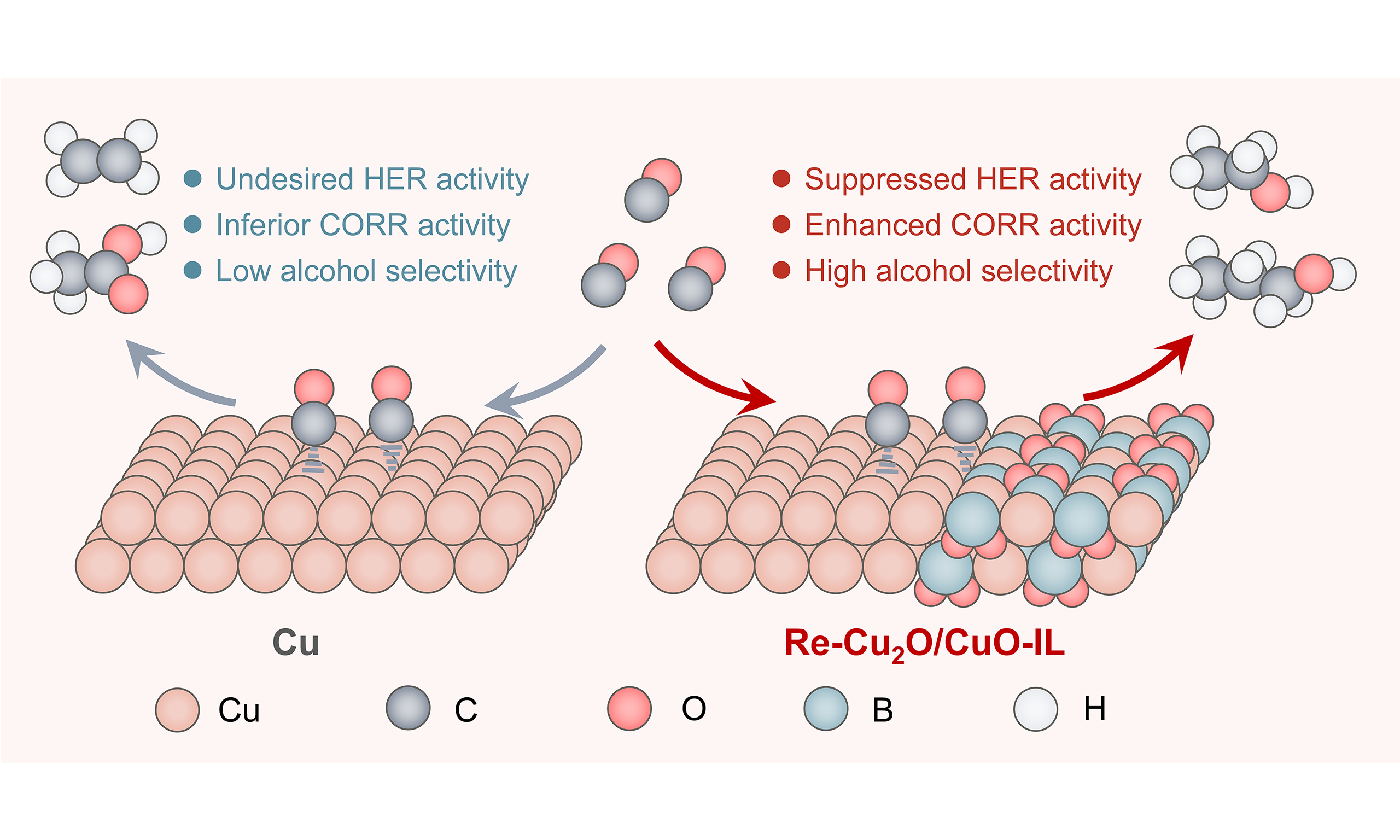
Electrocatalytic reduction of CO2/CO to multicarbon (C2+) alcohols on copper-based catalysts often suffers from low selectivity, primarily arising from the rapid degradation of highly active Cu+ sites and insufficient surface coverage of key reaction intermediates. Herein, we report a flower-like Cu2O/CuO electrocatalyst modified with a multifunctional ionic liquid (IL), 1-octyl-3-methylimidazolium tetrafluoroborate ([Omim][BF4]), to overcome these challenges. The [Omim]+ cation of [Omim][BF4] directs the formation of a hierarchical structure during the catalyst synthesis. Furthermore, the [BF4]- anion serves as a boron source to promote the in situ generation of CuBO2 under electrocatalytic reduction conditions, thereby effectively stabilizing the Cu+ active species. Consequently, electrochemical evaluations reveal that Cu2O/CuO-IL exhibits an encouraging Faradaic efficiency of 52.7% for C2+ alcohols (FEethanol: 25.6%, and FEn-propanol: 27.1%) at -0.77 V vs. reversible hydrogen electrode (RHE). In situ Raman spectroscopy further corroborates the sustained Cu+ retention and enhanced surface coverage of the pivotal *CO intermediate during the CO reduction reaction (CORR). This work demonstrates that a rational IL-directed surface engineering effectively stabilizes reactive Cu+ species and advances the selective electrosynthesis of C2+ alcohols.
Keywords
INTRODUCTION
Rising anthropogenic CO2 emissions demand sustainable carbon conversion technologies[1]. While electrochemical CO2 reduction reaction (CO2RR) on copper (Cu)-based catalysts provides a promising pathway for synthesizing valuable multi-carbon (C2+) products, its selectivity is hindered by unstable oxygenated intermediates and parasitic carbonate formation[2]. Alternatively, electrochemical CO reduction reaction (CORR) avoids CO2 loss and suppresses C1 products, yet directing high selectivity toward C2+ alcohols remains challenging[3]. Morphology engineering and surface modification have been explored to enhance product selectivity, with confined structures shown to increase *CO coverage and promote C–C coupling[4,5]. Moreover, Cu+ species facilitate *CO dimerization but are intrinsically unstable and readily reduced to Cu0 under reaction conditions[6]. Consequently, recent efforts, including heteroatom incorporation (e.g., iodine or boron) and functional molecular modification, have demonstrated that stabilizing Cu+ species and tuning the local electronic structure are imperative for improving the selectivity toward C2+ alcohols[7,8].
Building on these insights, we report an ionic liquid (IL)-assisted strategy for the rational design of a flower-like Cu2O/CuO-IL catalyst with enhanced selectivity toward C2+ alcohols. The imidazolium-based 1-octyl-3-methylimidazolium tetrafluoroborate ([Omim][BF4]) exhibits dual functionality. Specifically, the [Omim]+ cation directs the formation of hierarchical flower-like microspheres assembled by interconnected nanosheets, while the [BF4]- anion acts as a boron source to generate CuBO2 in situ during electroreduction. This bifunctional role effectively stabilizes the active Cu+ species and enhances *CO coverage, thereby accelerating C–C coupling. Thus, the Cu2O/CuO-IL catalyst achieves an impressive Faradaic efficiency of 52.7% for C2+ alcohols (FEC2+ alcohols) at -0.77 V vs. reversible hydrogen electrode (RHE) (FEethanol: 25.6%, and FEn-propanol: 27.1%). This work provides a versatile approach to regulate catalyst reconstruction and preserve active sites by employing IL as structure-directing agent and a heteroatom source.
RESULTS AND DISCUSSION
A series of Cu-based catalysts were synthesized via a one-pot solvothermal method with varying [Omim][BF4] concentration [Supplementary Figures 1 and 2]. Morphological characterization revealed an IL-concentration-dependent evolution from irregular pristine Cu nanoparticles to flower-like architectures composed of interconnected nanosheets at optimal IL loading [Figure 1A and B, Supplementary Figure 3]. This structural transformation was directed by the surfactant-like [Omim]+ cation, which acted as soft template to construct hierarchical structures, thereby maximizing the active surface area and facilitating mass transport. The high-resolution transmission electron microscope (HRTEM) image of Cu2O/CuO-IL clearly shows the Cu2O(111) and CuO(002) facets [Figure 1C]. Powder X-ray diffraction (PXRD) analysis revealed that modulating the [Omim][BF4] content (0-2.0 mol) drove a phase evolution from metallic Cu to Cu2O, Cu2O/CuO, and CuO, while simultaneously diminishing the overall crystallinity [Figure 1D]. Fourier transform infrared (FT-IR) spectra of the [Omim][BF4]-modified catalysts exhibited characteristic C–H and B–F vibrations, indicating the successful IL incorporation [Figure 1E]. Thermal gravimetric analysis (TGA) curves quantified the grafting amounts of IL [Figure 1F and Supplementary Table 1]. X-ray photoelectron spectroscopy (XPS) revealed the coexisting Cu+ and Cu2+ species in Cu2O/CuO-IL [Figure 1G], consistent with the lattice fringes observed in the HRTEM image. Conversely, the bare Cu catalyst only possessed a metallic Cu0 phase [Supplementary Figure 4]. Moreover, the presence of the imidazolium ring and B in [Omim][BF4] was further supported by N 1s and B 1s spectra, respectively [Figure 1H and I]. Elemental mapping images demonstrated the homogeneous distribution of [Omim][BF4] throughout the catalyst, indicating the uniform IL dispersion on Cu2O/CuO-IL [Supplementary Figure 5]. These results collectively confirm the successful integration of [Omim][BF4], which simultaneously modulates the surface microenvironment and electronic structure of the Cu-based catalysts.
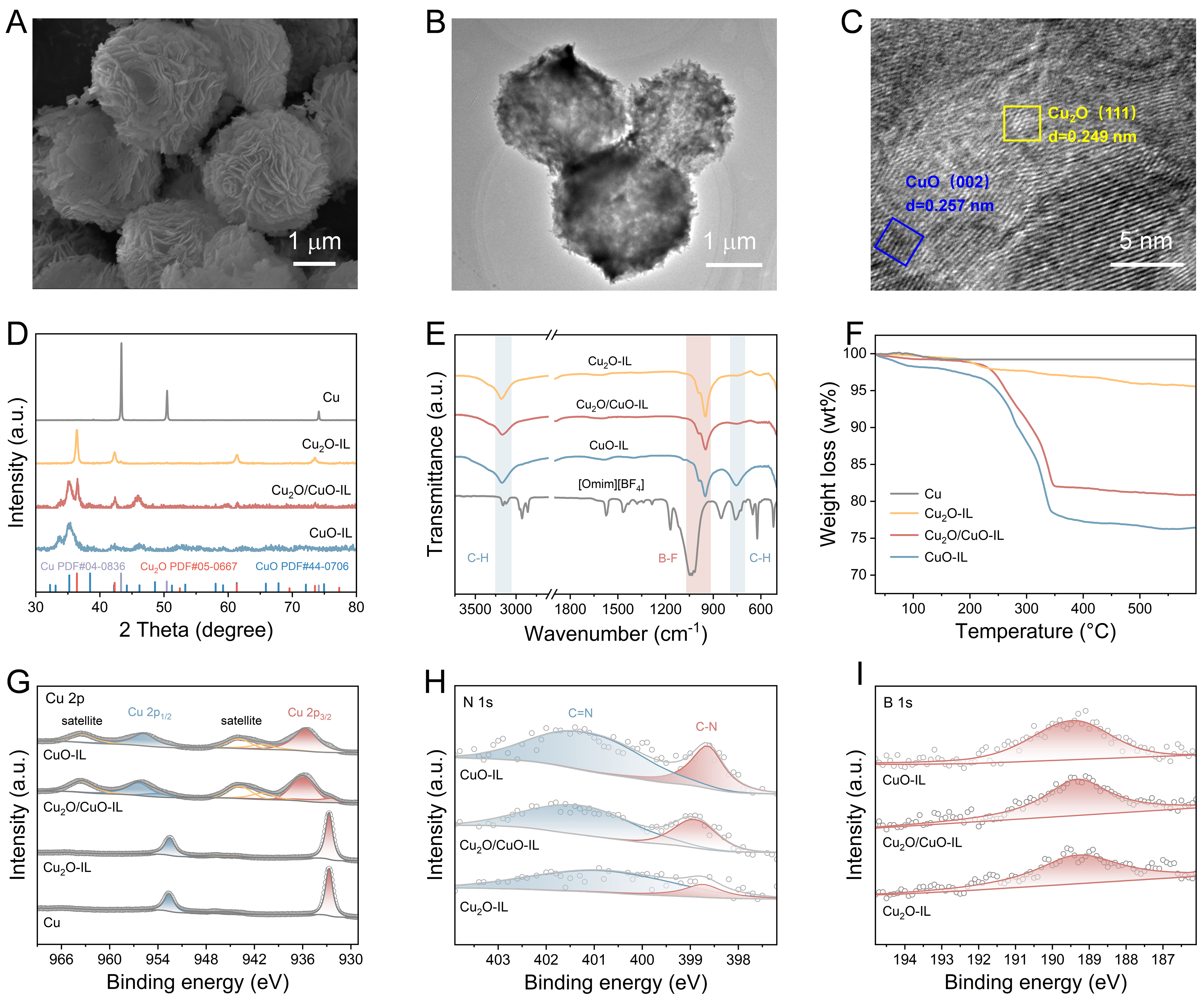
Figure 1. Structural characterization of IL-modified Cu-based catalyst. (A) SEM, (B) TEM, and (C) HRTEM images of Cu2O/CuO-IL catalyst; (D) PXRD patterns of Cu-based catalysts with and without [Omim][BF4] modification; (E) FT-IR spectra of [Omim][BF4] and [Omim][BF4]-modified Cu-based catalysts; (F) TGA curves; (G) Cu 2p, (H) N 1s, and (I) B 1s XPS spectra of Cu-based catalysts with and without [Omim][BF4] modification. IL: Ionic liquid; SEM: scanning electron microscope; TEM: transmission electron microscope; HRTEM: high-resolution transmission electron microscope; PXRD: powder X-ray diffraction; [Omim][BF4]: 1-octyl-3-methylimidazolium tetrafluoroborate; FT-IR: Fourier transform infrared; TGA: thermal gravimetric analysis; XPS: X-ray photoelectron spectroscopy.
The CORR performance of both pristine and IL-modified Cu-based catalysts was then systematically evaluated in a flow cell to determine the influence of the [Omim][BF4] modifier [Supplementary Figure 6]. Compared with pristine Cu, [Omim][BF4]-modified catalysts exhibited significantly enhanced current density and selectivity toward C2+ alcohols [Figure 2A-C]. Notably, the Cu2O/CuO-IL catalyst achieved a maximum FEC2+ alcohol of 52.7% at -0.77 V vs. RHE (FEethanol: 25.6% and FEn-propanol: 27.1%), with a partial current density of ~52 mA·cm-2 [Figure 2B and C, Supplementary Figure 7]. In contrast, the pristine Cu showed negligible n-propanol production under identical conditions. The enhanced CORR performance was further verified by comprehensive electrochemical measurements. [Omim][BF4]-modified catalysts exhibited more positive onset potentials, lower charge-transfer resistance, and larger electrochemically active surface areas than pristine Cu, collectively reflecting improved intrinsic activity and greater accessibility of active sites [Figure 2D and E, Supplementary Figure 8]. Evaluation of the stability of Cu2O/CuO-IL revealed that the FEC2+ alcohols remained above 30% over 10 h of continuous operation [Figure 2F]. These results clearly demonstrate that the introduction of [Omim][BF4] on Cu-based catalysts enables efficient C2+ alcohol production.
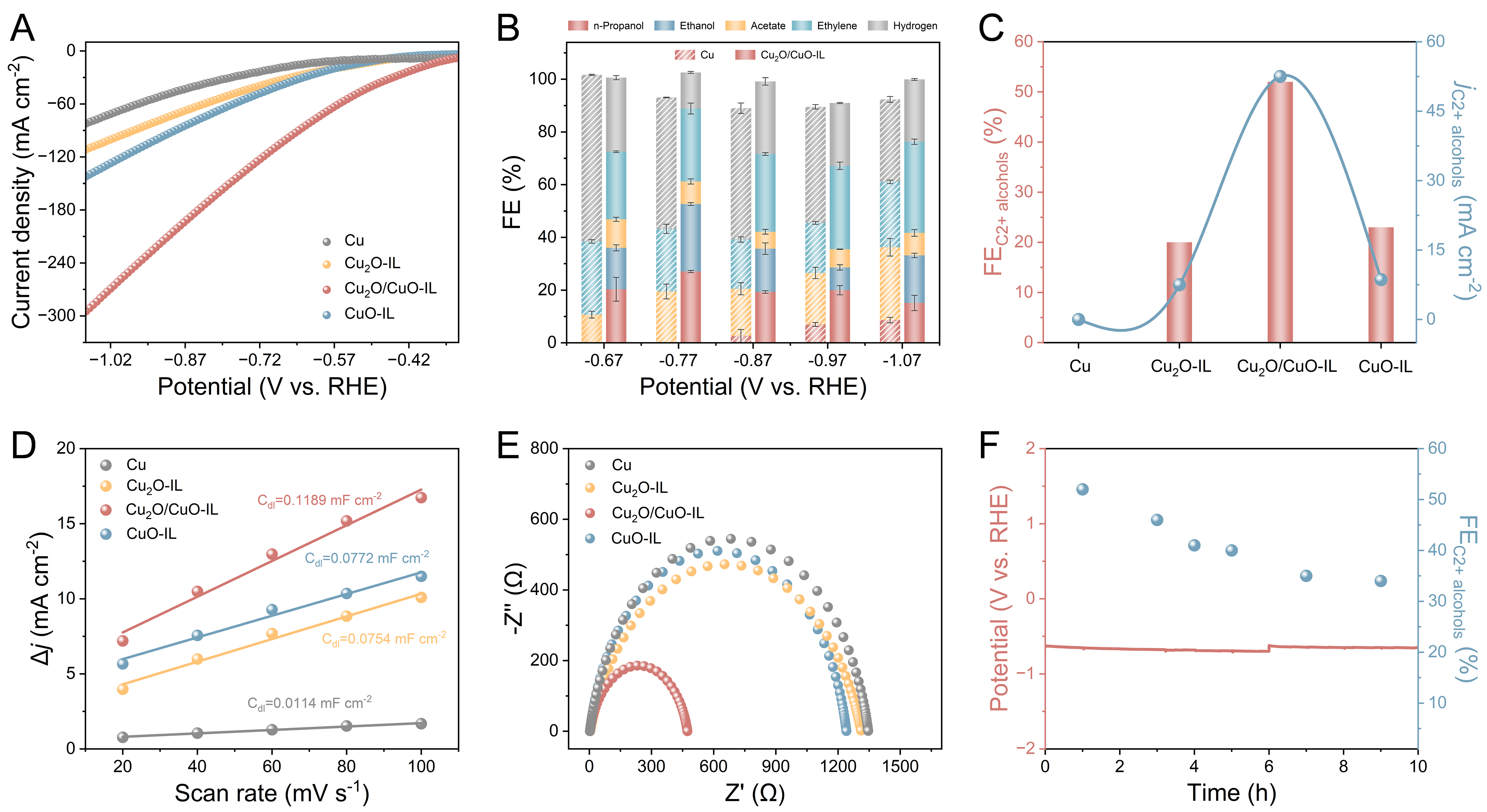
Figure 2. CO electroreduction performance. (A) Linear sweep voltammetry curves; (B) FEs of all CORR products at different potentials over pure Cu and Cu2O/CuO-IL catalysts [Error bars represent SD from three independent replicates (n = 3 per group; rectangle filled with lines: Cu catalyst; solid-filled rectangle: Cu2O/CuO-IL catalyst)]; (C) FEsC2+ alcohols and partial current densities for C2+ alcohols; (D) Cdl plots; (E) Nyquist plots of Cu-based catalysts with and without IL modification; (F) Stability for CORR over the Cu2O/CuO-IL catalyst. FEs: Faradaic efficiencies; CORR: CO reduction reaction; IL: ionic liquid; SD: standard deviation; RHE: reversible hydrogen electrode.
Structural characterization was further performed on the post-reaction catalysts to elucidate the reasons driving the product distributions. PXRD pattern, XPS spectrum, and HRTEM image revealed that
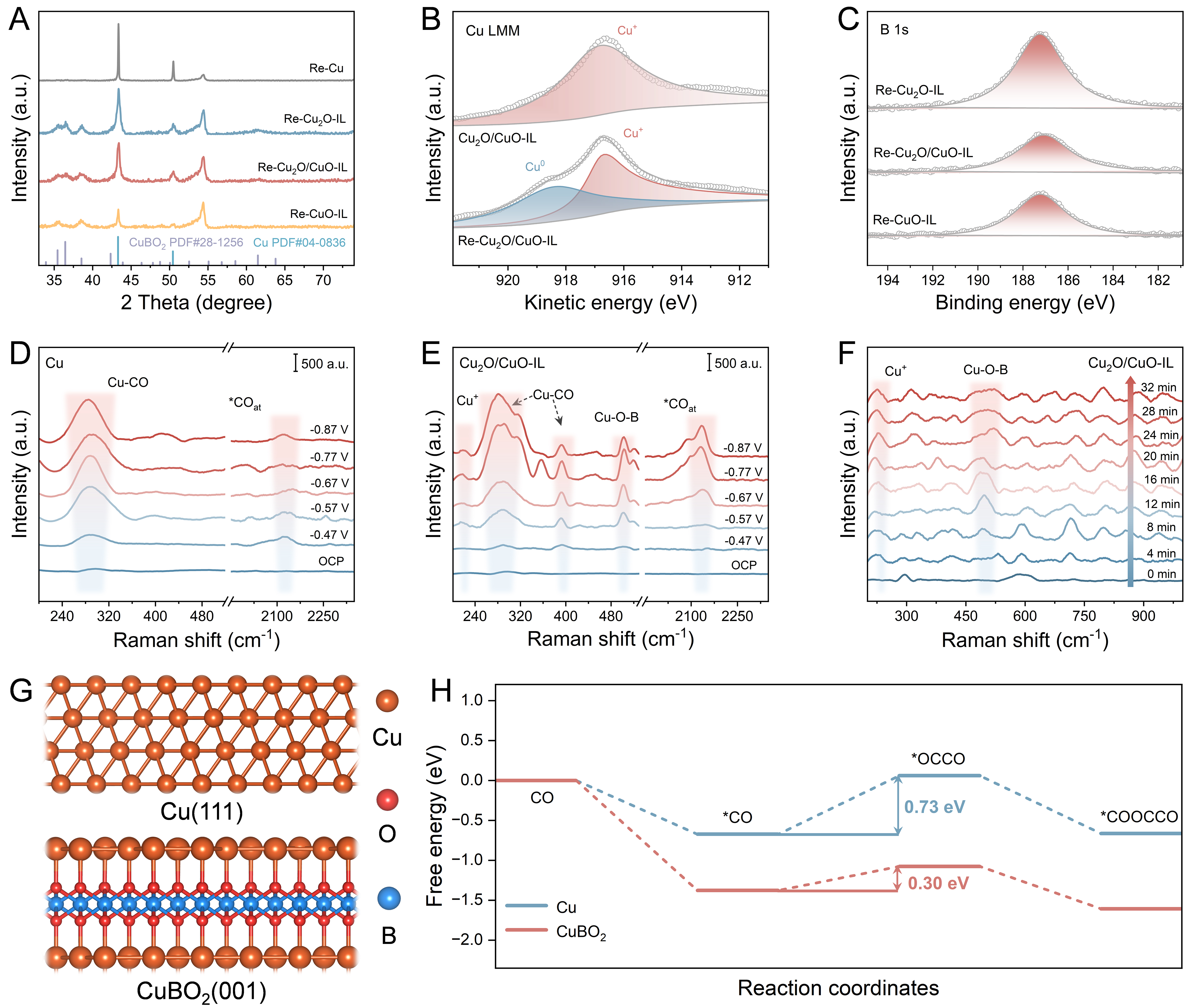
Figure 3. Investigation of reaction mechanism. (A) PXRD patterns of Cu-based catalysts with and without IL modification after CORR; (B) Comparison of Cu LMM spectra of Cu2O/CuO-IL before and after CORR; (C) Comparison of B 1s spectra of IL-modified Cu-based catalysts after CORR; In situ Raman spectra of (D) Cu and (E) Cu2O/CuO-IL during CORR at various potentials; (F) Time-resolved in situ Raman spectra of Cu2O/CuO-IL during CORR; (G) Optimized models of Cu(111) and CuBO2(001); (H) Reaction free energies for the formation of C2+ alcohols on Cu and CuBO2. PXRD: Powder X-ray diffraction; IL: ionic liquid; CORR: CO reduction reaction; LMM: one type of Auger electron peak; OCP: open circuit potential.
To clarify the enhanced C2+ alcohol selectivity on [Omim][BF4]-modified Cu catalyst, in situ Raman spectroscopy was employed to detect the active species on the catalyst surface during CORR. Both Cu and Cu2O/CuO-IL exhibited characteristic bands at ~293 and 2,120 cm-1, assigned to the Cu–CO and C≡O stretching vibrations of atop-bound *CO intermediate (*COatop)[9,10], respectively [Figure 3D and E]. The substantially higher peak intensities for Cu2O/CuO-IL than the bare Cu indicate an elevated *CO surface coverage, driven by the intermediate confinement effect of the imidazolium alkyl chains. Furthermore, time-resolved Raman spectra of Cu2O/CuO-IL presented progressively intensified peaks at 220 and 499 cm-1, corresponding to active Cu+ species and Cu–O–B bonds[11,12], respectively [Figure 3F]. These observations demonstrate that B retains oxygen to stabilize Cu+ active sites. Consequently, the synergy of elevated *CO coverage and robust Cu+ stabilization explains the superior C2+ alcohol generation on Cu2O/CuO-IL compared to bare Cu.
Density functional theory (DFT) calculations on CuBO2(001) and Cu(111) models further elucidate the enhanced C2+ alcohol selectivity of IL-derived CuBO2 during CORR [Figure 3G]. *CO adsorption is thermodynamically favored on CuBO2 (-1.38 eV) compared to bare Cu (-0.67 eV). This enhanced affinity originates from electron-deficient B atoms (empty p-orbitals) that suppress lattice oxygen loss and electronically stabilize Cu+ active sites, directly corroborating in situ Raman observations [Figure 3H, Supplementary Figures 11 and 12]. Furthermore, the barrier for the rate-determining *CO dimerization (*OCCO formation) on CuBO2 is merely 0.30 eV, substantially lower than on Cu (0.73 eV). By simultaneously elevating local *CO coverage and kinetically facilitating C–C coupling, the B-modulated Cu+ species seamlessly overcome the C2 formation bottleneck. This drives subsequent hydrogenation to ethanol or *C2–*C1 coupling toward n-propanol, whereas the weak *CO affinity and high coupling barrier on bare Cu severely hinder C2+ alcohol synthesis.
CONCLUSION
In summary, we report a one-pot method to synthesize the flower-like Cu-based nanocatalysts utilizing [Omim][BF4] as a versatile modifier. The Cu2O/CuO-IL catalyst with the optimal IL content achieves a
DECLARATIONS
Authors’ contributions
Supervised the project and revised the manuscript: Peng, L.; Yang, S.; Li, J. (Jun Li)
Performed the experiments, data analysis, and wrote the original manuscript: Li, J. (Jiaran Li); Ding, L.; Qiu, R.; Wan, J.
Conducted the theoretical calculations: Ma, Y.; Tang, X.; Xu, H.
Availability of data and materials
The data supporting the findings of this study are available within this article and its Supplementary Materials. Further data are available from the corresponding authors upon reasonable request.
AI and AI-assisted tools statement
Not applicable.
Financial support and sponsorship
This work was supported by the National Natural Science Foundation of China (No. 22373080; 22078274), the Fujian Provincial Natural Science Foundation of China (No. 2024J08008), the Fundamental Research Funds for the Central Universities (No. 20720240054), and the Nan-qiang Youth Scholar Program of Xiamen University and Xiaomi Young Talents Program/Xiaomi Foundation.
Conflicts of interest
All authors declared that there are no conflicts of interest.
Ethical approval and consent to participate
Not applicable.
Consent for publication
Not applicable.
Copyright
© The Author(s) 2026.
Supplementary Materials
REFERENCES
1. Zheng, L.; Fang, C.; Chen, Z.; et al. Advancing CO2 conversion: integrated use of dual active catalytic sites in flexible, porous polymeric porphyrin and ionic liquid composite networks. Chem. Synth. 2026, 6, 12.
2. Qiu, R.; Li, J.; Du, J.; et al. Promoting acetate production on the in situ reconstructed Cu nanoislands via pressure-regulated CO adsorption and electroreduction. Sci. Bull. 2025, 70, 3794-802.
3. Kim, J. Y. T.; Sellers, C.; Hao, S.; Senftle, T. P.; Wang, H. Different distributions of multi-carbon products in CO2 and CO electroreduction under practical reaction conditions. Nat. Catal. 2023, 6, 1115-24.
4. Liu, J.; You, F.; He, B.; et al. Directing the architecture of surface-clean Cu2O for CO electroreduction. J. Am. Chem. Soc. 2022, 144, 12410-20.
5. Soodi, S.; Zhang, J. J.; Zhang, J.; et al. Selective electroreduction of CO2 to C2+ products on cobalt decorated copper catalysts. Chem. Synth. 2024, 4, 44.
6. Fan, Y.; Yan, Y.; Xia, Z.; et al. Halide-induced Cu+ sites for efficient CO electroreduction to n-propanol. Chem. Catal. 2026, 6, 101688.
7. Shen, Y.; Fang, N.; Liu, X.; et al. Observation of metal-organic interphase in Cu-based electrochemical CO2-to-ethanol conversion. Nat. Commun. 2025, 16, 2073.
8. Zhou, Y.; Che, F.; Liu, M.; et al. Dopant-induced electron localization drives CO2 reduction to C2 hydrocarbons. Nat. Chem. 2018, 10, 974-80.
9. Chen, X.; Chen, J.; Alghoraibi, N. M.; et al. Electrochemical CO2-to-ethylene conversion on polyamine-incorporated Cu electrodes. Nat. Catal. 2021, 4, 20-7.
10. Zhang, R.; Zhang, J.; Wang, S.; et al. Synthesis of n-propanol from CO2 electroreduction on bicontinuous Cu2O/Cu Nanodomains. Angew. Chem. Int. Ed. Engl. 2024, 63, e202405733.
11. Yu, F.; Shu, M.; Zhang, G.; Yu, Q.; Wang, H. Enhancing CO2 electroreduction precision to ethylene and ethanol: the role of additional boron catalytic sites in Cu-based tandem catalysts. Adv. Sci. 2024, 11, e2410118.
Cite This Article
 Open Access
How to Cite
Download Citation
Export Citation File:
Type of Import
Tips on Downloading Citation
Citation Manager File Format
Type of Import
Direct Import: When the Direct Import option is selected (the default state), a dialogue box will give you the option to Save or Open the downloaded citation data. Choosing Open will either launch your citation manager or give you a choice of applications with which to use the metadata. The Save option saves the file locally for later use.
Indirect Import: When the Indirect Import option is selected, the metadata is displayed and may be copied and pasted as needed.
About This Article
Special Topic
Copyright

Data & Comments
Data
0











Comments
Comments must be written in English. Spam, offensive content, impersonation, and private information will not be permitted. If any comment is reported and identified as inappropriate content by OAE staff, the comment will be removed without notice. If you have any queries or need any help, please contact us at [email protected].