


Battery-like semiconductors enable dark photocatalysis
 0
0 Driving sustainable chemical transformations using solar energy remains a central challenge in modern chemistry, particularly in achieving temporal decoupling between energy capture and chemical conversion. Nature provides an elegant solution to this challenge through photosynthesis. In this process, the Calvin cycle produces carbohydrates not through direct illumination but by consuming energy carriers such as nicotinamide adenine dinucleotide phosphate (NADPH) and adenosine 5’-triphosphate (ATP) generated during the light-dependent reactions[1]. Inspired by this concept, writing in Nature Chemistry, Peidong Yang and colleagues at the University of California, Berkeley recently reported a photochargeable semiconductor capable of storing photogenerated electrons and releasing them on demand[2]. This capability allows chemical reactions to proceed even in the absence of continuous light irradiation, enabling highly efficient and scalable dehydrogenative coupling of amines into diamines with concurrent hydrogen evolution.
An artificial system that mimics segregated energy utilization was developed using zinc indium sulfide nanocrystals (ZIS NCs) as a model photochargeable material. These nanocrystals are capable of storing photogenerated charges in long-lived trap states [Figure 1A][2], thereby decoupling light absorption from catalytic turnover. Functioning similarly to solar batteries, they capture electrons generated under illumination and retain them beyond the irradiation period. As a result, reactive carriers are preserved over extended timescales and recombination losses are suppressed, enabling transformations that are difficult to achieve with conventional photocatalysts to be feasible[3]. Notably, diamines are important building blocks for polymers such as polyamides, epoxy resins and polyurethanes. Traditional synthetic methods for diamines often involve harsh conditions, toxic reagents and generate substantial waste, raising environmental concerns[4]. In contrast, photocatalytic dehydrogenative coupling using ZIS provides an efficient route in which two amine molecules are coupled[2,3], releasing hydrogen gas as the sole byproduct where hydrogen serves as a clean energy carrier, offering a more sustainable alternative.
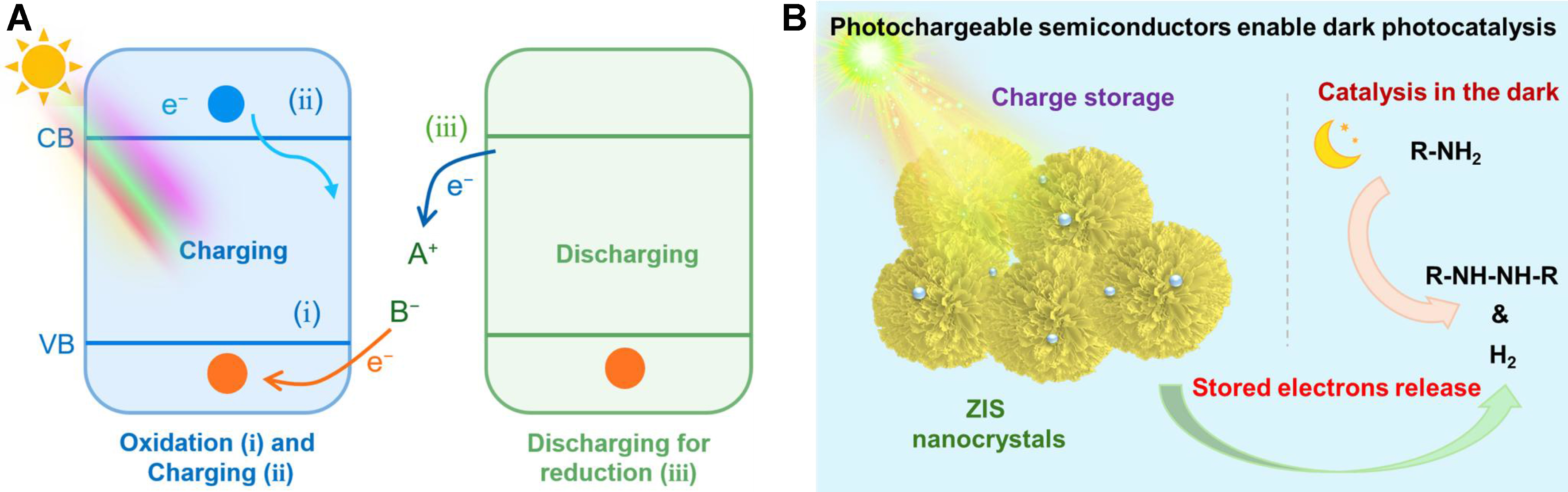
Figure 1. (A) Schematic illustration of photochargeable semiconductors enabling temporally decoupled photocatalysis; (B) Photocatalytic dehydrogenative coupling of amines over ZIS-based photochargeable catalysts. CB: Conduction band; VB: valence band; ZIS: zinc indium sulfide.
Incorporation of nickel as a hydrogen evolution cocatalyst, deposited in situ on the ZIS NCs via photoreduction of Ni2+, enhances catalytic performance. Note that while ZIS NCs serve as photochargeable electron reservoirs, the nickel cocatalyst provides catalytic sites for proton reduction, enabling the stored electrons to be efficiently utilized for hydrogen evolution during the dark phase [Figure 1B]. Diamine production rates exceed 120 mmol·g-1·h-1, with selectivity surpassing 95% and an apparent quantum efficiency (AQE) of 39.4% under ambient conditions. Notably, the production rate substantially surpasses previously reported semiconductor photocatalysts in amine dehydrogenative coupling reactions[2], underscoring the remarkable efficiency enabled by the photochargeable ZIS NCs platform. Interestingly, hydrogen evolution persists for over 15 min after light irradiation is stopped [Figure 1B]. The presence of residual photogenerated electrons in the ZIS nanocrystals was further confirmed by introducing ferricyanide [Fe(CN)6]3- as an electron scavenger after light-off. The system also shows excellent scalability, maintaining high efficiency on the tens-of-gram scales, along with robust recyclability over multiple cycles.
The exceptional photocatalytic performance originates from the unique photocharging behavior of the ZIS NCs. UV-vis spectroscopy reveals that illumination induces electron accumulation, leading to excitonic bleaching associated with conduction band filling, which is reversible upon oxygen exposure[5]. Quantitative analysis suggests that the stored electron density exceeds the conduction band capacity, indicating additional charge storage in deep trap states. Upon illumination, photogenerated holes oxidize surface-bound amines, while electrons are stabilized in sulfur-vacancy-associated trap states. Electron paramagnetic resonance and operando X-ray absorption spectroscopy confirm that these vacancies act as long-lived electron reservoirs, enabling charge persistence on the timescale of tens of minutes.
Such behavior fundamentally alters photocatalytic dynamics. Oxidation and reduction occur sequentially: oxidation takes place at the catalyst surface under illumination, whereas reduction proceeds after the light is turned off as trapped electrons are gradually released. The reaction proceeds via α-amino carbon-centered radical intermediates[6]. Importantly, the highly reducing environment created by trapped electrons suppresses overoxidation to imines by stabilizing radical intermediates, thereby ensuring high selectivity toward diamines. Hydrogen evolution is simultaneously facilitated by the nickel cocatalyst, highlighting efficient charge utilization between the semiconductor and cocatalyst.
Most importantly, the ZIS NCs photochargeable system exhibits broad substrate compatibility. A wide range of aryl amines undergo efficient coupling to yield diamines in high yield and selectivity. Amino acid esters are also readily converted, while secondary and tertiary amines, as well as dehydrogenative polymerization reactions, are also efficiently converted under similar conditions. Such versatility highlights the general applicability of the photochargeable concept in both small-molecule synthesis and polymer construction under mild conditions.
In summary, this work highlights the importance of storing and releasing photogenerated carriers in a controlled manner. Integrating energy storage functionality into photocatalysts bridges solar energy harvesting with chemical synthesis, allowing reactions to proceed independently of continuous illumination. Therefore, photochargeable semiconductors offer a promising strategy to overcome key limitations in conventional photocatalysis and open new avenues for sustainable chemical production.
Looking ahead, such systems provide a versatile platform for solar-driven chemical transformations ranging from organic synthesis to solar fuel production. Nevertheless, several challenges remain, including extending light absorption into the visible region, improving performance for non-aromatic substrates and integrating such systems into continuous-flow or industrial reactors. Despite these limitations, we still remain optimistic that the ability to separate light and chemistry opens new avenues for designing next-generation photocatalytic systems.
DECLARATIONS
Authors’ contributions
Drafted the manuscript: Wang, C.
Revised the manuscript: Varamesh, A.; Ding, Y.; Hu J.
Availability of data and materials
Not applicable.
AI and AI-assisted tools statement
Not applicable.
Financial support and sponsorship
None.
Conflicts of interest
Hu, J. is a Section Editor of the journal Chemical Synthesis. Hu, J. was not involved in any steps of the editorial processing, notably including reviewers’ selection, manuscript handling, or decision-making. The other authors declare that there are no conflicts of interest.
Ethical approval and consent to participate
Not applicable.
Consent for publication
Not applicable
Copyright
© The Author(s) 2026.
REFERENCES
1. Lv, J.; Xie, J.; Mohamed, A. G. A.; et al. Solar utilization beyond photosynthesis. Nat. Rev. Chem. 2023, 7, 91-105.
2. Luo, J.; Chen, X.; Jayasinghe, L.; et al. A photochargeable semiconductor for highly efficient dehydrogenative coupling of amines, Nat Chem 2026;18:1014-22.
3. Zhang, P.; Wang, T.; Chang, X.; Gong, J. Effective charge carrier utilization in photocatalytic conversions, Acc Chem Res 2016;49:911-21.
4. Nakajima, M.; Fava, E.; Loescher, S.; Jiang, Z.; Rueping, M. Photoredox-catalyzed reductive coupling of aldehydes, ketones, and imines with visible light. Angew. Chem. Int. Ed. 2015, 54, 8828-32.
5. Homer, M. K.; Larson, H. C.; Dixon, G. J.; Miura-Stempel, E.; Armstrong, N. R.; Cossairt, B. M. Extremely long-lived charge donor states formed by visible irradiation of quantum dots. ACS. Nano. 2024, 18, 24591-602.
Cite This Article
 Open Access
How to Cite
Download Citation
Export Citation File:
Type of Import
Tips on Downloading Citation
Citation Manager File Format
Type of Import
Direct Import: When the Direct Import option is selected (the default state), a dialogue box will give you the option to Save or Open the downloaded citation data. Choosing Open will either launch your citation manager or give you a choice of applications with which to use the metadata. The Save option saves the file locally for later use.
Indirect Import: When the Indirect Import option is selected, the metadata is displayed and may be copied and pasted as needed.
About This Article
Copyright

Data & Comments
Data
0











Comments
Comments must be written in English. Spam, offensive content, impersonation, and private information will not be permitted. If any comment is reported and identified as inappropriate content by OAE staff, the comment will be removed without notice. If you have any queries or need any help, please contact us at [email protected].