

When stronger binding hinders zeolite-catalyzed alcohol dehydration
 0
0 
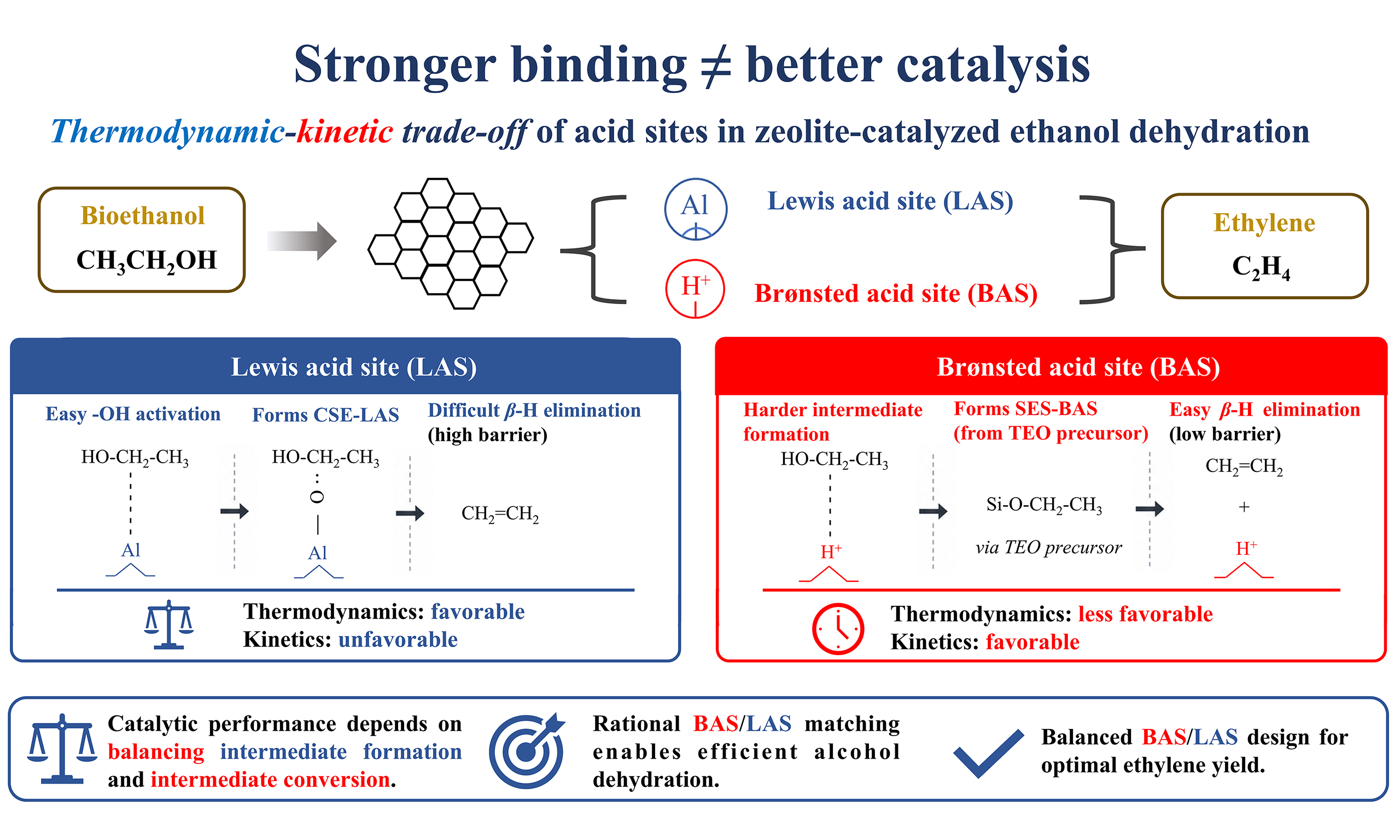
Alcohol dehydration over zeolites is a classic topic in solid acid catalysis, but it has gained fresh relevance as bioethanol is increasingly viewed as a renewable feedstock for light olefins[1]. Among these reactions, ethanol-to-ethylene conversion over ZSM-5 has attracted particular interest because even subtle changes in acid site type and local confinement can strongly affect performance[2]. Still, it has been difficult to clearly separate the roles of Brønsted acid sites (BAS) and Lewis acid sites (LAS) in real catalysts, where multiple sites, short-lived intermediates, and competing pathways exist at the same time. Earlier studies have identified surface ethoxy species as key BAS-bound intermediates in ethanol dehydration[3]. Solid-state nuclear magnetic resonance (NMR) provided another important piece of evidence by directly detecting triethyloxonium ions (TEO) in H-ZSM-5 during the reaction[4]. However, it has remained unclear how BAS and LAS each participate in the individual elementary steps of the same reaction network.
Hu et al. help fill this gap by combining solid-state NMR with density functional theory to track site-specific pathways for ethanol dehydration over ZSM-5[5]. They identify two central intermediates, chemisorbed ethanol on LAS (CSE-LAS) and surface ethoxy species on BAS (SES-BAS), and they further assign TEO as BAS-related precursors. Importantly, this work brings together several previously disconnected observations into a more coherent mechanistic framework [Figure 1A]. BAS and LAS should therefore not be seen simply as stronger and weaker forms of the same type of site. Rather, they perform distinct functions at different stages of the reaction.
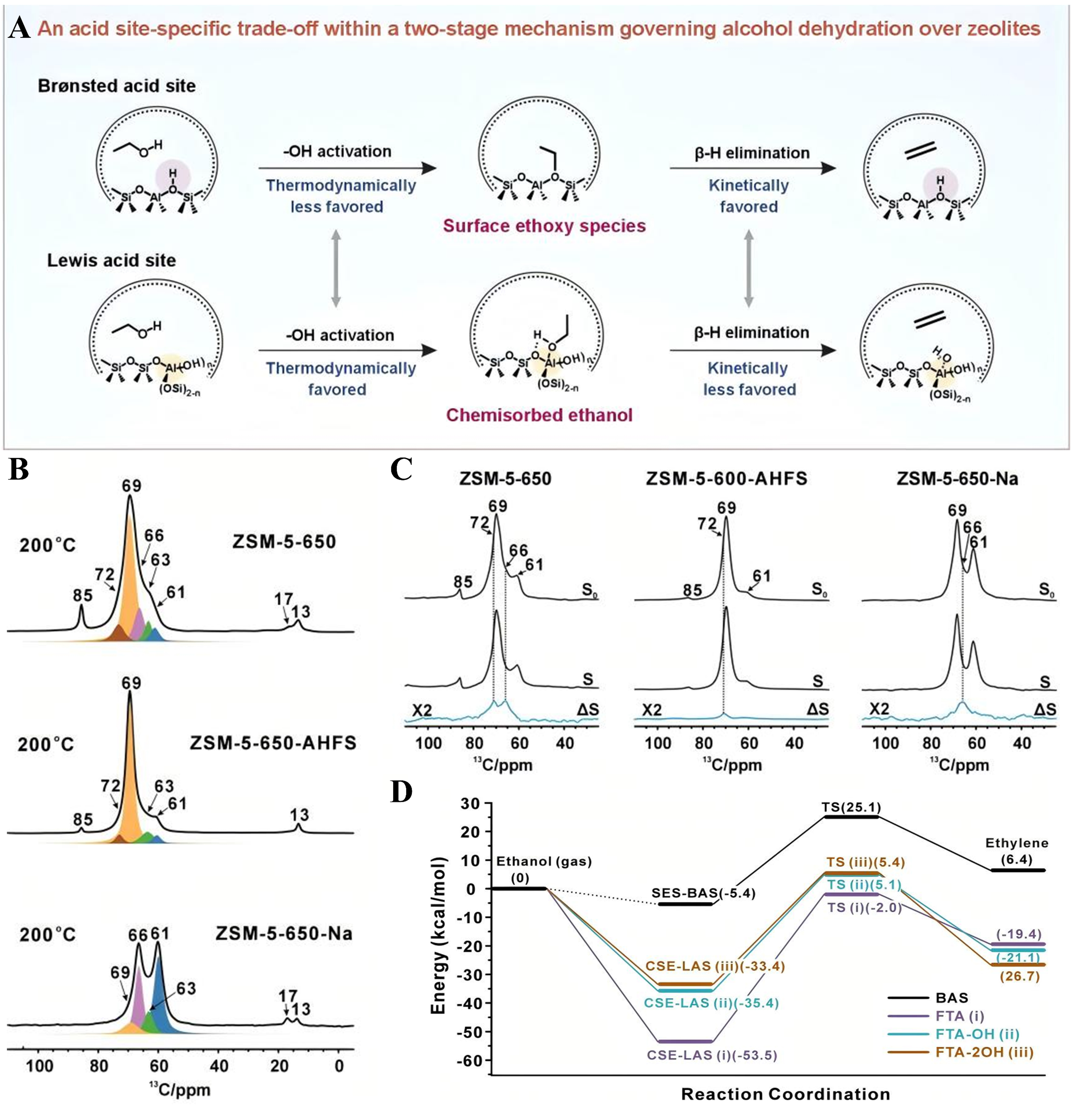
Figure 1. (A) The site-specific division of catalytic labor between BAS and LAS in zeolite-catalyzed alcohol dehydration; (B and C) selected experimental evidence identifying surface species associated with BAS-mediated and LAS-mediated pathways; (D) calculated reaction energy profiles comparing thermodynamic stabilization and kinetic barriers on BAS and LAS. This figure is reproduced with permission from[5], licensed under CC BY-NC-ND 4.0. BAS: Brønsted acid sites; LAS: Lewis acid sites; SES-BAS: surface ethoxy species on Brønsted acid sites; CSE-LAS: chemisorbed ethanol on Lewis acid sites.
The central finding of this study is that stronger binding does not necessarily lead to better catalysis. LAS are more effective in the first step, namely -OH activation, whereas BAS perform better in the later β-H elimination step [Figure 1A]. The spectroscopic results make this distinction quite clear. They separate chemisorbed ethanol on LAS from surface ethoxy species and TEO-related intermediates formed under BAS-rich conditions [Figure 1B and C]. The calculated energy profiles further reinforce this point [Figure 1D]. On LAS, ethanol is activated more easily at low temperature, so intermediate formation is thermodynamically favored. But this advantage creates a new problem that the intermediate is bound too strongly, which makes the following β-H elimination step harder. The authors support this interpretation by showing close agreement between experiment and theory. The BAS-rich sample has an apparent activation energy of 31.7 kcal·mol-1, whereas the LAS-rich sample shows 38.5 kcal·mol-1. These values match well with the density functional theory (DFT) barriers for SES-BAS decomposition and CSE-LAS conversion, respectively. BAS show the opposite pattern. Forming the intermediate is less favorable at first, but once BAS-bound species are generated, ethylene release becomes much easier, consistent with the role long assigned to surface ethoxy species on Brønsted sites[3]. In this way, the study shifts the discussion away from the overly simple question of which acid site is stronger. A more meaningful question is which type of site is better suited to a given elementary step. This insight supports the rational design of zeolite catalysts by matching BAS and LAS to their distinct roles in each reaction step, rather than relying solely on acidity strength.
This trade-off also changes how we should think about the coexistence of BAS and LAS in zeolites. They should not be viewed simply as redundant sites or as functions that merely compete with each other. Instead, the results suggest a genuine division of labor along the reaction pathway. Collectively, the data connect the NMR-assigned intermediates, CSE-LAS, SES-BAS, and TEO, with the barrier sequence resolved experimentally and computationally [Figure 1B-D]. In this sense, coexistence is not duplication, but complementarity. Efficient catalysis clearly depends on keeping both intermediate formation and intermediate conversion in balance, rather than maximizing only one of them. This view is also consistent with in situ solid-state NMR studies showing that ethanol conversion over H-ZSM-5 involves several coexisting surface species, whose roles vary with catalyst state and reaction conditions[6].
The implications for catalyst design are quite direct. High ethylene productivity is unlikely to be achieved simply by increasing the total acid site density or enriching only one type of site [Figure 1D]. A more practical approach is to tune the BAS/LAS ratio, their spatial arrangement, and the accessibility of the surrounding microporous environment, so that adsorption, intermediate stabilization, and product-forming turnover can remain properly matched. This perspective suggests that future zeolite design should move beyond acidity maximization and instead focus on matching each acid site with the elementary step it most effectively promotes. In this respect, the work by Xu and co-workers provides a useful mechanistic guideline that goes beyond ethanol dehydration itself. Furthermore, a complementary perspective is emphasized in a recent review, which shows that external surfaces and pore-mouth regions of zeolites can significantly influence reaction pathways, selectivity, and catalyst stability[7]. Taken together with the present BAS/LAS analysis reported by Hu et al.[5], this broader view suggests that acid-site identity, site location, and accessibility should be considered in concert in zeolite catalyst design. The authors further note that isopropanol dehydration follows a similar site-dependent kinetic pattern[5], which suggests that the same thermodynamic-kinetic trade-off may apply more broadly in zeolite-catalyzed alcohol dehydration. Overall, this study offers a timely reminder for solid-acid catalysis, while the most effective active site is not always the one that activates the reactant most easily, but the one that preserves the right balance among adsorption strength, intermediate stability, and productive turnover.
DECLARATIONS
Authors’ contributions
Made substantial contributions to the conception, writing, and critical revision of the manuscript: Chen, L. H.; Zheng, Z. C.
Availability of data and materials
Not applicable.
AI and AI-assisted tools statement
Not applicable.
Financial support and sponsorship
This work was supported by the National Natural Science Foundation of China (22293022, U25D9007), Natural Science Foundation of Hubei Province (2026AFA012) and Program of Introducing Talents of Discipline to Universities-Plan 111 (Grant No. B20002) from the Ministry of Science and Technology and the Ministry of Education of China.
Conflicts of interest
Both authors declared that there are no conflicts of interest.
Ethical approval and consent to participate
Not applicable.
Consent for publication
Not applicable.
Copyright
© The Author(s) 2026.
REFERENCES
1. Sun, J.; Wang, Y. Recent advances in catalytic conversion of ethanol to chemicals. ACS. Catal. 2014, 4, 1078-90.
2. Ouayloul, L.; Agirrezabal-Telleria, I.; Sebastien, P.; El Doukkali, M. Trend and progress in catalysis for ethylene production from bioethanol using ZSM-5. ACS. Catal. 2024, 14, 17360-97.
3. Kondo, J. N.; Ito, K.; Yoda, E.; Wakabayashi, F.; Domen, K. An ethoxy intermediate in ethanol dehydration on Brønsted acid sites in zeolite. J. Phys. Chem. B. 2005, 109, 10969-72.
4. Zhou, X.; Wang, C.; Chu, Y.; et al. Observation of an oxonium ion intermediate in ethanol dehydration to ethene on zeolite. Nat. Commun. 2019, 10, 1961.
5. Hu, M.; Chu, Y.; Wang, C.; et al. Unveiling the thermodynamic-kinetic trade-off effect on acid sites in zeolite-catalyzed alcohol dehydration. Nat. Commun. 2026, 17, 3675.
6. Zeng, S.; Li, J.; Wang, N.; et al. Investigation of ethanol conversion on H-ZSM-5 zeolite by in situ solid-state NMR. Energy. Fuels. 2021, 35, 12319-28.
Cite This Article
 Open Access
How to Cite
Download Citation
Export Citation File:
Type of Import
Tips on Downloading Citation
Citation Manager File Format
Type of Import
Direct Import: When the Direct Import option is selected (the default state), a dialogue box will give you the option to Save or Open the downloaded citation data. Choosing Open will either launch your citation manager or give you a choice of applications with which to use the metadata. The Save option saves the file locally for later use.
Indirect Import: When the Indirect Import option is selected, the metadata is displayed and may be copied and pasted as needed.
About This Article
Copyright

Data & Comments
Data
0










Comments
Comments must be written in English. Spam, offensive content, impersonation, and private information will not be permitted. If any comment is reported and identified as inappropriate content by OAE staff, the comment will be removed without notice. If you have any queries or need any help, please contact us at [email protected].