


Halogen termination engineering of Mo2CTx MXenes for high-capacitance supercapacitors via electronegativity modulation
 0
0 Abstract
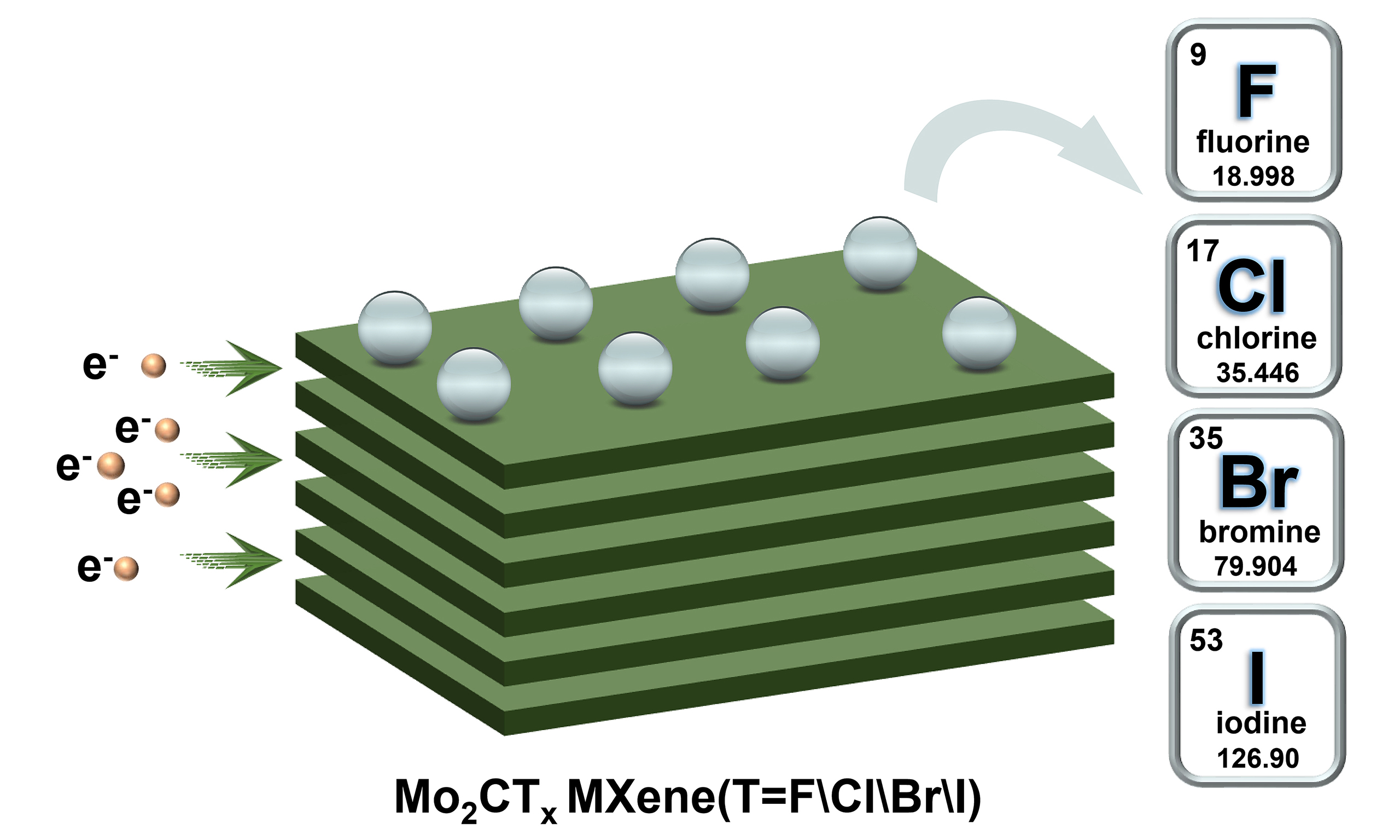
The electrochemical performances of MXenes (transition metal carbides/nitrides) are critically governed by their surface terminations, yet the role of halogen electronegativity in modulating capacitive behavior remains underexplored. Here, we demonstrate through integrated density functional theory calculations and experimental validation that tailored halogen terminations (F, Cl, Br, I) on Mo2CTx MXenes directly regulate their electric double-layer capacitance. Computational analysis reveals that lower electronegativity terminations reduce electrostatic shielding, thinning the double-layer interface and enhancing charge storage, yielding a capacitance hierarchy: Mo2CFx (9.23 μF/cm2) < Mo2CClx (10.10 μF/cm2) < Mo2CBrx (11.30 μF/cm2) < Mo2CIx (12.96 μF/cm2). Experimentally, solvothermal halogen substitution (HCl/HBr/HI) produces termination-specific Mo2CTx with retained crystallinity and controlled surface chemistry. Electrochemical measurements in 1 M H2SO4 confirm that I-terminated Mo2CTx achieves a specific capacitance of 539.3 F/g at 1 A/g, 2.16 times higher than F-terminated counterparts, with exception rate retention (> 30% at 100 mV/s). This performance stems from I-termination’s dual role, enlarging interlayer spacing for enhanced ion accessibility and increasing surface electron density on Mo atoms, as evidenced by differential charge density analysis. These findings provide a rational design strategy for MXene-based supercapacitors through precise surface termination control, bridging atomic-scale insights to macroscopic energy storage applications.
Keywords
INTRODUCTION
Two-dimensional transition metal carbides/nitrides (MXenes) have emerged as promising electrode materials for electric double layer capacitors (EDLCs) due to their layered structures, high specific surface area, high conductivity, tunable surface chemistry and high specific capacitance (> 300 F/g)[1-4]. In the general formula of MXenes (Mn+1XnTx), “M” represents a transition metal, “X” is carbon or nitrogen, and “Tx” denotes surface termination. Their capacitance arises from dual mechanisms: electric double-layer (EDL) charge storage facilitated by accessible interlayer spaces and pseudo-capacitive contributions from redox-active surface terminations (e.g., -O, -OH)[5,6]. Notably, the surface terminations (T) that directly contact the electrolyte have a significant impact on the capacitance of MXene electrodes[7-9]. However, conventional synthesis routes, such as hydrofluoric acid (HF) etching, introduce inert fluorine terminations, which limit capacitance (< 100 F/g) due to suppressed ion accessibility and redox activity. In contrast, fluoride-free methods [e.g., LiF/hydrochloric acid (HCl) or HF/LiCl etching] yield MXenes with Cl terminations and higher capacitances (> 200 F/g)[10,11], highlighting the critical role of surface chemistry in modulating electrochemical performance[12].
Recent advances in MXenes synthesis, including molten salt etching and hydrothermal processing, enable precise control over surface terminations (e.g., -O/-S, -Cl, -Br, -I, -BrI, -ClI, -ClBrI)[8,12-17]. For instance, MXene with -O/-S terminations withstand 10,000 cycles at 10 A/g[15]. Ti3C2Tx MXene with -OH/-O terminations achieves a gravimetric capacitance of 314 F/g via alkali treatment, outperforming HF-etched counterparts by roughly 214%[18], while n-butyllithium-treated Ti3C2Tx MXenes obtain a capacitance of
In this work, we combine density functional theory (DFT) calculations (VASP/JDFTx) with systematic electrochemical characterization to resolve the mechanistic ambiguity surrounding halogen terminations’ impact on capacitance.
EXPERIMENTAL
Materials
HCl (~37 wt%), HF (~40 wt%), hydrobromic acid (HBr, ~40 wt%), hydroiodic acid (HI 48-57 wt%), isopropyl alcohol (≥ 99.7%) and ethanol (99.5%) were obtained from Shanghai Hushi Laboratory Supplies Co., Ltd. Gallium metal (99.999%), Nafion perfluorinated resin solution was purchased from Shanghai Aladdin Biochemical Technology Co., Ltd. Molybdenum carbide (99.5%) was provided by Alfa Aesar (China) Chemical Co., Ltd. These reagents were used as received without further purification. Deionized water (DIW, resistivity > 18 MΩ·cm) was collected from a Milli-Q Biocel system.
Synthesis of Mo2Ga2C
Mo2Ga2C powder was prepared by mixing and sintering commercial Mo2C powder with Ga, following the procedure reported in previous literature.
Synthesis of Mo2CFx
To prepare Mo2CFx MXene, 200 mg of Mo2Ga2C was slowly added to a 50 mL Teflon-lined autoclave. Subsequently, 20 mL of HF was gradually introduced into the autoclave and stirred for 5 min. The mixture was then left at room temperature for 5 days to facilitate the etching reaction. After reaction, the residual powder was washed with DIW and anhydrous ethanol until reaching a neutral pH. The powder was then freeze-dried for 24 h to obtain Mo2CFx.
Synthesis of Mo2CTx (T = Cl, Br, I)
To prepare Mo2CTx MXene, concentrated hydrohalic acid (HX) were used to purify Mo2CFx sample. In a typical procedure, 200 mg Mo2CFx was slowly added to a 50 mL Teflon-lined autoclave. Subsequently, 20 mL of concentrated HX (X = Cl, Br, I) acid was gradually introduced into the autoclave and stirred for 5 min. The mixture was then left at 180 ℃ for 1 day to facilitate the purification. After purification, the residual powder was washed with DIW and anhydrous ethanol until reaching a neutral pH. The powder was then freeze-dried for 24 h to obtain Mo2CTx.
RESULTS AND DISCUSSION
Theoretical calculations
Firstly, the structural models of partial Mo2CTx (T = F, Cl, Br, I) MXenes along the c-axis are presented in Figure 1A, with the yellow regions representing surface termination and the blue regions indicating the solvation areas. The enthalpy of formation for halogen-terminated Mo2CTx MXene was calculated [Figure 1B]. The enthalpies of formation for Mo2CFx, Mo2CClx, Mo2CBrx, and Mo2CIx are -1.57, -0.93, -0.77, and -0.49 eV/atom, respectively. The bonding strength between terminations is F > Cl > Br > I, similar to the bonding strength of Ti3C2Tx MXene surface terminations, suggesting that this order of bonding strength may be universally present in MXenes[8]. Figure 1C-F illustrates the density of states for Mo2CTx, indicating that all four types of Mo2CTx MXene are metallic in nature[23,24]. Mo2CTx MXene displays exceptional electrical conductivity, especially in the case of Mo2CClx, Mo2CBrx, and Mo2CIx. The majority of electrons near the Fermi surface in Mo2CTx MXene are supplied by the Mo d-orbital electrons, followed by surface terminations[23,25]. For Mo2CFx, the Mo and C elements almost do not provide electrons, which might be the reason why the F terminations do not participate in redox reactions and thus display inert behavior[26,27]. However, for other Mo2CTx MXenes, the surface terminations provide electrons near the Fermi surface and thus generate additional redox peaks in the redox process, thereby increasing the capacity of the supercapacitor[17]. Hence, they are potential candidates for supercapacitors. Figure 1G shows the integral specific capacitance in the voltage window of -0.6 to 0.6 V vs. point of zero charge (PZC). The integral capacitances of Mo2C with halogen terminations are 9.23, 10.10, 11.30, and 12.96 μF/cm2, respectively. The order of the integral capacitance size is Mo2CFx < Mo2CClx < Mo2CBrx < Mo2CIx.
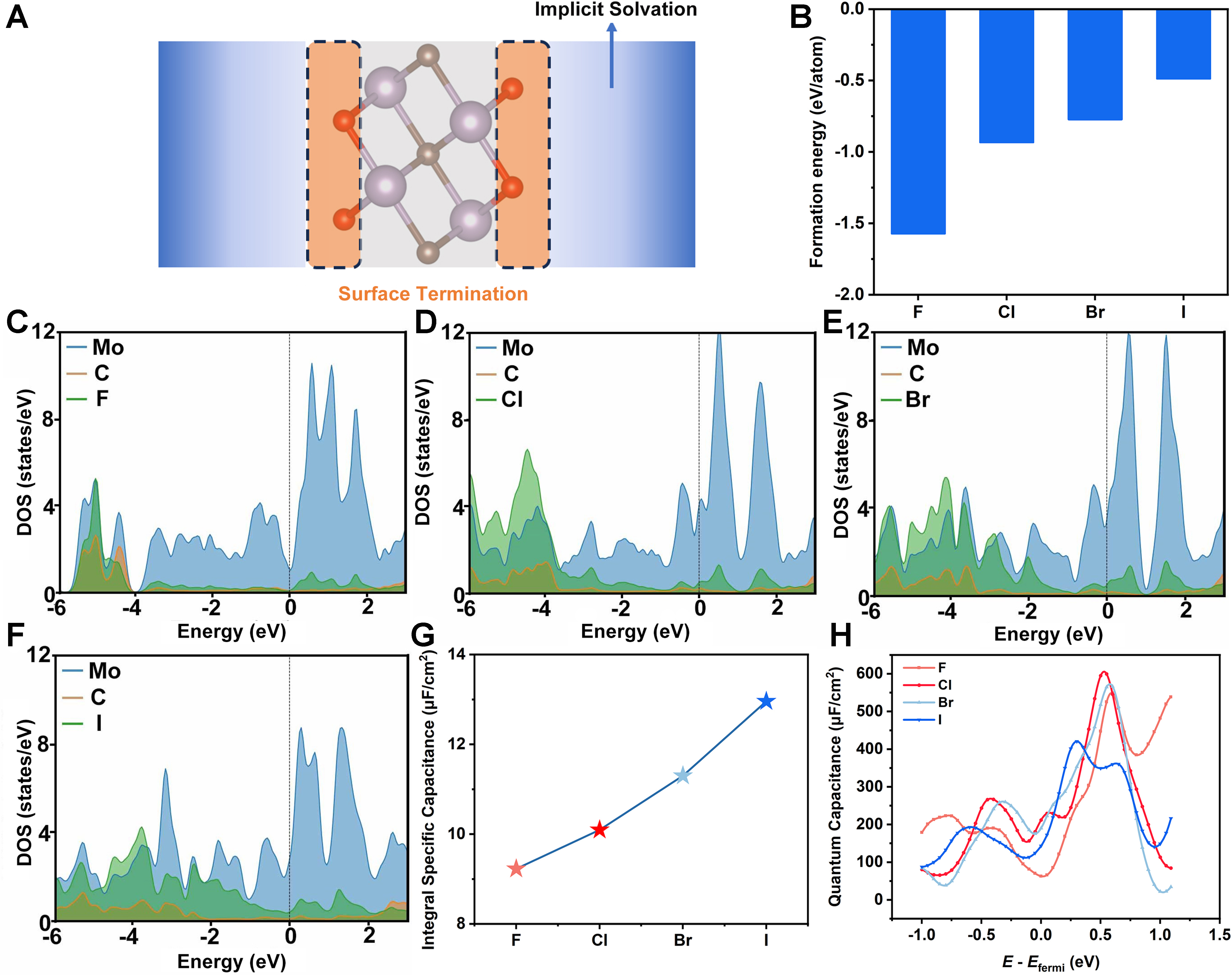
Figure 1. Structure, electronic, and capacitive properties of surface-terminated Mo2CTx (T = F, Cl, Br, I) MXene. (A) Structure model of Mo2CTx. The yellow area represents surface terminations, and the blue area represents the solvation region; (B) The formation energy of Mo2CTx; (C-F) The density of states of Mo2CTx; (G) Integral specific capacitance of Mo2CTx. The salmon, red, light-blue, and dark-blue stars represent Mo2CFx, Mo2CClx, Mo2CBrx, and Mo2CIx, respectively; (H) CQ of Mo2CTx. CQ: Quantum capacitance; DOS: density of states.
Figure 1H shows the quantum capacitance (CQ) of Mo2CTx (T = F, Cl, Br, I) MXene. Since Mo2CFx has the fewest electrons at the Fermi level, its CQ at the Fermi level is also the smallest. The CQ behavior of Mo2CTx MXene is completely different from that of graphene, which exhibits a “V” shape due to the Dirac point[28,29]. The CQ of monolayer graphene is about 20 μF/cm2 at 0.6 eV, while the minimum CQ of Mo2CTx is 200 μF/cm2, far greater than that of graphene[28]. The quantum charge curves in Figure 2A show that the quantum charging capacity of Mo2CIx is the smallest, indicating that the regulation of terminations can indeed effectively control the CQ behavior of MXene.
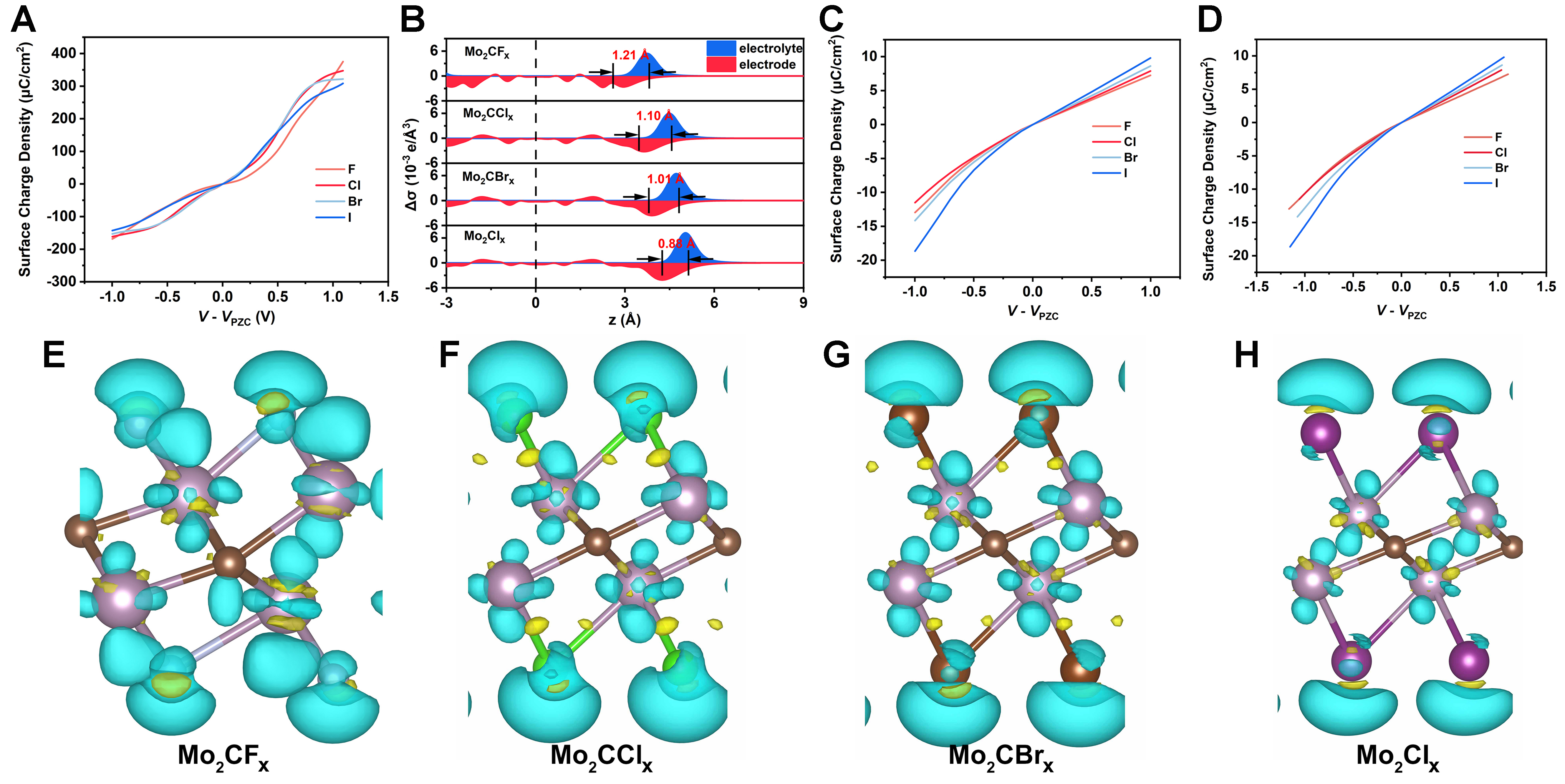
Figure 2. Charge distribution and electrical double layer characteristics of surface-terminated Mo2CTx (T = F, Cl, Br, I) MXenes. (A) Quantum charge curves corresponding to Mo2CTx; (B) Net charge distribution of electrode and electrolyte along the z direction, where the position of C layer is at z = 0 Å. The electrode applied potential is 1 V vs. PZC; (C) EDL charge curves corresponding to Mo2CTx; (D) Total charge curves corresponding to Mo2CTx; (E-H) Iso-surface (0.0005 e/Å3) of differential electron densities between charged (1 V vs. PZC) and uncharged Mo2CTx. PZC: point of zero charge; EDL: electric double-layer.
To reveal the impact of terminations changes on EDL capacitance, the electronic structure of the EDL at the electrode/electrolyte interface was calculated. Figure 2B shows the net charge distribution of the electrode and the electrolyte along the z-direction at an applied potential of 1 V vs. PZC. Notably, most of the net charge exists at the electrode/electrolyte interface. As halogens belong to the same group, the distribution shape of the excess charge in both the electrode and the electrolyte is almost the same, indicating that the charge distribution shape is independent of the surface terminations. As the atomic radius increases, the positive center of the electrode and the negative center of the electrolyte gradually deviate from the surface. The thickness of the double layer can be obtained by calculating the difference between the two centers. Figure 2B shows that as the electronegativity decreases, the thickness of the double layer decreases. According to the definition of a parallel plate capacitor, capacitance is inversely proportional to thickness, so its capacitance increases, consistent with the EDL charge curves corresponding to Mo2CTx (T = F, Cl, Br, I) MXene calculated in Figure 2C. In order to better study the charge distribution on the electrode surface, differential electron densities between charged (1 V vs. PZC) and uncharged Mo2CTx MXene were calculated. Interestingly, most of the charge is distributed on the surface of terminations that directly contact the electrolyte, implying the termination’s significant impact on the capacitance of MXene electrodes.
The total capacitance CTot can be obtained by connecting the CQ and the double-layer capacitance in series. Since CEDL is much smaller than CQ, the total capacitance is mainly determined by CEDL. This is similar to metal electrodes[30]. From Figure 2D, it is found that whether at positive voltage or negative voltage, the total charge curve of Mo2CFx is the smallest, and Mo2CIx is the largest. The derivative of Figure 2D gives the differential capacitance of Mo2CTx MXene. Supplementary Figure 1 shows that when a positive voltage is applied, the differential capacitance of Mo2CTx is almost a constant, about 6-9.5 μF/cm2. However, in the negative voltage region, the differential capacitance of Mo2CIx can be as high as 22 μF/cm2. The differential capacitance of graphene is roughly 3-5 μF/cm2[28]. To probe charge redistribution at the electrode-electrolyte interface, differential electron density iso-surfaces (isovalue = 0.0005 e/Å3) were calculated for charged (1 V vs. PZC) vs. uncharged Mo2CTx MXenes, shown in Figure 2E-H. Figure 2E (Mo2CFx) displays charge mainly on F terminations, indicating strong shielding from high electronegativity, restricting Mo electron delocalization. Figure 2F (Mo2CClx) shows broader density on Cl, with reduced shielding. Figure 2G (Mo2CBrx) reveals increased localization on Br and Mo layers, boosting surface electrons. Figure 2H (Mo2CIx) exhibits the strongest accumulation on I and Mo, due to low electronegativity, thinning the EDL for better ion access. Overall, decreasing electronegativity from F to I enhances charge redistribution, matching the capacitance order and emphasizing terminations’ role in MXene performance.
Based on the theoretical results, the capacitance behavior of Mo2CTx MXene can be effectively controlled through the regulation of terminations. Given that all Mo2CTx MXenes are metallic, their capacitance is primarily contributed by double-layer capacitance. When Mo2C is modified by functional groups with smaller electronegativity, its total capacitance increases, primarily due to the weakening of electrostatic shielding, leading to a reduction in the double-layer thickness. Therefore, the capacitance order is Mo2CFx < Mo2CClx < Mo2CBrx < Mo2CIx. This lays a foundation for understanding the electrochemical behavior of surface terminations of Mo2CTx MXene in capacitance.
Experimental verification
In order to further prove the theoretical claims, Mo2CFx samples prepared by HF etching were further purified using HCl, HBr, and HI through a solvothermal method to obtain samples with specific surface terminations. These four samples were named Mo2CFx, Mo2CClx, Mo2CBrx and Mo2CIx. Furthermore, the specific preparation strategy is described in the Methods section. As shown in Figure 3A, after the exfoliation of Ga atomic layers, Mo2CTx (T = F, Cl, Br, I) exhibited similar X-ray diffraction (XRD) results. Compared to the Mo2Ga2C precursor, the (002) peak located at around 10° shifted to a lower angle. Besides, the intensities of the remaining diffraction peaks decreased significantly, indicating the successful preparation of MXene. Specifically, the XRD patterns show (002) peak positions at 8.52° for Mo2CFx, 8.76° for Mo2CClx, 8.50° for Mo2CBrx, and 8.46° for Mo2CIx. This overall trend confirms progressive enlargement with decreasing halogen electronegativity and increasing atomic size from F to I, facilitating improved ion accessibility. The exception for Mo2CClx (smaller d-spacing than Mo2CFx) can be attributed to incomplete drying of the Mo2CFx sample, leading to retained interlayer water that increases its spacing, while the post-processing for Mo2CClx removes such water more effectively, resulting in a more compact structure. Scanning electron microscope (SEM) results reveal the typical layer structure after removed Ga layers [Supplementary Figure 2]. What is more, F, Cl, Br, I terminations are observed clearly via energy-dispersive X-ray spectroscopy (EDS) results [Supplementary Figure 3]. As depicted in Figure 3B, since Mo2CClx, Mo2CBrx, and Mo2CIx were prepared by solvothermal purification based on Mo2CFx, the area ratios of the oxidation peaks Mo5+ and Mo6+ increased significantly compared to Mo2CFx, implying more pronounced surface oxidation. This can be attributed to the oxidizing properties of HCl, HBr, and HI, which promoted the oxidation process on the surface of Mo2CFx. During the solvothermal treatment, these acid molecules acted as oxidants, oxidizing Mo atoms to higher valence states of Mo6+ and Mo5+, leading to an increase in the area ratio of these two valence states. In the solvothermal process, the F terminations on the surface of Mo2CFx were replaced by -Cl, -Br, or -I. As the electronegativity decreases in the order of Cl, Br, and I, the degree of electron cloud density shifting towards the Mo atoms in the covalent bonds formed with Mo increases accordingly. Consequently, the electron cloud density around the Mo atoms increases, shielding the effective positive charge experienced by the inner electrons and reducing the bond energy of Mo-C. In the X-ray photoelectron spectroscopy (XPS) survey spectrum [Figure 3C], the F terminations on the surface of the Mo2CFx sample were replaced by -Cl, -Br, and -I from the HCl, HBr, and HI solutions, respectively. This can be attributed to the solvothermal conditions providing sufficient energy and reaction environment to promote the nucleophilic attack of Cl-, Br-, and I- on the Mo–F bonds, forming the corresponding termination. Intriguingly, the C 1s spectra and termination-specific spectra across the four samples collectively corroborate these conclusions [Supplementary Figures 4 and 5]. While the solvothermal halogen substitution process is designed to replace F with Cl, Br, or I, the subsequent washing with DIW and ethanol may introduce minor oxygen terminations (-O or -OH), as is typical in MXene post-processing. Any trace oxygen presence could marginally enhance pseudo-capacitive contributions (as discussed for -O/-OH in the Introduction), potentially slightly elevating measured capacitances beyond pure EDL effects. Nevertheless, the experimental capacitance hierarchy (Mo2CFx < Mo2CClx < Mo2CBrx < Mo2CIx) aligns closely with DFT predictions for idealized pure-halogen models, indicating limited influence from oxygen on the overall trends.
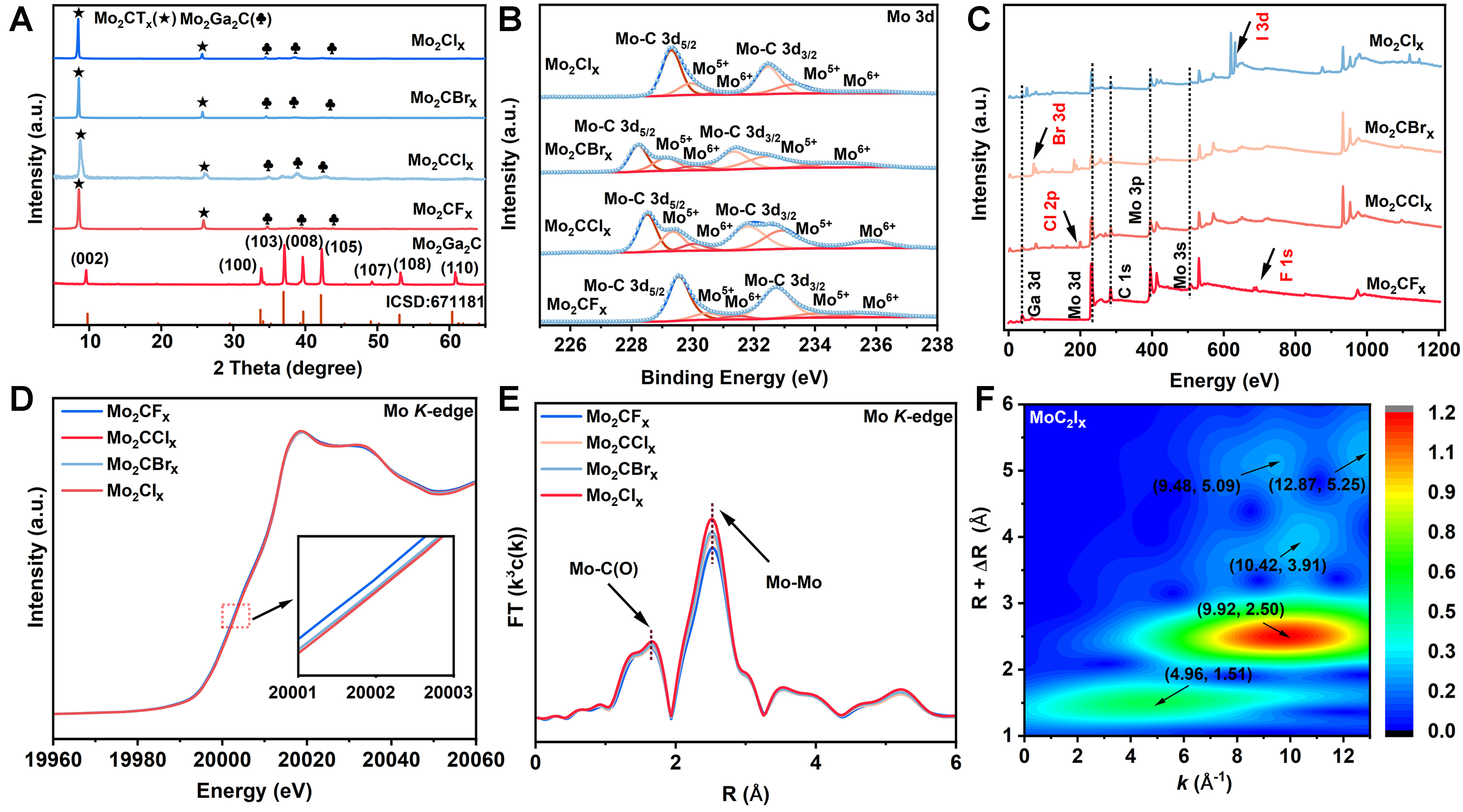
Figure 3. Spectroscopic analysis of the structure of surface-terminated Mo2CTx (T = F, Cl, Br, I) MXene. (A) XRD patterns; (B) XPS spectrum of Mo 3d; (C) XPS full spectrum; (D) Normalized XANES spectra of Mo K-edge; (E) FT-EXAFS of Mo K-edge; (F) WT of Mo2CIx. XRD: X-ray diffraction; XPS: X-ray photoelectron spectroscopy; XANES: X-ray absorption near-edge structure; FT-EXAFS: Fourier-transformed extended X-ray absorption fine structure; WT: wavelet transform.
Furthermore, compared to Mo2CFx, the Mo absorption edges of Mo2CClx, Mo2CBrx, and Mo2CIx shifted significantly towards higher energies, which is consistent with the XPS results, indicating an increase in the valence state of Mo [Figure 3D]. The results of the Mo K-edge extended X-ray absorption fine structure (EXAFS) [Figure 3E] showed that the coordination numbers of Mo–Mo and Mo–C at 2.5 and 1.5 Å followed the order of Mo2CIx > Mo2CBrx > Mo2CClx > Mo2CFx (without fitting). It is evident that due to the electronegativity order of -F > -Cl > -Br > -I, stronger electronegativity leads to stronger covalency and shorter bond lengths, resulting in increased distances between adjacent Mo atoms and weakened interactions between Mo atoms and Mo as well as C. Consequently, the coordination number of Mo decreases with increasing electronegativity of the termination. In the wavelet transform (WT) results [Figure 3F and Supplementary Figure 6], two maxima were observed at around 9.9 and 4.9 Å, corresponding to the chemical bonding environments of Mo–Mo and Mo–C, respectively. In summary, through systematic characterization analysis, it was confirmed that the solvothermal method can effectively control the surface terminations composition of Mo2CTx MXene. More importantly, the electronegativity of different terminations significantly affects the structural and electronic properties of the material, such as Mo valence state, Mo–C bond energy, and the coordination environments of Mo–Mo and Mo–C. These results provide important experimental evidence for understanding the structure-property relationship of MXene materials.
To further explore the influence of different surface terminations on the electrochemical performance of MXene materials, Mo2CTx (T = F, Cl, Br, I) was used as thin-film electrodes for supercapacitors. The experiments were conducted in 1 M H2SO4 electrolytes. As shown in Figure 4A-D, no obvious redox peaks appeared for the four samples at different scan rates, indicating that the electrochemical behavior of the samples was mainly non-Faradaic capacitance. The quasi-rectangular CV shape indicates fast pseudo-capacitive kinetics, where diffusion-controlled intercalation dominates without discrete peaks, as is typical in MXenes[13,20]. The cyclic voltammetry (CV) curves of the four samples at different scan rates exhibited similar shapes, suggesting that the capacitance behavior had a weak dependence on the scan rate, implying good rate performance, electrochemical stability, and fast charge-discharge capability of the samples. The rapid charge storage and release can be achieved precisely because the charge storage primarily occurs on the electrode surface, and the charge transfer and diffusion paths are short, while the layered structure of MXene provides a structurally stable framework for charge storage. Importantly, at the same scan rate, the area enclosed by the CV curves follows the order of Mo2CIx > Mo2CBrx > Mo2CClx > Mo2CFx, suggesting that the terminations I with lower electronegativity and larger size is beneficial for the adsorption and desorption of electrolyte ions, enhancing the EDL capacitance effect.
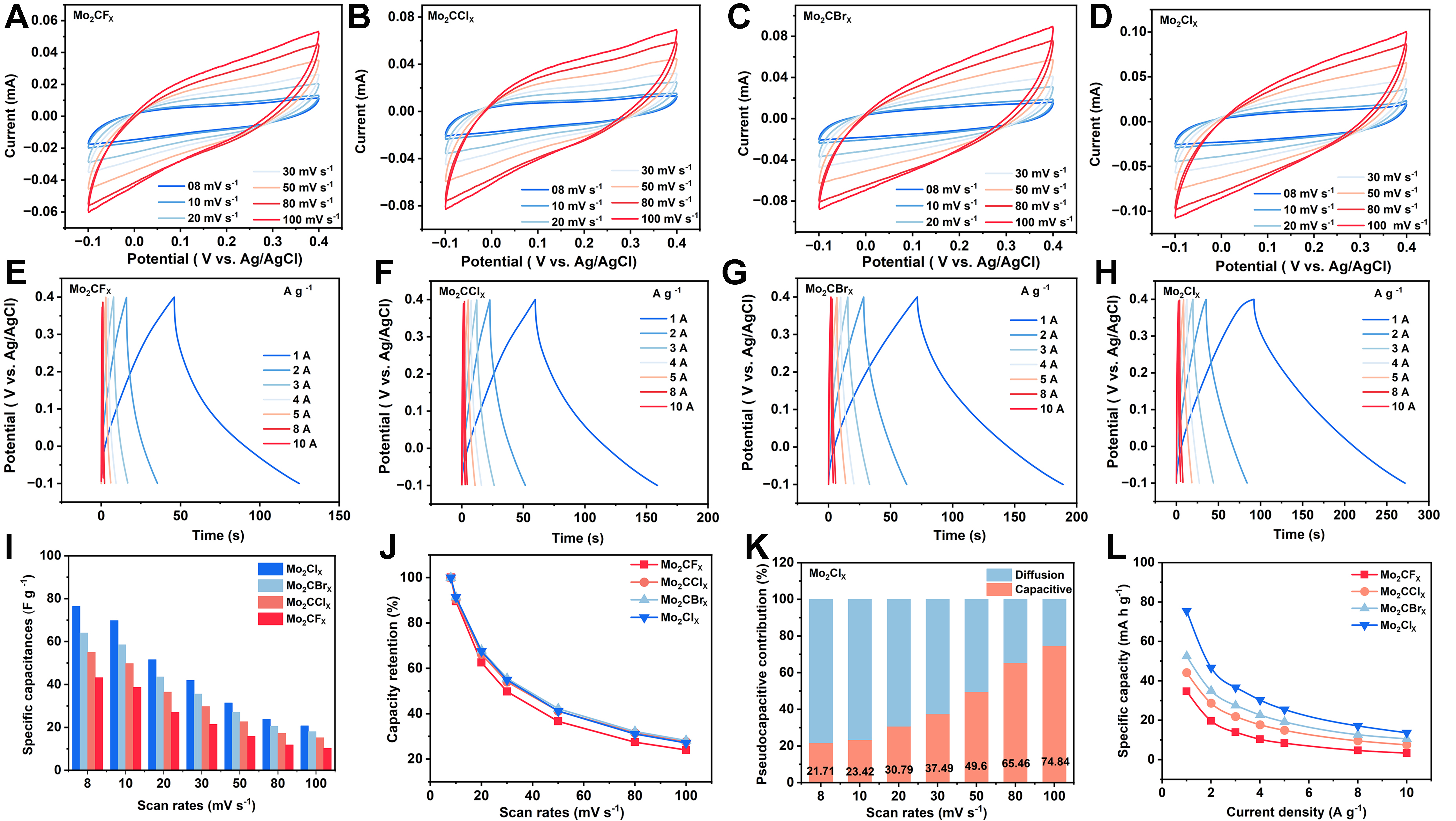
Figure 4. Electrochemical performance of surface-terminated Mo2CTx (T = F, Cl, Br, I) MXene. (A-D) The CV curves of Mo2CTx electrodes at different scan rates; (E-H) The GCD curves of Mo2CTx electrodes at different scan rates; (I) Capacitance comparison of the Mo2CTx electrode at different scan rates; (J) Capacitance retention at different scan rates; (K) The calculated diffusion and capacitive ratios at different scan rates for Mo2CIx; (L) Capacitance comparison of the Mo2CTx electrode at different current densities. CV: Cyclic voltammetry; GCD: galvanostatic charge/discharge.
As shown in Figure 4E-H, the galvanostatic charge/discharge (GCD) curves of the four samples Mo2CFx, Mo2CClx, Mo2CBrx, Mo2CIx were measured at different current densities. At the same current density, the charge-discharge time of the samples follows the order of Mo2CIx > Mo2CBrx > Mo2CClx > Mo2CFx. Longer charge-discharge times corresponding to higher specific capacitances. This sequence can be attributed to the terminations I with lower electronegativity, which leads to a higher electron cloud density on the surface Mo atoms of MXene and a lower EDL thickness, making it more favorable for the adsorption and desorption of electrolyte ions and enhancing the EDL capacitance effect. Despite a slight decrease in the overlap of the GCD curves at high currents, the shape of the GCD curves for all four samples remained highly consistent across multiple currents, demonstrating the excellent stability of the materials. No significant decay in charge-discharge time or severe deformation of the curve shape was observed during the cycling process, suggesting that the electrode materials can maintain their structural integrity and electrochemical activity during the charge-discharge process. This stability can be attributed to the unique layered structure of MXene and the regulation of the structural and electronic properties of the materials by surface terminations modification. The specific capacitances and capacitance retention rates of Mo2CTx (T = F, Cl, Br, I) samples at different scan rates are summarized in Figure 4I and J. As seen, the Mo2CIx sample achieves the highest specific capacitance of
Through the above systematic electrochemical performance measurements, we confirmed that the Mo2CTx (T = F, Cl, Br, I) samples have a charge storage mechanism dominated by non-Faradaic capacitance. The electronegativity and size of different terminations have significant effects on the electrochemical performance. Combining the results of structural analysis, the I termination with lower electronegativity and larger size can result in increasing the electron cloud density of the surface Mo atoms of MXene, reducing the EDL thickness, and increasing the specific surface area and active sites of the materials. These results reveal the intrinsic correlation between the structure and performance of MXene materials and are consistent with our theoretical calculations, may provide useful guidance for the design and optimization of high-performance MXene electrode materials.
CONCLUSIONS
In this work, we integrated theoretical calculations and experimental investigations to elucidate the regulatory effect of halogen terminations on the electrochemical performance of Mo2CTx MXenes for supercapacitor applications. The simulations revealed that the capacitance of halogen-terminated Mo2CTx MXenes is primarily contributed by the EDL capacitance, which can be effectively tuned by modifying the surface terminations. The total capacitance increased as the electronegativity of the terminations decreased, following the order of Mo2CFx < Mo2CClx < Mo2CBrx < Mo2CIx. Experimental results further validated the theoretical predictions, confirming that the I termination in Mo2CTx with lower electronegativity and larger size could enhance the EDL capacitance effect and increases the specific capacitance. These findings provide valuable insights into the intrinsic correlation between the structure and performance of MXene, facilitating the rational design and optimization of high-performance MXene electrode materials for advanced supercapacitors.
DECLARATIONS
Acknowledgments
We thank the Beijing Synchrotron Radiation Facility (1W1B), Hefei Synchrotron Radiation Facility (Infrared spectroscopy and microspectroscopy, MCD-A and MCD-B, Photoemission and Catalysis/Surface Science), and USTC Center for Micro and Nanoscale Research and Fabrication for helps in characterizations. Computational work was performed at the Hefei Advanced Computing Center. The AI-driven experiments, simulations and model training were performed on the robotic AI-Scientist platform of Chinese Academy of Science.
Authors’ contributions
Made substantial contributions to the experimental design and execution: Xu, H.
Made substantial contributions to the computational design and execution: Shou, H.
Contributed to data analysis and interpretation and led the manuscript writing: Xu, H.; Shou, H.
Provided guidance for the computational study: Zhou, Q.; Liu, H.; Wei, S.; Wu, X.; Wang, C.; Song, L.
Provided scientific guidance and supervision, administered the project, and acquired funding: Wu, X.; Wang, C.; Song, L.
Contributed to scientific discussion and manuscript revision: Xu, H.; Shou, H.; Zhou, Q.; Liu, H.; Wei, S.; Wu, X.; Wang, C.; Song, L.
Approved the final version of the manuscript: Xu, H.; Shou, H.; Zhou, Q.; Liu, H.; Wei, S.; Wu, X.; Wang, C.; Song, L.
Availability of data and materials
The raw data supporting the findings of this study are available within this Article and its Supplementary Materials. Further data are available from the corresponding authors upon request.
AI and AI-assisted tools statement
During the preparation of this manuscript, the AI tool OpenAI ChatGPT (version GPT-5, released 2025-08-07) was used solely for language editing. The tool did not influence the study design, data collection, analysis, interpretation, or the scientific content of the work. All authors take full responsibility for the accuracy, integrity, and final content of the manuscript.
Financial support and sponsorship
We extend our gratitude for the financial support received from the National Key R&D Program of China (2022YFA1504104 and 2022YFA1605400), NSFC (12225508, U23A20121, 22075264, and 22225301), the Strategic Priority Research Program of the Chinese Academy of Sciences (XDA0410401) and the Fundamental Research Funds for the Central Universities (WK2060000099, 20720220009, and WK2490000001) and USTC Bihe Youth Program for Interdisciplinary Innovation (BH-202508).
Conflicts of interest
All authors declared that there are no conflicts of interest.
Ethical approval and consent to participate
Not applicable.
Consent for publication
Not applicable.
Copyright
© The Author(s) 2026.
Supplementary Materials
REFERENCES
1. VahidMohammadi, A.; Rosen, J.; Gogotsi, Y. The world of two-dimensional carbides and nitrides (MXenes). Science 2021, 372, eabf1581.
2. Wang, D.; Zhou, C.; Filatov, A. S.; et al. Direct synthesis and chemical vapor deposition of 2D carbide and nitride MXenes. Science 2023, 379, 1242-7.
3. Lim, K. R. G.; Shekhirev, M.; Wyatt, B. C.; Anasori, B.; Gogotsi, Y.; Seh, Z. W. Fundamentals of MXene synthesis. Nat. Synth. 2022, 1, 601-14.
4. Liu, J.; Cao, H.; Jiang, B.; Xue, Y.; Fu, L. Newborn 2D materials for flexible energy conversion and storage. Sci. China. Mater. 2016, 59, 459-74.
5. Chen, X.; Paul, R.; Dai, L. Carbon-based supercapacitors for efficient energy storage. Natl. Sci. Rev. 2017, 4, 453-89.
6. Hu, M.; Dai, J.; Chen, L.; et al. Selectivity for intercalated ions in MXene toward a high-performance capacitive electrode. Sci. China. Mater. 2023, 66, 974-81.
7. Kajiyama, S.; Szabova, L.; Iinuma, H.; et al. Enhanced Li‐ion accessibility in MXene titanium carbide by steric chloride termination. Adv. Energy. Mater. 2017, 7, 1601873.
8. Li, M.; Li, X.; Qin, G.; et al. Halogenated Ti3C2 MXenes with electrochemically active terminals for high-performance zinc ion batteries. ACS. Nano. 2021, 15, 1077-85.
9. Zheng, C.; Yao, Y.; Rui, X.; et al. Functional MXene-based materials for next-generation rechargeable batteries. Adv. Mater. 2022, 34, e2204988.
10. Ghidiu, M.; Lukatskaya, M. R.; Zhao, M. Q.; Gogotsi, Y.; Barsoum, M. W. Conductive two-dimensional titanium carbide ‘clay’ with high volumetric capacitance. Nature 2014, 516, 78-81.
11. Dall’agnese, Y.; Lukatskaya, M. R.; Cook, K. M.; Taberna, P.; Gogotsi, Y.; Simon, P. High capacitance of surface-modified 2D titanium carbide in acidic electrolyte. Electrochem. Commun. 2014, 48, 118-22.
12. Zhang, P.; Shou, H.; Xia, Y.; et al. X-ray insights into formation of -O functional groups on MXenes: two-step dehydrogenation of adsorbed water. Nano. Lett. 2023, 23, 1401-8.
13. Li, Y.; Shao, H.; Lin, Z.; et al. A general Lewis acidic etching route for preparing MXenes with enhanced electrochemical performance in non-aqueous electrolyte. Nat. Mater. 2020, 19, 894-9.
14. Li, M.; Lu, J.; Luo, K.; et al. Element replacement approach by reaction with Lewis acidic molten salts to synthesize nanolaminated MAX phases and MXenes. J. Am. Chem. Soc. 2019, 141, 4730-7.
15. Shen, M.; Jiang, W.; Liang, K.; et al. One-pot green process to synthesize MXene with controllable surface terminations using molten salts. Angew. Chem. Int. Ed. Engl. 2021, 60, 27013-8.
16. Kamysbayev, V.; Filatov, A. S.; Hu, H.; et al. Covalent surface modifications and superconductivity of two-dimensional metal carbide MXenes. Science 2020, 369, 979-83.
17. Jawaid, A.; Hassan, A.; Neher, G.; et al. Halogen etch of Ti3AlC2 MAX phase for MXene fabrication. ACS. Nano. 2021, 15, 2771-7.
18. Li, T.; Yao, L.; Liu, Q.; et al. Fluorine-free synthesis of high-purity Ti3C2Tx (T=OH, O) via alkali treatment. Angew. Chem. Int. Ed. Engl. 2018, 57, 6115-9.
19. Chen, X.; Zhu, Y.; Zhang, M.; et al. N-butyllithium-treated Ti3C2Tx MXene with excellent pseudocapacitor performance. ACS. Nano. 2019, 13, 9449-56.
20. Lukatskaya, M. R.; Bak, S.; Yu, X.; Yang, X.; Barsoum, M. W.; Gogotsi, Y. Probing the mechanism of high capacitance in 2D titanium carbide using in situ X‐ray absorption spectroscopy. Adv. Energy. Mater. 2015, 5, 1500589.
21. Zhan, C.; Naguib, M.; Lukatskaya, M.; Kent, P. R. C.; Gogotsi, Y.; Jiang, D. E. Understanding the MXene pseudocapacitance. J. Phys. Chem. Lett. 2018, 9, 1223-8.
22. Jing, C.; Tao, S.; Fu, B.; et al. Layered double hydroxide-based nanomaterials for supercapacitors and batteries: strategies and mechanisms. Prog. Mater. Sci. 2025, 150, 101410.
23. Gan, J.; Li, F.; Tang, Y.; Tang, Q. Theoretical study of transition-metal-modified Mo2CO2 MXene as a catalyst for the hydrogen evolution reaction. ChemSusChem 2020, 13, 6005-15.
24. Zhang, J. J.; Dong, S. Superconductivity of monolayer Mo2C: the key role of functional groups. J. Chem. Phys. 2017, 146, 034705.
25. Shimada, T.; Takenaka, N.; Ando, Y.; Otani, M.; Okubo, M.; Yamada, A. Relationship between electric double-layer structure of MXene electrode and its surface functional groups. Chem. Mater. 2022, 34, 2069-75.
26. Wang, C.; Shou, H.; Chen, S.; et al. HCl-based hydrothermal etching strategy toward fluoride-free MXenes. Adv. Mater. 2021, 33, e2101015.
27. Kotmool, K.; Kaewmaraya, T.; Hussain, T.; Ahuja, R.; Luo, W.; Bovornratanaraks, T. Biaxial stress and functional groups (T = O, F, and Cl) tuning the structural, mechanical, and electronic properties of monolayer molybdenum carbide. Phys. Chem. Chem. Phys. 2022, 24, 17862-9.
28. Zhan, C.; Neal, J.; Wu, J.; Jiang, D. Quantum effects on the capacitance of graphene-based electrodes. J. Phys. Chem. C. 2015, 119, 22297-303.
29. Zhan, C.; Jiang, D. E. Contribution of dielectric screening to the total capacitance of few-layer graphene electrodes. J. Phys. Chem. Lett. 2016, 7, 789-94.
Cite This Article
 Open Access
How to Cite
Download Citation
Export Citation File:
Type of Import
Tips on Downloading Citation
Citation Manager File Format
Type of Import
Direct Import: When the Direct Import option is selected (the default state), a dialogue box will give you the option to Save or Open the downloaded citation data. Choosing Open will either launch your citation manager or give you a choice of applications with which to use the metadata. The Save option saves the file locally for later use.
Indirect Import: When the Indirect Import option is selected, the metadata is displayed and may be copied and pasted as needed.
About This Article
Copyright

Data & Comments
Data
0











Comments
Comments must be written in English. Spam, offensive content, impersonation, and private information will not be permitted. If any comment is reported and identified as inappropriate content by OAE staff, the comment will be removed without notice. If you have any queries or need any help, please contact us at [email protected].