


Controlled synthesis and electrocatalytic applications of atomically precise AuAg nanoclusters: a review
 0
0 Abstract
Bimetallic nanoclusters possess tunable physicochemical properties, improved performance, and enhanced stability for versatile applications. Among them, atomically precise AuAg nanoclusters have an important position in the series of bimetallic nanoclusters thanks to the easy preparation and crystallization, unique electronic structure, and robust stability. In this review, the general introduction of bimetallic nanoclusters and the uniqueness of AuAg nanoclusters are first explained. Then, the main strategies for the controlled synthesis of AuAg nanoclusters are summarized, with examples to illustrate the workflow and potential limitations. Following this, atomically precise AuAg nanoclusters for electrocatalytic applications, including overall water splitting, CO2 reduction reaction, and urea electrosynthesis, are discussed. In this major part, carefully chosen examples are analyzed to reveal the atomic-level structure-performance relationship and to understand the fundamental reaction mechanism. Finally, the current challenges and future outlooks in this field are discussed critically.
Keywords
INTRODUCTION
In the past decade, atomically precise noble metal (e.g., Au, Ag, Cu, and their alloys) nanoclusters have been continuously attracting a great deal of research attention, as they have found versatile applications in various fields such as catalysis[1-3], sensing[4,5], optoelectronic[6-8], imaging[9-11], and bio-labeling[12,13]. These nanoclusters typically have ultrasmall sizes, with diameters less than 3 nm, and this ultrasmall size endows them with strong quantum confinement, resulting in physicochemical properties significantly different from those of larger nanoparticles (NPs) or nanocrystals[14,15]. Note that, by manipulating the reaction kinetics, these metal nanoclusters can be synthetically obtained with high monodispersity of molecular purity[16,17], with the total structure being resolved by single crystal X-ray diffraction (SC-XRD) once a high-quality single crystal is successfully acquired[18-20]. The structure-resolved metal nanoclusters can offer unique advantages that are not available from polydisperse metal NPs or nanocrystals. In particular, atomically precise metal nanoclusters have uniform size, composition, charge, morphology, and an identical chemical coordination environment (including geometric configuration, metal coordination number, and metal-metal/metal ligand bond angles/lengths). These structural features are favorable for establishing the structure-performance relationship at the atomic level for various potential applications[21-23]. Compared to single-metal nanoclusters, introducing another metal to form bimetallic alloy nanoclusters can result in altered electronic structures and improved physicochemical properties, such as absorption, luminescence, and intriguing electrochemical behaviors[24-29]. Specifically, in the catalytic regime, bimetallic alloy nanoclusters exhibit inter-atomic synergistic effects; that is, the altered geometric configuration can generate new catalytic active sites on the alloy clusters, and the tuned electronic structure can enhance both catalytic activity and stability[30,31]. Such a synergistic effect is realized through orbital hybridization and charge redistribution between heterometallic atoms[32,33]. This effect not only optimizes the adsorption strength and configuration of the reaction substrates at active sites but also reduces the key reaction energy barriers through dual-site cooperative activation mechanisms, thereby achieving performance that surpasses that of homometallic nanocluster counterparts.
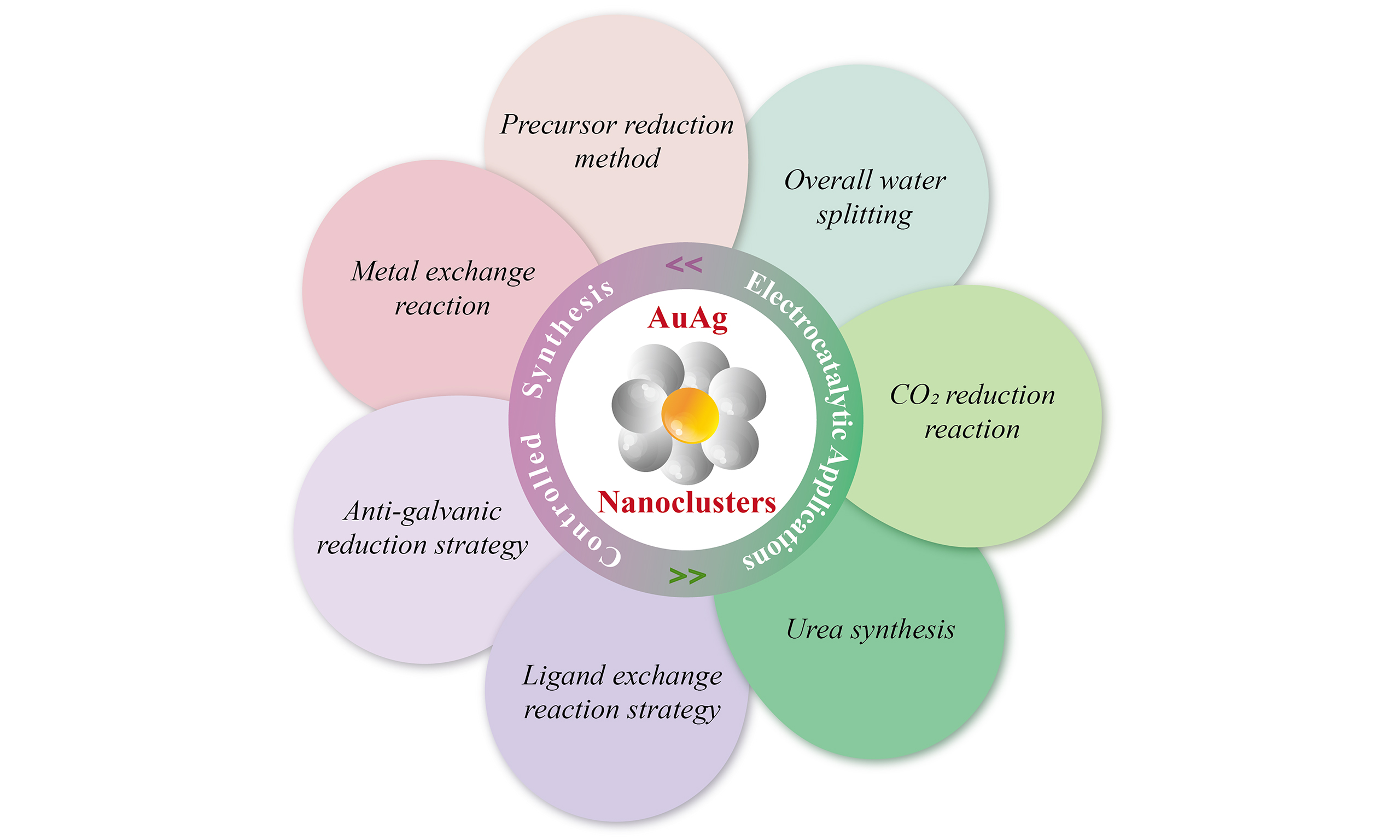
To date, various metals - including Au[34,35], Cu[36,37], Pd[38,39], Pt[40,41], Cd[42], Rh[43], etc. - have been successfully incorporated into Ag nanoclusters, constructing well-defined Ag-based bimetallic systems. Of all types of Ag-based bimetallic alloy nanoclusters, AuAg nanoclusters have probably gained the most intense research attention, mainly because Au and Ag share an s1d10 valence electron configuration and have similar atomic radii, resulting in minimal lattice strain during alloy formation[44]. Meanwhile, the slight difference in electronegativity drives significant interfacial electronic perturbation, which substantially affects the properties of the as-formed AuAg nanoclusters[45-49]. So far, atomically precise AuAg nanoclusters protected by thiolate ligand[50,51], alkynyl ligand[52,53], phosphine ligand[54,55], halogen[56], N-heterocyclic carbene (NHC)[57,58], and other ligands have been well explored. In the past few years, several instructive reviews have been published on the controllable synthesis and electrocatalytic applications of coinage metal(alloy) nanoclusters[26,29,51,59,60]. However, a comprehensive review on the most widely explored AuAg bimetallic nanoclusters is still missing. This review focuses on the controlled synthesis and electrocatalytic applications of atomically precise AuAg nanoclusters, featuring specific comparative insights into the synthetic strategies and distinctive analysis of the structure-performance relationships in electrocatalysis. In this review, the recent advances in the controlled synthesis of AuAg nanoclusters using various synthetic approaches are first summarized [Scheme 1]. Following that, the electrocatalytic applications - mainly including electrochemical overall water splitting (OWS), CO2 reduction reaction (CO2RR), and urea electrosynthesis - catalyzed by atomically precise AuAg nanocluster-based catalysts are discussed, with a focus on elucidating the structure–performance relationship of carefully selected examples [Scheme 1]. Finally, the current challenges and future perspective of this field are analyzed and envisioned.
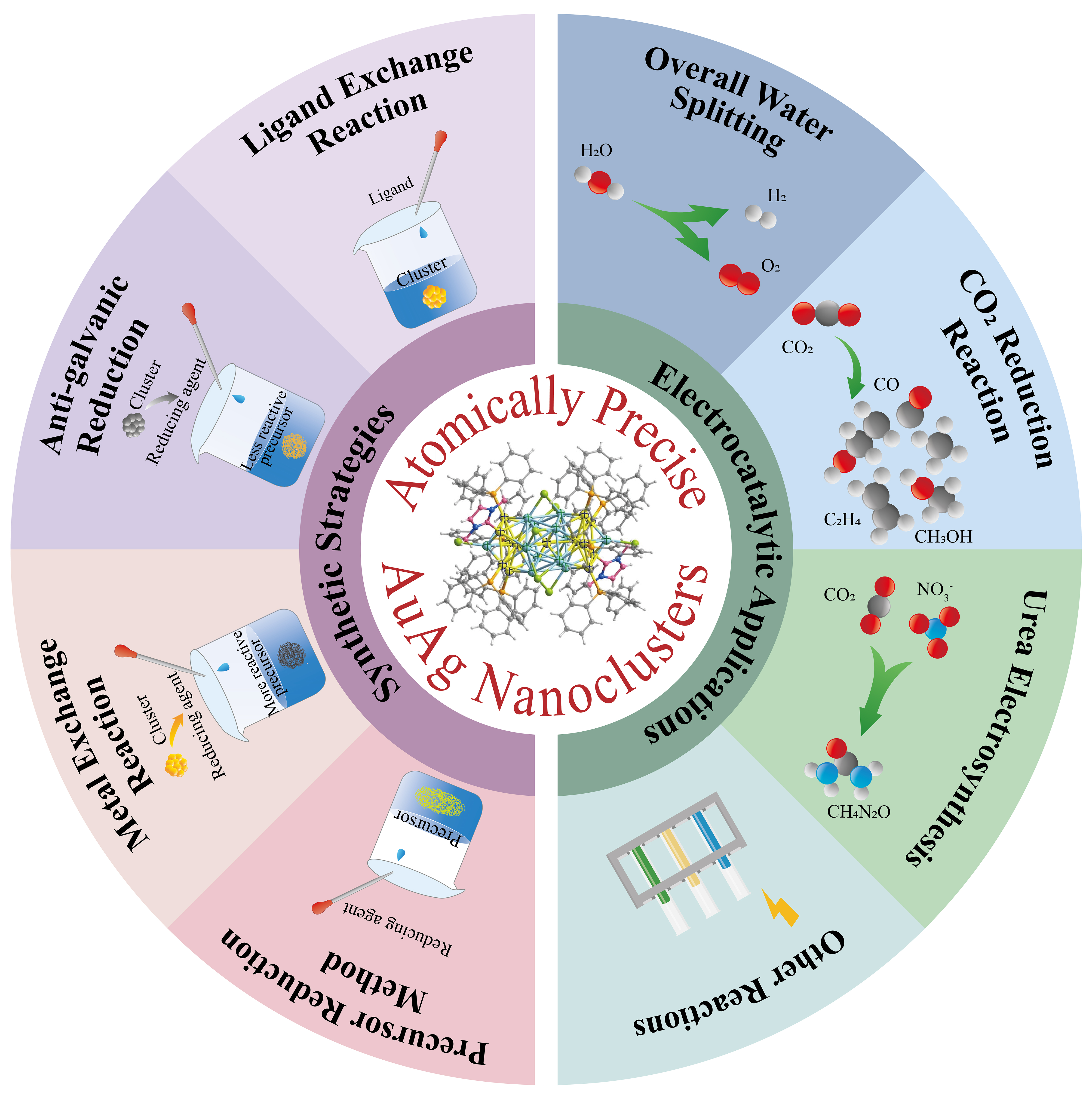
Scheme 1. Controlled synthesis and electrocatalytic applications of atomically precise AuAg nanoclusters.
CONTROLLED SYNTHESIS OF ATOMICALLY PRECISE AuAg NANOCLUSTERS
Precursor reduction method
The precursor reduction method is quite simple and straightforward, and it is probably the most widely employed method for synthesizing metal nanoclusters including AuAg clusters. In this method, the metal-ligand precursor or complex is first formed through the reaction between the metal salts and the ligand. Followed by the addition of a reducing agent, AuAg nanoclusters were produced. To improve the monodispersity of the obtained nanoclusters, post-reaction treatments or purification steps are necessary in most cases.
One typical example using this method is the synthesis of [Au34Ag27(C≡CR)34](PPh4) (PPh4: tetraphenylphosphonium) cluster with a concentric four-shell structure[61]. The Au34Ag27 nanocluster was synthesized by reducing a mixed solution of AuC≡CR and AgC≡CR with NaBH4 in an ice bath. Note that the order of reactant addition can be critical for obtaining specific AuAg nanoclusters. For instance, during the synthesis of Au8Ag3(PPh3)7Cl3 molecule, HAuCl4 was first treated with PPh3 (PPh3: triphenylphosphine) ligand to form some Au(I) complex, and then AgSbF6 was added to form AuAg alloy complex[62]. After filtration to remove the AgCl precipitate, NaBH4 was added to reduce the filtrate. Once the mixture turned red, it indicated that the Au8Ag3 cluster had formed, which is isostructural to the Au11(PPh3)7Cl3 nanocluster. Notably, if HAuCl4 and AgSbF6 were co-mixed with PPh3, they react immediately to form the AgCl precipitates; consequently, no AuAg cluster can be obtained. Similarly, the [Au13Ag12(PPh3)10Cl8]SbF6 nanocluster was fabricated using a nearly identical protocol[54]. Au(I)PPh3Cl was first prepared and then reacted with AgSbF6 in an ice bath for 30 min. The mixture was subsequently stirred in the dark for 24 h to yield the Au13Ag12 nanocluster, which comprises two Au7Ag6 icosahedra sharing a central gold atom. Interestingly, this procedure can produce two conformational Au13Ag12 cluster isomers with complete reversibility by controlling the reaction temperature[54].
It is worth noting that the precursor reduction method often fails to achieve precise control over the composition and structure of target alloy clusters. This is primarily due to insufficient regulation of metal nucleation and growth kinetics, which in turn leads to poor selectivity and generally low yield[63].
Metal exchange reaction
The metal exchange reaction usually employs pre-synthesized nanoclusters as the substrate to react with more reactive (or less noble) metal salts. Typically, the as-formed Ag nanocluster can react with Au(I) complex to yield AuAg nanoclusters[24].
Bootharaju et al. fabricated the Ag24Au(SPhMe2)18 (SPhMe2: 2,4-dimethylbenzenethiolate) nanoclusters using this method, where the Ag25(SPhMe2)18 nanocluster reacts with AuClPPh3 thanks to the electrochemical redox potential difference between Au(I) and Ag atoms in the Ag25 framework[64]. Interestingly, Au substitution in the Ag25 core induces some structural distortion in its icosahedral framework[64]. In another study conducted by Bootharaju et al., adding AuPPh3Cl to the [PdAg24(SR)18]2- (SR: thiolate ligand) nanocluster system controllably generated the mono-gold-substituted
Remarkably, the metal exchange of the Au(I)-to-Ag(I) process can be precisely controlled and directly visualized by mass spectrometry. In 2017, Yao et al. documented a surface motif exchange (SME) reaction to selectively replace the surface motifs of [Ag44(SR)30]4- nanoclusters, leading to the formation of core-shell structured [Ag32@Au12(SR)30]4- nanoclusters[66]. Such a process was analyzed in detail using mass spectrometry and tandem mass spectrometry. Theoretical calculations also disclosed that the Au@Ag core shell stabilizes the Ag20 shell, which can prevent the Au atoms from diffusing inwardly. Such a dedicated SME reaction opens a new door to the precise synthesis of AuAg nanoclusters with pre-designed alloying sites[66].
Although the metal exchange reaction can achieve atom-level cluster-to-cluster structural transformation, most current examples are limited to single-atom exchanges or involve only a very small number of metal atoms[64,67]. Customized nanocluster synthesis for regulating the number of doped metal atoms via the metal exchange reaction remains quite challenging. This is predominantly attributed to the inherently uncontrollable galvanic reduction process during the exchange reaction.
Anti-galvanic reduction strategy
Anti-galvanic reduction (AGR) refers to the reaction in which metal ions or complexes are reduced by less reactive (more noble) metal nanoclusters. AGR may seem to contradict the Galvanic theory, but such a reaction occurs on ultrasmall metal nanoclusters due to their quantum confinement effect.
In 2012, Wu first discovered this novel redox phenomenon of [Au25(SC2H4Ph)18] nanoclusters, which can react with AgNO3 at a 5.2:1 weight ratio, yielding [Au22Ag3S12]- and [Au23Ag2S12]- as the dominant products[68]. Following that, Yao et al. systematically studied this reaction, where two Ag atoms can be added onto [Au25(SC2H4Ph)18] to form Au25Ag2(SC2H4Ph)18 under well-controlled reaction conditions and precise reactant-substrate stoichiometry[69]. The successful preparation of monodisperse, high-purity
Beyond simple metal replacement or surface metal addition, the introduction of foreign metal atoms may induce size and structural changes in parent metal nanoclusters, leading to the formation of new nanoclusters. One classic case is the synthesis of the [Au13Ag12(PPh3)8(BMIm)2I8]SbF6 (BMIm: 1,3-bimethylimidazole) nanocluster with a rod-like carbene structure reported recently by Zhang et al.[70]. By reacting the pre-synthesized Au9 nanoclusters with freshly prepared Ag-BMIm under vigorous stirring in the dark, the
It is worth noting that the unique physicochemical properties arising from the size and surface effects of metal nanoclusters enable AGR to proceed spontaneously[23,24], but this reactivity does not apply to all types of noble metal nanoclusters. It is restricted to specific reaction systems and depends on the reaction conditions[71,72]. Therefore, expanding the universality and applicability of AGR is promising for producing novel atomically precise AuAg and other alloy nanoclusters.
Ligand exchange reaction strategy
Ligand exchange is another effective strategy for fabricating atomically precise AuAg nanoclusters[73]. It involves partial or complete replacement of the present ligands with incoming ligands on pre-synthesized AuAg nanoclusters. In addition, the extra ligand can initiate etching in the reaction system, leading to size transformation of the parent AuAg nanoclusters.
Au16Ag1(S-Adm)13 (Adm: Adamantane) was synthesized using this method by Kang et al.[74]. Firstly, a trace amount of Ag(I)
It should be noted that the ligand exchange reaction can facilitate atom-precise surface engineering of pre-formed alloy nanoclusters, allowing precise customization toward catalytic[74,75], optical[76], or biomedical applications[77] through functionalized ligands. Nevertheless, during the reaction process, the cluster structure is prone to unintended alterations[78], imposing fundamental constraints on those applications that require specific atomic structure or configurations.
Overall, the above four most widely employed synthetic methods possess different features. The comparison of their advantages, limitations, structural precision, and scalability is summarized in Table 1.
Comparison of the four major nanocluster synthetic methods
| Method | Advantages | Limitations | Structural precision | Scalability | Ref. |
| Precursor reduction method | Fast, simple operation | Non-uniform products, compromised purity | Low | High | [54,61-63] |
| Metal exchange reaction | Enabling atomic-level structural transformations between clusters; wide applicability | Hard to precisely control reaction rate and exchange extent | High | Medium | [24,64-67] |
| AGR | Realizing atomic-level incorporation of heterometal atoms while preserving core configuration, high monodispersity | Limited to specific reaction systems with stringent condition requirements | High | Low | [68,69,71,72] |
| Ligand exchange reaction | Achieving atomic-scale surface engineering and tailorable catalytic properties via functionalized ligands | Hard to precisely control the exchange extent | Medium | Medium | [73-78] |
Other synthetic methods
There are other synthetic approaches that have shown great promise for the synthesis of atomically precise AuAg nanoclusters. For example, photochemical synthesis provides an accessible platform to tailor nanoclusters with specific sizes. In 2023, Wang et al. reported the synthesis of atomically precise [Ag22Au3
Inter-cluster reactions can form bimetallic nanoclusters through chemical reactions between different cluster molecules, an extremely complex and mysterious process involving atomic exchange and bond reorganization[80]. For instance, Krishnadas et al. documented the fabrication of [Au12Ag32(FTP)30]4- superatomic nanoclusters via this method, where the dichloromethane solutions of [Au25(FTP)18]- and
ATOMICALLY PRECISE AuAg NANOCLUSTERS FOR ELECTROCATALYSIS APPLICATIONS
In the past decade, electrocatalytic science and technology have attracted steadily increasing research interest, particularly in the field of green energy storage and conversion, mainly due to their high efficiency, operation under mild conditions, cost-effectiveness, and extremely low or even zero carbon emissions[82]. Specifically, electrocatalysis can be regarded as a green technique, especially when intermittent electricity from solar, wind, and other renewable sources is used. Electrocatalysis has opened a sustainable avenue to address the severe carbon emissions and environmental pollution issues worldwide[83-85].
The ultrasmall size, abundant active sites, precise structure, and Au/Ag synergistic effect have endowed atomically precise AuAg nanoclusters with the ability to serve as model and efficient catalysts in a variety of electrocatalytic reactions[26]. In recent years, a handful of high-quality reviews focusing on electrocatalysis by metal nanoclusters - including but not limited to AuAg nanoclusters - have been published[1,2,86-88]. This review mainly discusses the AuAg clusters as electrocatalysts for OWS, CO2RR, and urea electrosynthesis.
AuAg NCs for OWS
Hydrogen energy, as an ideal energy carrier characterized by its high energy density and combustion product being solely water, has been widely regarded as one of the key renewable energy sources to achieve the carbon neutrality goal[85,89]. Recently, hydrogen production through electrochemical water splitting has been attracting increasing research attention, not only because it can provide high-purity H2 gas for direct use, but also because it can fully utilize renewable electricity generated from solar, wind, tidal, and other intermittent sources[90-93]. Electrochemical water splitting contains two half reactions: the hydrogen evolution reaction (HER) at the cathode and the oxygen evolution reaction (OER) at the anode. However, for both HER and OER, additional energy input is required to overcome the energy barrier[94,95]. To facilitate the reaction process, it is essential to lower the energy barriers; therefore, developing efficient and durable catalysts for both the HER and OER is imperative[96-99].
In the past few years, bimetallic nanoclusters have emerged as model and effective catalysts for both HER and OER, as they have good catalytic performance, and more importantly, their well-defined structure can offer a great platform to unravel the structure-activity relationship at the atomic level[30,32,100]. Specifically, for atomically precise AuAg nanoclusters, their uniform size and composition, unique electronic structure, precise Au/Ag stoichiometric ratio, and crystallographically resolved structures endow them with significant advantages as model bimetallic catalysts for gaining deep mechanistic understanding and guiding improved catalyst design[101]. In 2021, Li et al. reported an Au36Ag2(SR)18 nanocluster with low thiolate ligand surface coverage, which exhibited ultrahigh HER activity with a very low overpotential to achieve a given current density[102]. Specifically, Au36Ag2(SR)18 consists of three icosahedral (Ih) units, reminiscent of the monomeric Ih Au25(SR)18- and dimeric Ih Au38(SR)24, and these tri-units endowed it with a unique geometric and electronic structure. The outstanding HER performance is attributed to the low ligand-to-metal ratio, low-coordinated Au atoms, and the unfilled superatomic orbitals[102].
Recently, our group investigated the electrocatalytic performance of atomically precise
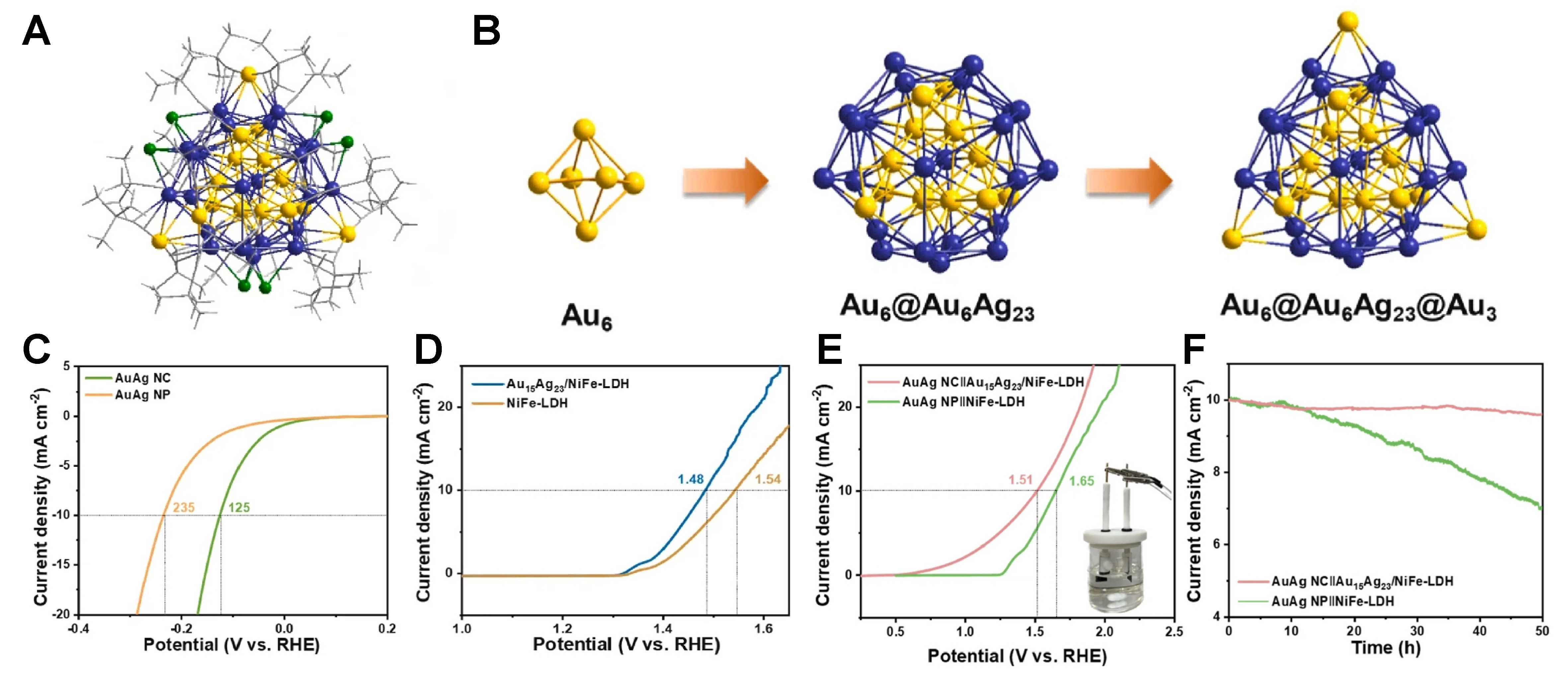
Figure 1. (A) Crystal structure and (B) structure anatomy of the Au15Ag23 nanocluster. Color labels: Au (gold), Ag (indigo), Br (green), C (25% gray); (C) The HER polarization curves of AuAg NC and AuAg NP in 0.5 M H2SO4; (D) The OER polarization curves of Au15Ag23/NiFe-LDH and NiFe-LDH in 1.0 M KOH; (E) The OWS performance of the AuAg NC || Au15Ag23/NiFe-LDH assembled electrolyzer and the AuAg NP || NiFe-LDH electrolyzer in 1.0 M KOH; (F) 50 h long-term OWS stability test. Reprinted with permission, copyright 2023 Elsevier Ltd[103]. HER: Hydrogen evolution reaction; NC: nanocluster; NP: nanoparticle; OER: oxygen evolution reaction; LDH: layered double hydroxide; OWS: overall water splitting; RHE: reversible hydrogen electrode.
AuAg NCs for electrochemical CO2RR
Electrochemical CO2RR represents a promising approach that can not only mitigate the growing global concern over the harmful effects of excessive CO2 emissions but also generate value-added carbon-based fuels and chemical feedstocks[104-106]. However, the development and implementation of CO2RR is hindered by several serious challenges such as the thermodynamic stability of the CO2 molecule and the competitive HER reaction. Moreover, CO2RR involves a very complex reaction pathway with multiple proton/electron transfer steps. Therefore, the CO2RR catalyst plays a central role in activating the CO2 molecule, determining the reaction pathway, and governing the catalytic activity and final product selectivity[107-109].
Atomically precise AuAg nanoclusters hold great merit as model and effective catalysts for CO2RR, not only due to their ultrasmall size and high activity and the exclusive selectivity for CO formation, but also because their atom-precise structure provides atomic-level insight into the reaction mechanism[110,111]. Specifically, with the aid of in-situ spectroscopic study and theoretical calculations, such an atomically precise structure is beneficial for identifying the real catalytic activity, elucidating the synergistic effect between Au and Ag, disclosing the surface ligand role, and even understanding the catalyst structure evolution/reconstruction mechanism[75]. For instance, Xu et al. reported the evolution from Au24Ag20 monomer clusters into Au43Ag38 dimeric nanoclusters, where the Au24Ag20 kernel of Au12@Ag20 is assembled into Au12@Ag19-Au-Au12@Ag19, forming the kernel of Au43Ag38[112]. Interestingly, the monomeric Au24Ag20 catalysts outperformed dimeric Au43Ag38 catalysts in CO2RR[112].
The kernel and shell structure in the metal core can significantly affect the CO2RR catalytic properties of AuAg nanoclusters, including the catalytic activity and stability. In 2022, Seong et al. reported a core-shell AuAg nanocluster of AuAg12@Au12(SEtPh)18 (SEtPh: 2-phenylethanethiolate)[110]. By engineering the active sites through replacing the Ag12(SR)18 shell of Ag25 with an Au12(SR)18 shell, the resulting AuAg12@Au12 NC exhibited dramatically enhanced performance compared to Au25. AuAg12@Au12(SEtPh)18 consists of an AuAg12 core and an Au12 shell protected by 18 phenylethanethiolate (SEtPh) ligands through dimeric staple units. The overall framework of AuAg12@Au12(SEtPh)18 resembles the icosahedral structure of Au25(SEtPh)18, where the thiolate ligands bond to the metal core-shell via S atoms, and the core-shell interface is stabilized by metal-metal bonds [Figure 2A]. Figure 2B and C demonstrates that the AuAg12@Au12/GDE catalyst exhibits a CO onset potential of 1.62 V and achieves a CO current density (jCO) of 339 mA·cm-2 at a full-cell potential of 2.66 V in a zero-gap CO2 electrolyzer, outperforming the Ag NP catalyst. During 24-hour galvanostatic electrolysis at a current density of 200 mA·cm-2, the full-cell potential remains stable at 2.13 ± 0.03 V with an initial CO selectivity of 90% and an energy efficiency of 57%, highlighting its excellent stability and practical applicability[110]. To better comprehend the reaction mechanism, the authors also performed operando attenuated total reflection surface-enhanced infrared absorption spectroscopy (ATR-SEIRAS) to confirm the active site. During CO2RR, the *CO formation is the key step, and the C=O stretching band of *CO for Au25 NC is centered at 2,096 cm-1[110]. Interestingly, the *CO signal observed for AuAg12@Au12(SEtPh)18 is located at 2,072 cm-1, which is consistent with that of Au25 NC. This indicates that the Au site in AuAg12@Au12(SEtPh)18 serves as the active site for CO2RR, and the transplanted Au atoms function as the active site for CO2-to-CO electroreduction. These findings demonstrate that atomic-level engineering of metal shells effectively enhances CO2-to-CO electroreduction, offering a novel strategy for designing high-performance electrocatalysts.
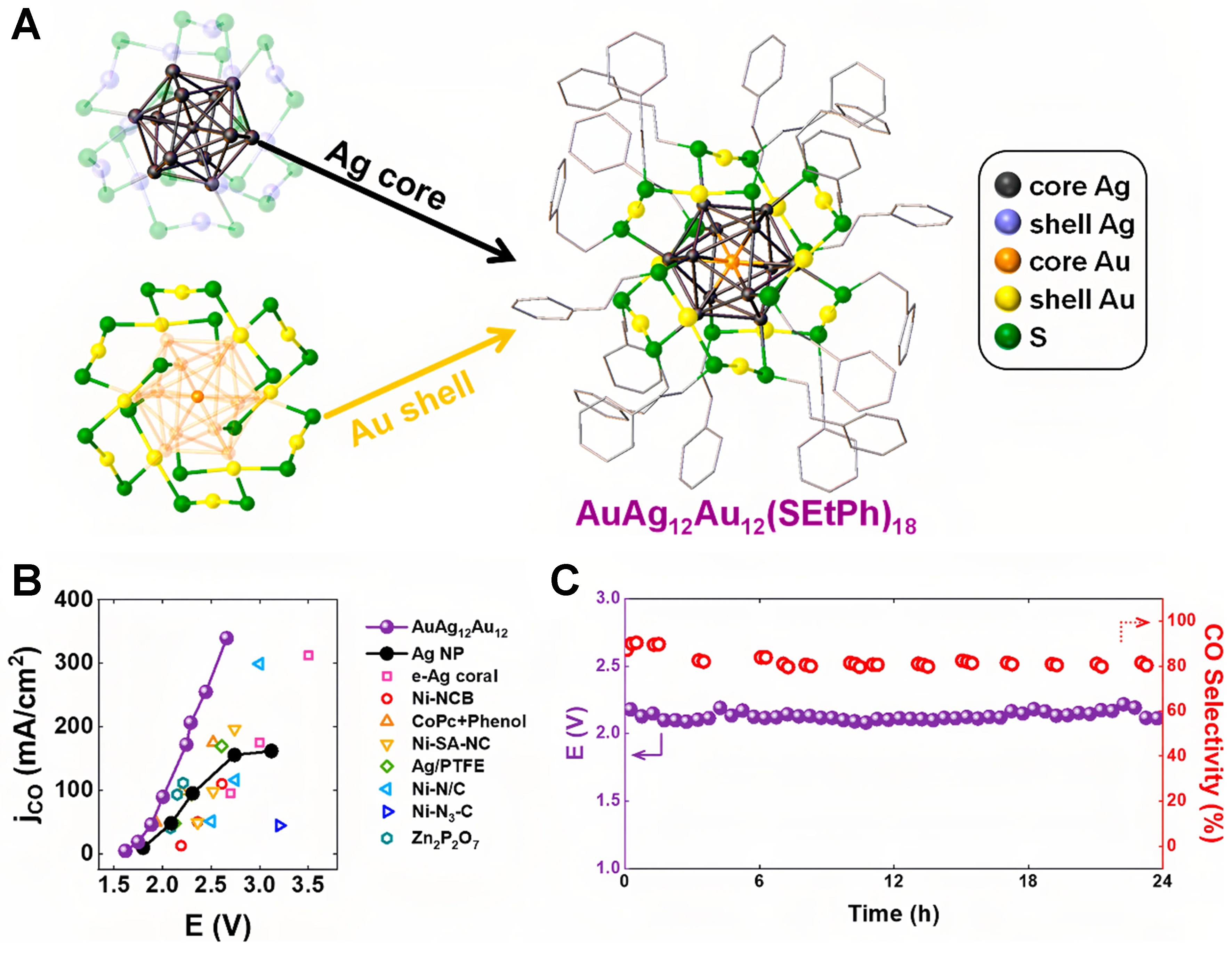
Figure 2. (A) Schematic illustration of the active-site engineering strategy for Ag25 NC and the crystal structure of AuAg12@Au12(SEtPh)18, with carbon atoms represented as gray wireframes; (B) Comparison of jCO in the zero-gap CO2 electrolyzer on the AuAg12Au12/GDE with other electrocatalysts; (C) Long-term CO2 electrolysis of the AuAg12Au12/GDE in a zero-gap cell monitored using the full-cell potential and CO selectivity at 200 mA·cm-2. Reproduced with permission, copyright 2022 American Chemical Society[110]. NC: Nanocluster; GDE: glass disk electrode; NP: nanoparticle; NCB: nitrogen-doped carbon black; SA: single atom; PTFE: polytetrafluoroethylene.
Furthermore, by doping Au or Pt atoms into Ag nanoclusters, the as-formed AuAg or PtAg nanoclusters exhibited drastically different CO2RR properties from the parent Ag nanoclusters. In a recent study, Yoo
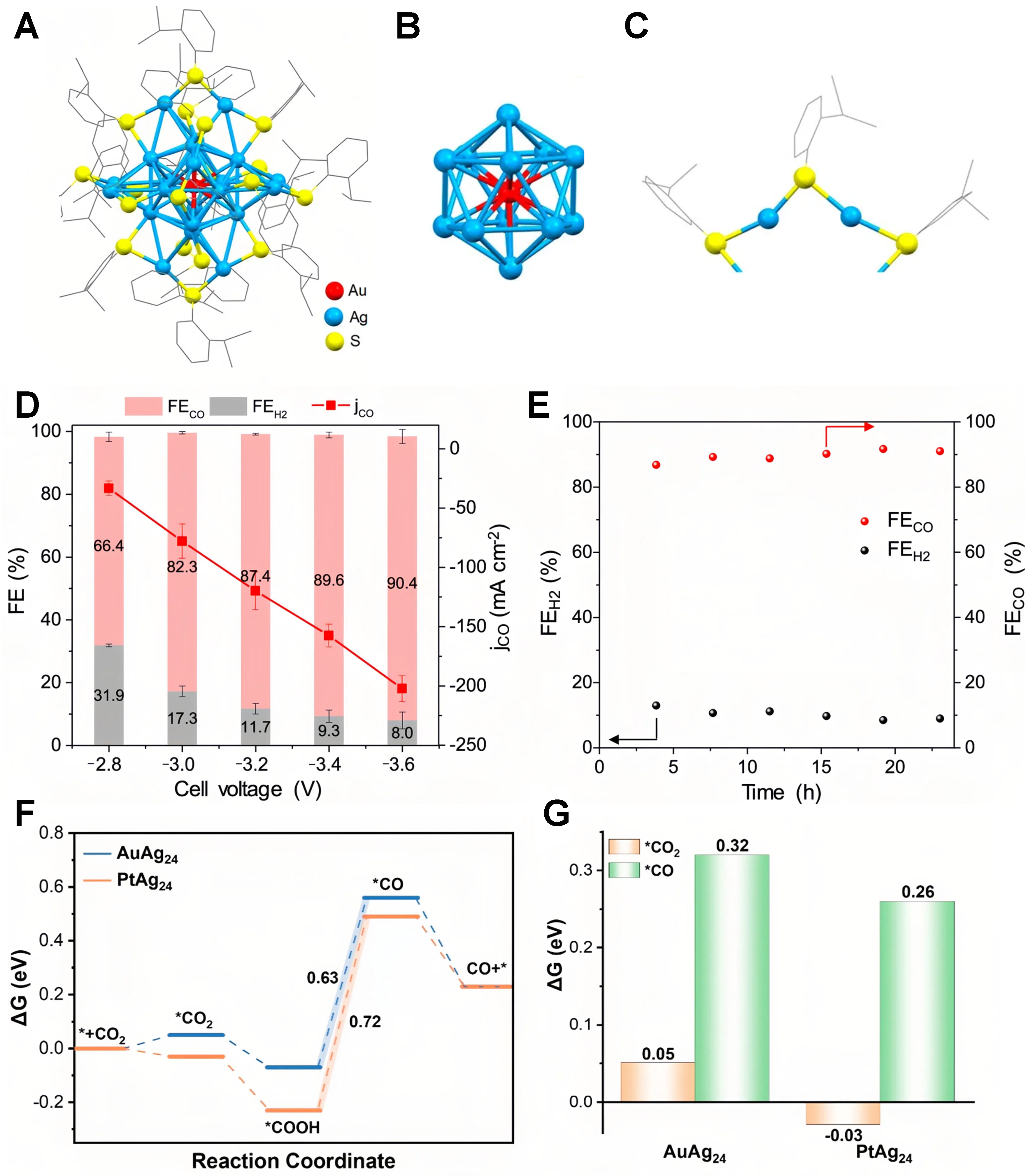
Figure 3. (A) Crystal structure of [AuAg24(IPBT)18]- NC; (B) Core structures of the dopant-centered AuAg12 icosahedra; (C) Surface metal-ligand coordination motifs of [AuAg24(IPBT)18]- NCs; (D) FECO and jCO of AuAg24 across cell voltages ranging from -2.8 to -3.6 V in a zero-gap MEA cell; (E) Long-term operation of AuAg24 at -3.2 V in the MEA cell; (F) Free energy diagram for CO2RR and (G) Adsorption free energies of *CO2 and *CO on AuAg24 and PtAg24 NCs at U = 0 V vs. SHE. Reprinted with permission, copyright 2025 American Chemical Society[113]. NC: Nanocluster; FECO: Faradaic efficiency of CO; jCO: CO current density; MEA: membrane electrode assembly; CO2RR: CO2 reduction reaction; SHE: standard hydrogen electrode.
It is worth noting that the CO2RR performance of the AuAg12@Au12, AuAg24 cluster-based catalysts is at least comparable with, if not superior to, most of the recently reported Au/Ag-based nanostructure catalysts under identical or similar conditions, in terms of FECO, CO current density, and long-term stability [Table 2]. To sum up, for AuAg nanoclusters in CO2RR, the metal core composition and configuration, as well as the employed surface capping ligands, are the main factors affecting the catalytic properties, as they can significantly tune the active sites, optimize the adsorption of reaction intermediates, and modulate the energy barrier of the rate-determining step.
Comparison of the CO2RR performance between AuAg12@Au12, AuAg24 and other top-level Au/Ag-based nanocatalysts
| Electrocatalyst | Electrolyte | Cell type | FECO (%) | JCO (mA·cm-2) | Stability (h) | Ref. |
| AuAg12@Au12 | 1.0 M KOH | MEA-cell | 90 | 206 | 24 | [110] |
| AuAg24 | 0.1 M KHCO3 | MEA-cell | 90.4 | -202.2 | 24 | [113] |
| Au24 | 0.1 M KHCO3 | MEA-cell | 90 | -90 | 100 | [114] |
| Ag15 | 0.5 M KHCO3 | H-cell | 95 | -13.0 | 10 | [115] |
| Hollow Au-Cu NP/C | 0.5 M KHCO3 | MEA-cell | 53.3 | ~-16.5 | 12 | [116] |
| D-100 Ag NWs | 0.1 M KHCO3 | GCE-cell | 88.1 | 0.35 | 24 | [117] |
| Ag-900D NNAs | 0.5 M KHCO3 | H-cell | 91.4 | 43.41 | ~11.7 | [118] |
| Au22 | 0.5 M KHCO3 | H-cell | 92.7 | ~-7.0 | 10 | [119] |
AuAg NCs for electrocatalytic urea synthesis
Urea is a basic yet important chemical raw material, as it is not only an essential nitrogen fertilizer for crop growth but also serves as a critical feedstock for producing a series of valuable chemicals, such as urea-formaldehyde, barbiturates, and urea-melamine-formaldehyde resins[120,121]. Currently, the industrial synthesis of urea heavily relies on the reaction between CO2 and NH3 at high temperatures (150 °C) and high pressures (150-250 bar). These harsh reaction conditions require expensive equipment and high energy input and, more importantly, generate significant CO2 emissions, which are a major contributor to global warming[122,123].
Electrochemical urea synthesis provides a new route for green urea production, as it can operate under mild conditions, utilize renewable electricity, and convert common wastewater contaminants (NO3-, NO2-, etc.) into valuable chemicals[124-126]. Fundamentally, urea electrosynthesis is an extremely complicated process, and the key lies in the construction of the C–N bond. Atomically precise AuAg nanoclusters offer significant advantages as model catalysts for understanding C–N bond formation, as they provide two neighboring metal sites to stabilize key intermediates for both CO2RR and nitrogenous compound electroreduction. More significantly, their atomically precise structure enables atomic-level insights into the structure-performance relationship[127,128].
In 2024, Chen et al. reported two Ag-based bimetallic clusters - Ag14Pd(PTFE)6(TPP)8 (Ag14Pd) (PTFE: pentafluorothiophenol, TPP: triph-enylphosphine) and
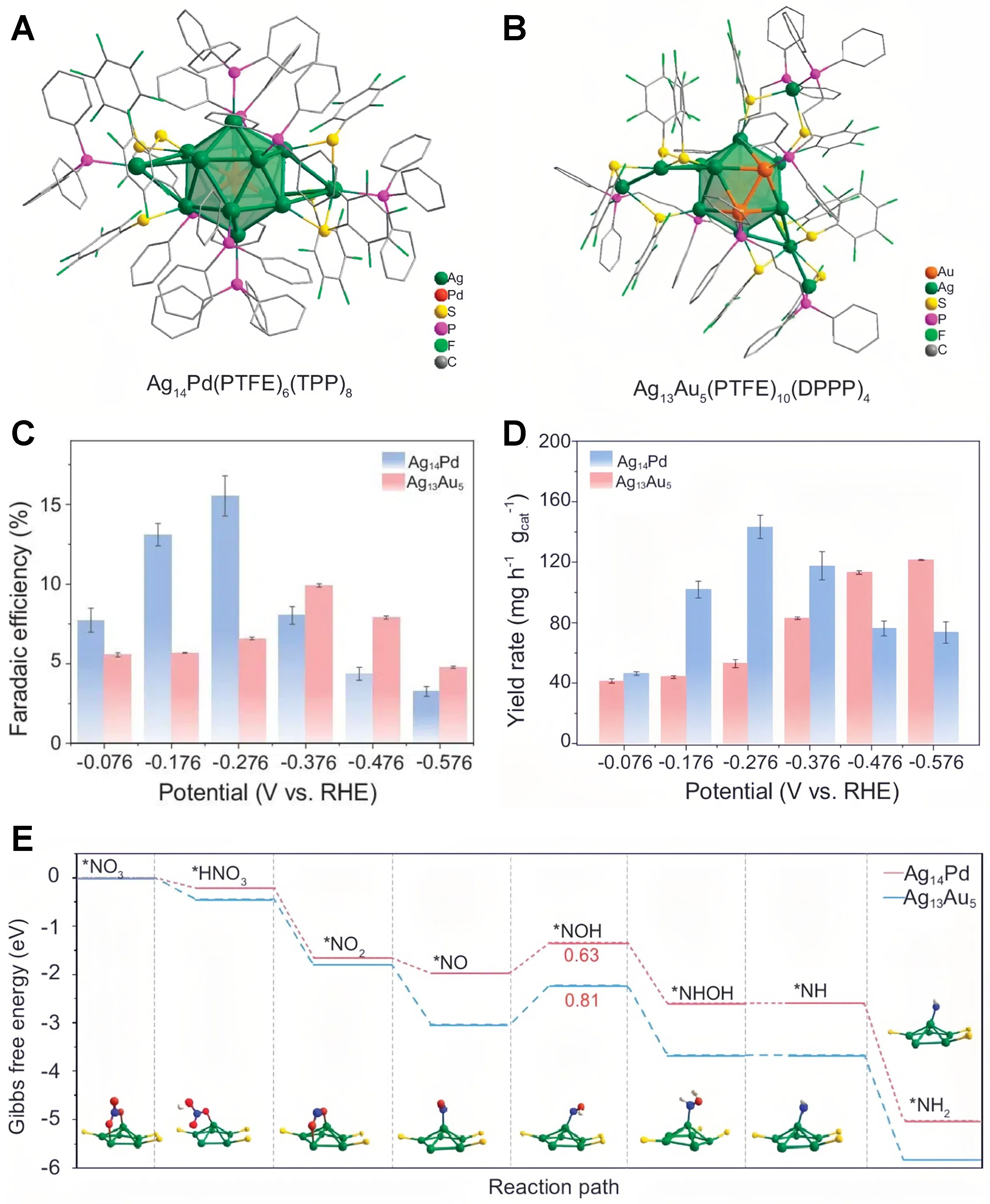
Figure 4. Overall structures of (A) Ag14Pd and (B) Ag13Au5 nanoclusters; (C) Potential dependent urea FEs and (D) the urea yield rates of Ag14Pd and Ag13Au5 nanoclusters; (E) Gibbs-free energy profile for urea production on Ag14Pd and Ag13Au5. Reproduced with permission, 2024 Oxford Academic Press[129]. FEs: Faradaic efficiencies; RHE: reversible hydrogen electrode.
Recently, Zhang et al. reported a carbene-ligand-protected AuAg nanocluster of [Au13Ag12(PPh3)8(BMIm)2I8]SbF6 (Au13Ag12), and studied the influence of the carbene ligand on the electrocatalytic urea synthesis[70]. The overall structure of Au13Ag12 is shown in Figure 5A and B. The Au13Ag12 nanocluster features a metal core of two vertex-sharing icosahedra in an S-configuration. Au atoms occupy the core, and they are bonded to the NHC ligands via shorter Au–C bonds (2.075 Å vs. Au–P: 2.30-2.34 Å), while Ag atoms at axial positions coordinate with the iodine ligands through Ag–I bonds (2.624 Å). Interestingly, when anchored on NiFe-LDH, the Au13Ag12 nanoclusters exhibited outstanding electrocatalytic performance for urea synthesis, achieving a urea production rate of 29.5 mmol·gcat-1·h-1 with a Faradaic efficiency (FE) of 34% at -0.5 V vs. reversible hydrogen electrode (RHE) [Figure 5C]. Such remarkable performance substantially surpasses that of AuAg nanoclusters stabilized by conventional ligands such as DPPP or Ph3P. Furthermore, the electrospray ionization mass spectrometry (ESI) results confirmed that the CO2 molecules can be chemically bonded onto the cluster surface [Figure 5D]. The authors also used the DFT calculations to study the electronic structure of the Au13Ag12 nanoclusters. Figure 5E-H presents the DFT-simulated l-Au-BMIm and l-Au-PPh3 and their bond properties. It can be noted that the carbene ligands can strengthen the Au–C bonds (2.01 Å bonding length vs. Au-PPh3: 2.30 Å) with higher bond energy (74.1 vs. 60.1 kcal/mol). There are frontier orbital overlaps between the Au orbitals and the carbene orbitals, specifically highest occupied molecular orbital (HOMO)-9 and HOMO-3, where HOMO-3 has an s character and HOMO-9 exhibits a p character. Specifically, a constructive overlap exists between Au’s
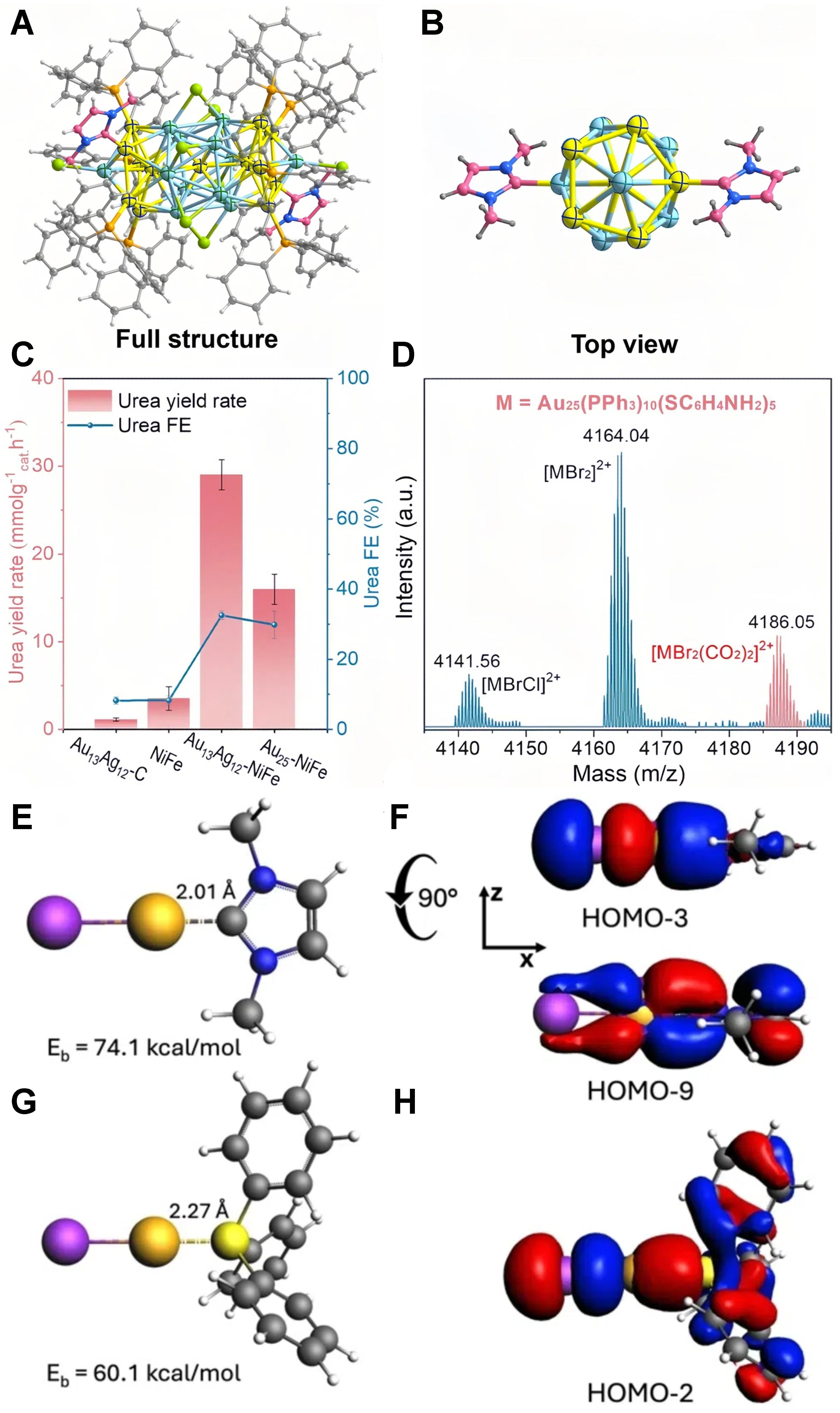
Figure 5. Crystal structure of Au13Ag12: BMIm: (A) full, (B) top view. Color code: Au, yellow; Ag, slate; P, orange; I, green; N, blue; C, gray and pink; (C) Urea FEs and the yield rates of a series of samples at -0.5 V (vs. RHE); (D) ESI-MS analysis of [Au25(PPh3)10(SC6H4NH2)X2]2+ (X: Cl/Br) nanocluster in CO2 saturated solution; (E) DFT structure of l-Au-BMIm and bond properties; (F) Two frontier MOs exhibit constructive overlap between Au orbitals and the carbene ligand; (G) DFT structure of I-Au-PPh3 and bond properties; (H) The HOMO-2 orbital possesses s character identical with that of the HOMO-3 orbital in l-Au-BMIm. Color code: Au (gold), P (yellow), Cl (green), C (gray), N (blue). Reprinted with permission, 2024 Wiley-VCH[70]. BMIm: 1, 3-Bimethylimidazole; FEs: Faradaic efficiencies; RHE: reversible hydrogen electrode; ESI-MS: electrospray ionization mass spectrometry; DFT: density functional theory; MOs: molecular orbitals; HOMO: highest occupied molecular orbital.
As a note, the electrocatalytic activity of the Au13Ag12, Ag14Pd cluster-based catalysts toward urea electrosynthesis - including the FEurea and the urea yield rate - is comparable to that of other Au/Ag-based nanostructure electrocatalysts, as compiled in Table 3.
Comparison of the electrocatalytic urea synthesis activity between the Au13Ag12, Ag14Pd and other Au/Ag-based nanostructure electrocatalysts
| Electrocatalyst | Electrolyte | Cell type | FEurea (%) | Yield rate (mmol·gcat·-1·h-1) | Ref. |
| Au13Ag12 | 0.1 M KHCO3 + 0.1 M KNO3 | H-cell | 34 | 29.5 | [70] |
| Ag14Pd | 1 M KOH | Flow-cell | 15.8 | ~2.39 | [129] |
| Ag-CuNi(OH)2 | 0.1 M KHCO3 + 0.1 M KNO3 | H-cell | 46.1 | 25.6 | [130] |
| AuCu SANFs | 0.5 M KHCO3 + 0.01 M KNO2 | H-cell | 24.7 | 64.83 | [131] |
| PdAuHene | 0.1 M KNO3 | H-cell | 33.88 | 6.68 | [132] |
| Ag@BiVO4/BiFeO3 | 0.2 M KHCO3 | H-cell | 24.4 | 1.2 | [133] |
| AuPd©SnOx | 0.075 M KHCO3 + 0.025 M KNO3 | H-cell | 21.3 | ~21.34 | [134] |
Besides the above electrocatalytic reactions, AuAg nanoclusters have also demonstrated great potential in other catalytic reactions such as multiple-component coupling reactions[135] and photoelectrochemical reactions[136]. Yet, from the structural view, the (electro)catalytic performance of the AuAg nanoclusters for various reactions, especially the complicated CO2RR and electrochemical urea synthesis, is mainly governed by the following factors: size, composition, charge state, metal core configuration, ligand type and spatial structure, as well as the metal-ligand bonding structure. These factors can significantly tune the catalytic active site, induce charge redistribution/polarization, optimize the adsorption capability of the reaction intermediates, and alter the energy barrier of the rate-determining step. These cross-reaction mechanistic principles must be considered in future AuAg nanocluster design for catalytic applications.
CONCLUSION AND OUTLOOK
Overall, the last decade has witnessed great success in the fundamental study of atomically precise AuAg nanoclusters, particularly in the development of synthetic methods and electrocatalytic applications. Despite the above progress, a series of critical challenges have gradually emerged, and addressing them with innovative solutions could bring new vitality to this field. Next, we will discuss the current main challenges and the potential opportunities for future developments.
1. Efficient synthetic methods with broad applicability are still lacking. For synthesizing atomically precise AuAg and other alloy metal nanoclusters with hierarchical structures, current methods face challenges such as complicated procedures, low yields, and poor product selectivity. More critically, most existing methods are only applicable to specific systems and lack general universality. In addition, these approaches heavily rely on “trial-and-error” strategies, which are labor-intensive, costly, tedious, and inefficient. Recently, machine learning (ML) has begun to make a significant impact on chemical sciences, including the study of metal nanoclusters[17,137,138]. ML has demonstrated great promise in the customized synthesis of metal nanoclusters[139], and it will likely revolutionize the future design of synthetic strategies for atomically precise AuAg nanoclusters.
2. Enhance the capability of precise structural design and structure extension of AuAg nanoclusters[29]. Improving the nanocluster catalytic performance heavily relies on precise structural design. However, technical bottlenecks persist in atomically precise control of size, composition, surface ligands, and spatial configuration. For example, designing nanocluster catalysts for electrocatalytic urea synthesis requires exact modulation of active site distribution and synergy to achieve efficient co-activation of N2 (NO3-, NO2-) and CO2 (HCO3-) - a demand unmet by the current methods[140]. In addition, extending the structures of AuAg nanoclusters can broaden the scope of research. For instance, introducing a heterometal atom into AuAg nanoclusters can tailor the catalytic performance. In 2022, our group reported the CO2RR performance of Au7Ag8 and Au2Ag8Cu5 clusters, where Au7Ag8 produces only CO, while Au2Ag8Cu5 yields HCO2H with a FE of 28.3%[141]. Encapsulating AuAg nanoclusters into a well-defined porous structure offers another way to tailor the functionality. A good example is the study conducted by Wang et al., in which the AuAg24 nanocluster was encapsulated into a metal-organic framework to form AuAg24@UiO-66-NH2 (UiO: University of Oslo) composite materials[142]. Such composite materials showed significantly enhanced activity in photocatalytic hydrogen production[142].
3. More in-depth reaction mechanism study in electrocatalytic applications. For electrocatalytic reactions involving complex processes with multiple electron/proton transfers, understanding the reaction mechanism - especially under working conditions - is extremely challenging. Atomically precise AuAg and other alloy nanoclusters have been employed as model catalysts for urea electrosynthesis, and will be expanded to other complicated electro-synthetic systems. The in-situ spectroscopic techniques - including in-situ attenuated total reflection surface-enhanced infrared spectroscopy (ATR-SEIRS), in-situ Raman spectroscopy, and the in-situ/operando synchrotron radiation techniques such as extended X-ray absorption fine structure (EXAFS), X-ray absorption near edge structure (XANES), and high-energy X-ray diffraction (HE-XRD) - can provide valuable information on key intermediates, helping to elucidate the reaction pathway and ultimately establish the structure-performance relationship[3,143,144]. For instance, in a recent study, our group reported an alkynyl-protected Ag16Cu18 cluster with intramolecular strain for oxime electrosynthesis, where ATR-SEIRS played a critical role in elucidating the reaction mechanism[145].
DECLARATIONS
Authors’ contributions
Literature search, original manuscript writing: Yang, J.
Literature search, format analysis: Qiao, L.
Format adjustment: Wu T.; Yang, C.; Liu, Z.
Supervision, manuscript editing: Chi, K.
Supervision, manuscript editing, funding acquisition: Tang, Z.
Availability of data and materials
Not applicable.
AI and AI-assisted tools statement
Not applicable.
Financial support and sponsorship
Tang, Z. acknowledges financial support from the Guangdong Natural Science Fund (No. 2023A0505050107).
Conflicts of interest
Qiao, L.; Yang, C. and Chi, K. are affiliated with the Petrochemical Research Institute, PetroChina Company Limited, China. The other authors declare that they have no conflicts of interest.
Ethical approval and consent to participate
Not applicable.
Consent for publication
Not applicable.
Copyright
© The Author(s) 2026.
REFERENCES
1. Du, Y.; Sheng, H.; Astruc, D.; Zhu, M. Atomically precise noble metal nanoclusters as efficient catalysts: a bridge between structure and properties. Chem. Rev. 2020, 120, 526-622.
2. Jin, R.; Li, G.; Sharma, S.; Li, Y.; Du, X. Toward active-site tailoring in heterogeneous catalysis by atomically precise metal nanoclusters with crystallographic structures. Chem. Rev. 2021, 121, 567-648.
3. Chen, M.; Guo, C.; Qin, L.; et al. Atomically precise Cu nanoclusters: recent advances, challenges, and perspectives in synthesis and catalytic applications. Nanomicro. Lett. 2024, 17, 83.
4. Shang, L.; Xu, J.; Nienhaus, G. U. Recent advances in synthesizing metal nanocluster-based nanocomposites for application in sensing, imaging and catalysis. Nano. Today. 2019, 28, 100767.
5. Qian, S.; Wang, Z.; Zuo, Z.; Wang, X.; Wang, Q.; Yuan, X. Engineering luminescent metal nanoclusters for sensing applications. Coord. Chem. Rev. 2022, 451, 214268.
6. Liu, Z.; Luo, L.; Kong, J.; Kahng, E.; Zhou, M.; Jin, R. Bright near-infrared emission from the Au39(SR)29 nanocluster. Nanoscale 2024, 16, 7419-26.
7. Obstarczyk, P.; Osmólska, J.; Swierczewski, M.; Bürgi, T.; Samoć, M.; Olesiak-Bańska, J. Enhanced nonlinear optical properties of Au25 nanocluster oligomers linked by bidentate dithiol. J. Mater. Chem. C. 2024, 12, 9571-7.
8. Li, J.; Bi, Y.; Liu, Z.; et al. Chiral metal nanocluster within nanoarchitecture of fullerene C60: chirality transfer and improvement of nonlinear optical property. Nano. Res. 2024, 17, 9255-60.
9. Jia, T. T.; Yang, G.; Mo, S. J.; et al. Atomically precise gold-levonorgestrel nanocluster as a radiosensitizer for enhanced cancer therapy. ACS. Nano. 2019, 13, 8320-8.
10. Hua, Y.; Huang, J. H.; Shao, Z. H.; et al. Composition-dependent enzyme mimicking activity and radiosensitizing effect of bimetallic clusters to modulate tumor hypoxia for enhanced cancer therapy. Adv. Mater. 2022, 34, e2203734.
11. Zhong, R. R.; Xie, M.; Luan, C. Z.; et al. Highly intense NIR emissive Cu4Pt2 bimetallic clusters featuring Pt(i)-Cu4-Pt(i) sandwich kernel. Chem. Sci. 2024, 15, 7552-9.
12. Kang, X.; Zhu, M. Tailoring the photoluminescence of atomically precise nanoclusters. Chem. Soc. Rev. 2019, 48, 2422-57.
13. Xu, M. M.; Jia, T. T.; Li, B.; et al. Tuning the properties of atomically precise gold nanoclusters for biolabeling and drug delivery. Chem. Commun. 2020, 56, 8766-9.
14. Jin, R.; Zeng, C.; Zhou, M.; Chen, Y. Atomically precise colloidal metal nanoclusters and nanoparticles: fundamentals and opportunities. Chem. Rev. 2016, 116, 10346-413.
15. Chakraborty, I.; Pradeep, T. Atomically precise clusters of noble metals: emerging link between atoms and nanoparticles. Chem. Rev. 2017, 117, 8208-71.
16. Yao, Q.; Chen, T.; Yuan, X.; Xie, J. Toward total synthesis of thiolate-protected metal nanoclusters. Acc. Chem. Res. 2018, 51, 1338-48.
17. Li, S.; Li, N. N.; Dong, X. Y.; Zang, S. Q.; Mak, T. C. W. Chemical flexibility of atomically precise metal clusters. Chem. Rev. 2024, 124, 7262-378.
18. Li, Y.; Zhou, M.; Song, Y.; Higaki, T.; Wang, H.; Jin, R. Double-helical assembly of heterodimeric nanoclusters into supercrystals. Nature 2021, 594, 380-4.
19. Yao, Q.; Liu, L.; Malola, S.; et al. Supercrystal engineering of atomically precise gold nanoparticles promoted by surface dynamics. Nat. Chem. 2023, 15, 230-9.
20. Shi, W. Q.; Zeng, L.; He, R. L.; et al. Near-unity NIR phosphorescent quantum yield from a room-temperature solvated metal nanocluster. Science 2024, 383, 326-30.
21. Yan, J.; Teo, B. K.; Zheng, N. Surface chemistry of atomically precise coinage-metal nanoclusters: from structural control to surface reactivity and catalysis. Acc. Chem. Res. 2018, 51, 3084-93.
22. Qin, R.; Liu, K.; Wu, Q.; Zheng, N. Surface coordination chemistry of atomically dispersed metal catalysts. Chem. Rev. 2020, 120, 11810-99.
23. Luo, X. M.; Li, Y. K.; Dong, X. Y.; Zang, S. Q. Platonic and Archimedean solids in discrete metal-containing clusters. Chem. Soc. Rev. 2023, 52, 383-444.
24. Wang, S.; Li, Q.; Kang, X.; Zhu, M. Customizing the structure, composition, and properties of alloy nanoclusters by metal exchange. Acc. Chem. Res. 2018, 51, 2784-92.
25. Ghosh, A.; Mohammed, O. F.; Bakr, O. M. Atomic-level doping of metal clusters. Acc. Chem. Res. 2018, 51, 3094-103.
26. Kang, X.; Li, Y.; Zhu, M.; Jin, R. Atomically precise alloy nanoclusters: syntheses, structures, and properties. Chem. Soc. Rev. 2020, 49, 6443-514.
27. Sharma, S.; Chakrahari, K. K.; Saillard, J. Y.; Liu, C. W. Structurally precise dichalcogenolate-protected copper and silver superatomic nanoclusters and their alloys. Acc. Chem. Res. 2018, 51, 2475-83.
28. Hossain, S.; Niihori, Y.; Nair, L. V.; Kumar, B.; Kurashige, W.; Negishi, Y. Alloy clusters: precise synthesis and mixing effects. Acc. Chem. Res. 2018, 51, 3114-24.
29. Xu, Q.; Gong, X.; Zhao, Z.; et al. Comprehensive and practical guidelines for reduction synthesis of atomically precise coinage–metal nanoclusters. Polyoxometalates 2025, 4, 9140075.
30. Kwak, K.; Choi, W.; Tang, Q.; et al. A molecule-like PtAu24(SC6H13)18 nanocluster as an electrocatalyst for hydrogen production. Nat. Commun. 2017, 8, 14723.
31. Kwak, K.; Lee, D. Electrochemistry of atomically precise metal nanoclusters. Acc. Chem. Res. 2019, 52, 12-22.
32. Choi, W.; Hu, G.; Kwak, K.; et al. Effects of metal-doping on hydrogen evolution reaction catalyzed by MAu24 and M2Au36 nanoclusters (M = Pt, Pd). ACS. Appl. Mater. Interfaces. 2018, 10, 44645-53.
33. Liu, X.; Cai, X.; Zhu, Y. Catalysis synergism by atomically precise bimetallic nanoclusters doped with heteroatoms. Acc. Chem. Res. 2023, 56, 1528-38.
34. Wang, S.; Jin, S.; Yang, S.; et al. Total structure determination of surface doping [Ag46Au24(SR)32](BPh4)2 nanocluster and its structure-related catalytic property. Sci. Adv. 2015, 1, e1500441.
35. Wang, Y.; Su, H.; Ren, L.; et al. Site preference in multimetallic nanoclusters: incorporation of alkali metal ions or copper atoms into the alkynyl-protected body-centered cubic cluster [Au7Ag8(C≡CtBu)12]+. Angew. Chem. Int. Ed. Engl. 2016, 55, 15152-6.
36. Ma, G.; Sun, F.; Qiao, L.; et al. Atomically precise alkynyl-protected Ag20Cu12 nanocluster: structure analysis and electrocatalytic performance toward nitrate reduction for NH3 synthesis. Nano. Res. 2023, 16, 10867-72.
37. Nag, A.; Butt, A. M.; Yang, M. Y.; et al. An atomically precise alloy AgCu cuboid nanocluster with a cubic core: gram scale synthesis, total structure, electronic structure, and catalytic performance. Mater. Horiz. 2025, 12, 5252-8.
38. Yan, J.; Su, H.; Yang, H.; et al. Total structure and electronic structure analysis of doped thiolated silver [MAg24(SR)18]2- (M = Pd, Pt) clusters. J. Am. Chem. Soc. 2015, 137, 11880-3.
39. Qin, L.; Sun, F.; Li, M.; et al. Atomically precise (AgPd)27 nanoclusters for nitrate electroreduction to NH3: modulating the metal core by a ligand induced strategy. Acta. Phys. Chim. Sin. 2025, 41, 100008.
40. Bootharaju, M. S.; Kozlov, S. M.; Cao, Z.; et al. Doping-induced anisotropic self-assembly of silver icosahedra in [Pt2Ag23Cl7(PPh3)10] nanoclusters. J. Am. Chem. Soc. 2017, 139, 1053-6.
41. He, L.; Yuan, J.; Xia, N.; et al. Kernel tuning and nonuniform influence on optical and electrochemical gaps of bimetal nanoclusters. J. Am. Chem. Soc. 2018, 140, 3487-90.
42. Bootharaju, M. S.; Chang, H.; Deng, G.; et al. Cd12Ag32(SePh)36: non-noble metal doped silver nanoclusters. J. Am. Chem. Soc. 2019, 141, 8422-5.
43. Chen, L.; Sun, F.; Shen, Q.; et al. Structure, optical properties, and catalytic applications of alkynyl-protected M4Rh2 (M = Ag/Au) nanoclusters with atomic precision: a comparative study. Dalton. Trans. 2023, 52, 9441-7.
44. Shah, S. A.; Hu, K.; Naveed, M.; et al. Synthesis of Au doped Ag nanoclusters and the doping effect of Au atoms on their physical and optical properties. Mater. Res. Express. 2020, 7, 016506.
45. Soldan, G.; Aljuhani, M. A.; Bootharaju, M. S.; et al. Gold doping of silver nanoclusters: a 26-fold enhancement in the luminescence quantum yield. Angew. Chem. Int. Ed. Engl. 2016, 55, 5749-53.
46. Chen, S.; Ma, H.; Padelford, J. W.; et al. Near infrared electrochemiluminescence of rod-shape 25-atom AuAg nanoclusters that is hundreds-fold stronger than that of Ru(bpy)3 standard. J. Am. Chem. Soc. 2019, 141, 9603-9.
47. Yin, Z.; Wang, Z.; Dai, X.; et al. Highly luminescent AuAg nanoclusters with aggregation-induced emission for high-performance white LED application. ACS. Sustainable. Chem. Eng. 2020, 8, 15336-43.
48. Zhou, Y.; Zheng, Y.; Zhu, X.; Chai, Y.; Yuan, R. Modular engineering of gold-silver nanocluster supermolecular structure endow strong electrochemiluminescence for ultrasensitive bioanalysis. Biosens. Bioelectron. 2021, 190, 113449.
49. Tang, W.; Chen, S.; Song, Y.; et al. Controllable fabrication of high-quantum-yield bimetallic gold/silver nanoclusters as multivariate sensing probe for Hg2+, H2O2, and glutathione based on AIE and peroxidase mimicking activity. J. Hazard. Mater. 2024, 480, 136254.
50. Wang, S.; Yu, H.; Zhu, M. Noble and valuable: atomically precise gold nanoclusters. Sci. China. Chem. 2016, 59, 206-8.
51. Wang, Z.; Pan, X.; Qian, S.; Yang, G.; Du, F.; Yuan, X. The beauty of binary phases: a facile strategy for synthesis, processing, functionalization, and application of ultrasmall metal nanoclusters. Coord. Chem. Rev. 2021, 438, 213900.
52. Lei, Z.; Wan, X. K.; Yuan, S. F.; Guan, Z. J.; Wang, Q. M. Alkynyl approach toward the protection of metal nanoclusters. Acc. Chem. Res. 2018, 51, 2465-74.
53. Liu, Z.; Liu, X.; Qin, L.; Chen, H.; Li, R.; Tang, Z. Alkynyl ligand for preparing atomically precise metal nanoclusters: structure enrichment, property regulation, and functionality enhancement. Chin. J. Struct. Chem. 2024, 43, 100405.
54. Qin, Z.; Zhang, J.; Wan, C.; et al. Atomically precise nanoclusters with reversible isomeric transformation for rotary nanomotors. Nat. Commun. 2020, 11, 6019.
55. Zhuang, S.; Chen, D.; Ng, W. P.; et al. Phosphine-triggered structural defects in Au44 homologues boost electrocatalytic CO2 reduction. Angew. Chem. Int. Ed. Engl. 2023, 62, e202306696.
56. Wang, Z.; Senanayake, R.; Aikens, C. M.; Chen, W. M.; Tung, C. H.; Sun, D. Gold-doped silver nanocluster [Au3Ag38(SCH2Ph)24X5]2- (X = Cl or Br). Nanoscale 2016, 8, 18905-11.
57. Shen, H.; Tian, G.; Xu, Z.; et al. N-heterocyclic carbene coordinated metal nanoparticles and nanoclusters. Coord. Chem. Rev. 2022, 458, 214425.
58. Albright, E. L.; Levchenko, T. I.; Kulkarni, V. K.; et al. N-heterocyclic carbene-stabilized atomically precise metal nanoclusters. J. Am. Chem. Soc. 2024, 146, 5759-80.
59. Fei, W.; Tao, Y.; Qiao, Y.; Tang, S.; Li, M. Structural modification and performance regulation of atomically precise metal nanoclusters by phosphine. Polyoxometalates 2023, 2, 9140043.
60. Yan, H.; Xiang, H.; Liu, J.; et al. The factors dictating properties of atomically precise metal nanocluster electrocatalysts. Small 2022, 18, e2200812.
61. Deng, G.; Ki, T.; Liu, X.; et al. Tailoring the subshell and electronic structure of an atomically precise AuAg alloy nanocluster. Chem. Commun. 2024, 60, 1289-92.
62. Qin, Z.; Zhao, D.; Zhao, L.; et al. Tailoring the stability, photocatalysis and photoluminescence properties of Au11 nanoclusters via doping engineering. Nanoscale. Adv. 2019, 1, 2529-36.
63. Shen, Y.; Liu, D.; Li, X. Homoleptic alkynyl-protected [Ag8Cu7(tBuC≡C)12]+ nanoclusters: synthesis, structure and ligand exchange induced transformation. J. Clust. Sci. 2024, 35, 1959-65.
64. Bootharaju, M. S.; Joshi, C. P.; Parida, M. R.; Mohammed, O. F.; Bakr, O. M. Templated atom-precise galvanic synthesis and structure elucidation of a [Ag24Au(SR)18]- nanocluster. Angew. Chem. Int. Ed. Engl. 2016, 55, 922-6.
65. Bootharaju, M. S.; Sinatra, L.; Bakr, O. M. Distinct metal-exchange pathways of doped Ag25 nanoclusters. Nanoscale 2016, 8, 17333-9.
66. Yao, Q.; Feng, Y.; Fung, V.; et al. Precise control of alloying sites of bimetallic nanoclusters via surface motif exchange reaction. Nat. Commun. 2017, 8, 1555.
67. Du, W.; Jin, S.; Xiong, L.; et al. Ag50(Dppm)6(SR)30 and its homologue AuxAg50-x(Dppm)6(SR)30 alloy nanocluster: seeded growth, structure determination, and differences in properties. J. Am. Chem. Soc. 2017, 139, 1618-24.
68. Wu, Z. Anti-galvanic reduction of thiolate-protected gold and silver nanoparticles. Angew. Chem. Int. Ed. Engl. 2012, 51, 2934-8.
69. Yao, C.; Chen, J.; Li, M. B.; Liu, L.; Yang, J.; Wu, Z. Adding two active silver atoms on Au25 nanoparticle. Nano. Lett. 2015, 15, 1281-7.
70. Zhang, J.; Zhang, Y.; Qin, Z.; et al. How carbene ligands transform AuAg alloy nanoclusters for electrocatalytic urea synthesis. Angew. Chem. Int. Ed. Engl. 2025, 64, e202420993.
71. Zhu, M.; Wang, P.; Yan, N.; et al. The fourth alloying mode by way of anti-galvanic reaction. Angew. Chem. Int. Ed. Engl. 2018, 57, 4500-4.
72. Zhuang, S.; Chen, D.; Fan, W.; et al. Single-atom-kernelled nanocluster catalyst. Nano. Lett. 2022, 22, 7144-50.
73. Kang, X.; Zhu, M. Transformation of atomically precise nanoclusters by ligand-exchange. Chem. Mater. 2019, 31, 9939-69.
74. Kang, X.; Xiong, L.; Wang, S.; Pei, Y.; Zhu, M. Combining the single-atom engineering and ligand-exchange strategies: obtaining the single-heteroatom-doped Au16Ag1(S-Adm)13 nanocluster with atomically precise structure. Inorg. Chem. 2018, 57, 335-42.
75. Hu, J.; Zhou, M.; Li, K.; et al. Evolution of electrocatalytic CO2 reduction activity induced by charge segregation in atomically precise AuAg nanoclusters based on icosahedral M13 unit 3D assembly. Small 2023, 19, e2301357.
76. Kuang, K.; Zhou, C.; Jing, M.; et al. Enhanced electrochemiluminescence of rod-shape 25-atom AuAg nanoclusters through ligand engineering. ChemElectroChem 2024, 11, e202300503.
77. Zan, X.; Li, Q.; Pan, Y.; et al. Versatile ligand-exchange method for the synthesis of water-soluble monodisperse AuAg nanoclusters for cancer therapy. ACS. Appl. Nano. Mater. 2018, 1, 6773-81.
78. Niihori, Y.; Eguro, M.; Kato, A.; et al. Improvements in the ligand-exchange reactivity of phenylethanethiolate-protected Au25 nanocluster by Ag or Cu incorporation. J. Phys. Chem. C. 2016, 120, 14301-9.
79. Wang, Y. X.; Zhang, J.; Su, H. F.; et al. Photochemical synthesis of atomically precise Ag nanoclusters. ACS. Nano. 2023, 17, 11607-15.
80. Krishnadas, K. R.; Baksi, A.; Ghosh, A.; Natarajan, G.; Som, A.; Pradeep, T. Interparticle reactions: an emerging direction in nanomaterials chemistry. Acc. Chem. Res. 2017, 50, 1988-96.
81. Krishnadas, K. R.; Baksi, A.; Ghosh, A.; Natarajan, G.; Pradeep, T. Manifestation of geometric and electronic shell structures of metal clusters in intercluster reactions. ACS. Nano. 2017, 11, 6015-23.
82. Seh, Z. W.; Kibsgaard, J.; Dickens, C. F.; Chorkendorff, I.; Nørskov, J. K.; Jaramillo, T. F. Combining theory and experiment in electrocatalysis: insights into materials design. Science 2017, 355, eaad4998.
83. Wang, Y.; Zheng, X.; Wang, D. Design concept for electrocatalysts. Nano. Res. 2022, 15, 1730-52.
84. Fu, X.; Zhang, J.; Kang, Y. Recent advances and challenges of electrochemical ammonia synthesis. Chem. Catal. 2022, 2, 2590-613.
85. Zhang, J.; Fu, X.; Kwon, S.; et al. Tantalum-stabilized ruthenium oxide electrocatalysts for industrial water electrolysis. Science 2025, 387, 48-55.
86. Li, C.; Chai, O. J. H.; Yao, Q.; et al. Electrocatalysis of gold-based nanoparticles and nanoclusters. Mater. Horiz. 2021, 8, 1657-82.
87. Liu, Y.; Yu, J.; Lun, Y.; Wang, Y.; Wang, Y.; Song, S. Ligand design in atomically precise copper nanoclusters and their application in electrocatalytic reactions. Adv. Funct. Mater. 2023, 33, 2304184.
88. Jing, W.; Shen, H.; Qin, R.; Wu, Q.; Liu, K.; Zheng, N. Surface and interface coordination chemistry learned from model heterogeneous metal nanocatalysts: from atomically dispersed catalysts to atomically precise clusters. Chem. Rev. 2023, 123, 5948-6002.
89. Walter, M. G.; Warren, E. L.; McKone, J. R.; et al. Solar water splitting cells. Chem. Rev. 2010, 110, 6446-73.
90. Jiang, W. J.; Tang, T.; Zhang, Y.; Hu, J. S. Synergistic modulation of non-precious-metal electrocatalysts for advanced water splitting. Acc. Chem. Res. 2020, 53, 1111-23.
91. Li, L.; Wang, P.; Shao, Q.; Huang, X. Metallic nanostructures with low dimensionality for electrochemical water splitting. Chem. Soc. Rev. 2020, 49, 3072-106.
92. Deshmukh, M. A.; Bakandritsos, A.; Zbořil, R. Bimetallic single-atom catalysts for water splitting. Nanomicro. Lett. 2024, 17, 1.
93. Chen, M.; Tan, S. X.; Cheng, S.; et al. Revisiting the ruthenium oxide-based water oxidation catalysts in acidic media: from amorphous to crystalline. Nano. Energy. 2025, 137, 110800.
94. Zhu, J.; Hu, L.; Zhao, P.; Lee, L. Y. S.; Wong, K. Y. Recent advances in electrocatalytic hydrogen evolution using nanoparticles. Chem. Rev. 2020, 120, 851-918.
95. Kuang, Y.; Yang, F.; Feng, L. Advancements in ruthenium (Ru)-based heterostructure catalysts: overcoming bottlenecks in catalysis for hydrogen evolution reaction. Adv. Energy. Mater. 2024, 14, 2402043.
96. Zhao, S.; Jin, R.; Song, Y.; et al. Atomically precise gold nanoclusters accelerate hydrogen evolution over MoS2 nanosheets: the dual interfacial effect. Small 2017, 13, 1701519.
97. Zhao, S.; Jin, R.; Abroshan, H.; et al. Gold nanoclusters promote electrocatalytic water oxidation at the nanocluster/CoSe2 interface. J. Am. Chem. Soc. 2017, 139, 1077-80.
98. Shen, Q.; Shen, L.; Chen, L.; et al. Heterointerface of all-alkynyl-protected Au28 nanoclusters anchored on NiFe-LDHs boosts oxygen evolution reaction: a case to unravel ligand effect. Rare. Met. 2023, 42, 4029-38.
99. Chen, M.; Shen, L.; Qin, L.; Ciucci, F.; Tang, Z. Atomically precise Cu6 nanoclusters for oxygen evolution catalysis: a combined experimental and theoretical study. Rare. Met. 2025, 44, 2428-37.
100. Du, Y.; Xiang, J.; Ni, K.; et al. Design of atomically precise Au2Pd6 nanoclusters for boosting electrocatalytic hydrogen evolution on MoS2. Inorg. Chem. Front. 2018, 5, 2948-54.
101. Tang, Y.; Sun, F.; Ma, X.; et al. Alkynyl and halogen co-protected (AuAg)44 nanoclusters: a comparative study on their optical absorbance, structure, and hydrogen evolution performance. Dalton. Trans. 2022, 51, 7845-50.
102. Li, Y.; Li, S.; Nagarajan, A. V.; et al. Hydrogen evolution electrocatalyst design: Turning inert gold into active catalyst by atomically precise nanochemistry. J. Am. Chem. Soc. 2021, 143, 11102-8.
103. Liu, X.; Tang, Y.; Chen, L.; Wang, L.; Liu, Y.; Tang, Z. Atomically precise Au15Ag23 nanoclusters co-protected by alkynyl and bromine: structure analysis and electrocatalytic application toward overall water splitting. Int. J. Hydrogen. Energy. 2024, 53, 300-7.
104. Birdja, Y. Y.; Pérez-Gallent, E.; Figueiredo, M. C.; Göttle, A. J.; Calle-Vallejo, F.; Koper, M. T. M. Advances and challenges in understanding the electrocatalytic conversion of carbon dioxide to fuels. Nat. Energy. 2019, 4, 732-45.
105. Saha, P.; Amanullah, S.; Dey, A. Selectivity in electrochemical CO2 reduction. Acc. Chem. Res. 2022, 55, 134-44.
106. Jiang, M.; Wang, H.; Zhu, M.; et al. Review on strategies for improving the added value and expanding the scope of CO2 electroreduction products. Chem. Soc. Rev. 2024, 53, 5149-89.
107. Wu, Y.; Jiang, Z.; Lu, X.; Liang, Y.; Wang, H. Domino electroreduction of CO2 to methanol on a molecular catalyst. Nature 2019, 575, 639-42.
108. Zhu, P.; Wang, H. High-purity and high-concentration liquid fuels through CO2 electroreduction. Nat. Catal. 2021, 4, 943-51.
109. Shirzadi, E.; Jin, Q.; Zeraati, A. S.; et al. Ligand-modified nanoparticle surfaces influence CO electroreduction selectivity. Nat. Commun. 2024, 15, 2995.
110. Seong, H.; Choi, M.; Park, S.; et al. Promoting CO2-to-CO electroreduction via the active-site engineering of atomically precise silver nanoclusters. ACS. Energy. Lett. 2022, 7, 4177-84.
111. Yoo, S.; Yoo, S.; Deng, G.; et al. Nanocluster surface microenvironment modulates electrocatalytic CO2 reduction. Adv. Mater. 2024, 36, e2313032.
112. Xu, J.; Xiong, L.; Cai, X.; et al. Evolution from superatomic Au24Ag20 monomers into molecular-like Au43Ag38 dimeric nanoclusters. Chem. Sci. 2022, 13, 2778-82.
113. Yoo, S.; Kim, D.; Deng, G.; et al. Impact of heterocore atoms on CO2 electroreduction in atomically precise silver nanoclusters. J. Am. Chem. Soc. 2025, 147, 12546-54.
114. Kulkarni, V. K.; Khiarak, B. N.; Takano, S.; et al. N-heterocyclic carbene-stabilized hydrido Au24 nanoclusters: synthesis, structure, and electrocatalytic reduction of CO2. J. Am. Chem. Soc. 2022, 144, 9000-6.
115. Qin, L.; Sun, F.; Ma, X.; et al. Homoleptic alkynyl-protected Ag15 nanocluster with atomic precision: structural analysis and electrocatalytic performance toward CO2 reduction. Angew. Chem. Int. Ed. Engl. 2021, 60, 26136-41.
116. Zhou, J. H.; Lan, D. W.; Yang, S. S.; et al. Thin-walled hollow Au–Cu nanostructures with high efficiency in electrochemical reduction of CO2 to CO. Inorg. Chem. Front. 2018, 5, 1524-32.
117. Liu, S.; Wang, X.; Tao, H.; et al. Ultrathin 5-fold twinned sub-25 nm silver nanowires enable highly selective electroreduction of CO2 to CO. Nano. Energy. 2018, 45, 456-62.
118. Chen, Q.; Liu, K.; Zhou, Y.; et al. Ordered Ag nanoneedle arrays with enhanced electrocatalytic CO2 reduction via structure-induced inhibition of hydrogen evolution. Nano. Lett. 2022, 22, 6276-84.
119. Gao, Z. H.; Wei, K.; Wu, T.; et al. A heteroleptic gold hydride nanocluster for efficient and selective electrocatalytic reduction of CO2 to CO. J. Am. Chem. Soc. 2022, 144, 5258-62.
120. Chen, C.; He, N.; Wang, S. Electrocatalytic C-N coupling for urea synthesis. Small. Sci. 2021, 1, 2100070.
121. Zhang, D.; Xue, Y.; Zheng, X.; Zhang, C.; Li, Y. Multi-heterointerfaces for selective and efficient urea production. Natl. Sci. Rev. 2023, 10, nwac209.
122. Hu, Q.; Zhou, W.; Qi, S.; et al. Pulsed co-electrolysis of carbon dioxide and nitrate for sustainable urea synthesis. Nat. Sustain. 2024, 7, 442-51.
123. Wei, X.; Liu, S. Q.; Liu, H.; et al. Lattice oxygen-driven co-adsorption of carbon dioxide and nitrate on copper: a pathway to efficient urea electrosynthesis. J. Am. Chem. Soc. 2025, 147, 6049-57.
124. Jiang, M.; Zhu, M.; Wang, M.; et al. Review on electrocatalytic coreduction of carbon dioxide and nitrogenous species for urea synthesis. ACS. Nano. 2023, 17, 3209-24.
125. Liu, J.; Li, Z.; Lv, C.; et al. Electrocatalytic upgrading of nitrogenous wastes into value-added chemicals: a review. Mater. Today. 2024, 73, 208-59.
126. Sui, X.; Wu, L.; Jia, S.; Jin, X.; Sun, X.; Han, B. CO2/NOx-involved electrochemical C-N coupling reactions. Chem. Res. Chin. Univ. 2024, 40, 764-75.
127. Li, Z.; Abroshan, H.; Liu, C.; Li, G. A critical review on the catalytic applications of non-metallic gold nanoclusters: selective oxidation, hydrogenation, and coupling reactions. Curr. Org. Chem. 2017, 21, 476-88. https://www.ingentaconnect.com/content/ben/coc/2017/00000021/00000006/art00003. (accessed 16 Dec 2025).
128. Sun, M.; Wu, G.; Jiang, J.; et al. Carbon-anchored molybdenum oxide nanoclusters as efficient catalysts for the electrosynthesis of ammonia and urea. Angew. Chem. Int. Ed. Engl. 2023, 62, e202301957.
129. Chen, H.; Liu, L.; Ma, X. H.; et al. Atomically precise silver-based bimetallic clusters for electrocatalytic urea synthesis. Natl. Sci. Rev. 2025, 12, nwae440.
130. Ye, W.; Zhang, Y.; Chen, L.; et al. A strongly coupled metal/hydroxide heterostructure cascades carbon dioxide and nitrate reduction reactions toward efficient urea electrosynthesis. Angew. Chem. Int. Ed. Engl. 2024, 63, e202410105.
131. Liu, S.; Yin, S.; Wang, Z.; et al. AuCu nanofibers for electrosynthesis of urea from carbon dioxide and nitrite. Cell. Rep. Phys. Sci. 2022, 3, 100869.
132. Xu, Y.; Wang, J.; Sheng, Y.; et al. Synergism of hydrogen-induced interstitial effect and gold-induced alloying effect in PdAuH metallene for urea electrosynthesis from nitrate and carbon dioxide. Inorg. Chem. 2025, 64, 3418-26.
133. Faustino, L. A.; de Angelis, L. D.; de Melo, E. C.; et al. Urea synthesis by Plasmon-Assisted N2 and CO2 co-electrolysis onto heterojunctions decorated with silver nanoparticles. Chem. Eng. J. 2025, 513, 163072.
134. Wang, H.; Tu, Y.; Li, S.; et al. Positive feedback of intermediates promotes efficient electrocatalytic C-N coupling at AuPd/SnOx interfaces. Appl. Catal. B. Environ. Energy. 2024, 358, 124355.
135. Qin, Z.; Sharma, S.; Wan, C. Q.; et al. A homoleptic alkynyl-ligated [Au13Ag16L24]3- cluster as a catalytically active eight-electron superatom. Angew. Chem. Int. Ed. Engl. 2021, 60, 970-5.
136. Jiang, Z.; Li, Z.; He, Q.; et al. Marrying luminescent metal nanoclusters to C3N4 for efficient photocatalytic hydrogen peroxide production. Mater. Rep. Energy. 2024, 4, 100267.
137. Wang, S.; Liu, T.; Jiang, D. E. Locating hydrides in ligand-protected copper nanoclusters by deep learning. ACS. Appl. Mater. Interfaces. 2021, 13, 53468-74.
138. Mastracco, P.; Gonzàlez-Rosell, A.; Evans, J.; Bogdanov, P.; Copp, S. M. Chemistry-informed machine learning enables discovery of DNA-stabilized silver nanoclusters with near-infrared fluorescence. ACS. Nano. 2022, 16, 16322-31.
139. Li, J.; Chen, T.; Lim, K.; et al. Deep learning accelerated gold nanocluster synthesis. Adv. Intell. Syst. 2019, 1, 1900029.
140. Peng, X.; Zeng, L.; Wang, D.; et al. Electrochemical C-N coupling of CO2 and nitrogenous small molecules for the electrosynthesis of organonitrogen compounds. Chem. Soc. Rev. 2023, 52, 2193-237.
141. Ma, X.; Sun, F.; Qin, L.; et al. Electrochemical CO2 reduction catalyzed by atomically precise alkynyl-protected Au7Ag8, Ag9Cu6, and Au2Ag8Cu5 nanoclusters: probing the effect of multi-metal core on selectivity. Chem. Sci. 2022, 13, 10149-58.
142. Wang, H.; Zhang, X.; Zhang, W.; Zhou, M.; Jiang, H. L. Heteroatom-doped Ag25 nanoclusters encapsulated in metal-organic frameworks for photocatalytic hydrogen production. Angew. Chem. Int. Ed. Engl. 2024, 63, e202401443.
143. Firet, N. J.; Blommaert, M. A.; Burdyny, T.; et al. Operando EXAFS study reveals presence of oxygen in oxide-derived silver catalysts for electrochemical CO2 reduction. J. Mater. Chem. A. 2019, 7, 2597-607.
144. Yang, Y.; Louisia, S.; Yu, S.; et al. Operando studies reveal active Cu nanograins for CO2 electroreduction. Nature 2023, 614, 262-9.
Cite This Article
 Open Access
How to Cite
Download Citation
Export Citation File:
Type of Import
Tips on Downloading Citation
Citation Manager File Format
Type of Import
Direct Import: When the Direct Import option is selected (the default state), a dialogue box will give you the option to Save or Open the downloaded citation data. Choosing Open will either launch your citation manager or give you a choice of applications with which to use the metadata. The Save option saves the file locally for later use.
Indirect Import: When the Indirect Import option is selected, the metadata is displayed and may be copied and pasted as needed.
About This Article
Copyright

Data & Comments
Data
0











Comments
Comments must be written in English. Spam, offensive content, impersonation, and private information will not be permitted. If any comment is reported and identified as inappropriate content by OAE staff, the comment will be removed without notice. If you have any queries or need any help, please contact us at [email protected].