
fig16
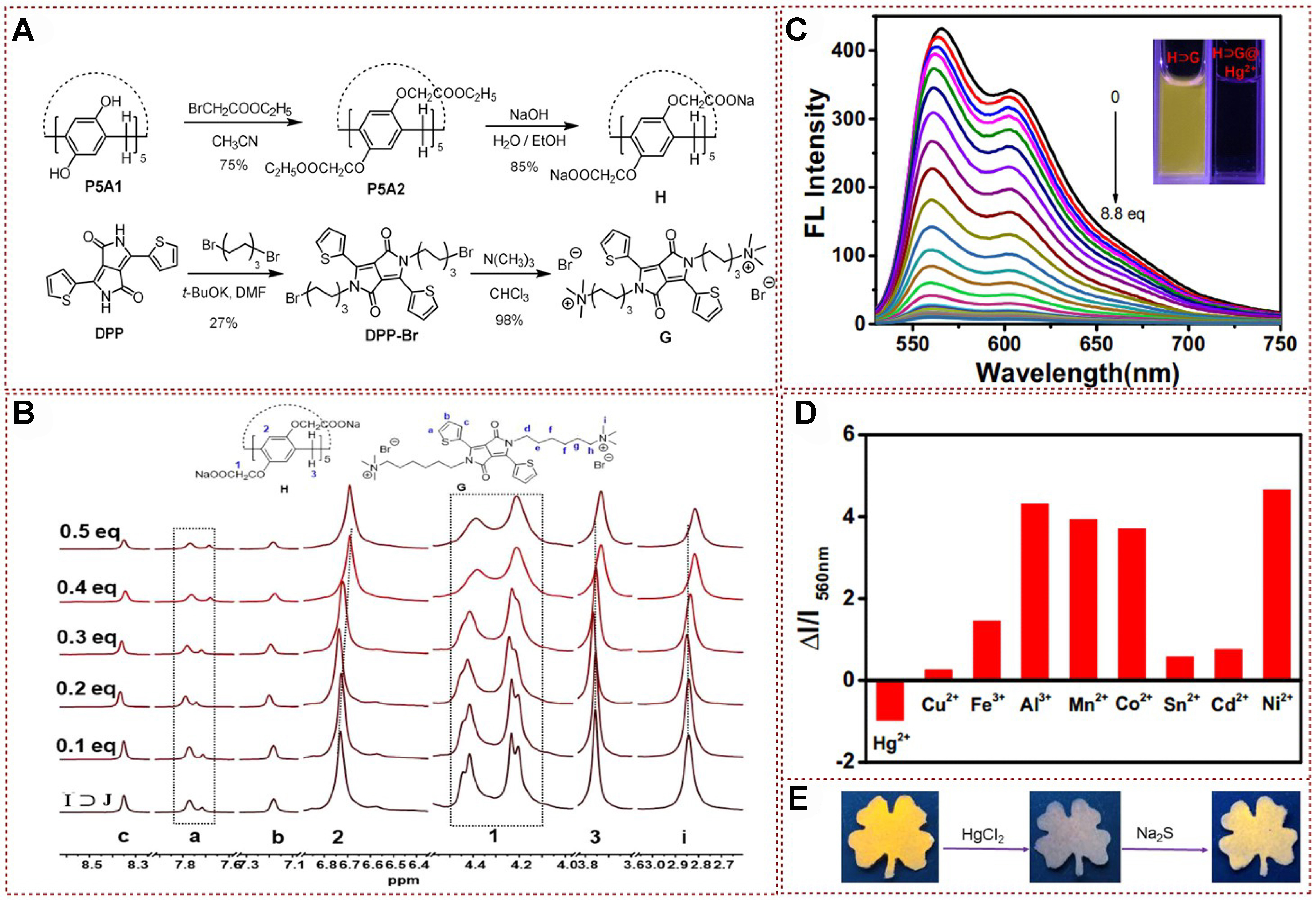
Figure 16. (A) Synthetic route. The host molecule H and the guest molecule G were synthesized through a series of chemical reactions, carefully controlled to ensure purity and efficiency; (B) The partial 1H NMR titration spectra of the H⊃G complex were recorded with varying equivalents of Hg2+ to observe the chemical shifts and interactions between the host-guest complex and the mercury ions; (C) Fluorescence spectra were obtained for the self-assembled H⊃G complex in the presence of increasing concentrations of Hg2+ to investigate the fluorescent response and sensitivity of the system to mercury ions; (D) The emission spectra of the H⊃G self-assembly were measured in an aqueous solution after the addition of 50 equivalents of various metal ions to assess the selectivity and specificity of the system towards different metals; (E) Photographs were taken of H⊃G-loaded filter paper exposed to Hg2+ and then treated with S2-, illuminated with 365 nm UV light, to visually demonstrate the system’s response to these specific ions[3]. Copyright 2022, MDPI. UV: Ultraviolet.