

fig7

Molecular structure design of polymers of intrinsic microporosity for membrane separation

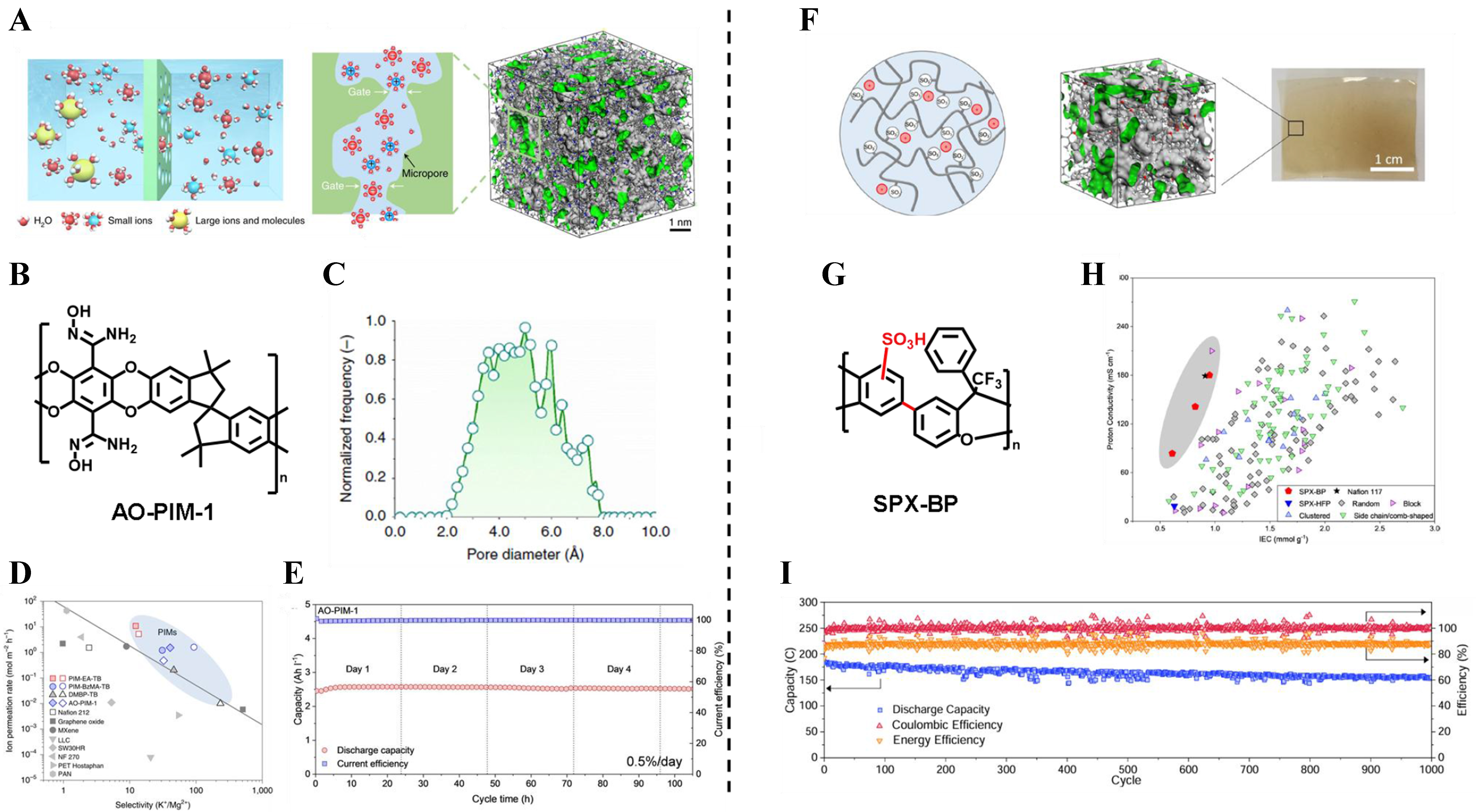
Figure 7. PFPIM membranes in redox flow battery. (A) Schematic diagram of ion exchange in aqueous organic redox flow batteries; (B) Chemical structure of AOPIM-1; (C) Pore size distribution of AOPIM-1; (D) The position of PIMs with other ion-change membranes at the upper bound of K+/Mg2+ separation; (E) long-term stability of the cells assembled with AOPIM-1 membrane at a current density of 40 mA·cm-2[99]; (F) Schematic illustration of membrane microstructure; (G) Structure of the SPX-BP membrane; (H) A plot illustrating the relationship between proton conductivity and IEC of SPX-BP, Nafion 117, and some classic phase-separated membranes; (I) Long-term stability of cells assembled with SPX-BP-0.95 at a current of 60 mA·cm-2[80]. PFPIM: Polar groups-functionalized polymers of intrinsic microporosity; AOPIM-1: amidoxime-functionalized polymers of intrinsic microporosity-1; PIMs: polymers of intrinsic microporosity; IEC: ion exchange capacity.

Chemical Synthesis
ISSN 2769-5247 (Online)

Portico

All published articles are preserved here permanently:

https://www.portico.org/publishers/oae/

Portico

All published articles are preserved here permanently:

https://www.portico.org/publishers/oae/