
fig7

Micro-/nano-engineering for battery materials and interface

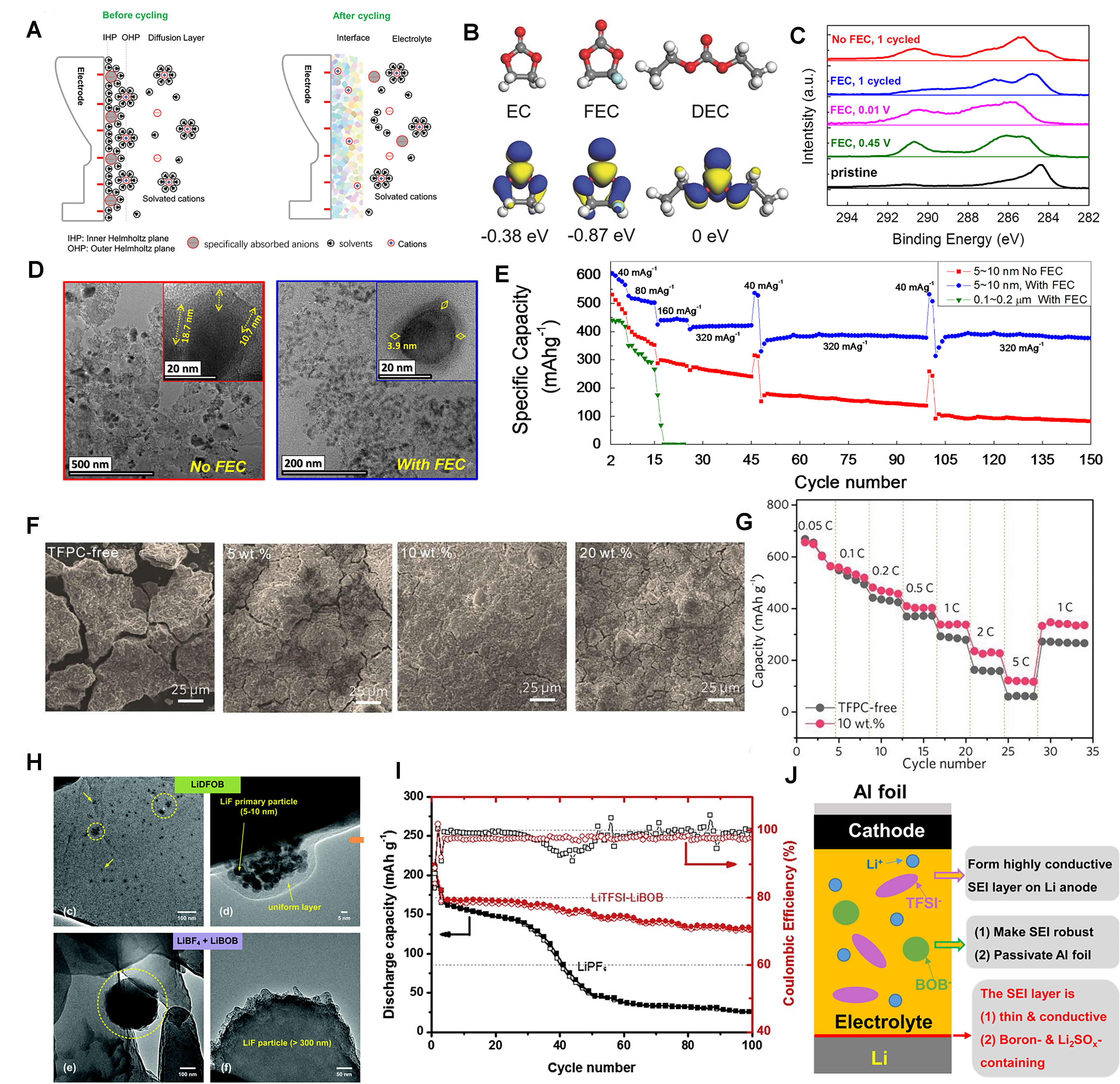
Figure 7. (A) The schematic diagram of the interface formation before and after cycling[97]. Copyright 2020, Wiley-VCH; (B) Molecular structure, visual LUMO and corresponding relative energy of EC, FEC, and DEC[100]. Copyright 2017, Wiley-VCH; (C) XPS C1s peaks of Sn electrode with FEC during 1st formation cycle; (D) HR-TEM images of cycled Sn electrode without FEC and with FEC additive; (E) Rate and cycle performance of Sn electrode without FEC and with FEC additive[101]. Copyright 2015, Elsevier; (F) SEM images of Si electrodes after cycling in the electrolytes containing 0, 5, 10, and 20 wt% TFPC for 50 cycles; (G) Rate capability of Si/C composite electrodes in the electrolytes without and with 10 wt% TFPC at various C rates[102]. Copyright 2019, Wiley-VCH; (H) TEM images of lithium plated from 1.2 M LiDFOB in EC:EMC, 0.6 M LiBF4 + 0.6 M LiBOB in EC:EMC[103]. Copyright 2018, RSC; (I) Cycle performance of the Li||NCA cells using the LiPF6 and LiTFSI-LiBOB electrolytes; (J) Schematic illustration of the effects of LiTFSI and LiBOB in the dual-salt electrolyte[92]. Copyright 2016, Elsevier. DEC: Diethyl carbonate; EC: ethylene carbonate; EMC: ethyl methyl carbonate; FEC: fluoroethylene carbonate; HR-TEM: high-resolution transmission electron microscopy; LiBOB: lithium Bis(oxalato)borate; LiDFOB: lithium Difluoro(oxalato)borate; LiTFSI: lithium Bis(trifluoromethanesulfonyl)imide; LUMO: lowest unoccupied molecular orbital; NCA: lithium nickel cobalt aluminum oxide; SEM: scanning electron microscopy; TFPC: trifluoropropylene carbonate; XPS: X-ray photoelectron spectroscopy; SEI: solid electrolyte interphase.

Chemical Synthesis
ISSN 2769-5247 (Online)

Portico

All published articles are preserved here permanently:

https://www.portico.org/publishers/oae/

Portico

All published articles are preserved here permanently:

https://www.portico.org/publishers/oae/