

Climate change calls for adapting energy systems and addressing resource adequacy risks
 0



 Download PDF
Transitioning from fossil fuels to variable renewable energy (vRE), such as solar and wind power, poses substantial resource adequacy (RA) risks. The spatial and temporal variability of these weather-dependent resources lead to supply-demand mismatches. Managing these risks is crucial, as vREs are projected to supply well over half of global power production by 2050.
Qiu et al. from the Massachusetts Institute of Technology (MIT) discuss these risks in their recent article published in Nature Energy[1]. They conclude that intensifying climate change will amplify renewable resource adequacy risks by shifting power supply and demand patterns, requiring resiting and reoptimization of vRE to deploy cost-effective, climate-resilient, and resource-adequate solutions. The study raises important considerations regarding its assumptions, limitations, real-world applicability, and implications for subsequent research.
The weather-energy modeling with comprehensive statistical analyses in the MIT study corresponds to the state-of-the-art. Future weather forecasts were obtained through thermodynamic modification of historical weather by superimposing thermal perturbations from a high-sensitivity CMIP6 model onto historical data (1980-2019)[2,3], yielding physically consistent climate projections for regional mesoscale climate until the year 2100. A drawback of this approach is that it overlooks new patterns in extreme events outside the historical data set, which could underestimate resilience effects. The hourly solar and wind data for the power system simulations were obtained through dynamical downscaling of climate fields, which better preserves the physical consistency of regional climate dynamics than statistical or numerical downscaling. Though machine learning techniques for downscaling have progressed significantly in recent years, they were not yet applicable here, because maintaining physical consistency remains challenging, among other issues[4].
The techno-economic system formed another critical modeling layer in the MIT study. The power system was simulated over a 50-year period using a 12 km resolution, county-level network across New England (ISO-NE, 321 sites) and Texas (ERCOT, 1,430 sites)[1], averaging ~500 km2 per site. The vRE resource was aggregated from a fine 100 m resolution to model a fully decarbonized solar-wind-4-h-battery system. System optimization aimed to minimize total system costs based on constant NREL Baseline 2023 technology costs, omitting technology progress over the simulation timeline, which could affect the optimized technology portfolios. Penalizing unserved energy at a high $100/kWh Value of Lost Load enforced capacity and infrastructure expansion, yielding a 99.972% RA level[1]. Such a steep penalty could incentivize alternative strategies, like battery duration extension or demand-side measures.
Qiu et al.[1] showed that modeled RA failures rise significantly in both regions despite increased renewable generation. Under a high-emission scenario, mid-century failures jump 5-fold in ISONE (0.24 events/year) and 2.4-fold in ERCOT (0.45 events/year), but RA duration increases much less from its historical baseline. Higher ambient temperatures boost cooling demand and peak loads, overloading transmission capacity. For example, grid congestion caused over 90% of the modeled ERCOT failures. However, proactive spatial reallocation substantially restored RA with minimal extra investment. ISONE required a 2.34% increase in total investment over baseline, primarily allocated to solar and storage capacity, to compensate for supply-side scarcity. ERCOT achieved system adequacy at a negligible 0.09% cost increase by prioritizing wind capacity and transmission while reducing solar. Although not explicitly reported in the MIT study, we estimate that the vRE reallocation spans up to several hundred kilometers. This geographic shift is poised to alter regional power system architectures, precipitating environmental and socioeconomic consequences that fell outside the scope of the study.
The MIT study[1] demonstrates that vRE siting under climate uncertainty is highly site- and system-dependent affecting the magnitude of RA risks, potential solutions, and costs, therefore limiting its quantitative findings to the considered U.S. geographical scope and energy systems. However, its methodology remains widely applicable. The efficacy of resiting and reoptimizing vRE assets to mitigate RA risks is not trivial and deserves further investigation across diverse climate and system topologies considering different renewable portfolios, interregional transmission, hydropower availability, Power-to-X schemes, spatial weather correlations, etc. For instance, Northern Europe, with its distinct climate, experiences higher RA risks with wind power during widespread winter cold spells with prolonged wind stills (Dunkelflaute)[5]. These conditions require a different system solution than those in the study, such as multi-day storage and firm generation assets, which affects the effectiveness of reallocating vRE to mitigate RA.
While the MIT study[1] focuses on RA risks of solar and wind power, rising extreme weather events affect virtually all energy systems and grid infrastructure[6]. Man-made threats, e.g., cybersecurity, compound these vulnerabilities[7]. Together, these disruptions link RA to resilience as part of overall reliability. By definition, RA balances supply and demand under known variables and foreseeable futures, while resilience is a system’s ability to survive and recover from extreme and unexpected events[8]. Standard RA metrics cannot handle these high-impact, low-frequency events, which necessitate multiple complementary metrics and analyses[8]. System planning and optimization tools should also be able to consider these uncertainties[9].
Technical solutions, such as supply- and demand-side flexibility alongside energy storage, are equally important to mitigate climate uncertainties[10]. In high-vRE systems, traditional low-CAPEX, high-OPEX generation, e.g., multifuel engines, could cover unmet load hours, transitioning later to sustainable fuels. Mobile solutions, such as battery containers and floating offshore wind plants, can relocate to shifting weather and reinforce infrastructure. However, many flexibility measures face increasing climate-driven uncertainties, which complicate system optimization.
To inform future research, the key findings on the MIT study's methods, results, and applicability are listed below, alongside additional observations:
(1) Local applicability: Climate-change-driven energy system risks, RA, and resilience are very site- and system-dependent affecting optimal climate-resistant system designs[1]
(2) System configuration: Flexibility elements (e.g., fuel, > 10 h storage, demand response, interregional exchange, etc.) - missing in the MIT system - mitigate RA risks
(3) Data access: High-resolution spatial weather-energy data from fine-scale meteorology to systems is preferable; but downscaling, data generation/emulation are often needed[1,11]
(4) Spatial resolution: Identifying local grid, environmental, and socioeconomic impacts requires fine resolution (e.g., 1 km); coarser scales may suffice at higher macro levels[12]
(5) System optimization: Solutions through minimizing system cost with annualized costs overlook profitability requiring methods with a stronger market coupling (e.g., NPV)[13]
(6) Cost parameters: Using constant technology costs in optimization overlooks technology progress over time which may affect the optimal system solutions for RA
(7) Market coupling: Larger electric systems are typically connected to interregional power exchanges that enhance effective market-optimal solutions to resource use and RA
(8) Planning practice: Energy planning horizons shift by timescale: socioeconomic projections within 10 years, climate/policy 25-30 years, and climate models 50+ years[14]
(9) Planning factors: Practical planning requires addressing climate change alongside social, socioeconomic, and environmental factors like regulation and land use
(10) Planning pathway: As planning horizon uncertainty grows, piecewise rather than single-step reoptimization and resiting may better capture emerging RA opportunities
(11) Resilience: A high RA level does not automatically ensure high resilience, which must be addressed in parallel to manage adequacy risks in all situations[15]
(12) Role of AI: AI may transform energy planning and RA by integrating AI, meteorology, data science, and physical models, but it still requires major development[4]
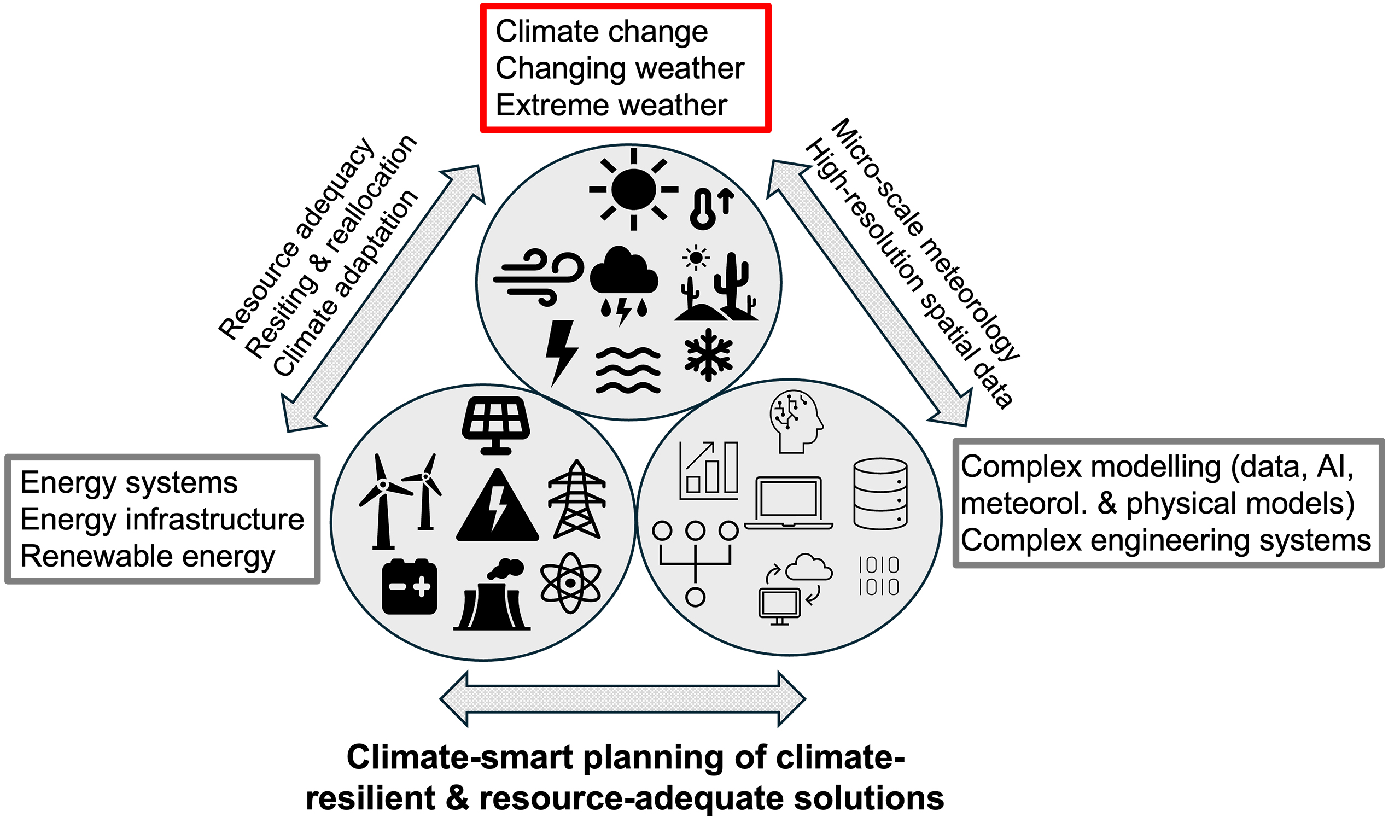
In conclusion, the MIT study and above observations emphasize a broader approach to adaptive, climate-resilient strategies for energy systems and infrastructure. This spans from fundamental science to broader systems-level issues[16], highlighting multi-disciplinary approaches[17] and complex engineering and system solutions to respond to climate change.
DECLARATIONS
Acknowledgments
We acknowledge the use of Font Awesome (https://fontawesome.com/license/free) for the preparation of the graphical abstract accompanying this manuscript. Certain free icons used in the graphical abstract, including those in the right corner data bubble (7 icons), thermometer, flood, battery, solar panel, and lighting, were sourced from Fonticons (https://fontawesome.com/icons) and incorporated into the graphical design, used in accordance with the applicable licensing terms (CC BY 4.0).
Authors’ contributions
The author contributed solely to the article.
Availability of data and materials
Not applicable.
AI and AI-assisted tools statement
During the preparation of this manuscript, the AI tool Google AI Mode (Gemini 3.5 Flash version, released 2026-05-14) was used solely for language editing. The tool did not influence the study design, data collection, analysis, interpretation, or the scientific content of the work. The author takes full responsibility for the accuracy, integrity, and final content of the manuscript.
Financial support and sponsorship
None.
Conflicts of interest
The author declares that there are no conflicts of interest.
Ethical approval and consent to participate
Not applicable.
Consent for publication
Not applicable.
Copyright
© The Author(s) 2026.
REFERENCES
1. Qiu, L.; Khorramfar, R.; Wang, S.; Amin, S.; Howland, M. F. Climate change reshapes resource adequacy risks and optimal renewable energy siting in wind and solar energy systems. Nat. Energy. 2026, 11, 1449-58.
2. Jones, A. D.; Rastogi, D.; Vahmani, P.; et al. Continental United States climate projections based on thermodynamic modification of historical weather. Sci. Data. 2023, 10, 664.
3. Eyring, V.; Bony, S.; Meehl, G. A.; et al. Overview of the coupled model intercomparison project phase 6 (CMIP6) experimental design and organization. Geosci. Model. Dev. 2016, 9, 1937-58.
4. Najafi, H.; Lagerwall, G. L.; Obeysekera, J.; Liu, J. Machine learning in climate downscaling: a critical review of methodologies, physical consistency, and operational applications. Water 2026, 18, 271.
5. Li, B.; Basu, S.; Watson, S. J.; Russchenberg, H. W. J. A Brief Climatology of Dunkelflaute Events over and Surrounding the North and Baltic Sea Areas. Energies 2021, 14, 6508.
6. International Energy Agency. Climate Resilience for Energy Security. Paris, 2022. Available from: www.iea.org [Last accessed on 18 Nov 2026].
7. Jasiūnas, J.; Lund, P. D.; Mikkola, J. Energy system resilience - a review. Renew. Sustain. Energy. Rev. 2021, 150, 111476.
8. The Electric Power Research Institute. Resource Adequacy for a Decarbonized Future. 2022. Available from: https://www.epri.com/research/products/000000003002023230 [Last accessed on 18 Nov 2026].
9. Khorramfar, R.; Brenner, A.; Booth, L.; et al. Optimization under uncertainty for energy infrastructure planning: a synthesis of methods, tools, and open challenges. 2026. Available from: http://arxiv.org/abs/2604.10795 [Last accessed on 18 Nov 2026].
10. Brockway, A. M.; Dunn, L. N. Weathering adaptation: Grid infrastructure planning in a changing climate. Clim. Risk. Manag. 2020, 30, 100256.
11. Mikkola, J.; Lund, P. D. Models for generating place and time dependent urban energy demand profiles. Appl. Energy. 2014, 130, 256-64.
12. Mongird, K.; Akdemir, K. Z.; Bracken, C.; et al. Energy infrastructure futures: a multiscale evaluation of projected power plant siting across the western interconnection. Earth's. Future. 2026, 14, e2025EF007725.
13. Delapedra-Silva, V.; Ferreira, P.; Cunha, J.; Kimura, H. Methods for financial assessment of renewable energy projects: a review. Processes 2022, 10, 184.
14. Burleyson, C. D.; Khan, Z.; Kulshresta, M.; Voisin, N.; Zhao, M.; Rice, J. S. When do different scenarios of projected electricity demand start to meaningfully diverge? Appl. Energy. 2025, 380, 124948.
15. De Marco, F.; Mannhardt, J.; Oneto, A.; Sansavini, G. Climate-resilient energy systems planning via system-informed identification of stressful events. Adv. App. Energy. 2025, 19, 100235.
16. Fuso Nerini, F.; Adshead, D.; Thacker, S.; Pant, R.; Hall, J. W. Breaking the cycle of underinvestment in climate-resilient energy infrastructure. Nat. Energy. 2025, 10, 1291-2.
Cite This Article
 Open Access
How to Cite
Lund, P. D. Climate change calls for adapting energy systems and addressing resource adequacy risks. Complex Eng. Syst. 2026, 6, 18. https://dx.doi.org/10.20517/ces.2026.28
Download Citation
If you have the appropriate software installed, you can download article citation data to the citation manager of your choice. Simply select your manager software from the list below and click on download.
Export Citation File
Type of Import
Tips on Downloading Citation
Citation Manager File Format
Type of Import
Direct Import: When the Direct Import option is selected (the default state), a dialogue box will give you the option to Save or Open the downloaded citation data. Choosing Open will either launch your citation manager or give you a choice of applications with which to use the metadata. The Save option saves the file locally for later use.
Indirect Import: When the Indirect Import option is selected, the metadata is displayed and may be copied and pasted as needed.
About This Article
Copyright

Data & Comments
Data
0











Comments
Comments must be written in English. Spam, offensive content, impersonation, and private information will not be permitted. If any comment is reported and identified as inappropriate content by OAE staff, the comment will be removed without notice. If you have any queries or need any help, please contact us at [email protected].