

Beyond the Haber-Bosch process: graphdiyne as an active platform for sustainable ammonia synthesis
 0
0 
Graphical Abstract
Abstract
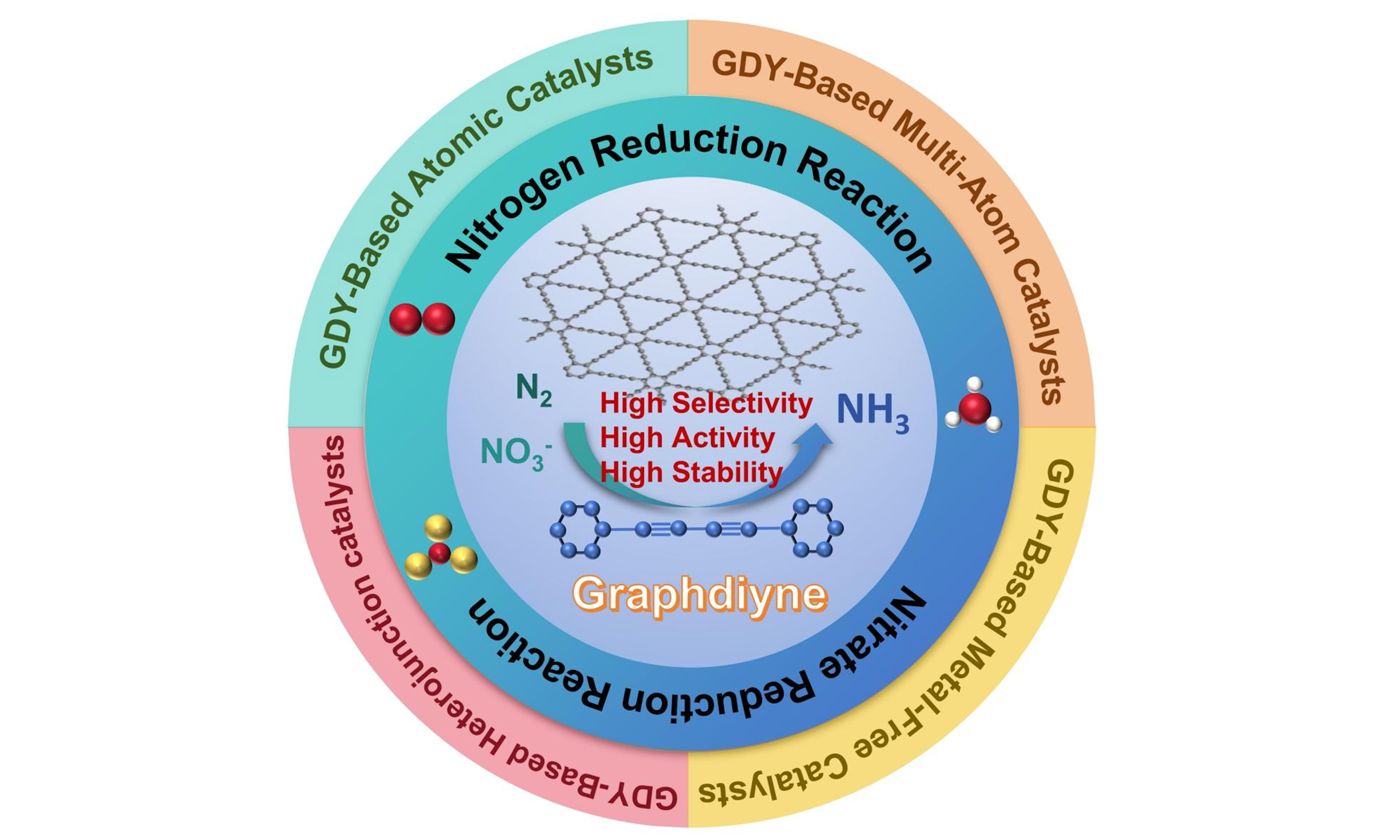
Sustainable ammonia production under ambient conditions is a potential alternative to the fossil-fuel-dependent and CO2-intensive Haber-Bosch route. However, the practical realization of such routes is impeded by the scarcity of catalysts capable of delivering high activity, selectivity, and durability simultaneously. Graphdiyne (GDY), a two-dimensional carbon allotrope with an intrinsically heterogeneous sp/sp2-hybridized framework, has emerged as a transformative active platform to address this challenge. GDY offers unique advantages that are particularly beneficial for nitrogen fixation; for example, the noninteger charge transfer between GDY and metal atoms can stabilize unconventional zero-valent metal atoms and modulate their d-band centers for optimal N2/NOx activation. The natural alkyne-rich pore structure facilitates the assembly of active species from single atoms to clusters, maximizing site utilization and preventing aggregation. This review provides a focused and systematic analysis of GDY-based catalysts for ammonia synthesis. The design principles, including electronic modulation, spatial confinement, and interfacial synergy, that govern the construction of high-performance GDY catalysts are introduced. The applications of the catalysts in both the nitrogen reduction reaction (NRR) and nitrate reduction reaction (NtRR) are then critically discussed, with particular emphasis on the mechanistic origins of enhanced activity and suppressed competing reactions. Finally, the key challenges that remain in this field are identified, and future research directions are proposed to guide the development of GDY-based catalysts toward practical and sustainable ammonia production.
Keywords


 Download PDF
REFERENCES
1. Ye, T. N.; Park, S. W.; Lu, Y.; et al. Vacancy-enabled N2 activation for ammonia synthesis on an Ni-loaded catalyst. Nature 2020, 583, 391-5.
3. Mallick, A.; Mayorga-Martinez, C. C.; Pumera, M. Low-dimensional materials for ammonia synthesis. Chem. Soc. Rev. 2025, 54, 5021-80.
4. Liang, J.; Li, Z.; Zhang, L.; et al. Advances in ammonia electrosynthesis from ambient nitrate/nitrite reduction. Chem 2023, 9, 1768-827.
5. Ai, X.; Chen, H.; Liang, X.; et al. Metal-coordinating single-boron sites confined in antiperovskite borides for N2-to-NH3 catalytic conversion. ACS. Catal. 2022, 12, 2967-78.
6. Li, S.; Fu, X.; Nørskov, J. K.; Chorkendorff, I. Towards sustainable metal-mediated ammonia electrosynthesis. Nat. Energy. 2024, 9, 1344-9.
7. Wang, P.; Chang, F.; Gao, W.; et al. Breaking scaling relations to achieve low-temperature ammonia synthesis through LiH-mediated nitrogen transfer and hydrogenation. Nat. Chem. 2017, 9, 64-70.
8. Zhang, N.; Jalil, A.; Wu, D.; et al. Refining defect states in W18O49 by mo doping: a strategy for tuning N2 activation towards solar-driven nitrogen fixation. J. Am. Chem. Soc. 2018, 140, 9434-43.
9. Ye, D.; Tsang, S. C. E. Prospects and challenges of green ammonia synthesis. Nat. Synth. 2023, 2, 612-23.
10. Jiao, F.; Xu, B. Electrochemical ammonia synthesis and ammonia fuel cells. Adv. Mater. 2019, 31, e1805173.
11. Wu, T.; Fan, W.; Zhang, Y.; Zhang, F. Electrochemical synthesis of ammonia: progress and challenges. Mater. Today. Phys. 2021, 16, 100310.
12. Chen, Y.; Guo, R.; Peng, X.; et al. Highly productive electrosynthesis of ammonia by admolecule-targeting single Ag sites. ACS. Nano. 2020, 14, 6938-46.
13. Li, J.; Jiang, Y.; Zhang, Z.; et al. Barium oxynitride electride as highly enhanced promotor for ruthenium catalyst in ammonia synthesis: comparative study with barium oxide. Adv. Energy. Mater. 2023, 13, 2302424.
14. Li, R.; Xiang, K.; Peng, Z.; Zou, Y.; Wang, S. Recent advances on electrolysis for simultaneous generation of valuable chemicals at both anode and cathode. Adv. Energy. Mater. 2021, 11, 2102292.
15. Yu, J.; Xi, Z.; Su, J.; et al. Influence of active hydrogen on pathway selection in electrochemical nitrate reduction. eScience 2025, 5, 100350.
16. Gao, W.; Guo, J.; Wang, P.; et al. Production of ammonia via a chemical looping process based on metal imides as nitrogen carriers. Nat. Energy. 2018, 3, 1067-75.
17. Lan, Y. Y.; Chen, W. X.; Si, D. H.; et al. Metal-organic framework glass-based self-supporting electrodes for efficient electrocatalytic nitrate reduction to ammonia. CCS. Chem. 2026, 8, 1997-2010.
18. Chen, T.; Wang, L.; Liang, C.; et al. Functional nanomaterials with tip effect: synthesis and applications in electrocatalysis. CCS. Chem. 2026, 8, 14-36.
19. Jia, S.; Zhao, K.; Han, L.; et al. Towards green chemistry from transformation of carbon dioxide and dinitrogen to value-added chemicals and fuels. Sci. Bull. 2025, 70, 3420-38.
20. Liu, H.; Guo, X.; Wang, L.; et al. Hydroxide-activated hydrogen spillover-mediated nitrogen reduction pathways for efficient ammonia synthesis. eScience 2026, 6, 100513.
21. Tan, Y.; Zhao, Y.; Chen, X.; et al. Cooperative Cu with defective MXene for enhanced nitrate electroreduction to ammonia. EcoEnergy 2024, 2, 258-67.
22. Feng, Y.; Ren, J. T.; Song, Y. X.; et al. Super-hydrophilic/aerophobic Co(OH)2/NiFe layered double hydroxide heterostructures with moderate work function difference for large-current-density electrochemical ammonia synthesis. CCS. Chem. 2025, 7, 1344-58.
23. Wei, Y.; Cheng, G.; Li, L.; et al. In situ dynamic reconstruction of Co3 Mo electrocatalyst for efficient nitrate reduction to ammonia. Adv. Funct. Mater. 2026, 36, e75762.
24. Singh, A. R.; Rohr, B. A.; Schwalbe, J. A.; et al. Electrochemical ammonia synthesis - the selectivity challenge. ACS. Catal. 2017, 7, 706-9.
25. Wei, X.; Chen, C.; Fu, X. Z.; Wang, S. Oxygen Vacancies-rich metal oxide for electrocatalytic nitrogen cycle. Adv. Energy. Mater. 2023, 14, 2303027.
26. Klein, C. K.; Manthiram, K. Sustainable ammonia synthesis: just around the corner? Joule 2022, 6, 1971-3.
27. Mu, B. S.; Xu, Y.; Tu, Z.; et al. Radiocatalytic ammonia synthesis from nitrogen and water. Natl. Sci. Rev. 2024, 11, nwae302.
28. Fu, Y.; Zhu, S.; Song, Y.; Wei, P.; Wang, G.; Bao, X. Sustainable electrochemical ammonia synthesis mediated by nitrogen oxides. CCS. Chem. 2026, 8, 1780-90.
29. Zhang, L.; Ji, X.; Ren, X.; et al. Electrochemical ammonia synthesis via nitrogen reduction reaction on a MoS2 catalyst: theoretical and experimental studies. Adv. Mater. 2018, 30, e1800191.
30. Wang, Q.; Pan, J.; Guo, J.; et al. Ternary ruthenium complex hydrides for ammonia synthesis via the associative mechanism. Nat. Catal. 2021, 4, 959-67.
31. Weber, J. E.; Mcmillion, N. D.; Hegg, A. S.; et al. Isocyanide ligation enables electrochemical ammonia formation in a synthetic cycle for N2 fixation. J. Am. Chem. Soc. 2024, 146, 33595-607.
32. Chang, F.; Gao, W.; Guo, J.; Chen, P. Emerging materials and methods toward ammonia-based energy storage and conversion. Adv. Mater. 2021, 33, e2005721.
33. Daisley, A.; Hargreaves, J. S. J. Chemical capacitors for ammonia synthesis. Nat. Catal. 2025, 8, 200-1.
34. Andersen, S. Z.; Čolić, V.; Yang, S.; et al. A rigorous electrochemical ammonia synthesis protocol with quantitative isotope measurements. Nature 2019, 570, 504-8.
35. Guo, H.; Zhang, X.; Lyu, J.; et al. Constructing asymmetrically coordinated transition metal single atoms with high loadings for ammonia electrosynthesis. Nat. Synth. 2026, Epub ahead of print.
36. Kibsgaard, J.; Nørskov, J. K.; Chorkendorff, I. The difficulty of proving electrochemical ammonia synthesis. ACS. Energy. Lett. 2019, 4, 2986-8.
37. Bruch, Q. J.; Connor, G. P.; Chen, C.; et al. Dinitrogen reduction to ammonium at rhenium utilizing light and proton-coupled electron transfer. J. Am. Chem. Soc. 2019, 141, 20198-208.
38. Liu, S.; Wang, M.; Ji, H.; Shen, X.; Yan, C.; Qian, T. Altering the rate-determining step over cobalt single clusters leading to highly efficient ammonia synthesis. Natl. Sci. Rev. 2021, 8, nwaa136.
39. Liao, G. Smith Jr., R. L.; Guo, H.; Qi, X. Review of carbon-based catalysts for electrochemical nitrate reduction and green ammonia synthesis. Green. Chem. 2024, 26, 11797-831.
40. Titirici, M. M.; White, R. J.; Brun, N.; et al. Sustainable carbon materials. Chem. Soc. Rev. 2015, 44, 250-90.
41. Valentini, F.; Grigoras, A. M.; Vaccaro, L.; Latterini, L. Sustainable nitrogen photofixation: considerations on the state of the art of non critical carbon materials. Carbon. Energy. 2024, 6, e545.
42. Masood ul Hasan, I. M.; Liu, Y.; Nawaz, M. Z.; et al. Trends and prospects in electrochemical nitrate-to-ammonia conversion: Emphasis on carbon-based metal-free catalysts. Renew. Sustain. Energy. Rev. 2026, 234, 116935.
43. Zhang, G.; Li, Y.; He, C.; Ren, X.; Zhang, P.; Mi, H. Recent progress in 2D catalysts for photocatalytic and electrocatalytic artificial nitrogen reduction to ammonia. Adv. Energy. Mater. 2021, 11, 2003294.
44. Wang, D. Y.; Gong, M.; Chou, H. L.; et al. Highly active and stable hybrid catalyst of cobalt-doped FeS2 nanosheets-carbon nanotubes for hydrogen evolution reaction. J. Am. Chem. Soc. 2015, 137, 1587-92.
45. Wu, K.; Qiu, X.; Luo, Y.; Zhang, C. Oxygen vacancy mediated-bismuth molybdate/graphitic carbon nitride type II heterojunction chemiresistor for efficient NH3 detection at room temperature. ACS. Sens. 2024, 9, 6698-708.
46. Xu, Z.; Deng, W.; Wang, X. 3D Hierarchical carbon-rich micro-/nanomaterials for energy storage and catalysis. Electrochem. Energ. Rev. 2021, 4, 269-335.
47. Zhu, Z.; Men, Y.; Zhang, W.; et al. Versatile carbon-based materials from biomass for advanced electrochemical energy storage systems. eScience 2024, 4, 100249.
48. Zhang, W.; Zhan, S.; Qin, Q.; et al. Electrochemical generation of catalytically active edge sites in C2N-type carbon materials for artificial nitrogen fixation. Small 2022, 18, e2204116.
49. Wu, Q.; Yan, X.; Jia, Y.; Yao, X. Defective carbon-based materials: controllable synthesis and electrochemical applications. EnergyChem 2021, 3, 100059.
50. Li, G.; Li, Y.; Liu, H.; Guo, Y.; Li, Y.; Zhu, D. Architecture of graphdiyne nanoscale films. Chem. Commun. 2010, 46, 3256-8.
51. Sun, Q.; Lu, T.; He, J.; Huang, C. Advances in the study of heteratomic graphdiyne electrode materials. Chem. J. Chinese. Univ. 2021, 42, 366.
52. Ge, C.; Chen, J.; Tang, S.; Du, Y.; Tang, N. Review of the electronic, optical, and magnetic properties of graphdiyne: from theories to experiments. ACS. Appl. Mater. Interfaces. 2019, 11, 2707-16.
53. Zhang, Y.; Huang, P.; Guo, J.; et al. Graphdiyne-based flexible photodetectors with high responsivity and detectivity. Adv. Mater. 2020, 32, e2001082.
54. Gao, X.; Liu, H.; Wang, D.; Zhang, J. Graphdiyne: synthesis, properties, and applications. Chem. Soc. Rev. 2019, 48, 908-36.
55. Fang, Y.; Liu, Y.; Qi, L.; Xue, Y.; Li, Y. 2D graphdiyne: an emerging carbon material. Chem. Soc. Rev. 2022, 51, 2681-709.
56. Li, J.; Gao, X.; Zhu, L.; et al. Graphdiyne for crucial gas involved catalytic reactions in energy conversion applications. Energy. Environ. Sci. 2020, 13, 1326-46.
57. Liang, S.; Deng, H.; Zhou, Z.; Wong, W. Y. Fabrication of graphdiyne and its analogues for photocatalytic application. EcoMat 2022, 5, e12297.
58. Nidhi, H. V.; Koppad, V. S.; Babu, A. M.; Varghese, A. Properties, synthesis and emerging applications of graphdiyne: a journey through recent advancements. Top. Curr. Chem. 2024, 382, 19.
59. Yang, B.; Jin, F.; Jin, Z.; Tsubaki, N. Directional electron transfer via Cu3P-graphdiyne-Ni3SbS6-δ interface: role of ohmic contact and graphdiyne synergy in boosting photocatalytic hydrogen evolution. Appl. Catal. B:. Environ. Energy. 2025, 378, 125624.
60. Jia, Z.; Li, Y.; Zuo, Z.; Liu, H.; Huang, C.; Li, Y. Synthesis and properties of 2D carbon - graphdiyne. Acc. Chem. Res. 2017, 50, 2470-8.
61. Yang, Z.; Zhang, D.; Wang, K.; He, J.; Li, J.; Huang, C. Investigating graphdiyne based materials for rechargeable batteries. Nano. Today. 2022, 46, 101588.
62. Wu, X.; Lu, Y.; Li, P.; et al. Current advances in the synthesis, properties, and biomedical applications of two-dimensional graphdiyne: a review. ACS. Appl. Nano. Mater. 2024, 7, 2461-93.
63. Han, Y. Y.; Lu, X. L.; Tang, S. F.; Yin, X. P.; Wei, Z. W.; Lu, T. B. Metal-free 2D/2D heterojunction of graphitic carbon nitride/graphdiyne for improving the hole mobility of graphitic carbon nitride. Adv. Energy. Mater. 2018, 8, 1702992.
64. Zhao, Y.; Yang, N.; Yu, R.; et al. Unique structural advances of graphdiyne for energy applications. EnergyChem 2020, 2, 100041.
65. Tang, S. F.; Lu, X. L.; Zhang, C.; Wei, Z. W.; Si, R.; Lu, T. B. Decorating graphdiyne on ultrathin bismuth subcarbonate nanosheets to promote CO2 electroreduction to formate. Sci. Bull. 2021, 66, 1533-41.
66. Yu, J.; Cao, C.; Jin, H.; et al. Uniform single atomic Cu1-C4 sites anchored in graphdiyne for hydroxylation of benzene to phenol. Natl. Sci. Rev. 2022, 9, nwac018.
67. Du, Y.; Zhou, W.; Gao, J.; Pan, X.; Li, Y. Fundament and application of graphdiyne in electrochemical energy. Acc. Chem. Res. 2020, 53, 459-69.
68. Kong, Y.; Li, J.; Zeng, S.; Yin, C.; Tong, L.; Zhang, J. Bridging the gap between reality and ideality of graphdiyne: the advances of synthetic methodology. Chem 2020, 6, 1933-51.
69. Qi, R.; Wang, D.; Lu, X. Heterojunction engineering in electrocatalytic nitrate-to-ammonia conversion. Coord. Chem. Rev. 2026, 551, 217483.
70. Khan, K.; Tareen, A. K.; Iqbal, M.; Shi, Z.; Zhang, H.; Guo, Z. Novel emerging graphdiyne based two dimensional materials: Synthesis, properties and renewable energy applications. Nano. Today. 2021, 39, 101207.
71. Hui, L.; Xue, Y.; Yu, H.; et al. Highly efficient and selective generation of ammonia and hydrogen on a graphdiyne-based catalyst. J. Am. Chem. Soc. 2019, 141, 10677-83.
72. Yu, H.; Xue, Y.; Hui, L.; et al. Graphdiyne-based metal atomic catalysts for synthesizing ammonia. Natl. Sci. Rev. 2021, 8, nwaa213.
73. Zou, H.; Rong, W.; Wei, S.; Ji, Y.; Duan, L. Regulating kinetics and thermodynamics of electrochemical nitrogen reduction with metal single-atom catalysts in a pressurized electrolyser. Proc. Natl. Acad. Sci. U. S. A. 2020, 117, 29462-8.
74. Feng, X.; Liu, J.; Chen, L.; et al. Hydrogen radical-induced electrocatalytic N2 reduction at a low potential. J. Am. Chem. Soc. 2023, 145, 10259-67.
75. Feng, B.; Zhang, D.; Han, Z.; et al. Rational synthesis of isomeric graphdiyne frameworks toward single-ruthenium catalysts and high-performance nitrogen reduction. Adv. Mater. 2025, 37, e2502980.
76. Zou, H.; Arachchige, L. J.; Rong, W.; et al. Low-valence metal single atoms on graphdiyne promotes electrochemical nitrogen reduction via M-to-N2 π-backdonation. Adv. Funct. Mater. 2022, 32, 2200333.
77. Fang, Y.; Xue, Y.; Hui, L.; Chen, X.; Li, Y. High-loading metal atoms on graphdiyne for efficient nitrogen fixation to ammonia. J. Mater. Chem. A. 2022, 10, 6073-7.
78. Guo, Y.; Liu, J.; Yang, Q.; et al. Regulating nitrogenous adsorption and desorption on Pd clusters by the acetylene linkages of hydrogen substituted graphdiyne for efficient electrocatalytic ammonia synthesis. Nano. Energy. 2021, 86, 106099.
79. Xing, C.; Wu, C.; Xue, Y.; et al. A highly selective and active metal-free catalyst for ammonia production. Nanoscale. Horiz. 2020, 5, 1274-8.
80. Yang, Q.; Guo, Y.; Gu, J.; et al. Scalable synthesis of 2D hydrogen-substituted graphdiyne on Zn substrate for high-yield N2 fixation. Nano. Energy. 2020, 78, 105283.
81. Zou, H.; Rong, W.; Long, B.; Ji, Y.; Duan, L. Corrosion-induced Cl-doped ultrathin graphdiyne toward electrocatalytic nitrogen reduction at ambient conditions. ACS. Catal. 2019, 9, 10649-55.
82. Fang, Y.; Xue, Y.; Hui, L.; et al. Graphdiyne-induced iron vacancy for efficient nitrogen conversion. Adv. Sci. 2022, 9, e2102721.
83. Fang, Y.; Xue, Y.; Li, Y.; et al. Graphdiyne interface engineering: highly active and selective ammonia synthesis. Angew. Chem. Int. Ed. Engl. 2020, 59, 13021-7.
84. Zhou, X.; Wu, W.; Xu, D.; Liu, C.; Zhang, Z. Bioinspired dual-site photocathode with atomic molybdenum and alkynyl networks for scalable solar ammonia synthesis. ACS. Nano. 2025, 19, 19417-28.
85. Feng, X.; Liu, J.; Kong, Y.; et al. Cu/CuxO/Graphdiyne tandem catalyst for efficient electrocatalytic nitrate reduction to ammonia. Adv. Mater. 2024, 36, e2405660.
86. Wu, H.; Gao, Y.; Zheng, X.; et al. Controlled growth of PtCux quantum dots on graphdiyne for efficient ammonia production. ACS. Mater. Lett. 2024, 6, 2787-93.
87. Wang, C.; Song, T.; Dai, H.; et al. Electronic perturbation of Pd single-atom catalysts on graphdiyne derivatives toward effective electrocatalytic nitrate reduction. ChemPhysMater 2025, 4, 321-9.
88. Zheng, Z.; Qi, L.; Xue, Y.; Li, Y. Highly selective and durable of monodispersed metal atoms in ammonia production. Nano. Today. 2022, 43, 101431.
89. Zhang, Z.; Feng, X.; Zhang, Z.; et al. Graphdiyne enabled nitrogen vacancy formation in copper nitride for efficient ammonia synthesis. J. Am. Chem. Soc. 2024, 146, 14898-904.
90. Kuang, J.; Yu, J.; Zhang, Q.; et al. Graphdiyne production in a flash: high-yield direct synthesis by electron beam irradiation. Adv. Mater. 2025, 37, e2506979.
91. Li, J.; Valenza, R.; Haussener, S. In situ synthesis of CuxO/N doped graphdiyne with pyridine N configuration for ammonia production via nitrate reduction. Small 2024, 20, e2310467.
92. Luan, X.; Qi, L.; Zhao, S.; Chen, Z.; Xue, Y. Controllable assembly of planar defect-rich bimetallic oxide interfaces for efficient ammonia production. Small. Methods. 2026, 10, e2500957.
93. Chen, Z.; Zhao, S.; Luan, X.; Zheng, Z.; Yan, J.; Xue, Y. A Co3O4/graphdiyne heterointerface for efficient ammonia production from nitrates. New. Carbon. Mater. 2024, 39, 142-51.
94. Zheng, X.; Xue, Y.; Zhang, C.; Li, Y. Controlled growth of multidimensional interface for high-selectivity ammonia production. CCS. Chem. 2023, 5, 1653-62.
95. Luan, X.; Qi, L.; Zheng, Z.; et al. In situ growth of a GDY-MnOx heterointerface for selective and efficient ammonia production. Chem. Commun. 2023, 59, 7611-4.
96. Zhao, S.; Zheng, Z.; Qi, L.; Xue, Y.; Li, Y. Controlled growth of donor-bridge-acceptor interface for high-performance ammonia production. Small 2022, 18, e2107136.
97. Wang, B.; Ma, J.; Yang, R.; et al. Bridging nickel-MOF and copper single atoms/clusters with H-substituted graphdiyne for the tandem catalysis of nitrate to ammonia. Angew. Chem. Int. Ed. Engl. 2024, 63, e202404819.
98. Ma, J.; Zhang, Y.; Wang, B.; Jiang, Z.; Zhang, Q.; Zhuo, S. Interfacial engineering of bimetallic Ni/Co-MOFs with H-substituted graphdiyne for ammonia electrosynthesis from nitrate. ACS. Nano. 2023, 17, 6687-97.
99. Gao, Y.; Liu, H.; Zheng, Z.; Luan, X.; Xue, Y.; Li, Y. Controlled growth of a graphdiyne-Prussian blue analog heterostructure for efficient ammonia production. NPG. Asia. Mater. 2023, 15, 12.
100. Ma, J.; Wang, R.; Wang, B.; Luo, J.; Zhang, Q.; Zhuo, S. Hybrid nanoarrays of Cu-MOFs@H-substituted graphdiyne with various levels of Lewis acidity for nitrate electroreduction. Chem. Commun. 2023, 59, 4348-51.
101. Fu, X.; Zhao, X.; Lu, T. B.; Yuan, M.; Wang, M. Graphdiyne-based single-atom catalysts with different coordination environments. Angew. Chem. Int. Ed. Engl. 2023, 62, e202219242.
102. Zheng, X.; Chen, S.; Li, J.; et al. Two-dimensional carbon graphdiyne: advances in fundamental and application research. ACS. Nano. 2023, 17, 14309-46.
103. Wu, R.; Huang, C.; Li, Y. Emerging electrochemical energy conversion materials: graphdiyne. Adv. Mater. 2026, e00027.
104. Zhan, S.; Zhao, Y.; Yang, N.; Wang, D. Pore structure of graphdiyne: design, synthesis and application. Chem. J. Chinese. Univ. 2021, 42, 333.
105. Wang, H.; Zhang, X.; Liu, J.; Chen, C. Modulating the electronic structure of graphdiyne-based nanomaterials for engineering nano-bio interfaces in biomedical applications. Adv. Drug. Deliv. Rev. 2025, 220, 115570.
106. Wu, T.; Sun, M.; Huang, B. Graphdiyne based catalysts for energy applications. Mater. Chem. Front. 2021, 5, 7369-83.
107. Do, D. P.; Lee, E.; Bui, V. Q.; Lee, H. Recent progress in two-dimensional graphdiyne: synthesis, characterization, and applications. ChemPhysMater 2025, 4, 91-107.
108. Ansari, M. Z.; Ansari, S. A.; Parveen, N.; et al. Exploring graphdiyne, MXene, borophene, and phosphorene as advanced 2D materials for next-generation metallic ion batteries. Prog. Mater. Sci. 2026, 158, 101617.
109. Huang, C.; Li, Y.; Wang, N.; et al. Progress in research into 2D graphdiyne-based materials. Chem. Rev. 2018, 118, 7744-803.
110. Yu, H.; Xue, Y.; Li, Y. Graphdiyne and its assembly architectures: synthesis, functionalization, and applications. Adv. Mater. 2019, 31, 1803101.
111. Liu, B.; Xu, L.; Zhao, Y.; Du, J.; Yang, N.; Wang, D. Heteroatoms in graphdiyne for catalytic and energy-related applications. J. Mater. Chem. A. 2021, 9, 19298-316.
112. Chen, H.; Liu, X.; Gong, D.; et al. Ultrahigh-water-flux desalination on graphdiyne membranes. Nat. Water. 2023, 1, 800-7.
113. Xie, H.; Jia, P.; Huang, H. Multidimensional graphdiyne structures and beyond for energy conversion and storage. Adv. Funct. Mater. 2025, 36, e10586.
114. Liu, X.; Zhao, Y.; Du, J.; Wang, D. Recent progress and challenges in crystalline graphdiyne. Sci. China. Mater. 2024, 67, 729-51.
115. Yin, X. P.; Wang, H. J.; Tang, S. F.; et al. Engineering the coordination environment of single-atom platinum anchored on graphdiyne for optimizing electrocatalytic hydrogen evolution. Angew. Chem. Int. Ed. Engl. 2018, 57, 9382-6.
116. Gao, Y.; Xue, Y.; Wu, H.; et al. Self-organized gradually single-atom-layer of metal osmium for an unprecedented hydrogen production from seawater. J. Am. Chem. Soc. 2024, 146, 10573-80.
117. Xue, Y.; Huang, B.; Yi, Y.; et al. Anchoring zero valence single atoms of nickel and iron on graphdiyne for hydrogen evolution. Nat. Commun. 2018, 9, 1460.
118. Zhang, S.; Kong, Y.; Gu, Y.; et al. Strong d-π orbital coupling of Co-C4 atomic sites on graphdiyne boosts potassium-sulfur battery electrocatalysis. J. Am. Chem. Soc. 2024, 146, 4433-43.
119. Zhang, L.; Li, J.; Wei, G.; Yang, H.; Bai, H.; Xi, G. Exploring the fate of copper ions in the synthesis of graphdiyne. Angew. Chem. Int. Ed. Engl. 2024, 63, e202316936.
120. Wu, R.; Fu, X.; Huang, C.; Gao, J.; Yang, J.; Li, Y. Recent progress in the preparation of graphdiyne-based materials. ChemistryEurope 2025, 3, e202500141.
121. Sakamoto, R.; Fukui, N.; Maeda, H.; Matsuoka, R.; Toyoda, R.; Nishihara, H. The accelerating world of graphdiynes. Adv. Mater. 2019, 31, e1804211.
122. Zhang, W.; Xu, J.; Wang, T.; Lin, X.; Wang, F. Graphdiyne as an emerging sensor platform: principles, synthesis and application. J. Adv. Res. 2025, 74, 283-301.
123. Yu, M.; He, J.; Hu, X.; et al. Graphdiyne and its derivatives: a stabilizer for metastable particles. Adv. Compos. Hybrid. Mater. 2025, 8, 377.
124. Yu, S.; Chen, J.; Chen, C.; et al. What happens when graphdiyne encounters doping for electrochemical energy conversion and storage. Coord. Chem. Rev. 2023, 482, 215082.
125. Peng, J.; Tian, Z.; Zhao, T.; Shang, H.; Wu, J. Recent progress in preparations and multifunctional applications towards MOF/GDY composites and their derivative materials. Catalysts 2025, 15, 1041.
126. Zhu, C.; Fu, S.; Shi, Q.; Du, D.; Lin, Y. Single-atom electrocatalysts. Angew. Chem. Int. Ed. Engl. 2017, 56, 13944-60.
127. Han, C.; Zhang, S.; Zhang, H.; et al. Metal-support interaction in single-atom electrocatalysts: a perspective of metal oxide supports. eScience 2024, 4, 100269.
128. Gao, Y.; Wang, D. Atomically dispersed catalysts: precise synthesis, structural regulation, and structure-activity relationship. CCS. Chem. 2024, 6, 833-55.
129. Bi, W.; Shaigan, N.; Malek, A.; Fatih, K.; Gyenge, E.; Wilkinson, D. P. Strategies in cell design and operation for the electrosynthesis of ammonia: status and prospects. Energy. Environ. Sci. 2022, 15, 2259-87.
130. Qing, G.; Ghazfar, R.; Jackowski, S. T.; et al. Recent advances and challenges of electrocatalytic N2 reduction to ammonia. Chem. Rev. 2020, 120, 5437-516.
131. Song, T.; Liu, X.; Zhu, Y. Toward fundamental insights into heterogeneous catalysis by supported atomically precise metal clusters. CCS. Chem. 2026, 8, 1175-203.
132. Ying, Y.; Fan, K.; Qiao, J.; Huang, H. Rational design of atomic site catalysts for electrocatalytic nitrogen reduction reaction: one step closer to optimum activity and selectivity. Electrochem. Energy. Rev. 2022, 5, 6.
133. Tang, T.; Bai, X.; Wang, Z.; Guan, J. Structural engineering of atomic catalysts for electrocatalysis. Chem. Sci. 2024, 15, 5082-112.
134. Zhang, M.; Ji, S.; Zhang, Z.; Zhu, M.; Yao, Q.; Xie, J. Engineering surface structure of atomically precise metal nanoclusters at the molecular level. CCS. Chem. 2026, 8, 37-59.
135. Wong, H.; Lu, Q.; Sun, M.; Huang, B. Rational design of graphdiyne-based atomic electrocatalysts: DFT and self-validated machine learning. Chem. J. Chinese. Univ. 2022, 43, 20220042.
136. Zhao, M.; Jiang, L.; Yu, Q. Environmental applications of single-atom catalysts based on graphdiyne. Catal. Sci. Technol. 2023, 13, 5154-74.
137. Kan, X.; Fan, C.; Wu, C.; Sun, C.; Li, Z.; Zhao, Y. Graphdiyne-supported atomic catalysts: synthesis and applications. ChemPlusChem 2020, 85, 2570-9.
138. Li, B.; Lai, C.; Zhang, M.; et al. Graphdiyne: a rising star of electrocatalyst support for energy conversion. Adv. Energy. Mater. 2020, 10, 2000177.
139. Xiong, S.; Wang, W.; Wang, F.; et al. Thermal catalytic synthesis of ammonia using uranium/graphdiyne composite at mild conditions. Nat. Commun. 2026, 17, 2894.
140. Jin, R.; Xu, X.; Xia, Y.; et al. Robust oxygen reduction electrocatalysis via dioxygen-bridged cobalt diatomic sites scaffolded by hierarchically porous nanoarchitectures. Sci. Bull. 2026, 71, 2012-21.
141. Dong, X. Y.; Jin, Y. J.; Chen, H.; Li, B.; Zang, S. Q.; Cai, J. Atomic-level dynamic spacing engineering in COF-based electrocatalysts for urea synthesis in ultra-low and wide potential ranges. Sci. Bull. 2026, 71, 1380-6.
142. Liu, S.; Lu, J.; Yu, X.; Pang, H.; Zhang, Q.; Park, H. S. Rational design of metal-organic framework-nanoparticle composite electrocatalysts for sustainable nitrogen electrochemistry. eScience 2025, 5, 100378.
143. He, B.; Ren, M.; Zhang, L.; et al. Breaking scaling relations and boosting ammonia synthesis in nitrogen reduction with V-containing heteronuclear double metal atoms. J. Mater. Chem. A. 2025, 13, 2093-104.
144. Wang, X.; Yang, L. Composition engineering opens an avenue toward efficient and sustainable nitrogen fixation. Energy. Environ. Mater. 2023, 7, e12600.
145. Ma, D.; Zeng, Z.; Liu, L.; Jia, Y. Theoretical screening of the transition metal heteronuclear dimer anchored graphdiyne for electrocatalytic nitrogen reduction. J. Energy. Chem. 2021, 54, 501-9.
146. Luo, Y.; Li, M.; Dai, Y.; et al. Transition metal-modified Co4 clusters supported on graphdiyne as an effective nitrogen reduction reaction electrocatalyst. Inorg. Chem. 2021, 60, 18251-9.
147. Jasin Arachchige, L.; Xu, Y.; Dai, Z.; Zhang, X. L.; Wang, F.; Sun, C. Double transition metal atoms anchored on Graphdiyne as promising catalyst for electrochemical nitrogen reduction reaction. J. Mater. Sci. Technol. 2021, 77, 244-51.
148. Ma, D.; Zeng, Z.; Liu, L.; Huang, X.; Jia, Y. Computational evaluation of electrocatalytic nitrogen reduction on TM single-, double-, and triple-atom catalysts (TM = Mn, Fe, Co, Ni) based on graphdiyne monolayers. J. Phys. Chem. C. 2019, 123, 19066-76.
149. Li, M.; Cui, Y.; Zhang, X.; Luo, Y.; Dai, Y.; Huang, Y. Screening a suitable Mo form supported on graphdiyne for effectively electrocatalytic N2 reduction reaction: from atomic catalyst to cluster catalyst. J. Phys. Chem. Lett. 2020, 11, 8128-37.
150. Chen, Z. W.; Chen, L. X.; Jiang, M.; et al. A triple atom catalyst with ultrahigh loading potential for nitrogen electrochemical reduction. J. Mater. Chem. A. 2020, 8, 15086-93.
151. Fu, C.; Li, Y.; Wei, H. Double boron atom-doped graphdiynes as efficient metal-free electrocatalysts for nitrogen reduction into ammonia: a first-principles study. Phys. Chem. Chem. Phys. 2021, 23, 17683-92.
152. Wang, Q. Y.; Xie, X. Y.; Zhou, H.; et al. Efficient NRR on S, N-doped/adsorbed graphdiyne: a density functional theory investigation. Mol. Catal. 2026, 601, 116092.
153. Wang, G.; Cai, W.; Fan, T.; Ji, Y. Nitrogen-doped graphdiyne for efficient electrocatalytic N2 reduction: a first-principles study. Appl. Surf. Sci. 2021, 570, 151109.
154. Cheng, Y.; Chen, W.; He, C.; Zhang, W. New insights into the long-range interaction mechanism of nitrogen reduction. J. Energy. Chem. 2025, 106, 842-51.
155. Feng, Z.; Tang, Y.; Chen, W.; Wei, D.; Ma, Y.; Dai, X. O-doped graphdiyne as metal-free catalysts for nitrogen reduction reaction. Mol. Catal. 2020, 483, 110705.
156. Fu, C.; Li, Y.; Wei, H. Single boron modulated graphdiyne nanosheets for efficient electrochemical nitrogen fixation: a first-principles study. Phys. Chem. Chem. Phys. 2022, 24, 19817-26.
157. Zheng, X.; Gao, X.; Vilá, R. A.; et al. Hydrogen-substituted graphdiyne-assisted ultrafast sparking synthesis of metastable nanomaterials. Nat. Nanotechnol. 2023, 18, 153-9.
158. Cui, C.; Jia, Y.; Zhang, H.; Geng, L.; Luo, Z. Plasma-assisted dinitrogen activation via dual platinum cluster catalysis: a strategy for ammonia synthesis under mild conditions. CCS. Chem. 2023, 5, 682-94.
159. Gao, X.; Li, J.; Zuo, Z. Advanced electrochemical energy storage and conversion on graphdiyne interface. Nano. Res. Energy. 2022, 1, 9120036.
160. Liu, Y.; Xue, Y.; Hui, L.; et al. Porous graphdiyne loading CoOx quantum dots for fixation nitrogen reaction. Nano. Energy. 2021, 89, 106333.
161. Fang, Y.; Xue, Y.; Hui, L.; Yu, H.; Li, Y. Graphdiyne@Janus magnetite for photocatalytic nitrogen fixation. Angew. Chem. Int. Ed. Engl. 2021, 60, 3170-4.
162. Hu, C.; Chen, X.; Jin, J.; et al. Surface plasmon enabling nitrogen fixation in pure water through a dissociative mechanism under mild conditions. J. Am. Chem. Soc. 2019, 141, 7807-14.
163. Li, J.; Zhu, L.; Tung, C. H.; Wu, L. Z. Engineering graphdiyne for solar photocatalysis. Angew. Chem. Int. Ed. Engl. 2023, 62, e202301384.
164. Torres-Pinto, A.; Silva, C. G.; Faria, J. L.; Silva, A. M. T. Advances on graphyne-family members for superior photocatalytic behavior. Adv. Sci. 2021, 8, 2003900.
165. Shandilya, P.; Mandyal, P.; Kumar, V.; Sillanpää, M. Properties, synthesis, and recent advancement in photocatalytic applications of graphdiyne: a review. Sep. Purif. Technol. 2022, 281, 119825.
166. Halder, D.; Sen, S.; Roy, S. Recent advances in mechanistic studies and catalyst development for electrochemical nitrate reduction to ammonia. Commun. Chem. 2025, 9, 58.
167. Yin, Y.; Wang, L.; Shang, H.; Zhang, X.; Chen, W.; Zou, X. Lateral coordination sulfur-modified charge asymmetry Cu-Ru diatomic catalyst for efficient and stable electrochemical nitrate reduction to ammonia. ACS. Nano. 2025, 19, 30338-48.
168. Richa, A.; Touil, S.; Fizir, M. Recent advances in the source identification and remediation techniques of nitrate contaminated groundwater: a review. J. Environ. Manage. 2022, 316, 115265.
169. Yang, M.; Wang, W.; Zhao, Z.; et al. Interfacial microenvironment engineering for electrocatalytic nitrate reduction toward a sustainable nitrogen cycle. Adv. Funct. Mater. 2026, 36, e30516.
170. Bai, J.; Dong, Z.; Jiang, X.; et al. Advancing nitrate-to-ammonia electrocatalysis: strategies in catalyst design, electrolyte engineering, and performance evaluation. Adv. Sci. 2025, 12, e08614.
171. Liu, L.; Long, Z.; Shi, K.; Zhong, H. A general crystallization picture of quantum dots: the underlying physical chemistry. CCS. Chem. 2025, 7, 926-49.
172. Luo, Z.; Castleman, A. W.; Khanna, S. N. Reactivity of metal clusters. Chem. Rev. 2016, 116, 14456-92.
173. Zhang, L.; Banis, M. N.; Sun, X. Single-atom catalysts by the atomic layer deposition technique. Natl. Sci. Rev. 2018, 5, 628-30.
174. Yang, M.; Wang, Z.; Jiao, D.; Li, G.; Cai, Q.; Zhao, J. Tuning single metal atoms anchored on graphdiyne for highly efficient and selective nitrate electroreduction to ammonia under aqueous environments: a computational study. Appl. Surf. Sci. 2022, 592, 153213.
175. Wu, Q.; Wang, Y.; Lin, D.; Li, H.; Zeng, S. Rational design of high-efficiency nitrate reduction catalysts on graphdiyne: synergistic effects in dual-active site configurations via DFT. J. Alloys. Compd. 2026, 1078, 189660.
176. Zhou, X.; Tamtaji, M.; Zhou, W.; Goddard, W. A.; Chen, G. Nonprecious triple-atom catalysts with ultrahigh activity for electrochemical reduction of nitrate to ammonia: a DFT screening. ACS. Appl. Mater. Interfaces. 2025, 17, 4854-64.
Cite This Article
 Open Access
How to Cite
Wang, S.; Wang, G.; Xiao, H.; Wu, H.; Xue, Y. Beyond the Haber-Bosch process: graphdiyne as an active platform for sustainable ammonia synthesis. Catal. Energy Environ. 2026, 1, 5. https://dx.doi.org/10.20517/cee.2026.13
Download Citation
If you have the appropriate software installed, you can download article citation data to the citation manager of your choice. Simply select your manager software from the list below and click on download.
Export Citation File
Type of Import
Tips on Downloading Citation
Citation Manager File Format
Type of Import
Direct Import: When the Direct Import option is selected (the default state), a dialogue box will give you the option to Save or Open the downloaded citation data. Choosing Open will either launch your citation manager or give you a choice of applications with which to use the metadata. The Save option saves the file locally for later use.
Indirect Import: When the Indirect Import option is selected, the metadata is displayed and may be copied and pasted as needed.
About This Article
Copyright

Data & Comments
Data
0







Comments
Comments must be written in English. Spam, offensive content, impersonation, and private information will not be permitted. If any comment is reported and identified as inappropriate content by OAE staff, the comment will be removed without notice. If you have any queries or need any help, please contact us at [email protected].