

Emerging piezo-photocatalytic conversion of microplastics: mechanisms, evidence standards, and interface-oriented catalyst design
 0

Graphical Abstract
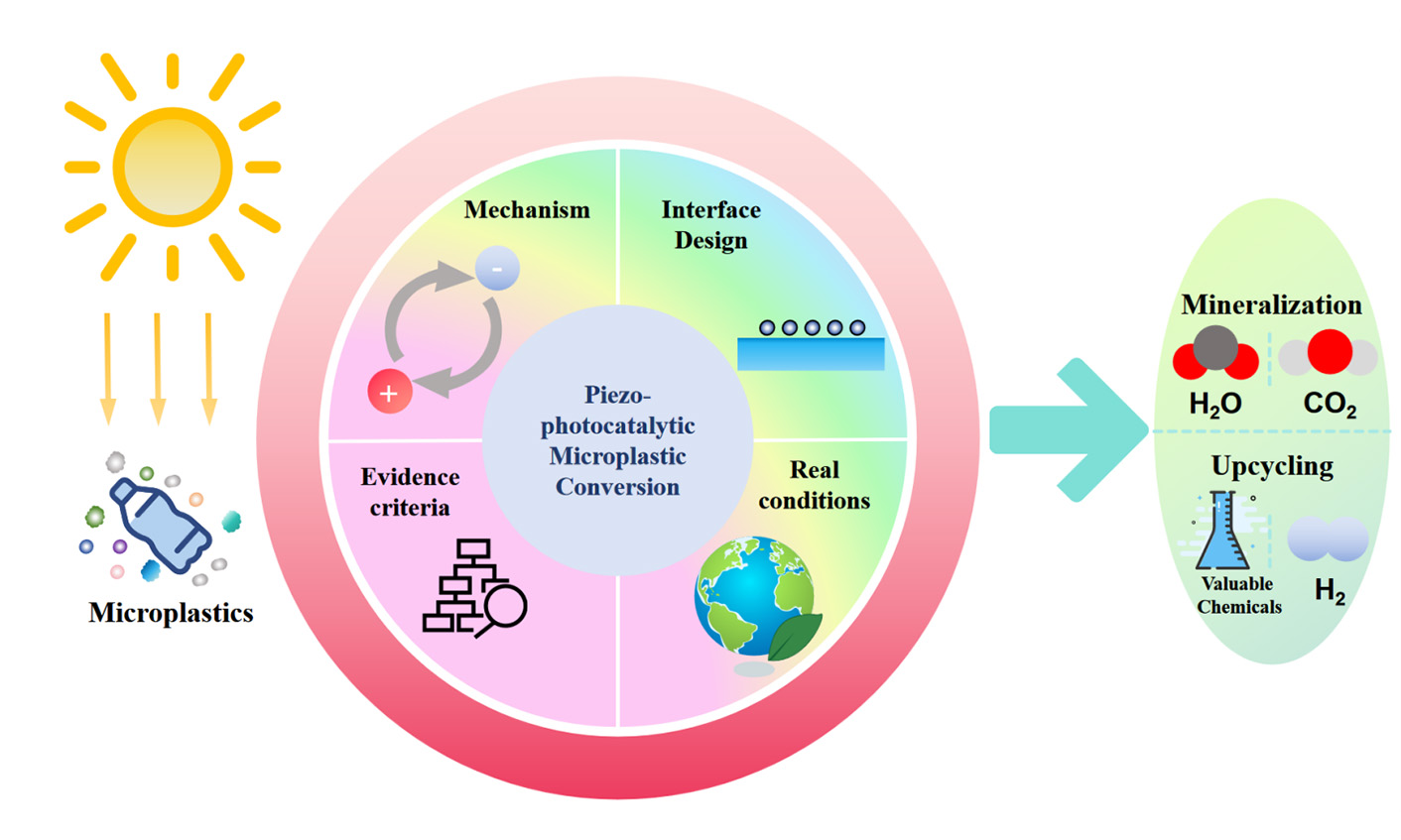
Abstract
Microplastics are persistent solid polymer pollutants, and their pollution of the oceans has become increasingly severe. However, due to their high chemical inertness and long degradation period, existing treatment strategies have not been effective in addressing this problem. In recent years, a large number of researchers have focused on photocatalysis and photoelectrocatalytic degradation of microplastics; however, there has been very little research on piezoelectric photocatalysis for microplastic treatment. Therefore, this review provides an in-depth analysis of the advantages and disadvantages of piezoelectric photocatalytic technology in this application area, as well as the challenges involved in the degradation of microplastics. We hope to summarize the existing findings of other researchers to conduct a comparative analysis of the aspects that require optimization and improvement in different degradation processes. This paper also explores the structure-dependent reactivity of various typical plastics, as well as the effects of multiphase transport and chemical pretreatment on piezoelectric photocatalytic efficiency. Finally, this review proposes future research directions aimed at establishing a reliable conversion evaluation system and developing practical piezoelectric photocatalytic platforms for microplastic remediation and resource recycling.
Keywords


 Download PDF
INTRODUCTION
Owing to its versatility, low density, chemical stability, and low production costs, plastic has become an indispensable material in people’s daily lives. Furthermore, its widespread use in packaging, transportation, medical devices, electronic products, and other industrial sectors has driven the continued growth in global plastic consumption. But the excessive use and improper disposal of plastics have led to a massive accumulation of plastic waste in terrestrial and aquatic environments, making the management of microplastic pollution an urgent priority[1-3]. Under the influence of environmental weathering processes, such as mechanical abrasion, ultraviolet radiation, thermal oxidation, chemical aging, and biodegradation, large plastic fragments gradually break down into microplastics and even nanoplastics[4,5]. These plastics, which are challenging to see with the naked eye, continue to have adverse effects on our physical health. Microplastics generally refer to plastic particles smaller than 5 millimeters[6]. Because of their tiny size, they are likely to be present in various environments and can easily be transported in a variety of ways. Microplastics can travel over long distances through rivers, lakes, oceans, sediments, and biological systems, causing pollution. They may also interact with organic matter, minerals, microorganisms, and other pollutants, thereby posing long-term risks to aquatic ecosystems and environmental health[7-10].
Researchers have begun to explore solar-energy-driven methods for microplastic conversion, leading to the application of photocatalysis. The field of photocatalysis has already achieved some success in removing organic pollutants[11-14]. However, the application of photocatalysis to microplastic degradation is more challenging because they are water-insoluble solid polymers. It is a complex, heterogeneous process in which both the occurrence of reactions during degradation and the conversion efficiency depend heavily on whether the free radicals generated by the catalyst can effectively break down the polymer’s surface and interior in solution. Common microplastics (such as polyethylene and polypropylene) have chemically inert C-C main chains and strong C-H bonds. Their hydrophobic surfaces further limit contact with photocatalysts and reactive species in the water, making activation and transformation difficult under mild conditions[15]. When light strikes the surface of a semiconductor material, it will generate electron and hole pairs which can produce ·OH and ·O2-[16,17]. These reactive oxygen species can oxidize and break the C-H and C-C bonds on the surface of microplastics. Therefore, photocatalysis is regarded as a highly valuable method for the sustainable conversion and recycling of microplastics[18,19]. However, it still faces challenges in several aspects of microplastic degradation. First, during the photocatalytic process, photo-generated electrons and holes often recombine rapidly. Second, widely used catalysts such as TiO2 have limited light absorption[20]. These inherent limitations drive research to find a strategy to overcome both charge separation and interfacial reactions in microplastic degradation.
Since then, piezo-photocatalysis has emerged as a new approach for environmental remediation by combining piezocatalysis with photocatalysis[21]. In simple terms, piezo-photocatalysis involves using the polarized electric field generated within a piezoelectric material by mechanical stimuli, under the combined action of light and mechanical stimulation to promote the separation of photo-generated electrons and holes. At the same time, mechanical effects such as ultrasound, vibration, and fluid flow can improve catalyst dispersion, thereby theoretically increasing the contact area between the catalyst and microplastics to enhance degradation efficiency. However, the mechanism of piezocatalysis remains under debate. Specifically, the main proposed mechanisms include energy-band theory and the screening-charge effect[22]. At this stage, it is very important to reveal how piezocatalysis truly enhances the photocatalytic process in applications. The coupling between piezocatalysis and photocatalysis should not be regarded as simply two superimposed independent processes. In this process, the mechanically generated piezopotential can modulate the local band bending of catalysts, thereby guiding the migration of electrons and holes[23,24]. To date, piezoelectric photocatalysis has achieved some success in environmental treatment. It has also demonstrated, to a certain extent, that the piezo-photocatalytic synergy is more effective than piezoelectric catalysis or photocatalysis alone[25-31]. However, there is still relatively little research on piezoelectric photocatalysis in the field of microplastic treatment. Microplastics cannot be dissolved in water; on the contrary, they have relatively large sizes and complex surface properties, which make them very difficult for catalysts to capture in an aqueous solution. Those conditions significantly reduce the effectiveness of the catalytic process. Furthermore, when evaluating the degradation of microplastics, relying only on the fragmentation of plastic particles, the roughening of their surfaces, or the observation of the introduced functional groups on the surface is insufficient to prove that microplastics have been completely degraded. More rigorous evidence of degradation should specifically include substantial breakage of long polymer chains, a significant decrease in molecular weight, the final degree of mineralization, the conversion of carbon, and toxicity assessments of degradation products[32]. Therefore, the evaluation standards for degrading microplastics should be clarified in a more systematic and comprehensive way. The relevant details will be discussed later in this review.
Ideally, in the future it would be possible to use a combination of tidal energy and solar energy in a seawater environment to enable a piezo-photocatalyst to directly degrade microplastics in seawater. The reaction products could then be collected and reprocessed into plastic products, or the hydrogen generated during the reaction could be stored and directly supplied for everyday use. Finally, the system would continue to treat pollutants in seawater, thereby achieving a resource cycle. Figure 1 schematically illustrates the overall degradation cycle. However, the practical realization of such a system remains challenging. Currently, most studies still use ultrasonic equipment. However, real-world seawater environments are more complex and pose a greater challenge to the lifespan and stability of catalysts[33-36].
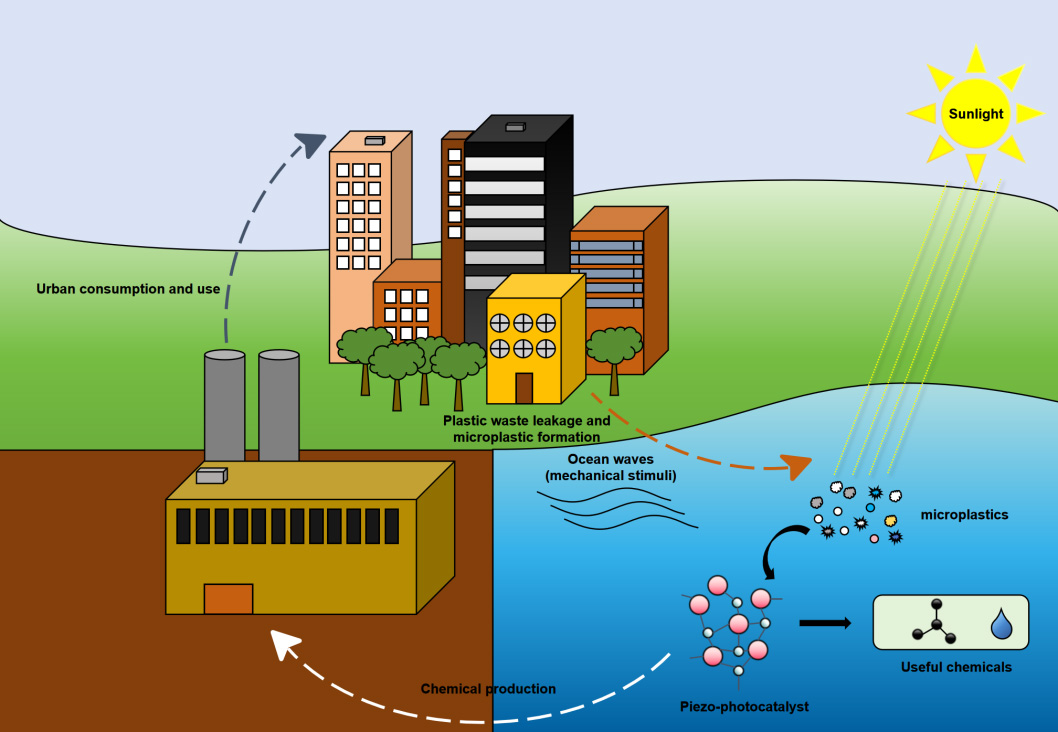
Figure 1. Conceptual illustration of future piezo-photocatalytic microplastic degradation and chemical upcycling in the marine environment.
STRUCTURAL CHARACTERISTICS AND DEGRADATION CHALLENGES OF MICROPLASTICS
Types and structure-dependent reactivity of microplastics
Currently, polyethylene (PE), polypropylene (PP), polystyrene (PS), polyvinyl chloride (PVC), and polyethylene terephthalate (PET) are among the most frequently detected types of microplastics in the natural environment[37]. Because the different chemical structures of common microplastics determine their distinct preferred reaction sites and oxidation pathways, there is no single reaction pathway for microplastic degradation that applies to all polymers. The rate at which they age in the environment and the difficulty of their degradation are primarily determined by the chemical structure of their polymer main chains. Specifically, PE, PP, PS, and PVC are all typical carbon-chain polymers, and their backbones are composed of relatively stable C-C bonds. Therefore, their catalytic activity typically depends on the oxidation state of the C-H/C-C bonds on their surfaces. In contrast, because PET contains ester bonds in its structure, it is easier for hydrolysis reactions to cause chain breakage and degradation in an aqueous environment[38]. The characteristics of these common microplastics are summarized in Table 1.
Structure-dependent reactivity, representative degradation pathways, and major challenges of common microplastics
| Microplastic | Key structural characteristics | Typical initial attack / cleavage | Representative degradation pathway / products | Major challenge for catalytic conversion | Ref. |
| PE | Saturated C-C backbone; mainly secondary C-H bonds; no readily hydrolysable groups; hydrophobic and semicrystalline | H abstraction from the C-H backbone | Alkyl radical → peroxyl radical → hydroperoxide → carbonyl species → C-C chain scission | Hydrophobicity and crystalline domains limit catalyst-polymer contact and ROS accessibility | [39,40] |
| PP | Saturated C-C backbone with pendant -CH3 groups and tertiary C-H sites; hydrophobic and semicrystalline | Preferential H abstraction at tertiary C-H sites | Carbon-centered radical → peroxyl/hydroperoxide → alkoxy radical → β-scission; alcohols, ketones and acids can form | Hydrophobicity and crystallinity restrict interfacial ROS attack and subsequent deep oxidation | [39,41] |
| PS | C-C backbone bearing phenyl groups and benzylic C-H sites | H abstraction / oxidation at benzylic positions | Benzyl-type radicals → oxygenated aromatic intermediates; benzaldehyde, acetophenone, benzoic acid and related products | Aromatic intermediates may persist; mass loss or surface oxidation does not demonstrate complete mineralization | [39,42,43] |
| PET | Aromatic polyester containing ester linkages; generally semicrystalline | Ester-bond hydrolysis and/or oxidative attack on accessible segments | Ester cleavage → oligomers, terephthalic acid (TPA) and ethylene glycol (EG); soluble intermediates can undergo further oxidation | Crystalline regions restrict penetration of water/reactive species; aromatic segments resist further oxidation | [44,45] |
| PVC | C-C backbone containing C-Cl bonds and high chlorine content | Dehydrochlorination / dechlorination followed by backbone oxidation | C-Cl cleavage or HCl elimination → unsaturated/polyene-like structures → further oxidation and chain scission | Chlorinated intermediates and chlorine release introduce additional toxicity and require chlorine-fate analysis | [46,47] |
Polyethylene (PE) and polypropylene (PP) are typical polyolefin microplastics; their backbones consist primarily of stable C-C and C-H bonds, and their structures lack functional groups. Therefore, before catalyzing the degradation of such microplastics, chemical treatment can be used to increase the number of oxygen-containing functional groups on their surfaces, thereby improving their surface wettability in aqueous solutions. Furthermore, because polyethylene and polypropylene are typically highly hydrophobic, they cannot come into extensive contact with the aqueous solution or the catalyst, which significantly reduces the degradation efficiency. Therefore, the strategy in degrading PP and PE mainly relies on oxidation-induced chain scission[39,48,49]. For PE, C-H abstraction typically involves oxidation to form carbon-centered radicals, followed by reaction with O2 to form peroxyl radicals and hydroperoxides, which ultimately lead to the formation of carbonyl-containing products and the cleavage of C-C bonds[50,51]. Unlike polyethylene, PP contains tertiary C-H sites with the methyl-substituted backbone in its structure. These sites are generally more prone to hydrogen abstraction. The resulting carbon-centered radicals can subsequently undergo peroxide formation and alkoxy radical formation, which may ultimately lead to the formation of ketones and alcohols[41,52,53]. However, the extent of degradation is still influenced by the stability of the crystalline regions and the number of surface reactive sites. Since PS contains aromatic phenyl side chains, its catalytic or oxidative transformation often results in the formation of certain aromatic oxygen-containing compounds, such as benzaldehyde and benzoic acid[42,43]. Therefore, the degradation of PS cannot be assessed solely based on mass loss or surface oxidation; it also requires analysis of the intermediates formed during the catalytic process. The PET main chain contains both hydrolyzable ester bonds and aromatic structures. The ester bonds can be hydrolyzed through simple chemical treatment or enzyme-catalyzed hydrolysis; however, the highly ordered crystalline regions inhibit the penetration of water and catalytic sites into the polymer interior to facilitate the reaction, thereby reducing the efficiency of microplastic degradation[44]. In the case of PVC, the presence of C-Cl bonds makes its degradation process more complex; therefore, when evaluating the degradation of PVC, attention must be paid to its dechlorination efficiency and the toxicity of its byproducts[46,47].
Pretreatment effects
Because of their properties, microplastics are typically insoluble or poorly dispersed in water. Therefore, different chemical pretreatment methods may be used to modify microplastics[54]. Among the polymers, polyethylene and polypropylene both have poor wettability, which reduces the contact area between the polymer surface and catalyst. As a result, the oxidation reaction occurs primarily on the exposed surface and has difficulty propagating into the polymer. Previous studies on the photocatalytic degradation of polyethylene-based microplastics have shown that degradation efficiency is closely related to the particle size and morphology of the microplastics, as well as the degree of contact between the photocatalyst and the polymer particles[55]. Crystallinity is also one of the key factors. Amorphous regions typically exhibit higher chain mobility and better reactant accessibility, which make these regions more sensitive to the reactive species. This means that even polymers of the same type may exhibit significantly different degradation kinetics depending on their crystallinity[56].
At this stage, chemical pretreatment becomes particularly important. It is primarily used to effectively separate microplastics from complex matrices prior to the analysis of environmental samples, or to improve the surface wettability of microplastics and enhance their reactivity prior to catalytic reforming. Although these two applications serve different purposes, they may both alter the initial physical and chemical properties of the polymer.
In fact, the actual effectiveness of chemical pretreatment mainly depends on the type of polymer and the treatment conditions. Previous comparative studies on PE, PS, PET, and PP have shown that H2SO4 causes dramatic changes in the surface morphology and functional groups of these materials. In contrast, HCl, H2O2, KOH, and NaOH only have relatively limited effects on most plastics[54]. However, high temperature and pressure can also cause chemical changes in polymers. Some researchers have found that oxygen-containing functional groups appear on the surface of PP after hydrothermal treatment[57]. Others have also used ozone to subject microplastics to intense oxidation. The results show that this process successfully introduces a great variety of oxygen-containing functional groups, and leads to physical cracking on the plastic surface[58]. However, since some chemical pretreatment methods themselves can cause oxidation and partial degradation of the plastic, researchers must distinguish the chemical changes resulting from pretreatment separately or from the photocatalytic process. Therefore, a blank control experiment that includes only the pretreatment steps is necessary.
In addition, while pristine microplastics are commonly used in laboratory studies, microplastics in real-world environments have typically undergone varying degrees of photoaging, thermal oxidation, mechanical abrasion, and biological colonization. Environmental aging alters the oxygen-containing functional groups, roughness, surface charge, wettability, and crystallinity of polymer surfaces. Oxidation and surface cracking may enhance the contact between active species and microplastics in water; therefore, the catalytic behavior of pristine and aged microplastics cannot be simply equated, and the aging state of the microplastics should be clearly reported when comparing degradation performance across different studies[59-61]. In summary, the ultimate goal of pretreatment should be to lay the groundwork for improving subsequent catalytic efficiency; therefore, when designing catalysts and studying surface reaction mechanisms, it is important to compare the catalysts’ degradation performance on microplastics that have undergone pretreatment under different conditions, as well as the selectivity of the products.
PHOTOCATALYTIC MICROPLASTIC DEGRADATION AND THE RATIONALE FOR PIEZOELECTRIC ENHANCEMENT
Piezo-photocatalysis: fundamental distinction and evidence of enhancement
The photocatalytic conversion of microplastics relies on the absorption of incident light by semiconductors. When light strikes the surface of the catalyst, electrons in the valence band are excited to the conduction band, thereby forming electron-hole pairs. These conduction-band electrons can participate in reduction reactions, while the holes can participate in the oxidation process of microplastics[17,19,62,63]. However, because photocatalysts are prone to electron-hole recombination, and microplastics possess the characteristics described in Section STRUCTURAL CHARACTERISTICS AND DEGRADATION CHALLENGES OF MICROPLASTICS, this process affects the conversion of charge carriers into active species. Therefore, simply modulating the electronic structure will not result in higher conversion efficiency for microplastics. Therefore, the piezoelectric effect is introduced to fix the direction of electron migration in the photocatalytic process. A piezocatalyst undergoes lattice deformation when stimulated by mechanical stresses such as ultrasonic waves. Piezo-photocatalysis, however, does not involve the superposition of the two catalytic processes; rather, it regulates carrier migration through piezoelectric polarization and piezoelectric potential generated by mechanical deformation. The principle is illustrated in Figure 2[21,64]. When compared with other advanced oxidation processes, piezo-photocatalysis can utilize mechanically induced polarization to regulate the separation of photogenerated charges, thereby enabling interfacial redox reactions. However, other AOPs, such as ozone oxidation, photocatalytic Fenton oxidation, and electrochemical oxidation, require the generation of reactive species through chemical oxidants, ozone, electrochemical pathways, or the Fenton reaction, whereas piezoelectric photocatalysis operates without the need for additional oxidants[65,66]. However, the external mechanical energy required for piezoelectric catalysis may partially offset the energy efficiency. Therefore, when reporting a comparison between piezo-photocatalysis and other AOP technologies, chemical inputs and total energy consumption should also be considered[67]. Therefore, the advantage of piezo-photocatalysis over conventional photocatalysis should not be limited to the additional utilization of mechanical energy, but rather to the dynamic regulation of redox chemistry and interfacial charge transfer at the reaction surface. Furthermore, to demonstrate that piezo-photocatalysis does indeed enhance the degradation efficiency of microplastics, it is not sufficient to merely compare the reaction rates under the three conditions of photocatalysis, piezocatalysis, and piezo-photocatalysis. To further compare the conventional heterogeneous photocatalysis, piezocatalysis and piezo-photocatalysis, we established Table 2 to clarify the advantages and limitations. The next section will further discuss how piezoelectric polarization modulates local potentials and the migration of photo-generated charge carriers, as well as how these effects should be verified at the mechanistic level.
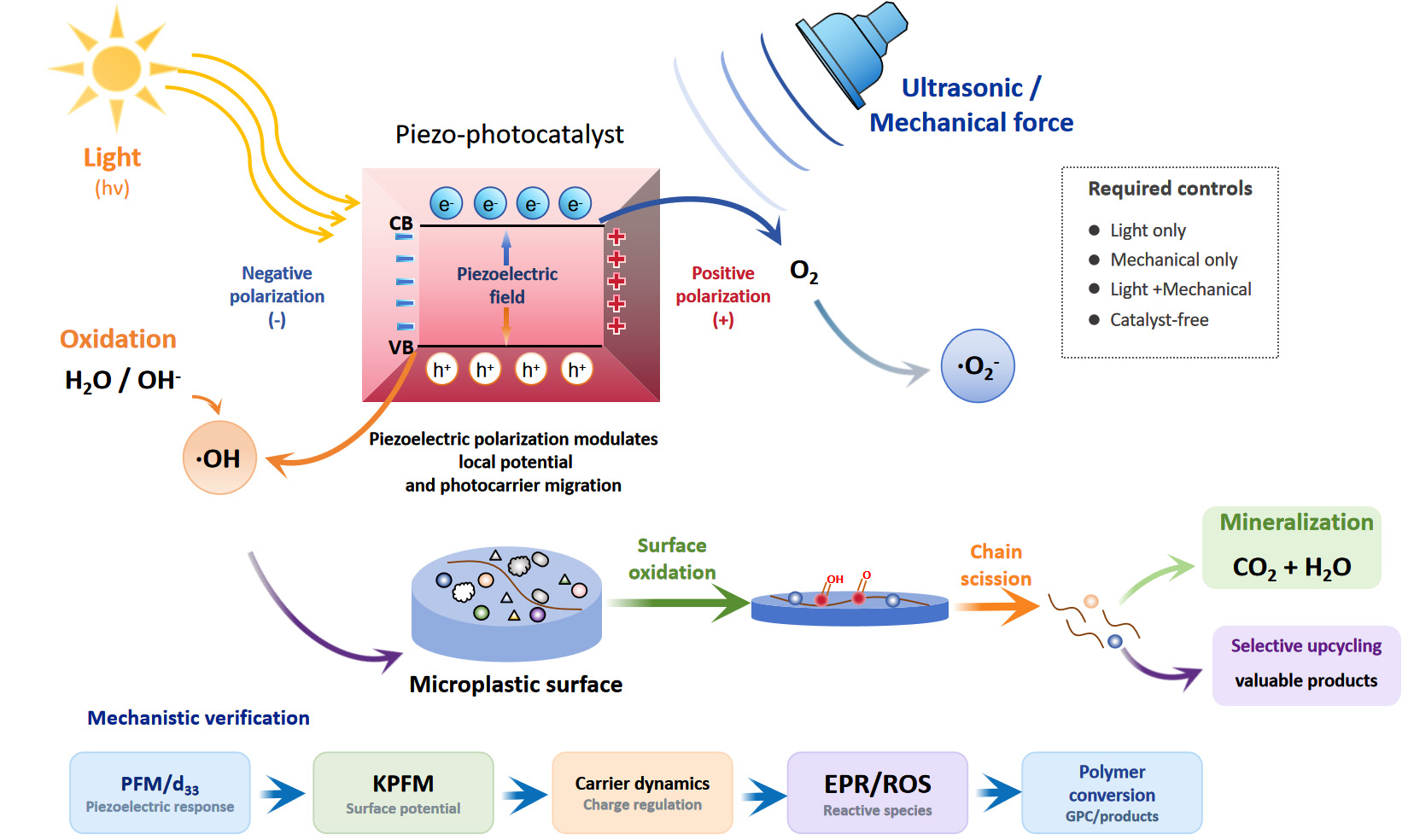
Figure 2. Working principle of piezo-photocatalysis. PFM: Piezoresponse force microscopy; KPFM: Kelvin probe force microscopy; EPR: electron paramagnetic resonance; ROS: reactive oxygen species; CB: conduction band; VB: valence band; d33: longitudinal piezoelectric coefficient; GPC: gel permeation chromatography.
Comparison of conventional heterogeneous photocatalysis, piezocatalysis, and piezo-photocatalysis for plastic conversion
| Comparison aspect | Conventional heterogeneous photocatalysis | Piezocatalysis | Piezo-photocatalysis | Ref. |
| Primary energy input | Light | Mechanical stimulation (ultrasound, vibration, flow) | Light + mechanical stimulation | [16,21,22,24] |
| Fundamental charge process | Photoexcitation generates e-/h+ pairs | Mechanical deformation induces piezopotential that can participate in redox reactions | Photocarriers are generated by light, while mechanically induced polarization dynamically modulates local potential | [16,19,21,22,24] |
| Advantages | Can directly use solar photons and does not require a mechanical-energy input | Can use mechanical energy and drive redox chemistry without photoexcitation in suitable piezoelectric systems | Apply polarization field to a photocatalysis can enhance charge separation and alter surface redox chemistry | [21,22,24] |
| Limitations | Carrier recombination, limited spectral utilization for some photocatalysts, and poor interfacial accessibility between catalyst and polymer | Strongly depends on effective stress transfer and charge screening, ultrasound can also cause cavitation and physical fragmentation that are not piezoelectric effects | Requires additional mechanical energy to separate true piezoelectric enhancement from cavitation effects, mechanical durability and reactor design also become important | [16,20-22,24] |
| Representative plastic performance | PS nanoplastics: 10.1% mineralization after 15 h under photocatalysis | PS nanoplastics: 11.5% mineralization after 15 h under piezocatalysis | The same PS-nanoplastic system: 46.6% mineralization after 15 h under coupled piezo-photocatalysis, exceeding the sum of the two individual processes | [68] |
| Direct microplastic evidence | Direct MP photocatalysis is comparatively well established for PE/PP/HDPE and other polymers, although reported endpoints vary across studies | Direct MP piezocatalytic studies remain limited and are mainly useful for isolating the contribution of mechanical polarization | Direct MP evidence is still scarce. Fe1-xS/FeMoO4/MoS2 achieved 58.46% PS-MP mass loss after 30 h and linked charge regulation to H2O2/self-Fenton chemistry and identified oxidation products | [17-20,36] |
| How mineralization should be interpreted | Mass loss, particle-size reduction, or surface oxidation alone cannot establish complete mineralization | The same criterion applies; mechanical fragmentation must be separated from chemical conversion | A higher coupled “degradation” or conversion percentage should not be interpreted as complete mineralization unless polymer-derived carbon is quantitatively traced to inorganic carbon | [68] |
| Minimum comparison needed | Report light spectrum or intensity, catalyst loading, polymer properties, and conversion endpoint | Report mechanical mode, frequency power and verify a measurable piezoelectric response; include catalyst-free controls where appropriate | At minimum, compare light-only, mechanical-only, and light + mechanical conditions; mechanistic attribution should link polarization - potential change - carrier regulation - ROS - polymer conversion | [21,22,24,68] |
Mechanistic regulation of photocarrier dynamics by piezoelectric polarization
Current research has shown that piezoelectric enhancement works by modulating the charge-transfer barrier and the built-in electric field, which can alter the charge migration direction and utilization efficiency of photogenerated carriers. In the chemically bonded BaTiO3@ReS2 Schottky heterojunction system developed by Liu et al., the Schottky junction between ReS2 and BaTiO3 provides an interfacial channel for electron transfer, while the mechanically induced BaTiO3 polarization field further lowers the Schottky barrier[69]. The electrons can then transfer more easily toward ReS2, thereby enhancing O2 activation and ·O2- formation. The piezo-photocatalytic apparent rate constant reported in this research reached 0.133 min-1, which is 16.6 and 2.44 times that of piezocatalysis and photocatalysis[69]. Li et al. found that the surface potential of a Bi2O2(OH)NO3/BiOI type-II heterojunction is approximately 1.6 times that of Bi2O2(OH)NO3 alone[70]. They demonstrated that piezoelectric polarization and the heterojunction-induced electric field can synergistically enhance charge separation efficiency. In the most recent research work, Niu et al. used piezoresponse force microscopy (PFM), Kelvin probe force microscopy (KPFM), and density functional theory (DFT) to further elaborate on this mechanism in a ZnO/N-CuO S-scheme heterojunction[71]. Under simultaneous light irradiation and ultrasound, this system achieved 98.3% cefotaxime removal. However, compared to the ultimate degradation efficiency, the experiments indicate that the key to heterojunction piezo-photocatalysis does not lie simply in the simultaneous presence of a built-in field. They mainly consider whether mechanically induced polarization can enhance the favorable interfacial potential gradient under actual operating conditions and then ultimately drive the directional migration of charge carriers[71]. Jing et al. recognized that it is still insufficient to infer the piezoelectric contribution based solely on steady-state photoluminescence (PL) quenching or photocurrent enhancement; therefore, in addition to the BiVO4/BiFeO3 n-p heterojunction, they also analyzed the electron diffusion coefficient, diffusion length, and electron lifetime[72]. The coupled reaction rate of this system reached 6.12 and 4.36 times that of photocatalysis and piezocatalysis[72].
On the other hand, some researchers have also found that the piezoelectric response does not simply have a linear effect on catalytic efficiency. BaTiO3 samples of different sizes exhibit different properties. A higher piezoelectric amplitude did not result in a higher reactivity. Furthermore, the authors found that the photocurrent response of small BaTiO3 platelets was 2.89 times that of larger samples, a phenomenon primarily attributed to switchable surface screening charges[73]. This result indicates that the key factor determining the actual catalytic enhancement is the catalyst’s ability to maintain effective surface charges for interfacial exchange under dynamic mechanical stimulation. This work also explains why the mechanism of piezocatalysis remains controversial. In short, Wang et al. summarized the main explanations as energy-band theory and the screening-charge effect[22]. The former emphasizes the role of the piezopotential in modulating semiconductor band bending and carrier migration, while the latter mainly discusses the role of polarization-induced surface charges and screening charges in interfacial redox processes. More recent articles have further pointed out that, in addition to the two models mentioned above, the displacement-current mechanism based on the nanogenerator principle has also been used to explain some piezocatalytic phenomena; therefore, studies of the mechanisms underlying these reactions should integrate evidence from pressure-dependent spectroscopy, KPFM, chronoamperometry, and in situ electron paramagnetic resonance (EPR)/Fourier-transform infrared spectroscopy (FTIR)[74].
Piezoelectric contribution and its relevance to microplastic conversion
To verify the piezoelectric contribution to catalysis, researchers should establish a chain of evidence that can demonstrate the material’s piezoelectric response contributes to the final chemical transformation. PFM and piezoelectric coefficients can confirm whether a material exhibits a measurable electromechanical response. However, those results cannot prove that piezoelectric polarization plays a role in the catalysis. Further stress-dependent KPFM is needed to determine whether mechanical deformation produces exploitable local potential changes. Based on this, photocurrent, electrochemical impedance spectroscopy, PL/ time-resolved photoluminescence (TRPL), and transient spectroscopic techniques can be used to determine whether mechanical stimulation alters the lifetime of photo-generated carriers and the charge separation process. However, further mechanistic validation should be extended to interfacial redox chemistry on the surface between the catalyst and plastics. Then, EPR/ electron spin resonance (ESR), reactive oxygen species (ROS)-selective probes, and radical scavenging experiments can be used to determine whether piezoelectric polarization further alters ROS generation. Therefore, a comprehensive degradation mechanism should establish a continuous relationship among the piezoelectric response, surface-potential modulation, photocarrier regulation, reactive-species evolution, and substrate conversion. At the same time, control experiments are also essential for identifying the contribution of piezoelectricity. At least three experimental conditions should be established, including light irradiation alone, mechanical stimulation alone, and the simultaneous application of light irradiation and mechanical stimulation. If ultrasound is used, a catalyst-free control under simultaneous light irradiation and ultrasound should also be included to evaluate the direct contribution of these external stimuli. Wu et al. compared non-piezoelectric Bi2Fe4O9 with piezoelectric BiFeO3 and Bi12(Bi0.5Fe0.5)O19.5 in a PET-MP piezocatalytic/Fenton-like system and evaluated the entire degradation process by analyzing the piezoelectric contribution[75].
The SnO2/g-C3N4/ poly(vinylidene fluoride-co-hexafluoropropylene) (PVDF-HFP) system was reported by Fazli et al. In this study, the researchers compared the effects of photocatalysis, piezocatalysis, and combined piezo-photocatalysis on PS nanoplastics and demonstrated the existence of a coupling effect[68]. Furthermore, this system immobilized SnO2/g-C3N4 on a piezoelectric PVDF-HFP nanofiber mat, thereby reducing excessive dispersion of the catalyst in water under mechanical agitation[68]. We summarize the significance of piezoelectric enhancement for understanding the mechanisms of microplastic transformation in existing studies in Table 3.
Representative experimental evidence for piezoelectric enhancement of photocatalytic processes and its relevance to microplastic conversion
| Evidence basis | Catalyst, target | Photo-piezo comparison | Polarization / field evidence | Carrier / ROS evidence | Mechanistic implication | Relevance to MP conversion | Ref. |
| Mechanistic analogue | BaTiO3@ReS2, RhB | k = 0.133 min-1; 16.6× piezocatalysis and 2.44× photocatalysis | Polarization field lowers the Schottky barrier | Enhanced O2 activation; ·O2- and h+ identified as major active species | Piezoelectric polarization reduces interfacial electron-transfer resistance and directs electrons to ReS2 | Shows how piezopotential can regulate an interfacial barrier before ROS formation | [69] |
| Bi2O2(OH)NO3/BiOI, tetracycline-HCl | > 80% degradation in 10 min under light + ultrasound; markedly above either process alone | Heterojunction surface potential ≈ 1.6 × BON; PFM + COMSOL support coupled fields | Photoelectrochemical tests + EPR | Vibration-induced polarization strengthens the heterojunction interfacial electric field and charge separation | Supports coupling between piezoelectric polarization and a pre-existing interfacial field | [70] | |
| ZnO/N-CuO on Zn foam, cefotaxime | 98.3% degradation in 30 min under photo-ultrasound conditions | PFM + KPFM + DFT show amplified built-in field | Carrier-migration analysis; strong photocarrier separation | Piezoelectric polarization modulates photocarrier kinetics through interfacial-field amplification | Strong model for linking local piezoresponse and surface-potential change to carrier transfer | [71] | |
| BiVO4/BiFeO3, RhB | k is 6.12× photocatalysis and 4.36× piezocatalysis; 98% degradation | Built-in polarization field in n-p heterojunction | Electron diffusion coefficient 27.44 × 103 cm2 s-1; diffusion length 14.49 cm; lifetime 7.66 × 10⁻³ s | Polarization-assisted heterojunction formation measurably changes carrier-transport kinetics | Demonstrates the value of quantitative carrier parameters rather than activity alone | [72] | |
| BaTiO3 ferroelectric platelets, model pollutant system | Smaller platelets show 2.89× higher photo-ultrasound photocurrent than larger platelets | PFM/domain behavior; switchable surface screening charges emphasized | Photocurrent response used to track charge behavior | Catalytic activity does not scale simply with piezoelectric amplitude; screening charges can dominate | Warns against using d33/PFM amplitude alone as evidence of useful piezoelectric enhancement | [73] | |
| Direct plastic evidence | SnO2/g-C3N4/PVDF-HFP, PS nanoplastics | Mineralization: photo 10.1%; piezo 11.5%; coupled 46.6% (15 h) | PVDF-HFP piezoelectric support; piezoelectric/PFM characterization | TOC mineralization; XPS and NTA track oxidation/fragmentation | Combined light-mechanical process exceeds the sum of individual processes, supporting genuine synergy | Direct plastic evidence; also separates mineralization from fragmentation | [68] |
| Fe1-xS/FeMoO4/MoS2, PS microplastics | PS-MP: 58.46% mass loss after 30 h; highest H2O2 yield under piezo-photo conditions | Piezoelectric response + heterointerface-induced built-in field | Photoelectrochemical characterization; H2O2 quantification; EPR; LC-MS | Field-assisted charge migration promotes H2O2 generation and self-Fenton ROS chemistry | Directly connects charge regulation, ROS formation and identified PS oxidation products | [36] | |
| ZnO/DCN-CNFe + PMS, real-world HDPE MPs | ~ 39.2 wt.% weight loss; TOC 14.06 mg L-1; selective oxidation rather than full mineralization | Interfacial band engineering and Fermi-level realignment | 1O2 dominant; yield 67.71 μmol L-1; in situ spectroscopy/DFT; product analysis | Interfacial charge flux steers PMS activation toward a non-radical 1O2 pathway | Shows that ROS identity/selectivity, not only ROS quantity, can govern MP upcycling | [76] |
The mechanistic evidence listed in Table 3 summarizes two types of evidence. Mechanistic analog studies elucidate the mechanism and viability of piezo-photocatalysis in pollutant degradation, whereas a direct plastic evidence section includes three studies directly involving plastic substrates. Since the literature on the piezo-photocatalytic degradation of microplastics remains very limited, these studies are included to provide mechanistic context for understanding the detailed mechanism in polymer conversion. Lu et al. developed a Fe1-xS/FeMoO4/MoS2 hetero-interpenetrated catalyst and established a mechanistic framework connecting interfacial charge regulation, oxidant generation, ROS chemistry, and polymer conversion products, thereby providing relatively comprehensive mechanistic evidence specific to microplastics[36]. Recent studies have also found that piezoelectric enhancement may alter the selectivity of ROS. Li et al. used Fe-doped carbon nanotubes to modulate the ZnO/carbon nitride heterojunction, making 1O2 the dominant ROS during the peroxymonosulfate (PMS) activation process, with a yield of 67.71 μmol L-1[76]. Approximately 700 mg of high-density polyethylene (HDPE) microplastics (MPs) were used, resulting in a weight loss of approximately 39.2 wt.% and the formation of intermediates such as carboxylic acids; however, this process did not achieve complete mineralization[76]. Therefore, establishing a chain of evidence for degradation is crucial. It can provide a foundation for the subsequent development of reliable microplastic degradation criteria and mechanism-guided catalyst design.
Mechanism-guided principles of designing piezo-photocatalyst for microplastic conversion
From the perspective of materials design, the current optimization of piezo-photocatalysts primarily focuses on defect engineering, heterojunction construction, and morphology/interface regulation. However, when it comes to microplastic conversion, simply increasing the bulk charge-separation efficiency is not enough. Material design for microplastics must address two issues simultaneously: first, how to maintain high piezo-photocatalytic activity through structural design; and second, how to concentrate active species at the interface between the catalyst and the microplastic. Defect engineering does not simply increase the number of surface active sites. For example, Yuan et al. successfully controlled oxygen vacancies (Ovs) in BaTiO3[77]. They found that an appropriate amount of Ovs can enhance local polarization while forming Ti3+-related sites[77]. However, performance did not improve as the number of defects was further increased. To achieve the best performance, researchers must find the balance between the number of defects and the degree of polarization. Defective BaTiO3-x in seawater also proves that defect-induced structural distortion can stabilize piezoelectrically active tetragonal domains. However, the activity in natural seawater is significantly lower than that in deionized water, indicating that the actual performance of defect-regulated materials is still influenced by the electrolyte environment. Therefore, when using microplastics, care should be taken to avoid excessive defects that could lead to carrier recombination. Point defects play a multifaceted regulatory role in heterojunction band alignment, interfacial charge transfer, and adsorption[78].
The advantage of the heterojunction structure is its ability to simultaneously control both the migration of charge carriers and the generation of surface-active species. Recent advances in conventional photocatalysis have further demonstrated that S-scheme heterojunction construction can effectively regulate directional charge transfer while preserving strong redox capability[79-81]. Future heterojunction designs should focus on how heterojunctions contribute to microplastic oxidation. It is important to ensure that electrons and holes are transported separately to surface sites, which can actually activate O2 or oxidize polymers, rather than simply pursuing lower PL intensity. Zhao et al. constructed a hierarchical porous TiO2 layer and adjusted the interface from plastophobic to plastophilic[82]. The results showed that optimal performance was achieved under semi-wet conditions at the interface between the plastic and the catalyst. This system achieved a mineralization rate of 5.63 mmol g-1 h-1 for LDPE and a conversion of 26.3% after 20 h[82]. Strong hydrophobic adsorption capacity does not equate to the interfacial affinity for plastics. If the catalyst surface is excessively hydrophobic toward microplastics, it may limit the transport of H2O and O2. Therefore, the equilibrium at the interface between the polymer and the oxide needs to be optimized. This interface requirement implies that future material designs should incorporate greater polymer specificity. Due to the varying characteristics of different microplastics, designs should be based on the surface chemistry of the target microplastics, and further investigation should be conducted to determine whether this approach truly enhances the efficiency of the oxidation process. Based on this understanding, two-dimensional materials - which have large dimensions, relatively short electron transport paths, and tunable surface chemistry - can theoretically serve as both a contact platform for microplastics and an electron transfer layer. This allows for the dispersion of additional piezoelectric domains or active sites on the surface of 2D materials. Nowadays, carbon-based materials have been developed that incorporate a hierarchical carbon nitride-supported single-atom Fe catalyst capable of stabilizing Fe-N4 sites, enabling the conversion of various practical plastic substrates and stable operation over six consecutive cycles[83]. However, there is currently insufficient evidence to prove that 2D-0D morphology is inherently superior to other common, high-performance material designs; therefore, this paper presents it as a structure worthy of systematic comparison. In direct water treatment, if large amounts of nanoscale catalysts are freely dispersed in water, this is likely to cause secondary pollution, thereby negating the environmental benefits of the process. Fazli et al. used a SnO2/g-C3N4/PVDF-HFP nanofiber mat to immobilize the photocatalytic components on a flexible piezoelectric substrate to prevent catalyst dispersion[68]. Confining both the capture of microplastics and their subsequent degradation to a single interface can significantly reduce the use of nanoparticle catalysts, which is proved by the application of immobilized photocatalytic membrane reactors in conventional MP treatment. This approach will provide a basis for the direct application in rivers or seawater[84]. Therefore, rather than simply studying catalysts with smaller particle sizes, it may be more practical in the future to focus on fibrous mats, flexible films, and supported porous layers - structures that are not only easier to recover but also more readily stimulated by mechanical forces.
EVIDENCE CRITERIA FOR MICROPLASTIC CONVERSION
For microplastic conversion, the term degradation is often used to describe entirely different processes. Fragmentation, surface oxidation, mineralization, and resource recovery can all be described as degradation. These results cannot be directly evaluated in terms of degradation rate. Fragmentation refers only to the conversion of plastic particles into smaller particles through catalysis; surface oxidation indicates a chemical change on the surface of microplastics, but polymer-chain scission can only be demonstrated when there is a significant change in the main-chain structure; Mineralization requires that the carbon in the polymer ultimately be converted into inorganic carbon. Upcycling primarily focuses on the yield and selectivity of the products. Some researchers have shown that non-selective polymer oxidation and selective conversion are distinct objectives, and therefore their final evaluations will also differ[85]. Therefore, the changes observed in mass loss, particle-size reduction, surface roughening, and FTIR/Raman measurements can only be considered preliminary evidence. When Meides et al. studied on PS weathering, they found that surface oxidation and ultimate structural failure occur at different stages, which indicated that surface damage is not synonymous with degradation[86]. And when significant cracks appeared on the surface of PP-MPs, the extensive fragmentation did not necessarily occur. Only a portion of the dissolved organic carbon could be attributed to carbon lost from the polymer[87]. This issue is even more significant when mechanical stimulation is introduced in the system because ultrasound itself can cause physical changes in microplastics. Therefore, the absence of observable chemical changes should not be directly regarded as evidence of degradation[88]. The assessment system should track the migration of polymer carbon in solids, in liquids, and in the air. During photodegradation, polymers simultaneously release dissolved organic carbon and form colloids[89]. The degradation of microplastics into soluble organic compounds does not follow a single pathway. Chain scission, oxidation, and recombination reactions may occur simultaneously in the whole process[90]. Therefore, dissolved organic carbon (DOC)/total organic carbon (TOC) should be used in conjunction with techniques such as gas chromatography–mass spectrometry (GC-MS), liquid chromatography–mass spectrometry (LC-MS)/high-resolution mass spectrometry (HRMS), and nuclear magnetic resonance (NMR) to distinguish between the two distinct processes, which are the transfer of carbon from the solid phase to the liquid phase and further chemical transformation of carbon. The molecular weight analysis is an important indicator of degradation in polymers. For soluble polymers, chain scission should be analyzed by comparing the Mn and Mw values before and after the reaction using size-exclusion chromatography (SEC)/gel permeation chromatography (GPC). It is important to note that solely considering molecular weight cannot be used to make a determination, and molecular-weight data should not be interpreted in isolation either, since cross-linking may also occur during the degradation process. Actual carbon recovery cannot be determined solely by comparing the carbon mass before and after the reaction; instead, the carbon mass before the reaction must be compared to the final target products resulting from the degradation[85,91]. And a decrease in liquid TOC does not fully correspond to the degree of mineralization. This is because some of the carbon may be released into the air as CO2, or it may be adsorbed onto the surface of the catalyst and converted into volatile organic compounds, among other things. A large number of blank experiments must be conducted to analyze the actual mineralization of the polymer[92]. Overall, when discussing the degradation efficiency in the paper, it is important to clarify the context such as whether it refers to mineralization, the amount of target product produced, or the reduction in solid mass, among other factors. A single degradation percentage should not be used without qualification. For enabling quantitative comparison across different studies, the specific performance metrics should be reported. Therefore, the conversion rate can be expressed as γMP = ∆mMP / mcatt with a unit of mgMP gcat-1 h-1 for the polymer mass conversion. For mineralization, the unit should be mmolC gcat-1 h-1, which depends on what kind of carbon-based rate researchers aim to describe. Then we establish an evidence hierarchy and standardized reporting framework for microplastic conversion, as summarized in Figure 3, to improve the comparability of research results.
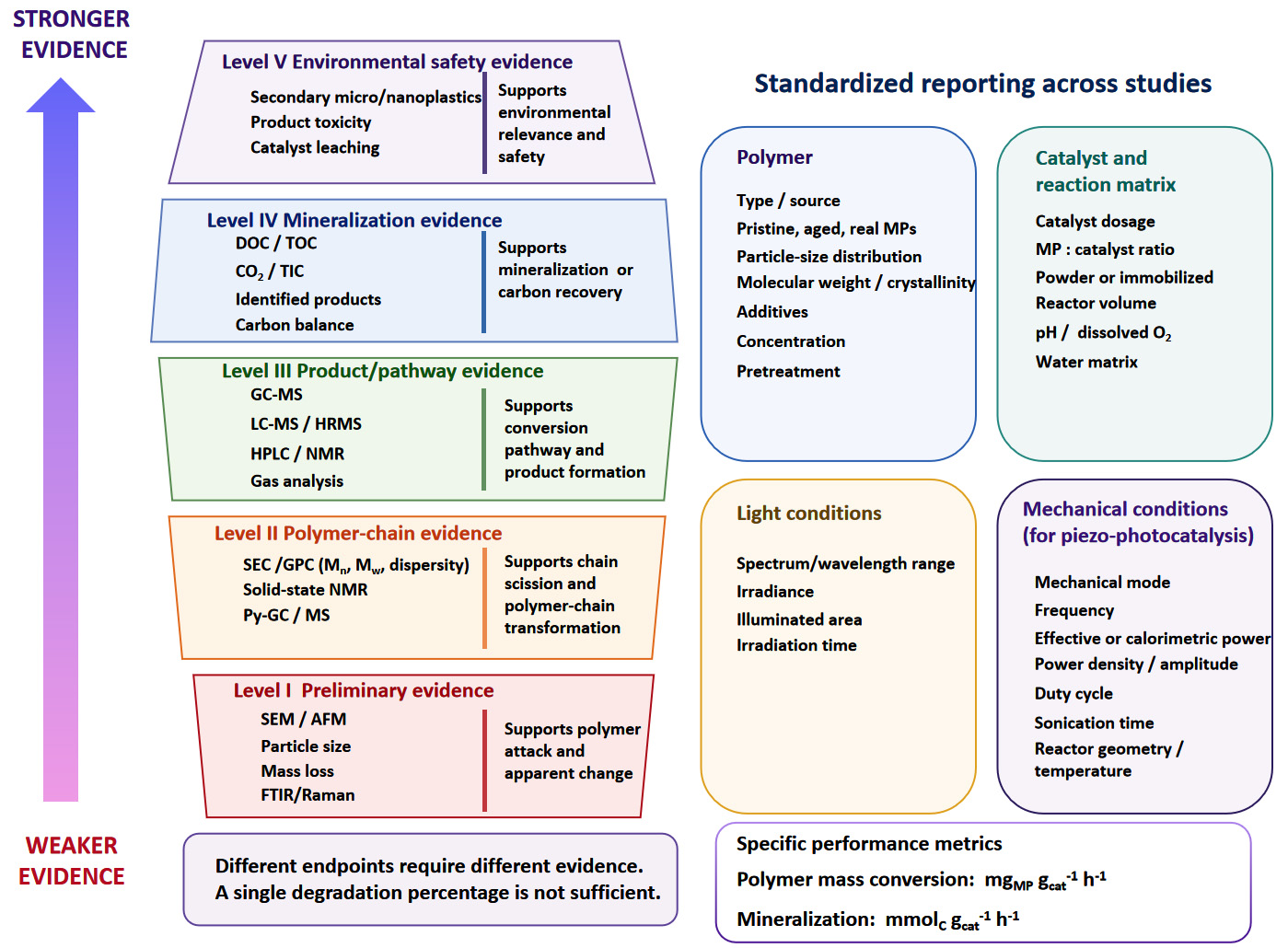
Figure 3. Evidence hierarchy and standardized reporting framework for microplastic conversion. MP: Microplastic; DOC: dissolved organic carbon; TOC: total organic carbon; TIC: total inorganic carbon; GC-MS: gas chromatography–mass spectrometry; LC-MS: liquid chromatography–mass spectrometry; HRMS: high-resolution mass spectrometry; HPLC: high-performance liquid chromatography; NMR: nuclear magnetic resonance; SEC: size-exclusion chromatography; GPC: gel permeation chromatography; Py-GC/MS: pyrolysis–gas chromatography–mass spectrometry; SEM: scanning electron microscopy; AFM: atomic force microscopy; FTIR: Fourier-transform infrared spectroscopy.
The environmental safety of the degradation process should also be a factor in the evaluation. This is because microplastics that have undergone catalytic reactions may produce nanoscale microplastics and soluble organic compounds, all of which can cause secondary environmental pollution[93,94]. Therefore, if a researcher’s goal is pollution control, they should not only focus on degradation efficiency but also emphasize the analysis of the environmental impact of the degradation products; they cannot evaluate the research results solely based on the aforementioned criteria. When comparing degradation data across different studies, it is essential to standardize the types and sources of microplastics. For example, microplastic particles that meet commercial standards are completely different from the actual plastic waste we encounter in everyday life. The chemical properties of virgin plastic and plastic that has undergone oxidation and seawater aging are also different. Therefore, the complete properties of the microplastics and the reaction conditions must be reported. Furthermore, the pretreatment and catalytic degradation steps must be described separately[95].
At the same time, specific details regarding the photocatalytic conditions must be clearly stated. For example, the actual power delivered to the reactor by a 300 W Xe lamp may fall far short of the stated intensity; therefore, reporting the irradiation area is crucial. Furthermore, the spectrum and wavelength of the light source should be clearly defined, as photons of different wavelengths have different energies, which results in different numbers of photons being excited[96-98]. Therefore, comparisons between different studies must be based on a thorough description of the actual lighting conditions. In research on piezoelectric photocatalysis, it is essential to standardize the input mechanical energy. For example, 40 kHz only indicates the vibration frequency, but does not directly indicate the intensity of the mechanical stimulation received by the catalyst and microplastics; similarly, a 300 W equipment rating does not indicate the power directly input into the reaction system. Therefore, in research on piezoelectric systems, the actual input power should be calculated by reporting the power per unit volume, the duration of the mechanical stimulation, and the increase in fluid temperature during mechanical vibration[99,100]. At the same time, if we want to highlight energy-saving breakthroughs in the reaction system, we must calculate the external energy consumption during the catalytic process. For example, while the combination of light and mechanical stimulation does improve catalytic efficiency and reduce reaction time, it may result in higher total energy consumption.
Finally, experiments should not be limited to idealized and standardized models; they should gradually move toward real-world degradation environments. Different scenarios involving catalyzed plastics should correspond to different levels of experimental significance and cannot be entirely categorized as microplastic transformation. The same applies to the environment in which the reaction system is located; different aquatic environments different aquatic environments represent different experimental conditions. Therefore, in future studies, microplastics themselves, the choice of water bodies, the specific aquatic environment, pH levels, and the types of major ions should all be clearly reported to ensure the conditions are as close as possible to real-world environments[101-103]. Furthermore, real water can influence the conversion of microplastics via piezo-photocatalysis through a combination of ROS chemical reactions and interfacial processes. Soluble organic matter may also compete with reactive species and adsorb onto the catalyst surface. For example, studies have shown that oxidation products derived from humic substances form surface complexes, thereby inhibiting interfacial charge transfer[104,105]. Inorganic ions may also influence the reaction pathways of reactive oxygen species. For example, carbonate ions can scavenge highly reactive ·OH radicals to form less reactive carbonate radicals, while chloride ions can participate in chemical reactions involving hypochlorite radicals.
CONCLUSION AND OUTLOOK
Through a comprehensive analysis of the various aspects of piezo-photocatalysis in the degradation of microplastics, it can be observed that the degradation of microplastics fundamentally differs from that of soluble organic pollutants, based on the properties of the pollutants. The mechanisms of degradation reactions and the criteria for evaluating degradation also vary. Therefore, there are still many challenges that need to be overcome.
Although piezo-photocatalysts show considerable potential for degrading microplastics, research in this application area is still in its early stages. This may be attributed to several factors: microplastics still struggle to interact effectively with the catalyst. By analyzing these current challenges, future catalyst design should focus on well-defined and polymer accessible interfaces. Strategies such as heterojunction engineering, interfacial chemical bonding, and structured catalyst architectures may provide useful routes for charge transfer and interactions between polymer and catalyst.
Future research should be based on claim-specific evaluation criteria that distinguish apparent weight loss and surface oxidation from polymer chain degradation, mineralization, and selective upcycling. Additionally, more catalytic experiments should be conducted under simulated real-world conditions. Practical evaluation should move on from pristine microplastics to aged and real plastic waste. The experimental conditions should progress from DI water to river water or seawater. Long-term stability should also be evaluated. The mechanical integrity and piezoelectric performance under continuous mechanical stimulation will be important for future study. For catalyst design, future researchers should establish a material system for different polymer types due to their different chemical structures. Tailoring the design of materials can also improve the selectivity of the target product[106].
Long-term stability for piezo-photocatalysts, catalyst stability, structural integrity, and piezoelectric performance are three different stability dimensions, which should be tested separately. Catalyst loss or deterioration of its piezoelectric response may gradually occur on a catalyst while retaining an apparent conversion rate under repeated mechanical stimulation. A flexible PVDF/Sb2S3-NiS membrane maintained piezo-photocatalytic operation for more than 280 h over 70 cycles. A PVDF-networked membrane kept its morphology and ferroelectric phases after 50 cycles[107,108]. Therefore, future microplastic conversion studies should report not only catalytic retention rate but also the piezoelectric response before and after cycling. The durability should be correlated with the applied mechanical mode, frequency, amplitude, and cycle number. For example, two different experiments have reported that the catalyst underwent five cycles. However, because the mechanical stimulation methods chosen in each experiment differed, the number of mechanical vibrations to which the catalyst was subjected also varied. Therefore, it is not possible to directly compare the stability of the two catalysts. Different intensities of stress applied on the catalysts can also lead to inaccurate reports. Then simply discussing the number of times the material was subjected to vibration is insufficient to evaluate its stability. The type of force acting on a material also affects the assessment of its service life. For example, the forces exerted on a material by ultrasound and flow are completely different, so the deformation of the material throughout the catalytic process cannot be generalized. Therefore, reports on catalyst activity should not simply equate catalytic cycling with mechanical fatigue testing. The specific mechanical stress parameters experienced by the catalyst during the catalytic process should be described in detail, followed by a thorough discussion.
For scale-up, simply increasing reactor volume is unlikely to solve the major limitations of microplastic conversion. This is because, as the reactor volume increases, the catalyst at the bottom of the flask does not receive sufficient light intensity, and microplastics also clump together, making it more difficult for ROS to come into contact with the surfaces of more microplastic particles. Taken together, these factors will also affect the transmission of mechanical stimuli. Therefore, for microplastic conversion, a more practical research direction would be to increase the surface area of the reactor and construct a thin-layer structure. This would ensure that light and water flow act uniformly on the catalyst, and since the catalyst is immobilized on a support substrate, there would be no need to separate the particulate catalyst after the reaction. Furthermore, films are easier than powder to control the degree of deformation during mechanical stimulation[107,108]. Also, such reactors further demonstrate that key conditions can be specifically tailored to different situations[109]. For microplastics, this suggests a future capture-excite-convert configuration. First, use structures such as porous membranes or filter beds to adsorb microplastics from the liquid; then, expose the membrane structure to uniform sunlight and water flow simultaneously. At this point, the microplastics concentrated near the catalyst interface can be directly converted on the surface of the structure. However, this strategy has not yet been validated for long-term microplastic conversion[110,111]. Based on the challenges discussed above, we established a roadmap for piezo-photocatalytic microplastic conversion in Figure 4.
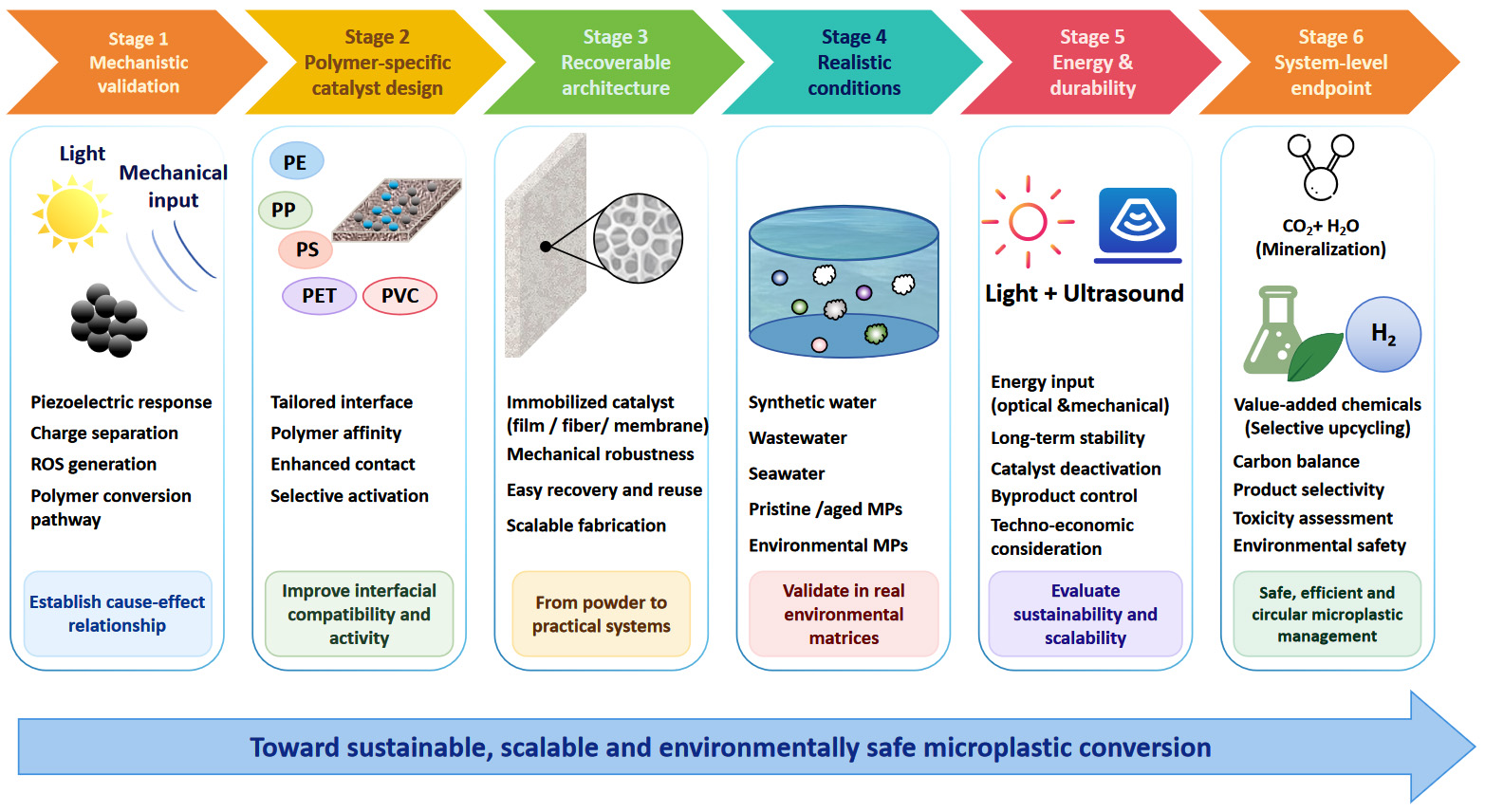
Figure 4. Roadmap toward practical piezo-photocatalytic microplastic conversion. ROS: Reactive oxygen species; PE: polyethylene; PP: polypropylene; PS: polystyrene; PET: polyethylene terephthalate; PVC: polyvinyl chloride; MP: microplastic.
Overall, piezo-photocatalysis is an emerging approach for microplastic conversion.
Future research should focus on integrating mechanistic verification, standard conversion criteria, catalyst recovery, and application in the real world.
DECLARATIONS
Authors’ contributions
Writing - original draft: Zou, M.
Validation: Zou, M.; Zhang, J.
Investigation: Zou, M.
Formal analysis: Zou, M.; Zhang, J.
Data curation: Zou, M.
Idea conception: Ran, J.
Project supervision: Ran, J.
Resources: Ran, J.
Review & editing: Zhang, J.; Chen T.; Ridwan, J.; Afzal, A.; Rida, R.; Hashem, E. M.; Ran, J.
Availability of data and materials
Not applicable.
AI and AI-assisted tools statement
During the preparation of this manuscript, the AI tool ChatGPT (OpenAI, GPT-5.6 Sol, released 2026-07-09) was used solely for language editing. The tool did not influence the study design, data collection, analysis, interpretation, or the scientific content of the work. All authors take full responsibility for the accuracy, integrity, and final content of the manuscript.
Financial support and sponsorship
The authors gratefully acknowledge financial support from the Australian Research Council (ARC) through the Discovery Project program (FT230100192).
Conflicts of interest
Ran, J. is an editorial board member of Catalysis, Energy and Environment. He has no involvement in the review or editorial process for this manuscript, including reviewer selection, evaluation, or the final decision. The other authors declare that they have no conflicts of interest.
Ethical approval and consent to participate
Not applicable.
Consent for publication
Not applicable.
Copyright
© The Author(s) 2026.
REFERENCES
1. Hale, R. C.; Seeley, M. E.; La Guardia, M. J.; Mai, L.; Zeng, E. Y. A global perspective on microplastics. JGR. Oceans. 2020, 125, e2018JC014719.
2. Borrelle, S. B.; Ringma, J.; Law, K. L.; et al. Predicted growth in plastic waste exceeds efforts to mitigate plastic pollution. Science. 2020, 369, 1515-8.
3. Lau, W. W. Y.; Shiran, Y.; Bailey, R. M.; et al. Evaluating scenarios toward zero plastic pollution. Science. 2020, 369, 1455-61.
4. Lambert, S.; Wagner, M. Formation of microscopic particles during the degradation of different polymers. Chemosphere. 2016, 161, 510-7.
5. Iñiguez, M. E.; Conesa, J. A.; Fullana, A. Recyclability of four types of plastics exposed to UV irradiation in a marine environment. Waste. Manag. 2018, 79, 339-45.
6. Hartmann, N. B.; Hüffer, T.; Thompson, R. C.; et al. Are we speaking the same language? Environ. Sci. Technol. 2019, 53, 1039-47.
7. Lebreton, L.; Greer, S.; Borrero, J. Numerical modelling of floating debris in the world’s oceans. Mar. Pollut. Bull. 2012, 64, 653-61.
8. Woodall, L. C.; Sanchez-Vidal, A.; Canals, M.; et al. The deep sea is a major sink for microplastic debris. R. Soc. open. sci. 2014, 1, 140317.
9. Li, J.; Liu, H.; Chen, J. P. Microplastics in freshwater systems: a review on occurrence, environmental effects, and methods for microplastics detection. Water. Res. 2018, 137, 362-74.
10. Cózar, A.; Echevarría, F.; González-Gordillo, J. I.; et al. Plastic debris in the open ocean. Proc. Natl. Acad. Sci. U.S.A. 2014, 111, 10239-44.
11. Khan, M. M.; Adil, S. F.; Al-mayouf, A. Metal oxides as photocatalysts. J. Saudi. Chem. Soc. 2015, 19, 462-4.
12. Hunge, Y.; Yadav, A.; Kang, S.; Lim, S. J.; Kim, H. Visible light activated MoS2/ZnO composites for photocatalytic degradation of ciprofloxacin antibiotic and hydrogen production. J. Photoch. Photobio. A. 2023, 434, 114250.
13. Li, Y.; Fang, Y.; Cao, Z.; et al. Construction of g-C3N4/PDI@MOF heterojunctions for the highly efficient visible light-driven degradation of pharmaceutical and phenolic micropollutants. Appl. Catal. B:. Environ. 2019, 250, 150-62.
14. Choquette-Labbé, M.; Shewa, W.; Lalman, J.; Shanmugam, S. Photocatalytic degradation of phenol and phenol derivatives using a nano-TiO2 catalyst: integrating quantitative and qualitative factors using response surface methodology. Water. 2014, 6, 1785-806.
16. Koe, W. S.; Lee, J. W.; Chong, W. C.; Pang, Y. L.; Sim, L. C. An overview of photocatalytic degradation: photocatalysts, mechanisms, and development of photocatalytic membrane. Environ. Sci. Pollut. Res. 2019, 27, 2522-65.
17. Uheida, A.; Mejía, H. G.; Abdel-Rehim, M.; Hamd, W.; Dutta, J. Visible light photocatalytic degradation of polypropylene microplastics in a continuous water flow system. J. Hazard. Mater. 2021, 406, 124299.
18. Ge, J.; Zhang, Z.; Ouyang, Z.; et al. Photocatalytic degradation of (micro)plastics using TiO2-based and other catalysts: properties, influencing factor, and mechanism. Environ. Res. 2022, 209, 112729.
19. Vital-Grappin, A. D.; Ariza-Tarazona, M. C.; Luna-Hernández, V. M.; et al. The role of the reactive species involved in the photocatalytic degradation of HDPE microplastics using C,N-TiO2 powders. Polymers. 2021, 13, 999.
20. Yeszhan, Y.; Bexeitova, K.; Yermekbayev, S.; et al. Photocatalytic degradation of microplastics in aquatic environments: materials, mechanisms, practical challenges, and future perspectives. Water. 2025, 17, 2139.
21. Ye, Z.; Zheng, R.; Li, S.; et al. A review: recent advances of piezoelectric photocatalysis in the environmental fields. Nanomaterials. 2024, 14, 1641.
22. Wang, K.; Han, C.; Li, J.; Qiu, J.; Sunarso, J.; Liu, S. The mechanism of piezocatalysis: energy band theory or screening charge effect? Angew. Chem. Int. Ed. 2022, 61, e202110429.
23. Jia, P.; Li, J.; Huang, H. Piezocatalysts and piezo-photocatalysts: from material design to diverse applications. Adv. Funct. Mater. 2024, 34, 2407309.
24. Deng, Y.; Liu, J.; Zhou, Z.; et al. Recent advances in piezoelectric coupled with photocatalytic reaction system: synergistic mechanism, enhancement factors, and application. ACS. Appl. Mater. Interfaces. 2024, 16, 50071-95.
25. You, H.; Wu, Z.; Jia, Y.; et al. High-efficiency and mechano-/photo- bi-catalysis of piezoelectric-ZnO@ photoelectric-TiO2 core-shell nanofibers for dye decomposition. Chemosphere. 2017, 183, 528-35.
26. Lei, H.; Zhang, H.; Zou, Y.; Dong, X.; Jia, Y.; Wang, F. Synergetic photocatalysis/piezocatalysis of bismuth oxybromide for degradation of organic pollutants. J. Alloys. Compd. 2019, 809, 151840.
27. Zhou, X.; Wu, S.; Li, C.; et al. Piezophototronic effect in enhancing charge carrier separation and transfer in ZnO/BaTiO3 heterostructures for high-efficiency catalytic oxidation. Nano. Energy. 2019, 66, 104127.
28. Liu, X.; Xiao, L.; Zhang, Y.; Sun, H. Significantly enhanced piezo-photocatalytic capability in BaTiO3 nanowires for degrading organic dye. J. Materiomics. 2020, 6, 256-62.
29. Jiang, Z.; Tan, X.; Xu, J.; Huang, Y. Piezoelectric-induced internal electric field in Bi2WO6 nanoplates for boosting the photocatalytic degradation of organic pollutants. ACS. Appl. Nano. Mater. 2022, 5, 7588-97.
30. Gao, Q.; Zhou, L.; Xu, S.; Dai, S.; Zhu, Q.; Li, Y. Significant improvement and mechanism of tetracycline degradation with the synergistic piezoelectric effect of ZnO/CuS Z-scheme heterojunction photocatalysts. Environ. Sci:. Nano. 2023, 10, 581-94.
31. Liu, P.; Dong, L.; Zhang, Z.; et al. A review: recent progress of piezoelectric effect coupled photocatalytic reaction: diverse mechanisms, system/structure design, characterization and application. Catal. 2026, 2, 11.
32. Golmohammadi, M.; Fatemeh, Musavi. S.; Habibi, M.; et al. Molecular mechanisms of microplastics degradation: a review. Sep. Purif. Technol. 2023, 309, 122906.
33. Zhang, Y.; Zhang, X.; Zhang, Y.; Zhang, Y.; Li, H.; Huang, H. Enhanced piezo-photocatalytic activity of ZnS/Fe2O3: benefit from type I junction and weak water flow-induced piezoelectric polarization. J. Photoch. Photobio. A. 2025, 460, 116117.
34. Jiang, Y.; Toe, C. Y.; Mofarah, S. S.; et al. Efficient cocatalyst-free piezo-photocatalytic hydrogen evolution of defective BaTiOx nanoparticles from seawater. ACS. Sustainable. Chem. Eng. 2023, 11, 3370-89.
35. Zhuang, J.; Wang, Y.; Lin, L.; et al. Water flow-driven high piezo-photocatalytic efficacy in superthin and densely porous GO-TiO2/PVDF-HFP composite film for ROS generation. Chem. Eng. J. 2025, 520, 166270.
36. Lu, Y.; Dong, Y.; Liu, W.; Jin, Q.; Lin, H. Piezo-photocatalytic enhanced microplastic degradation on hetero-interpenetrated Fe1-xS/FeMoO4/ MoS2 by producing H2O2 and self-Fenton action. Chem. Eng. J. 2025, 508, 160935.
37. Geyer, R.; Jambeck, J. R.; Law, K. L. Production, use, and fate of all plastics ever made. Sci. Adv. 2017, 3, e1700782.
38. Gewert, B.; Plassmann, M. M.; Macleod, M. Pathways for degradation of plastic polymers floating in the marine environment. Environ. Sci‑Proc. Imp. 2015, 17, 1513-21.
39. Boruah, B.; Lopez‐Ruiz, J. A. Progress on photo-, electro-, and photoelectron-catalytic conversion of recalcitrant polyethylene, polypropylene, and polystyrene - a review. ChemSusChem. 2025, 18, e202401714.
40. Gardette, J. L.; Therias, S. Photooxidation of polyethylene: chemical mechanisms and advanced characterization strategies. J. Vinyl. Addit. Techn. 2026, 32, 854-64.
41. Ye, J.; Liu, H.; Gao, W.; et al. Radicals mediated polypropylene waste plastics oxidation into ketone fuel. Chem. Eng. J. 2024, 490, 151899.
42. Gautam, B.; Tsai, T.; Chen, J. Towards sustainable solutions: a review of polystyrene upcycling and degradation techniques. Polym. Degrad. Stab. 2024, 225, 110779.
43. Jiang, S.; Chen, Y.; Huang, Y.; Hu, P. Photooxidation of polystyrene into high-value chemicals. Eur. J. Org. Chem. 2025, 28, e202401109.
44. Groseclose, T. M.; Nguyen, H. B. Recent advances in enzyme engineering for improved deconstruction of poly(ethylene terephthalate) (PET) plastics. Commun. Mater. 2025, 6, 190.
45. Guo, Z.; Wu, J.; Wang, J. Chemical degradation and recycling of polyethylene terephthalate (PET): a review. RSC. Sustainability. 2025, 3, 2111-33.
46. Yu, J.; Sun, L.; Ma, C.; Qiao, Y.; Yao, H. Thermal degradation of PVC: a review. Waste. Manag. 2016, 48, 300-14.
47. Lu, L.; Li, W.; Cheng, Y.; Liu, M. Chemical recycling technologies for PVC waste and PVC-containing plastic waste: a review. Waste. Manag. 2023, 166, 245-58.
48. Surana, M.; Pattanayak, D. S.; Yadav, V.; Singh, V.; Pal, D. An insight decipher on photocatalytic degradation of microplastics: mechanism, limitations, and future outlook. Environ. Res. 2024, 247, 118268.
49. Paulraj, V. D.; Narayanasamy, S. A comprehensive review on microbial degradation of polyethylene plastics: ecotoxicity, deterioration process, recurrent intermediates and key enzymes involved. Arch. Microbiol. 2025, 207, 331.
50. Chen, J.; Wu, J.; Sherrell, P. C.; et al. How to build a microplastics-free environment: strategies for microplastics degradation and plastics recycling. Adv. Sci. 2022, 9, 2103764.
51. Li, H.; Jiang, S.; He, S.; et al. Accelerated solar-driven polyolefin degradation via self-activated hydroxy-rich ZnIn2S4. Nano. Lett. 2024, 24, 11624-31.
52. Manabe, N.; Kawamura, K.; Ishikawa, M.; et al. Development of a novel potentiometric titration method for determination of polypropylene degradation. Polym. Test. 2005, 24, 994-7.
53. Mowery, D. M.; Assink, R. A.; Derzon, D. K.; Klamo, S. B.; Clough, R. L.; Bernstein, R. Solid-state 13C NMR investigation of the oxidative degradation of selectively labeled polypropylene by thermal aging and γ-irradiation. Macromolecules. 2005, 38, 5035-46.
54. Lee, H. B.; Lee, K. S.; Kim, S. J.; et al. Effect of chemical agents on the morphology and chemical structures of microplastics. Polymers. 2022, 14, 4353.
55. Llorente-García, B. E.; Hernández-López, J. M.; Zaldívar-Cadena, A. A.; Siligardi, C.; Cedillo-González, E. I. First insights into photocatalytic degradation of HDPE and LDPE microplastics by a mesoporous N-TiO2 coating: effect of size and shape of microplastics. Coatings. 2020, 10, 658.
56. Padermshoke, A.; Kajiwara, T.; An, Y.; et al. Characterization of photo-oxidative degradation process of polyolefins containing oxo-biodegradable additives. Polymer. 2022, 262, 125455.
57. Akaniro, I. R.; Zhang, R.; Tsang, C. H. M.; Wang, P.; Yang, Z.; Zhao, J. Exploring the potential of hydrothermal treatment for microplastics removal in digestate. ACS. Sustainable. Chem. Eng. 2024, 12, 14187-99.
58. Kye, H.; Yoon, Y.; Hwang, T. Changes in physical and chemical properties of microplastics by ozonation. Process. Saf. Environ. Prot. 2024, 192, 1062-72.
59. Xu, Y.; Ou, Q.; Van, Der. Hoek. J. P.; Liu, G.; Lompe, K. M. Photo-oxidation of micro- and nanoplastics: physical, chemical, and biological effects in environments. Environ. Sci. Technol. 2024, 58, 991-1009.
60. Su, X.; Liu, M.; Dou, J.; et al. Comprehensive understanding on the aging process and mechanism of microplastics in the sediment-water interface: untangling the role of photoaging and biodegradation. Environ. Sci. Technol. 2024, 58, 16164-74.
61. Sucharitakul, P. Replicating real-world microplastics with accelerated physicochemical ageing. Nat. Rev. Earth. Environ. 2024, 5, 334-334.
62. Jeyaraj, J.; Baskaralingam, V.; Stalin, T.; Muthuvel, I. Mechanistic vision on polypropylene microplastics degradation by solar radiation using TiO2 nanoparticle as photocatalyst. Environ. Res. 2023, 233, 116366.
63. He, Y.; Rehman, A. U.; Xu, M.; Not, C. A.; Ng, A. M.; Djurišić, A. B. Photocatalytic degradation of different types of microplastics by TiOx/ZnO tetrapod photocatalysts. Heliyon. 2023, 9, e22562.
64. Tu, S.; Guo, Y.; Zhang, Y.; et al. Piezocatalysis and piezo-photocatalysis: catalysts classification and modification strategy, reaction mechanism, and practical application. Adv. Funct. Mater. 2020, 30, 2005158.
65. Kumar, A.; Indhur, R.; Bux, F.; Kumari, S. Recent advances in mechanistic insights into microplastics mitigation strategies via emerging advanced oxidation processes: Legislation, challenges, and future direction. Sci. Total. Environ. 2024, 957, 177150.
66. Jiang, T.; Wang, Y.; Cai, C.; Nie, C.; Peng, H.; Ao, Z. Piezocatalysis for water treatment: mechanisms, recent advances, and future prospects. Environ. Sci. Ecotechnol. 2025, 23, 100495.
67. Zhuang, W.; Zhang, Y.; Luo, Q.; Du, S.; Wu, B.; Sui, M. Piezoelectric catalytic process: a genuinely energy-saving approach for water treatment? Chem. Eng. J. 2024, 499, 155956.
68. Fazli, A.; Lauciello, S.; Brescia, R.; Carzino, R.; Athanassiou, A.; Fragouli, D. Synergistic degradation of polystyrene nanoplastics in water: harnessing solar and water-driven energy through a Z-scheme SnO2/g-C3N4/PVDF-HFP piezo-photocatalytic system. Appl. Catal. B. Environ. 2024, 353, 124056.
69. Liu, W.; Wang, P.; Ao, Y.; et al. Directing charge transfer in a chemical-bonded BaTiO3@ReS2 Schottky heterojunction for piezoelectric enhanced photocatalysis. Adv. Mater. 2022, 34, 2202508.
70. Li, Y.; Zhang, X.; Sha, R.; et al. Efficient piezo-photocatalysis of Bi2O2(OH)NO3/BiOI heterojunction: collaboration of piezoelectric polarization and interface electric field. Chem. Eng. J. 2024, 480, 147976.
71. Niu, J.; He, T.; Qiu, C.; Song, Z. Piezoelectric polarization modulates photocarrier kinetics via enhanced built-in field at heterojunctions. Chem. Eng. J. 2025, 508, 161206.
72. Jing, Q.; Liu, Z.; Cheng, X.; et al. Boosting piezo-photocatalytic activity of BiVO4/BiFeO3 heterojunctions through built-in polarization field tailoring carrier transfer performances. Chem. Eng. J. 2023, 464, 142617.
73. Du, L.; Zhang, B.; Zhang, Y.; et al. Insights on the mechanism of piezocatalysis: switchable screen charge effects enhanced the piezo-photocatalytic activities of BaTiO3 ferroelectric platelets. J. Alloys. Compd. 2025, 1021, 179669.
74. He, J.; Zhang, M.; Duan, X.; Zhu, M. In situ evidence unveiling the debate of mechanism for piezo-catalysis. ACS. Catalysis. 2026, 16, 13909-21.
75. Wu, M.; Wang, R.; Miao, L.; et al. Synergistically piezocatalytic and Fenton-like activation of H2O2 by a ferroelectric Bi12(Bi0.5Fe0.5)O19.5 catalyst to boost degradation of polyethylene terephthalate microplastic (PET-MPs). J. Colloid. Interface. Sci. 2025, 682, 738-50.
76. Li, Z.; Ai, W.; Zhang, J.; et al. Iron-doped carbon nanotubes facilitate ZnO interfacial charge accumulation for selective singlet oxygen generation in piezo-photocatalytic microplastics upcycling. Environ. Sci. Technol. 2026, 60, 23546-57.
77. Yuan, J.; Feng, W.; Zhang, Y.; et al. Unraveling synergistic effect of defects and piezoelectric field in breakthrough piezo-photocatalytic N2 reduction. Adv. Mater. 2024, 36, 2303845.
78. Zu, D.; Wei, H.; Lin, Z.; et al. The role of point defects in heterojunction photocatalysts: perspectives and outlooks. Adv. Funct. Mater. 2024, 34, 2408213.
79. Yang, C.; Li, X.; Li, M.; Liang, G.; Jin, Z. Anchoring oxidation co-catalyst over CuMn2O4/graphdiyne S-scheme heterojunction to promote eosin-sensitized photocatalytic hydrogen evolution. Chin. J. Catal. 2024, 56, 88-103.
80. Wu, Y.; Yan, Y.; Deng, Y.; Huang, W.; Yang, K.; Lu, K. Rational construction of S-scheme CdS quantum dots/In2O3 hollow nanotubes heterojunction for enhanced photocatalytic H2 evolution. Chin. J. Catal. 2025, 70, 333-40.
81. Li, S.; You, C.; Yang, F.; Liang, G.; Zhuang, C.; Li, X. Interfacial Mo-S bond modulated S-scheme Mn0.5Cd0.5S/Bi2MoO6 heterojunction for boosted photocatalytic removal of emerging organic contaminants. Chin. J. Catal. 2025, 68, 259-71.
82. Zhao, J.; Miao, P.; Zhang, X.; et al. Photothermal mineralization of polyolefin microplastics via TiO2 hierarchical porous layer-based semiwetting air-plastic-solid interfaces. Adv. Mater. 2024, 36, 2400681.
83. Lin, J.; Hu, K.; Wang, Y.; et al. Tandem microplastic degradation and hydrogen production by hierarchical carbon nitride-supported single-atom iron catalysts. Nat. Commun. 2024, 15, 8769.
84. Biao, W.; Awanis, Hashim. N.; Rabuni, M. F. B.; Lide, O.; Ullah, A. An innovative strategy for polyester microplastic fiber elimination from laundry wastewater via coupled separation and degradation using TiO2-based photocatalytic membrane reactor. Sep. Purif. Technol. 2025, 356, 129929.
85. Su, K.; Gao, T.; Tung, C. H.; Wu, L. Z. Photocatalytic cracking of non-biodegradable plastics to chemicals and fuels. Angew. Chem. Int. Ed. 2024, 63, e202407464.
86. Meides, N.; Menzel, T.; Poetzschner, B.; et al. Reconstructing the environmental degradation of polystyrene by accelerated weathering. Environ. Sci. Technol. 2021, 55, 7930-8.
87. Tuttle, E.; Wiman, C.; Muñoz, S.; Law, K. L.; Stubbins, A. Sunlight-driven photochemical removal of polypropylene microplastics from surface waters follows linear kinetics and does not result in fragmentation. Environ. Sci. Technol. 2024, 58, 5461-71.
88. Xiong, B.; Salehi, M.; Sipe, J.; Wiesner, M. Transforming the study of the mechanical degradation of plastic: advancing microplastic release predictions through quantitative approaches. Environ. Sci. Technol. 2025, 59, 21382-5.
89. Kteeba, S. M.; Guo, L. Photodegradation processes and weathering products of microfibers in aquatic environments. Environ. Sci. Technol. 2024, 58, 16535-46.
90. Albergamo, V.; Wohlleben, W.; Plata, D. L. Tracking dynamic chemical reactivity networks with high-resolution mass spectrometry: a case of microplastic-derived dissolved organic carbon. Environ. Sci. Technol. 2024, 58, 4314-25.
91. Bhattacharjee, S.; Guo, C.; Lam, E.; et al. Chemoenzymatic photoreforming: a sustainable approach for solar fuel generation from plastic feedstocks. J. Am. Chem. Soc. 2023, 145, 20355-64.
92. Guo, Y.; Zhu, B.; Tang, C. Y.; Zhou, Q.; Zhu, Y. Photogenerated outer electric field induced electrophoresis of organic nanocrystals for effective solid-solid photocatalysis. Nat. Commun. 2024, 15, 428.
93. Sun, A.; Wang, W. Photodegradation controls of potential toxicity of secondary sunscreen-derived microplastics and associated leachates. Environ. Sci. Technol. 2025, 59, 5223-36.
94. Sun, A.; Wang, W. Photodegradation of plastic leachate: revealing the key role of halogen in reduced cytotoxicity in marine systems. Environ. Sci. Technol. 2025, 59, 17822-33.
95. Cowger, W.; Booth, A. M.; Hamilton, B. M.; et al. Reporting guidelines to increase the reproducibility and comparability of research on microplastics. Appl. Spectrosc. 2020, 74, 1066-77.
96. Cañellas, S.; Nuño, M.; Speckmeier, E. Improving reproducibility of photocatalytic reactions - how to facilitate broad application of new methods. Nat. Commun. 2024, 15, 307.
97. Bonchio, M.; Bonin, J.; Ishitani, O.; et al. Best practices for experiments and reporting in photocatalytic CO2 reduction. Nat. Catal. 2023, 6, 657-65.
98. Holmes, A.; Wang, E. Toward standardized and comparable reporting for sacrificial photocatalytic hydrogen evolution. ACS. Energy. Lett. 2026, 11, 4220-9.
99. Adamou, P.; Harkou, E.; Villa, A.; Constantinou, A.; Dimitratos, N. Ultrasonic reactor set-ups and applications: a review. Ultrason. Sonochem. 2024, 107, 106925.
100. Devos, C.; Bampouli, A.; Brozzi, E.; et al. Ultrasound mechanisms and their effect on solid synthesis and processing: a review. Chem. Soc. Rev. 2025, 54, 85-115.
101. Gouda, M. Z.; Xu, E. G.; Ateia, M. Why pristine, aged, and real-world microplastics are all essential for environmental research. Environ. Sci. Technol. 2025, 60, 7-10.
102. Sarkar, A. K.; Rubin, A. E.; Zucker, I. Engineered polystyrene-based microplastics of high environmental relevance. Environ. Sci. Technol. 2021, 55, 10491-501.
103. Reineccius, J.; Schönke, M.; Waniek, J. J. Abiotic long-term simulation of microplastic weathering pathways under different aqueous conditions. Environ. Sci. Technol. 2022, 57, 963-75.
104. Awfa, D.; Ateia, M.; Fujii, M.; Yoshimura, C. Photocatalytic degradation of organic micropollutants: Inhibition mechanisms by different fractions of natural organic matter. Water. Res. 2020, 174, 115643.
105. Ali, I.; Tan, X.; Li, J.; et al. Interaction of microplastics and nanoplastics with natural organic matter (NOM) and the impact of NOM on the sorption behavior of anthropogenic contaminants - a critical review. J. Clean. Prod. 2022, 376, 134314.
106. Chen, C.; Gu, K.; Wang, P.; Liu, Z. Q.; Ao, Y. spatially separated redox centers in anthraquinone-grafted metal-organic frameworks for efficient piezo-photocatalytic H2O2 production. Angew. Chem. Int. Ed. 2025, 64, e202425656.
107. Ma, T.; Liao, G.; Gao, F.; et al. Flexible hybrid membrane with synergistic exciton dynamics for excessive 280 h of durably piezo-photocatalytic H2O‐to‐H2 conversion. Small. 2024, 20, 2408056.
108. Li, W.; Duan, W.; Liao, G.; et al. 0.68% of solar-to-hydrogen efficiency and high photostability of organic-inorganic membrane catalyst. Nat. Commun. 2024, 15, 6763.
109. Song, P.; Shi, Y.; Cai, Y.; et al. Integration of three-dimensional printed flow-through photoreactor with Z-Scheme photocatalytic membrane for sunlight-drivable micropollutant removal from water. ACS. Mater. Lett. 2025, 7, 585-94.
110. Chen, W.; Xing, Z.; Zhang, N.; et al. Hierarchical Bi2Fe4O9/BiOI S-scheme heterojunctions with exceptional hydraulic shear induced photo-piezoelectric catalytic activity. npj. Clean. Water. 2024, 7, 86.
Cite This Article
 Open Access
How to Cite
Zou, M.; Zhang, J.; Chen, T.; Ridwan, J.; Afzal, A.; Rida, R.; Hashem, E. M.; Ran, J. Emerging piezo-photocatalytic conversion of microplastics: mechanisms, evidence standards, and interface-oriented catalyst design. Catal. Energy Environ. 2026, 1, 8. https://dx.doi.org/10.20517/cee.2026.12
Download Citation
If you have the appropriate software installed, you can download article citation data to the citation manager of your choice. Simply select your manager software from the list below and click on download.
Export Citation File
Type of Import
Tips on Downloading Citation
Citation Manager File Format
Type of Import
Direct Import: When the Direct Import option is selected (the default state), a dialogue box will give you the option to Save or Open the downloaded citation data. Choosing Open will either launch your citation manager or give you a choice of applications with which to use the metadata. The Save option saves the file locally for later use.
Indirect Import: When the Indirect Import option is selected, the metadata is displayed and may be copied and pasted as needed.
About This Article
Copyright

Data & Comments
Data
0








Comments
Comments must be written in English. Spam, offensive content, impersonation, and private information will not be permitted. If any comment is reported and identified as inappropriate content by OAE staff, the comment will be removed without notice. If you have any queries or need any help, please contact us at [email protected].