

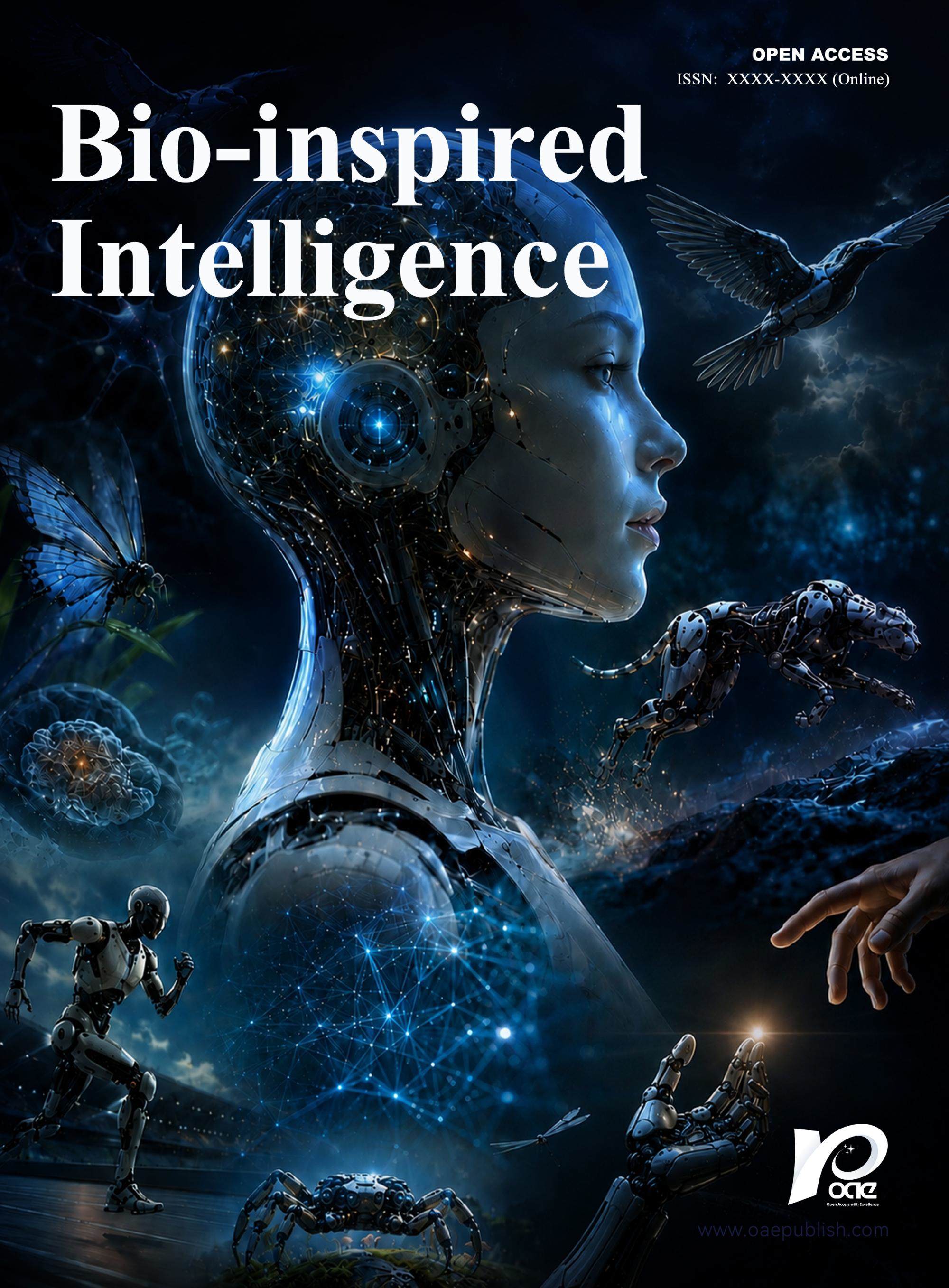
Bio-inspired Intelligence: bridging biological principles and intelligent systems
 0
0 

 Download PDF
The rapid development of artificial intelligence, robotics, neuroscience, cognitive science, computational science, biomechanics, and advanced materials is reshaping the landscape of intelligent systems. Despite remarkable progress in algorithms and computational power, biological organisms continue to demonstrate extraordinary capabilities in perception, learning, locomotion, adaptation, decision-making, coordination, and interaction. These capabilities have evolved through highly integrated relationships among structure, sensing, computation, actuation, behavior, and the environment, offering a rich source of principles for the development of next-generation intelligence.
It is within this context that Bio-inspired Intelligence is established as an international, peer-reviewed, open-access journal dedicated to advancing the science and technology of intelligence inspired by biology. The journal aims to provide a multidisciplinary platform connecting foundational sciences - including biology, neuroscience, cognitive science, biomechanics, and materials science - with artificial intelligence, robotics, control, and computational engineering.
The emergence of bio-inspired intelligence reflects a broader shift in how intelligence is understood. Intelligence is no longer viewed solely as the outcome of increasingly powerful computation. Biological systems demonstrate that intelligent behavior can emerge from the interaction of neural processes, body morphology, physical materials, sensory mechanisms, behavioral strategies, and environmental dynamics. At the same time, biological principles can be abstracted into computational models and algorithms without necessarily requiring direct physical imitation. This creates a broad spectrum of research, ranging from brain-inspired computation and evolutionary algorithms to embodied intelligent robots and biohybrid systems.
Bio-inspired Intelligence seeks to bring these research directions together under a common scientific framework. The journal focuses on understanding, modeling, abstracting, and engineering the principles through which biological systems perceive, learn, reason, move, adapt, coordinate, and interact. We are particularly interested in research that establishes a meaningful connection between biological inspiration and new forms of intelligence, rather than merely adopting biological terminology or superficial morphological analogies.
Biological inspiration can enter the research process at different levels. At the computational level, neural architectures, synaptic plasticity, evolutionary processes, collective behavior, and biological learning strategies can inspire new computational paradigms, learning algorithms, optimization methods, and decision-making frameworks. At the perceptual level, biological sensory systems can inspire new approaches to vision, tactile sensing, multimodal perception, active sensing, and sensorimotor intelligence. At the physical level, biological morphology, compliant structures, materials, and locomotion mechanisms can inspire new robots, actuators, intelligent materials, and embodied systems. These different levels are complementary rather than mutually exclusive.
A central objective of the journal is therefore to connect biological principles, intelligent computation, physical embodiment, and engineering realization. We welcome both theoretical and experimental research, from fundamental models of biological intelligence to computational algorithms, intelligent materials, robotic systems, and real-world applications. This broad scope allows the journal to accommodate research across different levels of abstraction while maintaining a common emphasis on biological inspiration and intelligent behavior.
Embodiment represents an important dimension of this vision. In many biological systems, intelligence is closely coupled with the body and the physical environment. Morphology can simplify control, materials can provide passive adaptation, and movement can actively shape perception. Such interactions have motivated the emerging concepts of embodied intelligence and physical intelligence. Bio-inspired Intelligence welcomes research investigating these relationships and encourages experimental validation on physical platforms when embodiment is central to the scientific question.
At the same time, the journal recognizes that not all forms of bio-inspired intelligence require physical embodiment. Brain-inspired computation, neuromorphic intelligence, evolutionary computation, swarm intelligence, and biologically inspired learning can generate important advances at the computational or theoretical level. The journal therefore welcomes rigorous theoretical, computational, and simulation-based contributions when they provide substantive biological grounding and advance the understanding or engineering of intelligence.
The journal covers a broad range of interconnected research areas, including bio-inspired intelligence and biological mechanisms of intelligent behavior; brain-inspired intelligence, neural computation, and neuromorphic systems; bio-inspired computation, learning, optimization, and evolutionary intelligence; embodied and physical intelligence; bio-inspired perception, cognition, navigation, and sensorimotor coordination; bio-inspired control, decision-making, and adaptation; bio-inspired robotics and autonomous systems; soft robotics, intelligent materials, morphing structures, and biomechanics; swarm and collective intelligence; and human–machine, organism–machine, and biohybrid systems.
An important goal of the journal is to promote interaction between communities that have traditionally developed along separate disciplinary paths. Researchers in neuroscience may investigate the mechanisms of biological information processing, computer scientists may abstract these mechanisms into computational models, control researchers may develop adaptive strategies, roboticists may implement them in physical systems, and materials scientists may create structures capable of sensing and responding to their environments. Bringing these perspectives together can reveal scientific principles that would remain difficult to identify within individual disciplines.
The journal also places strong emphasis on scientific rigor and meaningful validation. The appropriate form of validation depends on the nature of the contribution. Theoretical studies should provide rigorous analysis and clearly defined assumptions; computational studies should use appropriate benchmarks and comparisons; biological studies should provide quantitative evidence; and embodied systems should be evaluated through reproducible physical experiments where appropriate. By recognizing different forms of scientific evidence, the journal seeks to encourage both fundamental discoveries and practical technological advances.
Engineering translation is another important dimension of Bio-inspired Intelligence. Biological inspiration can contribute to healthcare, robotics, autonomous systems, environmental monitoring, agriculture, industrial inspection, disaster response, exploration, and human augmentation. We particularly welcome studies that demonstrate how biological principles can lead to improved adaptability, efficiency, robustness, autonomy, or interaction with complex environments.
The development of bio-inspired intelligent systems also raises important questions concerning safety, reliability, ethics, sustainability, privacy, animal welfare, and human oversight. As intelligent technologies become increasingly integrated with biological organisms, human users, and natural environments, responsible innovation must become an integral part of research and engineering practice. The journal encourages constructive discussion of these issues alongside technological development.
Our vision for Bio-inspired Intelligence is to establish a global forum that connects biological discovery with computational intelligence, physical embodiment, and engineering innovation. Rather than defining the field by a particular biological species, computational method, robot morphology, or application, the journal defines its identity through a common question: What can the principles of biological intelligence teach us about understanding, designing, and building new forms of intelligence?
By bringing together researchers across biology, neuroscience, artificial intelligence, computation, robotics, control, biomechanics, materials science, and related disciplines, Bio-inspired Intelligence aims to accelerate the discovery and translation of biological principles into intelligent technologies. We invite the global research community to contribute original discoveries, innovative methodologies, critical reviews, and forward-looking perspectives, and to help shape the scientific foundations and technological future of bio-inspired intelligence.
DECLARATIONS
Authors’ contributions
The author contributed solely to the article.
Availability of data and materials
Not applicable.
AI and AI-assisted tools statement
Not applicable.
Financial support and sponsorship
None.
Conflicts of interest
The author Wei He is the Editor-in-Chief of Bio-inspired Intelligence. This Editorial was not externally peer-reviewed and was accepted directly by the publisher. The Editor-in-Chief was not involved in the handling or decision-making of this manuscript.
Ethical approval and consent to participate
Not applicable.
Consent for publication
Not applicable.
Copyright
© The Author(s) 2026.
Cite This Article
 Open Access
How to Cite
He, W. Bio-inspired Intelligence: bridging biological principles and intelligent systems. . 2026, 1, 1. https://dx.doi.org/10.20517/bi.2026.01
Download Citation
If you have the appropriate software installed, you can download article citation data to the citation manager of your choice. Simply select your manager software from the list below and click on download.
Export Citation File
Type of Import
Tips on Downloading Citation
Citation Manager File Format
Type of Import
Direct Import: When the Direct Import option is selected (the default state), a dialogue box will give you the option to Save or Open the downloaded citation data. Choosing Open will either launch your citation manager or give you a choice of applications with which to use the metadata. The Save option saves the file locally for later use.
Indirect Import: When the Indirect Import option is selected, the metadata is displayed and may be copied and pasted as needed.
About This Article
Copyright

Data & Comments
Data
0







Comments
Comments must be written in English. Spam, offensive content, impersonation, and private information will not be permitted. If any comment is reported and identified as inappropriate content by OAE staff, the comment will be removed without notice. If you have any queries or need any help, please contact us at [email protected].