

Toward AI-agent-assisted reaction intelligence: a mechanistically informed framework for predictive SuFEx chemistry
 0


 Download PDF
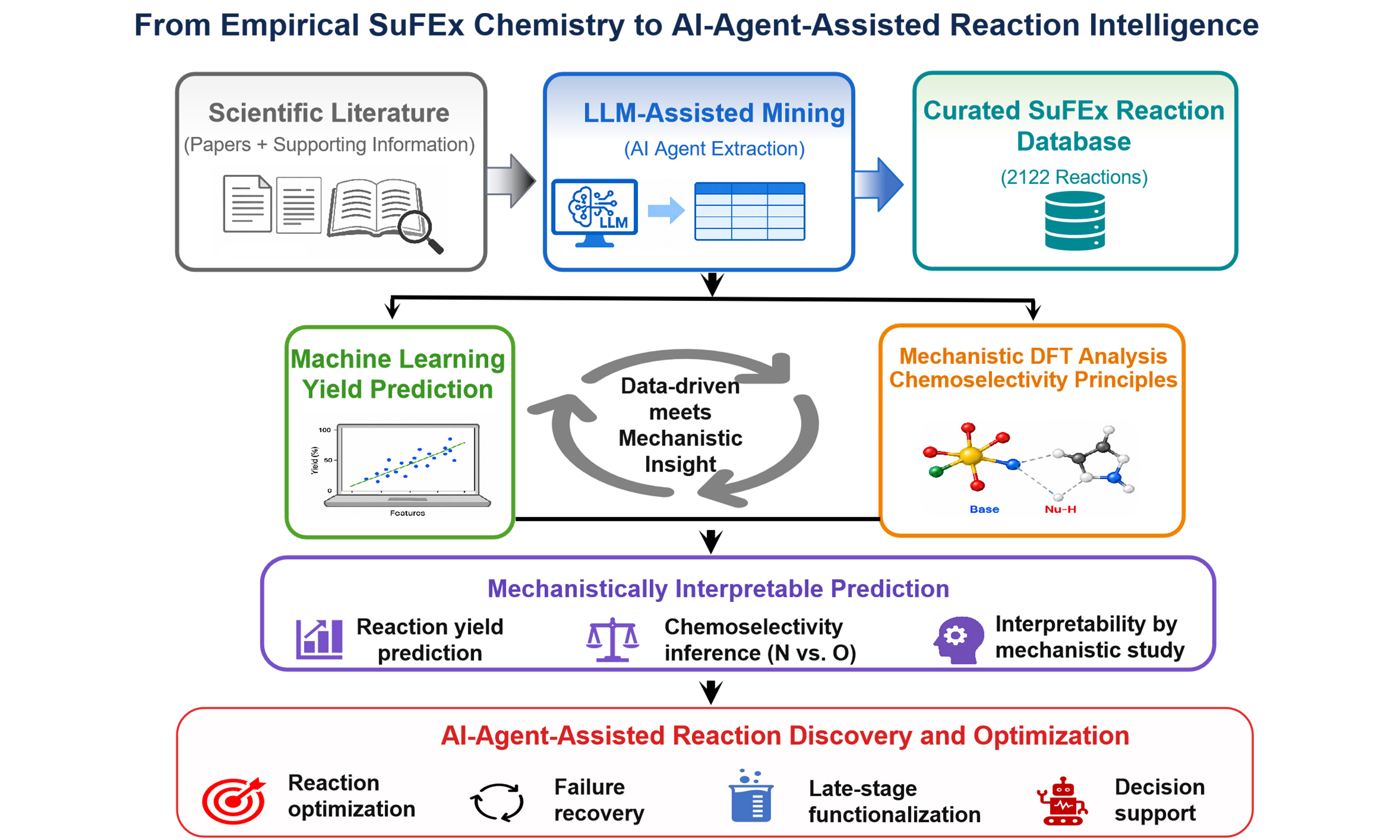
Artificial intelligence (AI) is increasingly reshaping chemical research by transforming fragmented experimental knowledge into structured and predictive resources that can support reaction discovery and optimization. Related advances in materials discovery have demonstrated how AI and automated experimentation can be integrated into iterative discovery workflows, illustrating the broader emergence of AI-assisted platforms[1,2]. However, many areas of synthetic chemistry remain fundamentally empirical, relying on incomplete literature data and human intuition for reaction optimization. Sulfur(VI) fluoride exchange (SuFEx) chemistry is a representative example: despite its broad utility in click chemistry, chemical biology, and materials science, its reaction outcomes remain difficult to predict due to strong sensitivity to substrates, additives, and reaction conditions. In this context, the recent work by Tan et al. presents a comprehensive AI-assisted and mechanistically informed workflow for transforming SuFEx chemistry into a more structured and predictive reaction space[3], as shown in Figure 1A. By integrating large language model (LLM)-assisted literature mining, machine learning, density functional theory (DFT) analysis, and experimental validation, the authors demonstrate a modular workflow for predicting reaction yields, inferring chemoselectivity, and guiding reaction optimization.
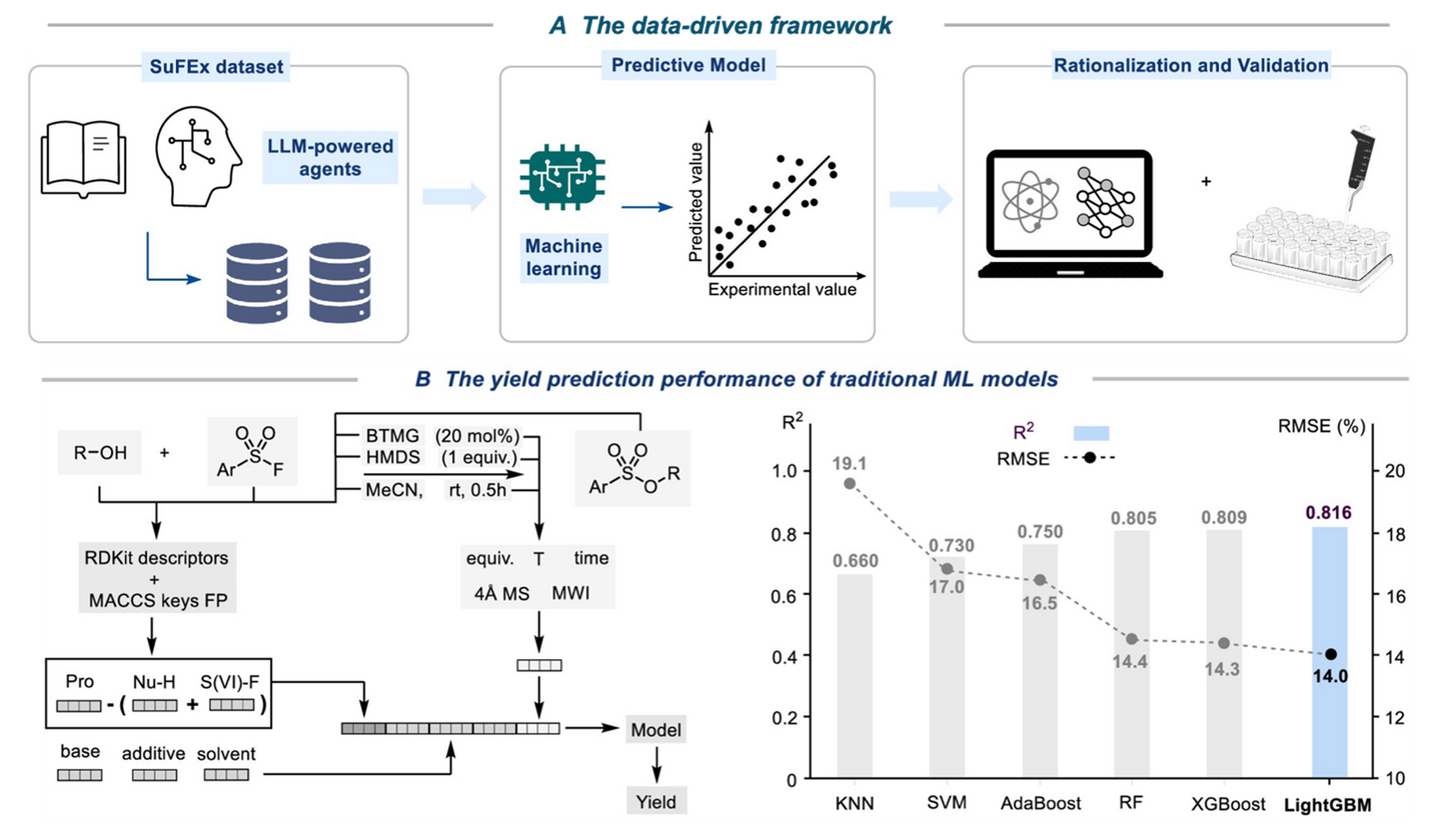
Figure 1. (A) Proposed data-driven framework integrating LLM-assisted literature mining, machine-learning prediction, mechanistic analysis, and experimental validation; (B) Machine-learning prediction of SuFEx reaction yields using curated reaction descriptors. This figure is reproduced with permission from reference[3]. Copyright 2026 American Chemical Society. LLM: Large language model; SuFEx: Sulfur(VI) fluoride exchange; BTMG: 2-tert-butyl-1,1,3,3-tetramethylguanidine; HMDS: hexamethyldisilazane; RMSE: Root Mean Square Error; KNN: K-Nearest Neighbors; SVM: Support Vector Machine; RF: Random Forest; MACCS: molecular access system; FP: finger print; MS: molecular sieves; MWI: microwave irradiation.
A key contribution of this work is a comprehensive SuFEx reaction dataset. Using LLM-enabled agents and expert curation, the authors extracted 2,122 reactions reported before 2025, including both successful and unsuccessful transformations often omitted from conventional datasets. The dataset spans diverse sulfur(VI) hubs, nucleophiles, bases, additives, solvents, and reaction conditions, helping reduce the positive-result bias that can limit model generalization. This literature-to-data paradigm aligns with broader developments in AI-assisted catalyst discovery, where large AI models, particularly LLMs, are increasingly being explored for extracting and organizing scientific knowledge and connecting literature-derived information with data-centric predictive workflows[4]. Using this dataset, the authors developed models to predict SuFEx reaction yields across diverse substrates and conditions [Figure 1B]. LightGBM performed best, achieving an R2 of 0.816 and Root Mean Square Error (RMSE) of 14.0% under random splitting. Adding solvent dielectric constant-a mechanistically motivated descriptor from DFT analysis-modestly improved performance (R2 = 0.825; RMSE = 13.7%). In addition, the lower performance observed with scaffold-based splitting compared to random splitting highlights the challenge of generalizing to structurally distinct substrates. Overall, the work shows that incorporating physically meaningful descriptors can improve both prediction and chemical interpretability, although the dielectric-constant effect is incremental.
A key innovation is the treatment of chemoselectivity, a longstanding challenge in SuFEx chemistry. Because quantitative selectivity data are rarely available, the authors recast selectivity prediction as a comparative yield-prediction task: competing pathways are evaluated separately, and the major product is inferred from their predicted yields. On an external test set of 28 N/O chemoselectivity reactions, the approach correctly predicted 23 cases (82% accuracy). Although encouraging, the validation set was small and largely limited to simple two-site N/O competition. More complex multisite chemoselectivity scenarios were not evaluated. Thus, the results provide a promising proof of concept for yield-based chemoselectivity inference, but its generalizability to broader selectivity problems remains to be established.
The study becomes especially compelling when machine learning is coupled with mechanistic analysis. Through DFT calculations of three representative N/O-selectivity systems, the authors rationalize four key variables governing N/O chemoselectivity: electrophilicity of the sulfur(VI) hub, intrinsic nucleophilicity of the competing functional groups, relative nucleophile acidity, and additive basicity. The calculations reveal how strong bases can selectively enhance oxygen nucleophilicity through partial deprotonation, whereas highly activated sulfur(VI) electrophiles preserve the intrinsic preference for nitrogen attack. These factors collectively explain why seemingly small changes in reaction conditions can dramatically alter chemoselectivity. The machine-learning model, in contrast, primarily captures statistical relationships within the curated reaction data and does not independently establish the proposed mechanistic picture. Nevertheless, the consistency between trends captured by the predictive model and the DFT-based interpretation suggests that statistical prediction and mechanistic analysis can provide complementary perspectives on reaction behavior. Importantly, the model is better described as mechanistically informed through the inclusion of chemically meaningful descriptors rather than physically constrained in a strict sense.
Another notable strength of the work is its progression from retrospective prediction toward targeted prospective experimental guidance. The predictive model was used to prioritize candidate reaction conditions in two model-guided optimization/failure-recovery cases, as shown in Figure 2. Experimental validation confirmed that the selected conditions could improve the outcomes of these representative reactions. Although numerical yield predictions were not always exact, these targeted demonstrations show that the framework can provide useful directions for experimental optimization within the reaction space represented by the available data. However, the limited number of prospective examples does not yet establish broad or autonomous reaction-optimization capability. This distinction is important. For practicing synthetic chemists, the value of predictive models often lies not in reproducing experimental yields with perfect accuracy, but in reducing experimental search space and accelerating decision-making. Such capabilities suggest how future AI-assisted systems may help prioritize candidate reaction conditions and guide experimental exploration, rather than relying exclusively on exhaustive empirical screening. The authors further implement the predictive framework in a publicly accessible platform, SuFExPredictor, enabling users to estimate yields, evaluate chemoselectivity, and prioritize promising literature-derived candidate conditions. The study further demonstrates the framework in a prospective drug-related transformation, highlighting its potential relevance to medicinal chemistry and late-stage functionalization, where efficient exploration of chemical space is critical.
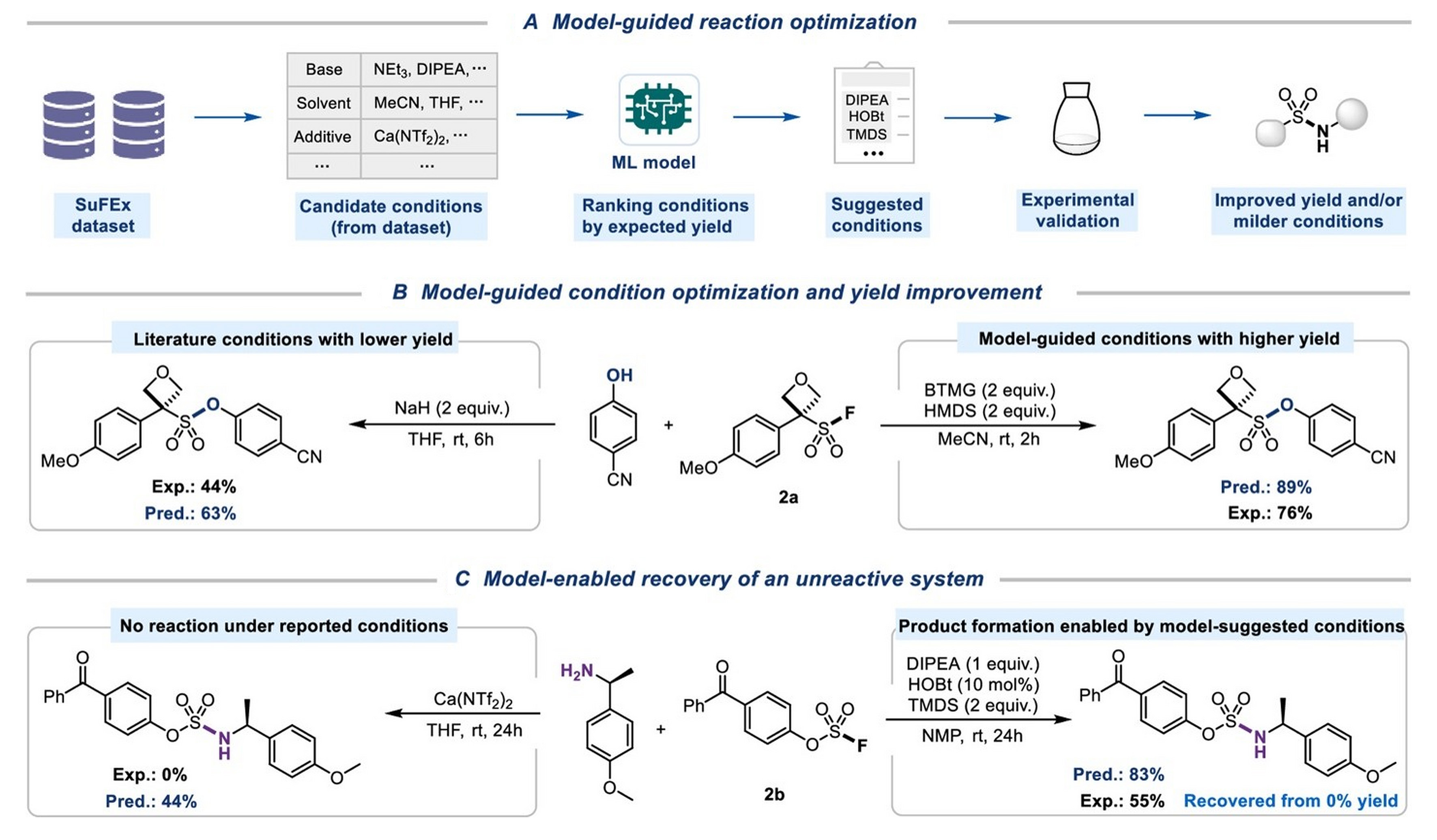
Figure 2. Model-guided optimization and recovery of SuFEx reactions. (A) Schematic illustration of data-driven condition selection followed by experimental validation; (B) Model-guided replacement of harsh base conditions enables improved yield for the SuFEx reaction of 2a with 4-cyanophenol; (C) Recovery of a previously unreactive SuFEx transformation through model-suggested activation conditions. This figure is reproduced with permission from reference[3]. Copyright 2026 American Chemical Society. ML: Machine learning; DIPEA: N,N-diisopropylethylamine; HOBt: 1-hydroxybenzotriazole; TMDS: 1,1,3,3-tetramethyldisiloxane; BTMG: 2-tert-Butyl-1,1,3,3-tetramethylguanidine; HMDS: hexamethyldisilazane; THF: tetrahydrofuran; NMP: N-methyl-2-pyrrolidone.
Overall, this study presents an early-stage modular workflow that integrates literature mining, data curation, predictive modeling, mechanistic interpretation, and experimental validation. Although human-supervised, it provides a useful example of an AI-assisted workflow rather than a fully autonomous agentic research system. The multiagent tools primarily support literature extraction and data structuring, while model development, mechanistic analysis, condition selection, and experimental validation remain human guided. Several limitations should be considered. LLM-assisted extraction may introduce errors and therefore requires expert curation. Literature-derived datasets can also retain biases in substrate classes, conditions, and reported outcomes, limiting predictions beyond the represented chemical space. Defining applicability domains and incorporating uncertainty quantification will be important, particularly given incomplete treatment of side reactions, limited coverage of novel substrates, and insufficient evaluation of complex multisite chemoselectivity. More broadly, the workflow contains components relevant to future agentic research systems: continuously updated reaction databases, predictive models for condition selection, mechanistic modules for chemical interpretation, and experimental platforms for validation. Integration with active learning and automated experimentation could refine chemical knowledge[5-7] and eventually enable closed-loop reaction discovery[8]. However, such autonomous integration is not demonstrated in the present study and remains a prospective direction requiring further advances in uncertainty-aware decision-making, active learning, automated experimentation, and orchestration of the individual modules.
DECLARATIONS
Authors’ contributions
Made substantial contributions to the conception and design of the study and performed data analysis and interpretation: Zeeshan, M.; Yang, W.
Availability of data and materials
Not applicable.
AI and AI-assisted tools statement
During the preparation of this manuscript, the AI tool ChatGPT (version GPT-5.6 Terra, released 2026-07-09) was used solely to revise the Graphic Abstract. The tool did not influence the study design, data collection, analysis, interpretation, or the scientific content of the work. Both authors take full responsibility for the accuracy, integrity, and final content of the manuscript.
Financial support and sponsorship
This work was primarily supported by the U.S. Department of Energy, Office of Science, Catalysis Science Program under award number DE-SC0007167.
Conflicts of interest
Both authors declared that there are no conflicts of interest.
Ethical approval and consent to participate
Not applicable.
Consent for publication
Not applicable.
Copyright
© The Author(s) 2026.
REFERENCES
1. Kusne, A. G.; Yu, H.; Wu, C.; et al. On-the-fly closed-loop materials discovery via Bayesian active learning. Nat. Commun. 2020, 11, 5966.
2. Szymanski, N. J.; Rendy, B.; Fei, Y.; et al. An autonomous laboratory for the accelerated synthesis of inorganic materials. Nature 2023, 624, 86-91.
3. Tan, H. D.; Gao, B.; Huang, H.; et al. Data-driven, mechanistically guided prediction of yield and chemoselectivity in SuFEx reactions. J. Am. Chem. Soc. 2026, 148, 24138-50.
4. Zhang, D.; Chen, Y.; Liu, C.; et al. Accelerating catalyst materials discovery with large artificial intelligence models. Angew. Chem. Int. Ed. Engl. 2026, 65, e26150.
5. Burger, B.; Maffettone, P. M.; Gusev, V. V.; et al. A mobile robotic chemist. Nature 2020, 583, 237-41.
6. Shields, B. J.; Stevens, J.; Li, J.; et al. Bayesian reaction optimization as a tool for chemical synthesis. Nature 2021, 590, 89-96.
7. Tom, G.; Schmid, S. P.; Baird, S. G.; et al. Self-driving laboratories for chemistry and materials science. Chem. Rev. 2024, 124, 9633-732.
Cite This Article
 Open Access
How to Cite
Zeeshan, M.; Yang, W. Toward AI-agent-assisted reaction intelligence: a mechanistically informed framework for predictive SuFEx chemistry. AI Agent 2026, 2, 30. https://dx.doi.org/10.20517/aiagent.2026.34
Download Citation
If you have the appropriate software installed, you can download article citation data to the citation manager of your choice. Simply select your manager software from the list below and click on download.
Export Citation File
Type of Import
Tips on Downloading Citation
Citation Manager File Format
Type of Import
Direct Import: When the Direct Import option is selected (the default state), a dialogue box will give you the option to Save or Open the downloaded citation data. Choosing Open will either launch your citation manager or give you a choice of applications with which to use the metadata. The Save option saves the file locally for later use.
Indirect Import: When the Indirect Import option is selected, the metadata is displayed and may be copied and pasted as needed.
About This Article
Copyright

Data & Comments
Data
0









Comments
Comments must be written in English. Spam, offensive content, impersonation, and private information will not be permitted. If any comment is reported and identified as inappropriate content by OAE staff, the comment will be removed without notice. If you have any queries or need any help, please contact us at [email protected].