

Robin as a lab-in-the-loop multi-agent system for scientific discovery
 0



 Download PDF
MAIN TEXT
Robin is best read as a careful lab-in-the-loop demonstration rather than as proof of fully autonomous biology. In the Nature study, Ghareeb et al. linked literature search, evidence synthesis, hypothesis ranking, experimental planning, computational analysis and hypothesis revision around one disease case: dry age-related macular degeneration (dAMD)[1]. Human scientists still chose the problem frame, performed the wet-lab work and retained responsibility for interpretation. The central message of the Highlight is therefore architectural: Robin makes the intellectual loop of discovery more explicit and auditable, but it does not remove the need for experimental validation.
This contribution should be placed in a broader landscape of agentic science. Earlier work had already explored retrieval-augmented ontological graphs and multi-agent materials-design workflows[2], autonomous chemical research agents that plan and execute laboratory tasks[3], end-to-end artificial intelligence (AI)-research systems that generate ideas, run computational experiments and write papers[4], and decentralized scientific-agent swarms such as ScienceClaw plus Infinite[5]. Robin differs from these examples less by being the first multi-agent scientific system and more by joining source-grounded biomedical hypothesis generation with follow-up analysis of newly produced experimental data in a single therapeutics workflow. Table 1 summarizes these distinctions.
Robin in relation to prior agentic-science systems
| System or direction | What it demonstrates | How Robin is positioned |
| RAG and multi-agent materials design[2] | Graph-based retrieval, multi-agent reasoning and executable simulations | Shares the multi-agent/tool idea, but applies it to biomedical repurposing with wet-lab feedback |
| Coscientist/Autonomous chemistry[3] | LLM planning and orchestration for chemistry workflows | Robin emphasizes literature-grounded therapeutic hypotheses and post-experiment biological data analysis |
| AI Scientist and related AI-research agents[4] | End-to-end computational research loops, manuscript generation and automated review | Robin’s experiments are biological and lab-in-the-loop, so physical validation remains human executed |
| ScienceClaw plus Infinite swarms[5] | Distributed agents coordinate through artifacts, provenance and shared scientific discourse | Robin is more centrally scaffolded around one disease workflow rather than open-ended swarm discovery |
The system itself is deliberately modular [Figure 1]. Crow and Falcon are literature agents built on the PaperQA2 line of retrieval and evidence-synthesis work[6]: Crow provides fast orientation, whereas Falcon prepares deeper candidate reports. Finch writes and executes analysis code for data modalities such as flow cytometry and RNA sequencing. The division of labor is useful, but the ablation results should be interpreted with caution: better performance may arise from retrieval discipline, citation checking, tool access and workflow scaffolding, not from agent specialization alone.
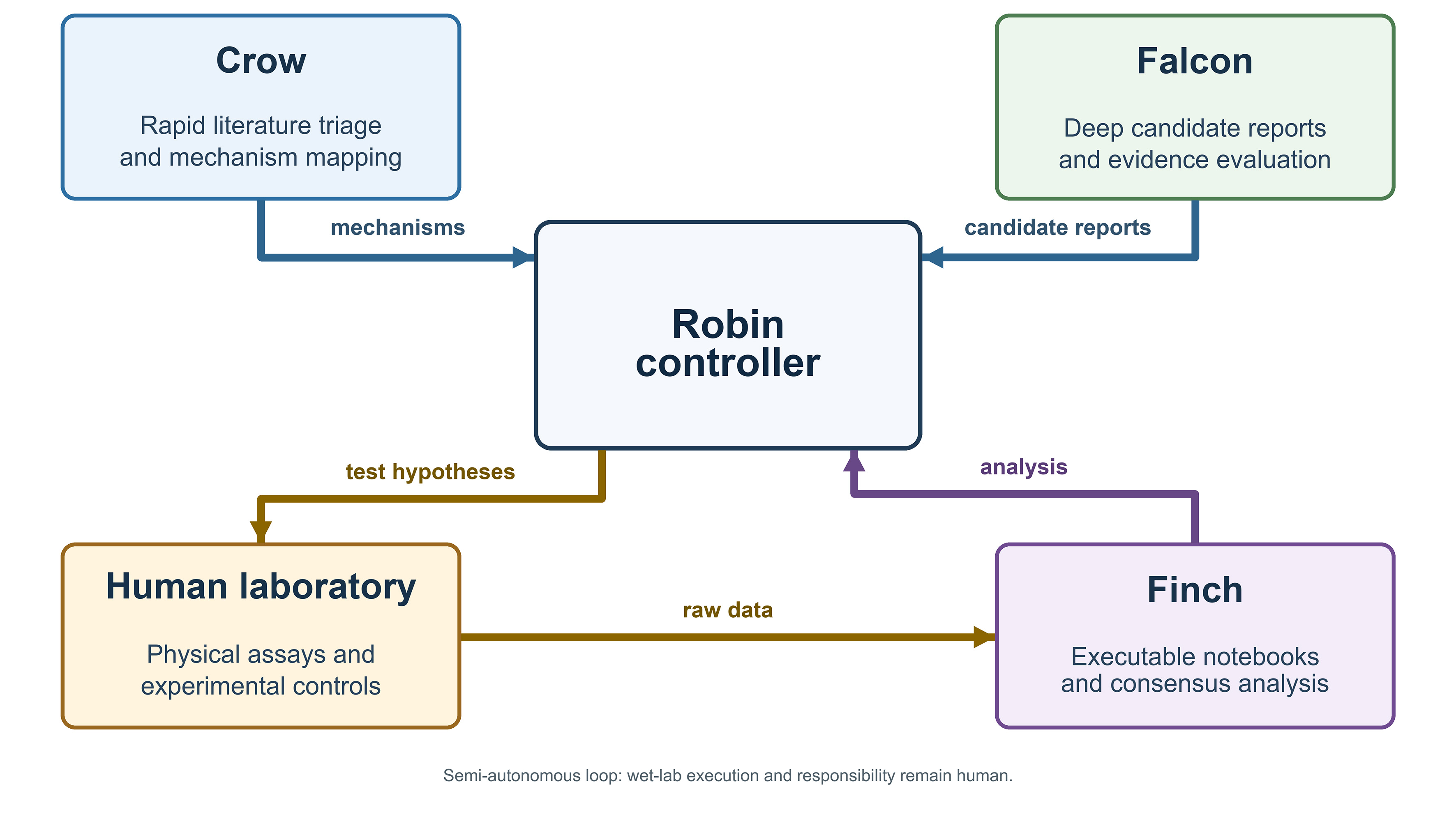
Figure 1. Robin’s lab-in-the-loop architecture.
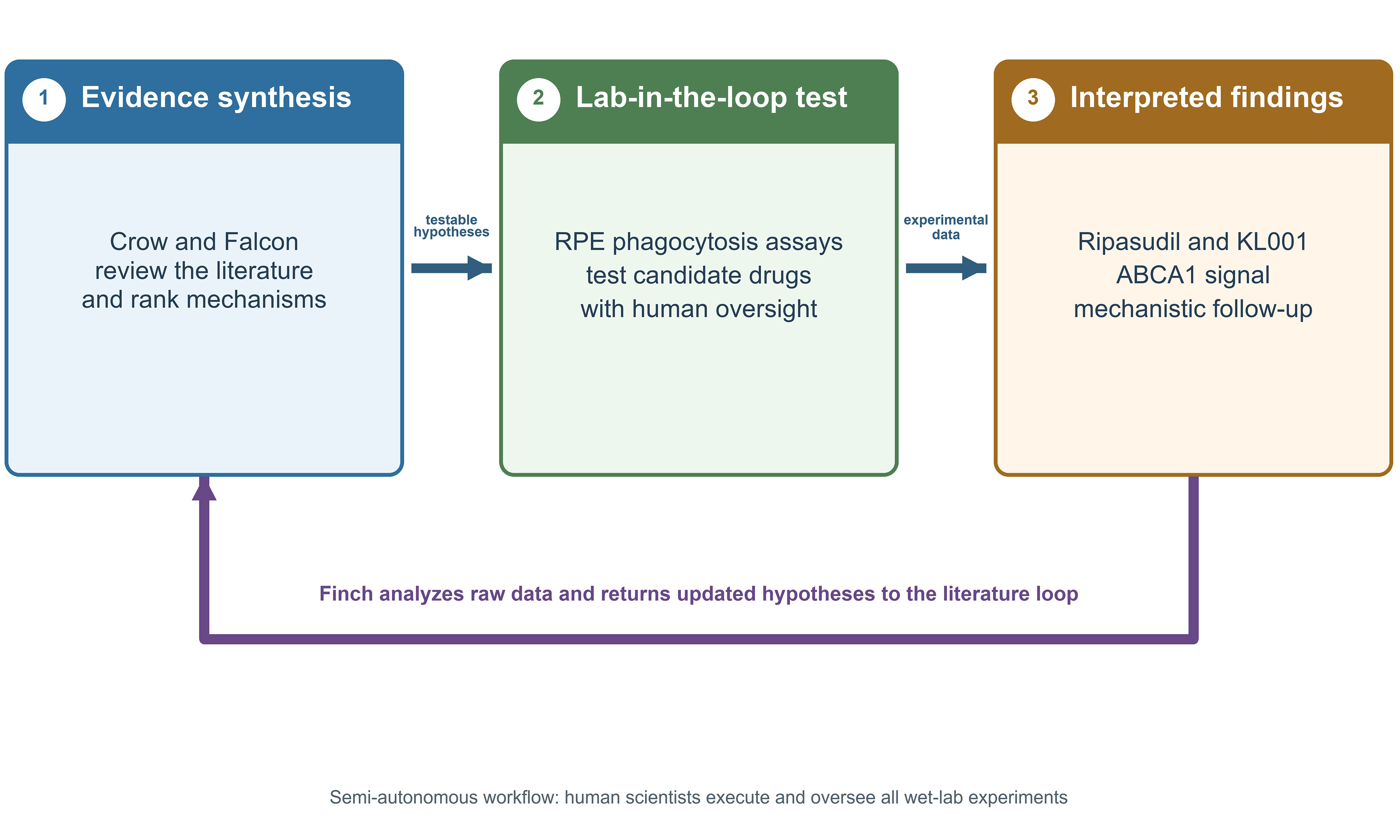
The dAMD case is compelling because Robin moved from a disease label to an experimentally testable phenotype. It reviewed 151 papers to nominate ten disease mechanisms, prioritized enhancement of retinal pigment epithelium (RPE) phagocytosis, and then reviewed about 400 additional papers to propose candidate compounds[1]. The initial positive result for Y-27632 supported the literature-derived reasoning but did not by itself constitute a therapeutic discovery; prior preclinical work had already shown that a clinically used rho kinase, Ripasudil (ROCK) inhibition can restore RPE phagocytic capacity in relevant contexts[7].
The stronger translational signal came in the second iteration. Robin nominated ten additional compounds, and Finch’s analysis reported that ripasudil, a glaucoma-approved ROCK inhibitor, increased ARPE-19 phagocytosis 1.89-fold relative to dimethyl sulfoxide controls; human analysis showed a 1.75-fold increase, and dose-response work plus primary human RPE stem-cell-derived assays supported greater potency than Y-27632 (Drug developed by Cayman Chemical Company; Cat. No. 10005583)[1]. KL001, a circadian-clock modulator, also emerged as an unexpected RPE-steam cell (SC) hit[1]. These findings are intriguing but remain preclinical and in vitro, with false-positive risk, assay dependence and replication requirements still unresolved. Table 2 summarizes the evidence claims and interpretive cautions.
Evidence claims and interpretive cautions
| Claim | Supported by | Important caution |
| RPE phagocytosis is a plausible dAMD intervention axis | Literature review, mechanism ranking and the selected phagocytosis assay[1] | One disease use case cannot prove general discovery performance |
| Ripasudil is a promising repurposing candidate | ARPE-19 and RPE-SC assays, dose-response trends and known ocular use[1] | In vivo models, dosing, durability and clinical endpoints remain untested |
| KL001 broadens the search space | Unexpected positive signal in RPE-SC screening[1] | Mechanism and reproducibility require follow-up work |
| Agent scaffolding improves reliability | Crow/Falcon ablations and Finch task evaluations[1] | The causal contribution of multi-agent decomposition is intertwined with retrieval, verification and tool use |
Robin’s RNA-seq loop further shows how an agent can generate mechanistic follow-up rather than stop at a screening hit. After Y-27632 treatment, Finch identified a threefold critical lipid efflux pump (ABCA1) upregulation with a very small adjusted P-value[1]. ABCA1 is biologically plausible because lipid efflux in RPE is linked to retinal homeostasis and AMD-related degeneration[8]. Still, transcriptional association is not a mechanism: additional perturbation studies would be needed to prove that ABCA1 mediates the phagocytosis phenotype. Please note that this Research Highlight does not add new experiments; it clarifies what the reported study does and does not establish.
The comparison with OpenAI Deep Research is informative but not decisive. Deep Research generated 17 unique candidates that were screened in RPE-SCs and did not identify ROCK inhibition[1]. However, retrieval strategy, prompt framing, tool access, candidate-selection policy and experimental context may all have differed. The fairest conclusion is not that one product is categorically superior, but that domain-specific scaffolds can matter when the scientific objective is narrow, evidence-sensitive and experimentally constrained.
Robin therefore marks a meaningful step toward AI-organized discovery, while also illustrating the new evaluation bottleneck. Future systems will need transparent provenance, calibrated novelty checks, negative-result handling, reproducible notebooks, expert review and safety governance before they can be trusted across diseases or disciplines. For now, Robin should be valued as a well-grounded demonstration of semi-autonomous hypothesis-to-analysis orchestration, not as a general proof that distributed agents can autonomously discover therapies.
DECLARATIONS
Authors’ contributions
Conceptualization, writing and editing, literature analysis: Xing, X.; Zhang, JY.
Writing, literature analysis: Wang, J.; Celaje, J.
Availability of data and materials
Not applicable.
AI and AI-assisted tools statement
During the preparation of this manuscript, the AI tool ChatGPT (version 5.5 Pro, released 2026-04-23) was used solely for language editing. The tool did not influence the study design, data collection, analysis, interpretation, or the scientific content of the work. All authors take full responsibility for the accuracy, integrity, and final content of the manuscript.
Financial support and sponsorship
None.
Conflicts of interest
All authors declared that there are no conflicts of interest.
Ethical approval and consent to participate
Not applicable.
Consent for publication
Not applicable.
Copyright
© The Author(s) 2026.
REFERENCES
1. Ghareeb, A. E.; Chang, B.; Mitchener, L.; et al. A multi-agent system for automating scientific discovery. Nature 2026, 655, 497-505.
2. Buehler, M. J. Generative retrieval-augmented ontologic graph and multiagent strategies for interpretive large language model-based materials design. ACS. Eng. Au. 2024, 4, 241-77.
3. Boiko, D. A.; MacKnight, R.; Kline, B.; Gomes, G. Autonomous chemical research with large language models. Nature 2023, 624, 570-8.
4. Lu, C.; Lu, C.; Lange, R. T.; et al. Towards end-to-end automation of AI research. Nature 2026, 651, 914-9.
5. Wang, F. Y.; Marom, L.; Pal, S.; et al. Autonomous agents coordinating distributed discovery through emergent artifact exchange. arXiv 2026, arXiv:2603.14312. Available online: https://doi.org/10.48550/arXiv.2603.14312 (accessed 28 September 2026).
6. Skarlinski, M. D.; Cox, S.; Laurent, J. M.; et al. Language agents achieve superhuman synthesis of scientific knowledge. arXiv 2024, arXiv:2409.13740. Available online: https://doi.org/10.48550/arXiv.2409.13740 (accessed 28 September 2026).
7. Mao, Y.; Finnemann, S. C. Acute RhoA/Rho kinase inhibition is sufficient to restore phagocytic capacity to retinal pigment epithelium lacking the engulfment receptor MerTK. Cells. 2021, 10, 1927.
Cite This Article
 Open Access
How to Cite
Xing, X.; Zhang, J. Y.; Wang, J.; Celaje, J. Robin as a lab-in-the-loop multi-agent system for scientific discovery. AI Agent 2026, 2, 33. https://dx.doi.org/10.20517/aiagent.2026.27
Download Citation
If you have the appropriate software installed, you can download article citation data to the citation manager of your choice. Simply select your manager software from the list below and click on download.
Export Citation File
Type of Import
Tips on Downloading Citation
Citation Manager File Format
Type of Import
Direct Import: When the Direct Import option is selected (the default state), a dialogue box will give you the option to Save or Open the downloaded citation data. Choosing Open will either launch your citation manager or give you a choice of applications with which to use the metadata. The Save option saves the file locally for later use.
Indirect Import: When the Indirect Import option is selected, the metadata is displayed and may be copied and pasted as needed.
About This Article
Copyright

Data & Comments
Data
0









Comments
Comments must be written in English. Spam, offensive content, impersonation, and private information will not be permitted. If any comment is reported and identified as inappropriate content by OAE staff, the comment will be removed without notice. If you have any queries or need any help, please contact us at [email protected].