

The rise of the digital materials ecosystem
 0
0 
INTRODUCTION: BEYOND ISOLATED AI TOOLS
Artificial intelligence (AI) is reshaping materials research, but the most important shift may not be the rise of any single model. Rather, it is the emergence of a broader research architecture in which databases, scientific theories, AI models, and experimental automation are deeply connected. In this context, a recent perspective by Li et al. on the Digital Materials Ecosystem provides a timely conceptual framework[1]. It defines a new paradigm in which data, theory, and automation are integrated into a unified and iterative system for materials discovery. Instead of treating databases as passive repositories and AI as isolated prediction tools, this framework envisions a self-improving ecosystem that connects knowledge extraction, simulation, prediction, validation, and feedback. The concept of the Digital Materials Ecosystem, proposed by Prof. Hao Li from Tohoku University several years ago, gives this perspective added significance as both a conceptual synthesis and a forward-looking research agenda.
THE DIGITAL MATERIALS ECOSYSTEM AS A UNIFYING FRAMEWORK
At the center of this framework is the idea that modern materials discovery should be organized as a connected ecosystem with three essential components: databases, AI coupled with theoretical frameworks, and closed-loop innovation enabled by experimentation [Figure 1]. Li et al.[1] make this architecture explicit and argue that materials databases are the backbone of the ecosystem, because they enable efficient aggregation, retrieval, reuse, and analysis of experimental and theoretical information across diverse material classes. As databases grow in scale and complexity, they support a transition from empirical trial-and-error toward systematic and predictive design. Just as importantly, the article emphasizes that this ecosystem is not limited to one materials domain; it is intended to span catalysis, solid-state batteries, hydrogen storage, and other emerging material systems.
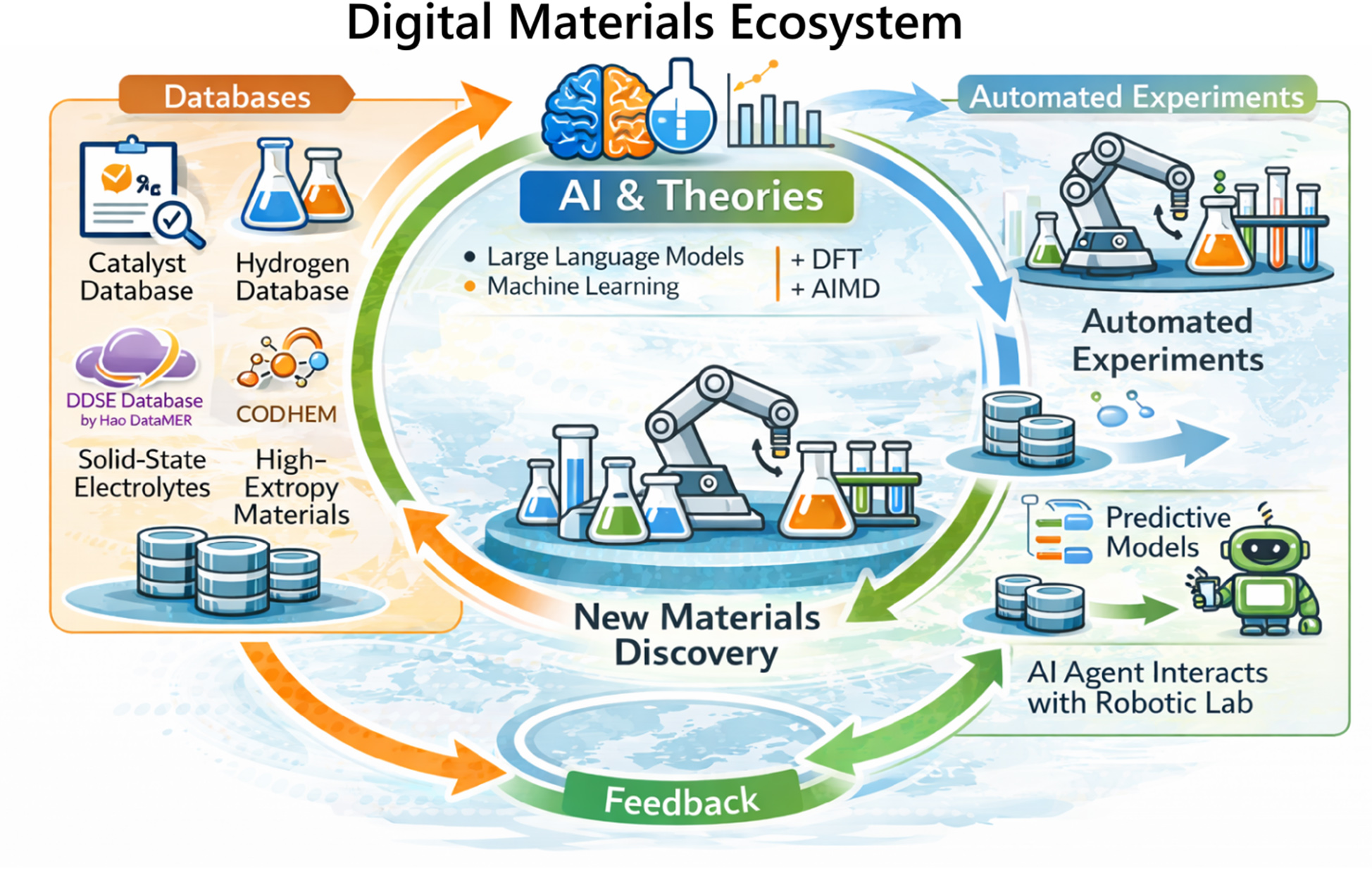
Figure 1. Conceptual diagram of the digital materials ecosystem. The framework comprises three interconnected components: databases (left), AI integrated with theoretical models (center), and closed-loop innovation enabled by advanced experimental technologies (right). AI: Artificial intelligence; DFT: Density Functional Theory; AIMD: ab initio Molecular Dynamics; DDSE: Dynamic Database of Solid-State Electrolyte; CODHEM: Consolidated Database of High Entropy Materials.
A key strength of the Digital Materials Ecosystem concept is that it is not purely abstract. Li et al.[1] link the concept to concrete digital platforms, including Digital Catalysis Platform (DigCat: www.digcat.org) for catalysis[2,3], Dynamic Database of Solid-State Electrolyte (DDSE) for solid-state electrolytes[4,5], and Digital Hydrogen Platform (DigHyd: www.dighyd.org) for hydrogen storage[6,7], as well as the broader Digital Materials Platform (DigMat: www.digmat.org). These examples illustrate how curated databases can move beyond data collection toward integrated scientific infrastructures that support visualization, literature tracking, AI-powered question answering, simulation, and machine learning-driven analysis. In this sense, the ecosystem is not merely a philosophical proposal; it is already beginning to take form as a family of interoperable digital research platforms.
LARGE AI MODELS AS THE COMPUTATIONAL ENGINE
A recent paper by Li, Chen, Peng, Ou et al.[8] provides an important methodological extension of this idea, especially for catalysis. It argues that catalyst discovery is entering a new data-driven stage in which large AI models, particularly universal machine learning interatomic potentials (MLIPs) and large language models (LLMs), are transforming how researchers explore chemical space, extract knowledge, and design catalysts. Importantly, the article does not present these models as standalone tools. Instead, it places them in a broader continuum that links ontology, concepts, computation, and experiment. This view fits naturally within the Digital Materials Ecosystem: databases provide the substrate, large AI models provide scalable learning and reasoning, and theory provides physical grounding. Together, they form the computational and intellectual engine of the ecosystem.
This point is especially important because the current excitement around AI in science is often overly model-centric. Li, Chen, Peng, Ou et al.[8] make clear that the real power of large AI models emerges when they are embedded in broader research infrastructures. Universal MLIPs extend atomistic simulation toward larger spatial and temporal scales, while LLMs improve data acquisition, literature understanding, training efficiency, and even elements of self-directed research. Yet these capabilities only become truly transformative when they are connected to high-quality data resources and physically meaningful theoretical frameworks. From this perspective, the Digital Materials Ecosystem offers a more mature interpretation of AI for science: the goal is not bigger models alone, but better coupling between data, theory, and action.
FROM DATA INFRASTRUCTURE TO AUTONOMOUS LABORATORIES
A recent roadmap paper by Xin et al.[9] further strengthens this interpretation by showing what is required for such an ecosystem to work in practice. The authors argue that AI-driven catalysis still faces major barriers, including limited data quality and availability, weak generalizability, insufficient interpretability, and the persistent gap between in silico predictions and real experiments. Their proposed solution is highly consistent with the Digital Materials Ecosystem framework: build an AI-ready data ecosystem, develop multimodal foundation models, and ultimately connect these tools to autonomous laboratories. Read alongside the article by Li et al.[1], this roadmap can be seen as a concrete operational pathway for turning the Digital Materials Ecosystem from a conceptual model into a practical discovery infrastructure for catalyst design.
One of the most compelling aspects of the paper by Xin et al.[9] is its insistence that future AI systems must be grounded in standardization, ontology, metadata, and interoperability. This emphasis is crucial. A Digital Materials Ecosystem cannot function if its data remain fragmented, poorly described, or disconnected from experimental context. Likewise, multimodal models cannot deliver reliable scientific reasoning if they are trained on incomplete or inconsistent datasets. The roadmap therefore shifts attention from isolated demonstrations toward the infrastructure needed for robustness, reproducibility, and cross-domain reuse. In doing so, it reinforces one of the core messages of Li et al.[1]: that the digital future of materials science depends as much on trustworthy data infrastructures as on algorithmic innovation.
CLOSED-LOOP INNOVATION AND THE RISE OF AGENTIC DISCOVERY
The final and perhaps most forward-looking dimension of the Digital Materials Ecosystem is its closed-loop character. Li et al.[1] emphasize that automated synthesis and high-throughput characterization can close the loop between AI prediction and experimental validation, allowing new data to be continuously fed back into the system for model refinement. Xin et al.[9] extend this idea toward autonomous and agentic laboratories, where planning, execution, analysis, and optimization increasingly occur in human-in-the-loop but minimally supervised workflows. In parallel, Li, Chen, Peng, Ou et al.[8] point toward AI-empowered closed-loop platforms driven by integrated MLIPs, multimodal LLMs, and automation systems. Together, these three articles converge on the same conclusion: the future lies not in static prediction, but in self-improving discovery cycles.
Within this framework, the Digital Materials Ecosystem may be viewed as a broader umbrella concept that naturally accommodates the rise of AI agents in science. Databases provide memory, theoretical models provide mechanistic constraints, large AI models provide representation and reasoning, and automated laboratories provide action and feedback. Once these components are connected, an AI agent is no longer just a chatbot or optimizer; it becomes part of a scientific operating system capable of coordinating retrieval, hypothesis generation, simulation, validation, and iterative decision-making. This is why the concept is particularly relevant for the journal AI Agent: it offers a systems-level vision for how agentic intelligence can move beyond narrow task automation toward real scientific discovery.
OUTLOOK
Looking ahead, the long-term value of the Digital Materials Ecosystem will depend not simply on the continued scaling of AI models, but on whether the field can establish a truly trustworthy and interoperable scientific infrastructure. The next stage should therefore focus on four closely connected priorities. First, high-quality and benchmarked datasets must become a central objective. A recent work by Li et al.[1] makes clear that reliable, traceable, and standardized data are essential if digital materials science is to move from data accumulation to genuine knowledge generation. Second, future AI models must become more scientifically grounded. As emphasized in both the review and the roadmap, progress will require models that are not only accurate and multimodal, but also interpretable, physics-informed, and capable of exposing the logic behind their outputs. Third, the rise of AI agents in materials science should be guided by mechanistic reasoning rather than by text generation alone. Within a mature Digital Materials Ecosystem, agents should be able to coordinate retrieval, simulation, planning, and validation while remaining anchored to domain knowledge, uncertainty quantification, and experimental feedback. Finally, closed-loop automation must evolve from isolated demonstrations into standardized and reproducible research practice. Autonomous laboratories, interoperable ELN/LIMS (Electronic Laboratory Notebook/Laboratory Information Management System) systems, cloud platforms, and human-AI collaboration will be essential for building self-refining workflows that continuously connect digital predictions with physical validation. If these challenges are addressed, the Digital Materials Ecosystem may become more than a useful concept: it may provide the operating framework for a new era of autonomous, explainable, and experimentally grounded materials discovery.
DECLARATIONS
Authors’ contributions
Contributed to the writing and preparation of the manuscript: Mishra, A. R.; Pascasio, J.; Yang, J.; Li, W. L.
Availability of data and materials
Not applicable.
AI and AI-assisted tools statement
The authors utilized OpenAI tools [ChatGPT (GPT-5 series), version 5.3, released in 2025] to generate and edit Figure 1, ensuring compliance with OAE’s editorial and ethical standards.
Financial support and sponsorship
Li, W. L. acknowledges support from the ACS Petroleum Research Fund (Doctoral New Investigator Grant 69037-DNI10), the Hellman Fellowship, and the University of California, San Diego.
Conflicts of interest
All authors declared that there are no conflicts of interest.
Ethical approval and consent to participate
Not applicable.
Consent for publication
Not applicable.
Copyright
© The Author(s) 2026.
REFERENCES
1. Zhang, D.; Jia, X.; Wang, Y.; et al. Digital materials ecosystem: from databases to AI agents for autonomous discovery. Chem. Sci. 2026, 17, 5782-804.
2. Zhang, D.; Li, H. Digital Catalysis Platform (DigCat): a gateway to big data and AI-powered innovations in catalysis. ChemRxiv 2024.
3. Wang, X.; Li, Z.; Zhang, D.; Li, H.; Xu, H.; Cheng, D. Catalysis AI agent guides discovering the universal design principle of Cu-based single-atom alloy catalysts for CO2 electroreduction. Angew. Chem. Int. Ed. Engl. 2026, e24612.
4. Yang, F.; dos Santos, E. C.; Jia, X.; et al. A Dynamic Database of Solid-State Electrolyte (DDSE) picturing all-solid-state batteries. Nano. Mater. Sci. 2024, 6, 256-62.
5. Wang, Q.; Yang, F.; Wang, Y.; et al. Unraveling the complexity of divalent hydride electrolytes in solid-state batteries via a data-driven framework with large language model. Angew. Chem. Int. Ed. Engl. 2025, 64, e202506573.
6. Zhang, D.; Jia, X.; Tran, H. B.; et al. “DIVE” into hydrogen storage materials discovery with AI agents. Chem. Sci. 2026, 17, 3031-42.
7. Jang, S. H.; Zhang, D.; Tran, H. B.; et al. Physically interpretable descriptors drive the materials design of metal hydrides for hydrogen storage. Chem. Sci. 2025, 16. , 23111-20.[PMID:41190189 DOI10.1039/d5sc07296d PMCID:PMC12580975].
8. Zhang, D.; Chen, Y.; Liu, C.; et al. Accelerating catalyst materials discovery with large artificial intelligence models. Angew. Chem. Int. Ed. Engl. 2026, e26150.
Cite This Article
 Open Access
How to Cite
Download Citation
Export Citation File:
Type of Import
Tips on Downloading Citation
Citation Manager File Format
Type of Import
Direct Import: When the Direct Import option is selected (the default state), a dialogue box will give you the option to Save or Open the downloaded citation data. Choosing Open will either launch your citation manager or give you a choice of applications with which to use the metadata. The Save option saves the file locally for later use.
Indirect Import: When the Indirect Import option is selected, the metadata is displayed and may be copied and pasted as needed.
About This Article
Copyright

Data & Comments
Data
0





Comments
Comments must be written in English. Spam, offensive content, impersonation, and private information will not be permitted. If any comment is reported and identified as inappropriate content by OAE staff, the comment will be removed without notice. If you have any queries or need any help, please contact us at [email protected].