

Stabilizing moisture-sensitive thermoelectrics via anodic protection
 0
0 
MAIN TEXT
The rapidly growing demand for thermal management in advanced fields such as integrated circuits, optical communications, and low-temperature medicine has accelerated the development of efficient, quiet, and compact thermoelectric cooling devices[1-3]. However, conventional Bi2Te3-based systems are constrained by the scarcity of tellurium (Te) and limited performance at elevated temperatures due to their narrow band gap and associated bipolar effects, which lead to rapid efficiency degradation above about 400 K[4,5]. In contrast, Mg3(Sb, Bi)2 exhibits excellent thermoelectric performance over a broad temperature range (300-773 K), along with advantages such as low cost, light weight, and good mechanical robustness[6,7]. These attributes make them strong candidates to replace n-type Bi2Te3 alloys in next-generation devices[8]. However, their practical application is severely hindered by a critical challenge: the high chemical reactivity of Mg makes these materials vulnerable to moisture-induced corrosion, leading to rapid performance degradation[9,10]. Existing protection strategies, such as using organic, HfO2, Al2O3, and Mg-Mn alloy coatings, provide only partial mitigation and remain susceptible to failure due to cracking or delamination[11,12]. More importantly, they fail to address corrosion during material storage and processing. Therefore, developing a fundamental solution that ensures intrinsic humidity stability while preserving high thermoelectric performance throughout the entire material lifecycle remains an urgent priority.
In a study published in Nature Materials, Sui and co-workers introduced an innovative sacrificial anodic protection method into the design of Mg3(Sb, Bi)2 materials and devices[13]. Through multi-objective optimization, they screened and constructed in situ uniformly distributed multi-scale Mg17Al12 anode second phases within the Mg3(Sb, Bi)2 matrix [Figure 1]. Owing to its lower equilibrium potential, Mg17Al12 forms micro-galvanic cells that preferentially corrode, thereby providing thermodynamic cathodic protection to the matrix. Meanwhile, corrosion-induced Mg/Al hydroxides and oxides generate a self-healing hybrid passivation layer, which further isolates the material from moisture. The self-healing capability depends on the Pilling-Bedworth (PB) ratio[14]. A PB ratio slightly above unity facilitates self-healing by generating a moderate compressive stress that ensures newly formed oxides seamlessly seal surface voids, preventing further moisture infiltration. This intrinsic material design reduces the average corrosion rate of Mg3(Sb, Bi)2 by 92% (to 95 μm·year-1) in air and by 86% (to 0.36 μm·h-1) in water, effectively solving corrosion issues during material storage and processing that cannot be addressed by conventional coating strategies. Importantly, since the Mg17Al12 phase is generated in situ by introducing Al, the content of Mg in the matrix will also be concomitantly influenced. Thus, the content of Mg vacancies, as well as the carrier concentration and thermoelectric properties, might change with the addition of Al[15]. For practical applications, we must balance the stability and energy-conversion efficiency. In the Nature Materials study[13], the thermoelectric performance is even slightly enhanced by incorporating 20 at% Al. Moreover, the biased carrier concentration in the matrix due to the in situ formation of the second phase can be further optimized via tuning the content of other dopants, such as Te and lanthanide elements[16]. Therefore, the second-phase engineering, in conjunction with carrier concentration optimization, can enable an ideal balance between stability and functionality. This strategy is also generalizable, as demonstrated in other moisture-sensitive systems, including Mg2(Sn, Ge) and CaMg2Bi2, through incorporating Al to construct anodic secondary phases. Yet, the appropriate dopants can vary from Al, depending on the matrix material, the thermodynamically favorable second phase, and the difference in equilibrium potential between them. The Nature Materials article offers an excellent paradigm and principles for screening suitable element candidates.
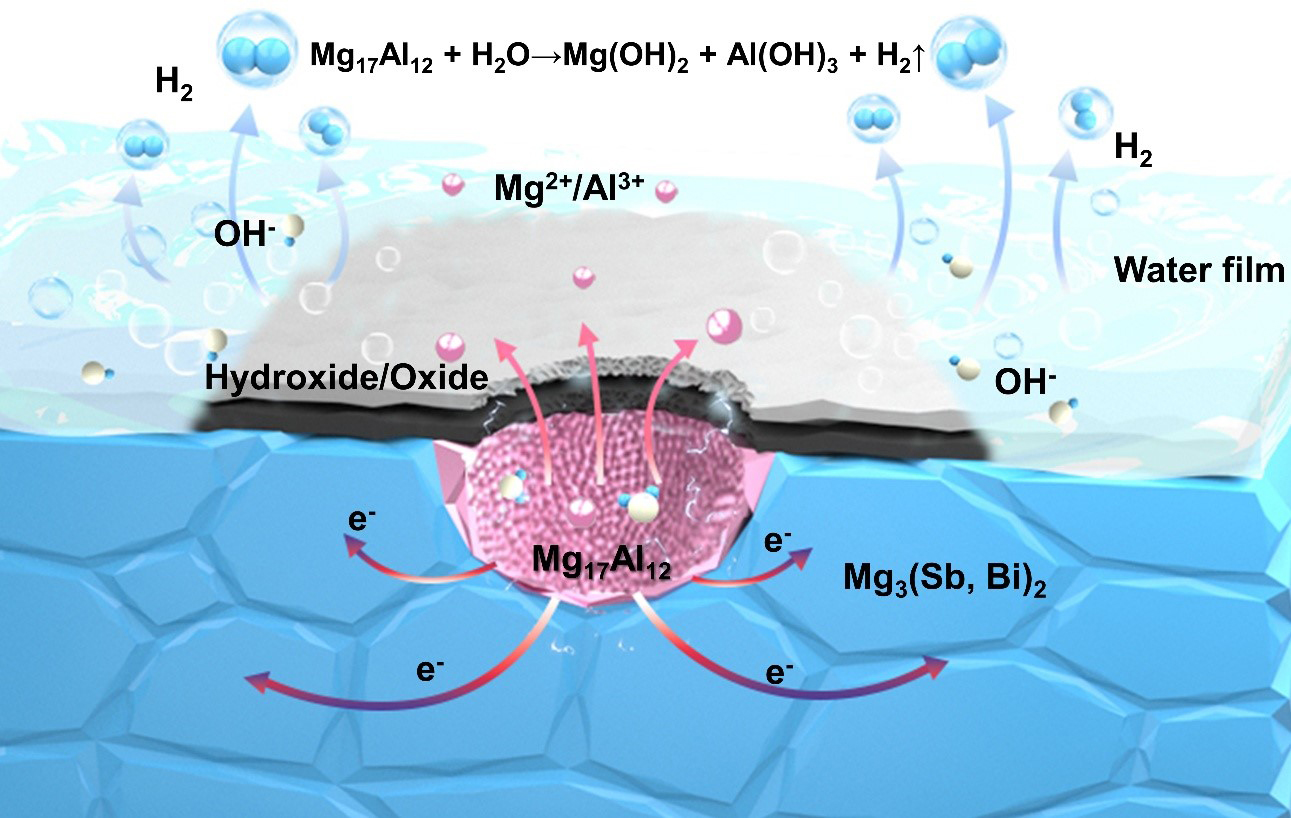
Figure 1. Schematic of the autonomous anodic protection mechanism. The Mg3(Sb, Bi)2 matrix, Mg17Al12 secondary phase, and the condensed water film collectively constitute a self-driven micro-galvanic cell, functioning as the cathode, sacrificial anode, and local electrolyte, respectively. Driven by the electrochemical potential gradient, the anodic Mg17Al12 undergoes preferential oxidation, releasing Mg2+ and Al3+ ions while concurrently transferring electrons to the cathodic matrix. This electron flux facilitates the reduction of water at the Mg3(Sb, Bi)2 surface into H2 gas and OH- ions. The resultant local supersaturation triggers the precipitation of dense Mg/Al-based oxides and hydroxides, which rapidly coalesce into a passivation film that seamlessly shields the Mg3(Sb, Bi)2 surface against further environmental corrosion.
In addition to material optimization, Sui and colleagues tackled another hidden corrosion source that limits device-level reliability, namely accelerated material corrosion induced by the interface barrier layer. The commonly used Fe interface layer possesses a much higher equilibrium potential than the Mg3(Sb, Bi)2 matrix, accelerating corrosion of the matrix during operation[17]. To overcome this, the team replaced Fe with Mg17Al12 as the interface layer. This design maintains low contact resistivity, matched thermal expansion, and chemical stability, which are essential requirements for thermoelectric interface materials[18,19], while simultaneously eliminating interfacial galvanic corrosion and providing cathodic protection. As a result, no performance degradation of the thermoelectric device was observed after 28 days under harsh hot-humid conditions (350 K, 70% RH). The study also reminds us that the galvanic stability, which had been overlooked, should also be included in the design principles of thermoelectric interface materials in future studies.
This work shifts the design paradigm for thermoelectric materials and devices from conventional coating strategies to sacrificial anode protection. It highlights the power of an integrated, multi-scale approach combining electrochemistry, materials science, and device engineering to enhance both stability and functionality. Beyond enabling moisture-resistant and high-performance Mg-based thermoelectric devices, this study establishes a broadly applicable design strategy for corrosion-resistant functional materials.
DECLARATIONS
Authors’ contributions
Wrote the manuscript: Yu, Y.
Created the figure: Zhang, Q.
Contributed through helpful discussions: Wuttig, M.
Availability of data and materials
Not applicable.
AI and AI-assisted tools statement
Not applicable.
Financial support and sponsorship
This work was supported by the German Research Foundation (DFG) within the Collaborative Research Center SFB 917.
Conflicts of interest
Yu, Y. is an Editorial Board Member of the Advanced Energy Conversion journal. He had no involvement in the review or editorial process of this manuscript, including but not limited to reviewer selection, evaluation, or the final decision, while the other authors have declared that they have no conflicts of interest.
Ethical approval and consent to participate
Not applicable.
Consent for publication
Not applicable.
Copyright
© The Author(s) 2026.
REFERENCES
2. Snyder, G. J.; Leblanc, S.; Crane, D.; et al. Distributed and localized cooling with thermoelectrics. Joule 2021, 5, 748-51.
3. Li, C.; Luo, Y.; Li, W.; et al. The on-chip thermoelectric cooler: advances, applications and challenges. Chip 2024, 3, 100096.
4. Zhang, X.; Zhu, H.; Dong, X.; et al. High-performance MgAgSb/Mg3(Sb,Bi)2-based thermoelectrics with η = 12% at T ≤ 583K. Joule 2024, 8, 3324-35.
5. Liu, Z.; Guo, Z.; Li, A.; Wang, L.; Sui, J.; Mori, T. Tellurium-free thermoelectric materials and devices for low-temperature energy harvesting. Nat. Rev. Mater. 2026, 923.
6. Mao, J.; Zhu, H.; Ding, Z.; et al. High thermoelectric cooling performance of n-type Mg3Bi2-based materials. Science 2019, 365, 495-8.
7. Li, H.; Li, J.; Newton, M. A. A.; et al. A critical review of Mg3Sb2-based thermoelectric materials. Appl. Phys. Express. 2026, 19, 020101.
8. Shang, H.; Liang, Z.; Xu, C.; et al. N-type Mg3SbxBix alloys as promising thermoelectric materials. Research 2020, 2020, 2020/1219461.
9. Li, A.; Nan, P.; Wang, Y.; et al. Chemical stability and degradation mechanism of Mg3Sb2-Bi thermoelectrics towards room-temperature applications. Acta. Mater. 2022, 239, 118301.
10. Wu, X.; Ma, X.; Yao, H.; et al. Revealing the chemical instability of Mg3SbxBix-based thermoelectric materials. ACS. Appl. Mater. Interfaces. 2023, 15, 50216-24.
11. Ying, P.; Villoro, R. B.; Bahrami, A.; et al. Performance degradation and protective effects of atomic layer deposition for Mg‐based thermoelectric modules. Adv. Funct. Mater. 2024, 34, 2406473.
12. Wu, X.; Lin, Y.; Han, Z.; et al. Interface and surface engineering realized high efficiency of 13% and improved thermal stability in Mg3Sb1.5Bi0.5‐based thermoelectric generation devices. Adv. Energy. Mater. 2022, 12, 2203039.
13. Yu, Z.; Sun, Y.; Wu, H.; et al. Anodic protection enables moisture-stable Mg3(Sb, Bi)2 for thermoelectric cooling. Nat. Mater. 2026, 2563.
14. Jiang, Q.; Lu, D.; Liu, C.; Liu, N.; Hou, B. The pilling-bedworth ratio of oxides formed from the precipitated phases in magnesium alloys. Front. Mater. 2021, 8, 761052.
15. Jiang, J.; Yuan, M.; Fu, Y.; et al. Defect-energy-targeted lattice repair delivers high thermoelectric performance in magnesium antimonide. J. Am. Chem. Soc. 2026, 148, 12333-42.
16. Zhang, J.; Song, L.; Iversen, B. B. Probing efficient N‐type lanthanide dopants for Mg3Sb2 thermoelectrics. Advanced. Science. 2020, 7, 2002867.
17. Qu, N.; Sun, Y.; Liu, Z.; et al. Interfacial design contributing to high conversion efficiency in Mg3(Sb, Bi)2/Bi2Te3 thermoelectric module with superior stability. Adv. Energy. Mater. 2023, 14, 2302818.
18. Liu, M.; Wu, X.; Guo, M.; et al. Thermoelectric interface materials for reliable power generation. Materials. Today. 2025, 90, 838-58.
Cite This Article
 Open Access
How to Cite
Download Citation
Export Citation File:
Type of Import
Tips on Downloading Citation
Citation Manager File Format
Type of Import
Direct Import: When the Direct Import option is selected (the default state), a dialogue box will give you the option to Save or Open the downloaded citation data. Choosing Open will either launch your citation manager or give you a choice of applications with which to use the metadata. The Save option saves the file locally for later use.
Indirect Import: When the Indirect Import option is selected, the metadata is displayed and may be copied and pasted as needed.
About This Article
Copyright

Data & Comments
Data
0





Comments
Comments must be written in English. Spam, offensive content, impersonation, and private information will not be permitted. If any comment is reported and identified as inappropriate content by OAE staff, the comment will be removed without notice. If you have any queries or need any help, please contact us at [email protected].