

Artificial intelligence in interventional cardiology: present landscape and future directions
 0

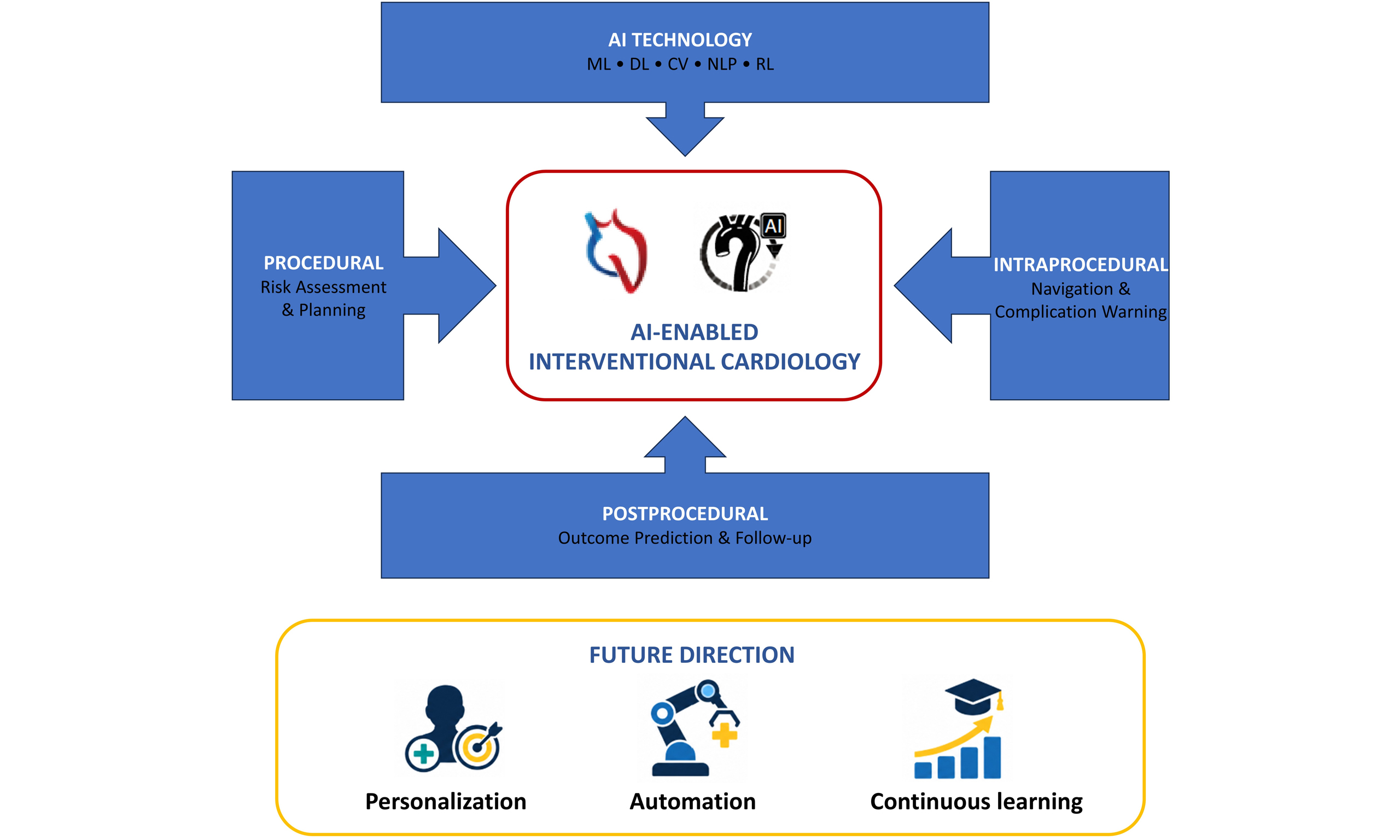
Graphical Abstract
Abstract
With population aging and the rising incidence of cardiac disease, interventional cardiology, as a cornerstone of treatment for conditions such as coronary and structural heart disease, faces persistent challenges, including stringent precision requirements, heavy reliance on operator experience, and variability in diagnostic and therapeutic efficiency. With robust capabilities in data mining, image recognition, real-time analysis, and predictive modeling, artificial intelligence (AI) offers a novel pathway to address the aforementioned challenges and support the intelligent transformation of interventional cardiology. This narrative review briefly outlines the background to the application of AI in interventional cardiology, focuses on core supporting technologies including deep learning, machine learning, and computer vision, and summarizes current research and clinical applications of AI across preprocedural risk assessment and planning, intraprocedural real-time navigation and early warning of complications, and postprocedural follow-up and prognosis prediction. It also analyzes the principal challenges currently facing AI in this field, such as data quality and security issues, insufficient algorithm interpretability, barriers to clinical translation, and constraints from ethical and regulatory frameworks. Finally, in light of technological advances and clinical needs, this review outlines future directions, including the integration of AI with interventional devices, multimodal data integration and modeling, and the development of personalized interventional strategies, thereby providing a reference for promoting the standardized and large-scale application of AI technology in interventional cardiology.
Keywords


 Download PDF
REFERENCES
1. Qu C, Liao S, Zhang J, et al. Burden of cardiovascular disease among elderly: based on the Global Burden Of Disease Study 2019. Eur Heart J Qual Care Clin Outcomes. 2024;10:143-53.
2. Faxon DP, Williams DO. Interventional cardiology: current status and future directions in coronary disease and valvular heart disease. Circulation. 2016;133:2697-711.
3. Ullah M, Wahab A, Khan SU, et al. Stent as a novel technology for coronary artery disease and their clinical manifestation. Curr Probl Cardiol. 2023;48:101415.
4. Safdar M, Ullah M, Wahab A, et al. Genomic insights into heart health: exploring the genetic basis of cardiovascular disease. Curr Probl Cardiol. 2024;49:102182.
5. Avvedimento M, Tang GHL. Transcatheter aortic valve replacement (TAVR): recent updates. Prog Cardiovasc Dis. 2021;69:73-83.
6. Beyar R, Davies JE, Cook C, Dudek D, Cummins PA, Bruining N. Robotics, imaging, and artificial intelligence in the catheterisation laboratory. EuroIntervention. 2021;17:537-49.
7. Arfat Y, Mittone G, Esposito R, Cantalupo B, DE Ferrari GM, Aldinucci M. Machine learning for cardiology. Minerva Cardiol Angiol. 2022;70:75-91.
8. Hou L, Zhao J, He T, Su K, Li Y. Machine Learning-Based Prediction of In-Stent Restenosis Risk Using Systemic Inflammation Aggregation Index Following Coronary Stent Placement. Risk Manag Healthc Policy. 2024;17:1779-86.
9. Shameer K, Johnson KW, Glicksberg BS, Dudley JT, Sengupta PP. Machine learning in cardiovascular medicine: are we there yet? Heart. 2018;104:1156-64.
10. Johnson KW, Torres Soto J, Glicksberg BS, et al. Artificial intelligence in cardiology. J Am Coll Cardiol. 2018;71:2668-79.
11. Rudnicka Z, Pręgowska A, Glądys K, Perkins M, Proniewska K. Advancements in artificial intelligence-driven techniques for interventional cardiology. Cardiol J. 2024;31:321-41.
12. Li Z, Liu F, Yang W, Peng S, Zhou J. A survey of convolutional neural networks: analysis, applications, and prospects. IEEE Trans Neural Netw Learn Syst. 2022;33:6999-7019.
13. Papanastasiou G, Dikaios N, Huang J, Wang C, Yang G. Is attention all you need in medical image analysis? A review. IEEE J Biomed Health Inform. 2024;28:1398-411.
14. Reading Turchioe M, Volodarskiy A, Pathak J, Wright DN, Tcheng JE, Slotwiner D. Systematic review of current natural language processing methods and applications in cardiology. Heart. 2022;108:909-16.
15. Adejumo P, Thangaraj PM, Dhingra LS, et al. Natural language processing of clinical documentation to assess functional status in patients with heart failure. JAMA Netw Open. 2024;7:e2443925.
16. Jiang F, Jiang Y, Zhi H, et al. Artificial intelligence in healthcare: past, present and future. Stroke Vasc Neurol. 2017;2:230-43.
17. Kweon J, Kim K, Lee C, et al. Deep reinforcement learning for guidewire navigation in coronary artery phantom. IEEE Access. 2021;9:166409-22.
18. Kurata A, Fukuyama N, Hirai K, et al. On-site computed tomography-derived fractional flow reserve using a machine-learning algorithm-clinical effectiveness in a retrospective multicenter cohort. Circ J. 2019;83:1563-71.
19. Yang J, Shan D, Wang X, et al. On-Site Computed tomography-derived fractional flow reserve to guide management of patients with stable coronary artery disease: the TARGET randomized trial. Circulation. 2023;147:1369-81.
20. Liu S, Neleman T, Hartman EMJ, et al. Automated quantitative assessment of coronary calcification using intravascular ultrasound. Ultrasound Med Biol. 2020;46:2801-9.
21. Neleman T, Liu S, Tovar Forero MN, et al. The prognostic value of a validated and automated intravascular ultrasound-derived calcium score. J Cardiovasc Transl Res. 2021;14:992-1000.
22. Bae Y, Kang SJ, Kim G, et al. Prediction of coronary thin-cap fibroatheroma by intravascular ultrasound-based machine learning. Atherosclerosis. 2019;288:168-74.
23. Jun TJ, Kang SJ, Lee JG, et al. Automated detection of vulnerable plaque in intravascular ultrasound images. Med Biol Eng Comput. 2019;57:863-76.
24. Wang YY, Qiu CH, Jiang J, Xia SR. Detecting the media-adventitia border in intravascular ultrasound images through a classification-based approach. Ultrason Imaging. 2019;41:78-93.
25. Bajaj R, Eggermont J, Grainger SJ, et al. Machine learning for atherosclerotic tissue component classification in combined near-infrared spectroscopy intravascular ultrasound imaging: validation against histology. Atherosclerosis. 2022;345:15-25.
26. Chu M, Jia H, Gutiérrez-Chico JL, et al. Artificial intelligence and optical coherence tomography for the automatic characterisation of human atherosclerotic plaques. EuroIntervention. 2021;17:41-50.
27. Shibutani H, Fujii K, Ueda D, et al. Automated classification of coronary atherosclerotic plaque in optical frequency domain imaging based on deep learning. Atherosclerosis. 2021;328:100-5.
28. Liu R, Zhang Y, Zheng Y, Liu Y, Zhao Y, Yi L. Automated detection of vulnerable plaque for intravascular optical coherence tomography images. Cardiovasc Eng Technol. 2019;10:590-603.
29. Liu S, Xin J, Wu J, et al. Multi-view contour-constrained transformer network for thin-cap fibroatheroma identification. Neurocomputing. 2023;523:224-34.
30. Avram R, Olgin JE, Ahmed Z, et al. CathAI: fully automated coronary angiography interpretation and stenosis estimation. NPJ Digit Med. 2023;6:142.
31. Du T, Xie L, Zhang H, et al. Training and validation of a deep learning architecture for the automatic analysis of coronary angiography. EuroIntervention. 2021;17:32-40.
32. Kim GY, Lee JH, Hwang YN, Kim SM. A novel intensity-based multi-level classification approach for coronary plaque characterization in intravascular ultrasound images. Biomed Eng Online. 2018;17:151.
33. Zhou P, Zhu T, He C, Li Z. Automatic classification of atherosclerotic tissue in intravascular optical coherence tomography images. J Opt Soc Am A Opt Image Sci Vis. 2017;34:1152-9.
34. Lee J, Prabhu D, Kolluru C, et al. Automated plaque characterization using deep learning on coronary intravascular optical coherence tomographic images. Biomed Opt Express. 2019;10:6497-515.
35. Kim B, Kim J, Kim YH, Jun TJ, Ahn JM. Deep learning-based treatment decision support framework for multi-vessel coronary artery disease using integrated coronary angiography and clinical data. BMC Med Inform Decis Mak. 2026:26.
36. Wang M, Niu G, Chen Y, et al. Development and validation of a deep learning-based fully automated algorithm for pre-TAVR CT assessment of the aortic valvular complex and detection of anatomical risk factors: a retrospective, multicentre study. EBioMedicine. 2023;96:104794.
37. Hong H, Jia H, Zeng M, et al. Risk stratification in acute coronary syndrome by comprehensive morphofunctional assessment with optical coherence tomography. JACC Asia. 2022;2:460-72.
38. Lv R, Wang L, Maehara A, et al. Combining IVUS + OCT data, biomechanical models and machine learning method for accurate coronary plaque morphology quantification and cap thickness and stress/strain index predictions. J Funct Biomater. 2023;14:41.
39. Piayda K, Phinicarides R, Afzal S, et al. Dynamic coronary roadmap in percutaneous coronary intervention: results from an open-label, randomized trial. JACC Cardiovasc Interv. 2021;14:2523-5.
40. Piayda K, Kleinebrecht L, Afzal S, et al. Dynamic coronary roadmapping during percutaneous coronary intervention: a feasibility study. Eur J Med Res. 2018;23:36.
41. Ploscaru V, Popa-Fotea NM, Calmac L, et al. Artificial intelligence and cloud based platform for fully automated PCI guidance from coronary angiography-study protocol. PLoS One. 2022;17:e0274296.
42. Danilov VV, Klyshnikov KY, Gerget OM, et al. Aortography keypoint tracking for transcatheter aortic valve implantation based on multi-task learning. Front Cardiovasc Med. 2021;8:697737.
43. Park J, Kweon J, Kim YI, et al. Selective ensemble methods for deep learning segmentation of major vessels in invasive coronary angiography. Med Phys. 2023;50:7822-39.
44. Park T, Khang S, Jeong H, et al. Deep learning segmentation in 2D X-ray images and non-rigid registration in multi-modality images of coronary arteries. Diagnostics. 2022;12:778.
45. Westra J, Andersen BK, Campo G, et al. Diagnostic performance of in-procedure angiography-derived quantitative flow reserve compared to pressure-derived fractional flow reserve: the FAVOR II Europe-Japan Study. J Am Heart Assoc. 2018:7.
46. Hu X, Zhang J, Yang S, et al.; FLAVOUR II study group. Angiography-derived fractional flow reserve versus intravascular ultrasound to guide percutaneous coronary intervention in patients with coronary artery disease (FLAVOUR II): a multicentre, randomised, non-inferiority trial. Lancet. 2025;405:1491-504.
47. Suk J, de Haan P, Lippe P, Brune C, Wolterink JM. Mesh neural networks for SE(3)-equivariant hemodynamics estimation on the artery wall. Comput Biol Med. 2024;173:108328.
48. Benjamins JW, Hendriks T, Knuuti J, Juarez-Orozco LE, van der Harst P. A primer in artificial intelligence in cardiovascular medicine. Neth Heart J. 2019;27:392-402.
49. Jeelani S, Dany A, Anand B, Vandana S, Maheswaran T, Rajkumar E. Robotics and medicine: a scientific rainbow in hospital. J Pharm Bioallied Sci. 2015;7:S381-3.
50. Min HS, Ryu D, Kang SJ, et al. Prediction of coronary stent underexpansion by pre-procedural intravascular ultrasound-based deep learning. JACC Cardiovasc Interv. 2021;14:1021-9.
51. Wu P, Gutiérrez-Chico JL, Tauzin H, et al. Automatic stent reconstruction in optical coherence tomography based on a deep convolutional model. Biomed Opt Express. 2020;11:3374-94.
52. Hamana T, Nishimori M, Shibata S, et al. Deep-learning-driven optical coherence tomography analysis for cardiovascular outcome prediction in patients with acute coronary syndrome. Eur Heart J Digit Health. 2024;5:692-701.
53. Lu H, Lee J, Ray S, et al. Automated stent coverage analysis in intravascular OCT (IVOCT) image volumes using a support vector machine and mesh growing. Biomed Opt Express. 2019;10:2809-28.
54. Nam HS, Kim CS, Lee JJ, Song JW, Kim JW, Yoo H. Automated detection of vessel lumen and stent struts in intravascular optical coherence tomography to evaluate stent apposition and neointimal coverage. Med Phys. 2016;43:1662.
55. Yang G, Mehanna E, Li C, et al. Stent detection with very thick tissue coverage in intravascular OCT. Biomed Opt Express. 2021;12:7500-16.
56. Wissel T, Riedl K, Schaefers K, et al. Delineation of coronary stents in intravascular ultrasound pullbacks. In: Medical Imaging 2021: Image-Guided Procedures, Robotic Interventions, and Modeling; 2021 Feb 15-19; Online, California, USA. 2021.
58. Sallam M. ChatGPT utility in healthcare education, research, and practice: systematic review on the promising perspectives and valid concerns. Healthcare. 2023;11:887.
59. Stehlik J, Schmalfuss C, Bozkurt B, et al. Continuous wearable monitoring analytics predict heart failure hospitalization: the LINK-HF Multicenter Study. Circ Heart Fail. 2020;13:e006513.
60. Devore AD, Xie J, Etters L, et al. A digital platform to optimize guideline-directed heart failure therapy: rationale and design of the AIM-POWER trial. J Card Fail. 2025;31:1837-46.
61. McDonagh TA, Metra M, Adamo M, et al.; ESC Scientific Document Group. 2021 ESC Guidelines for the diagnosis and treatment of acute and chronic heart failure: developed by the Task Force for the diagnosis and treatment of acute and chronic heart failure of the European Society of Cardiology (ESC) With the special contribution of the Heart Failure Association (HFA) of the ESC. Eur Heart J. 2021;42:3599-726.
62. Stevenson LW, Ross HJ, Rathman LD, Boehmer JP. Remote monitoring for heart failure management at home. J Am Coll Cardiol. 2023;81:2272-91.
63. Iftikhar H. AI-driven personalization of dual antiplatelet therapy duration post-PCI: a novel approach balancing ischemic and bleeding risks in the UAE population. medRxiv. 2025:2025.03.16.25324067.
64. Johnson KW, Shameer K, Glicksberg BS, et al. Enabling precision cardiology through multiscale biology and systems medicine. JACC Basic Transl Sci. 2017;2:311-27.
65. Yan Y, Zhang JW, Zang GY, Pu J. The primary use of artificial intelligence in cardiovascular diseases: what kind of potential role does artificial intelligence play in future medicine? J Geriatr Cardiol. 2019;16:585-91.
66. Topol EJ. High-performance medicine: the convergence of human and artificial intelligence. Nat Med. 2019;25:44-56.
68. Willemink MJ, Koszek WA, Hardell C, et al. Preparing medical imaging data for machine learning. Radiology. 2020;295:4-15.
69. Kelly CJ, Karthikesalingam A, Suleyman M, Corrado G, King D. Key challenges for delivering clinical impact with artificial intelligence. BMC Med. 2019;17:195.
70. Liu X, Faes L, Kale AU, et al. A comparison of deep learning performance against health-care professionals in detecting diseases from medical imaging: a systematic review and meta-analysis. Lancet Digit Health. 2019;1:e271-97.
71. Rudin C. Stop explaining black box machine learning models for high stakes decisions and use interpretable models instead. Nat Mach Intell. 2019;1:206-15.
72. Reyes M, Meier R, Pereira S, et al. On the interpretability of artificial intelligence in radiology: challenges and opportunities. Radiol Artif Intell. 2020;2:e190043.
73. He J, Baxter SL, Xu J, Xu J, Zhou X, Zhang K. The practical implementation of artificial intelligence technologies in medicine. Nat Med. 2019;25:30-6.
74. Sendak MP, D’Arcy J, Kashyap S, et al. A path for translation of machine learning products into healthcare delivery. EMJ Innov. 2020.
76. Vayena E, Blasimme A, Cohen IG. Machine learning in medicine: addressing ethical challenges. PLoS Med. 2018;15:e1002689.
77. Gerke S, Minssen T, Cohen G. Ethical and legal challenges of artificial intelligence-driven healthcare. In: Bohr A, Memarzadeh K, Editors. Artificial Intelligence in Healthcare. Academic Press; 2020. pp. 295-336.
79. Bajwa J, Munir U, Nori A, Williams B. Artificial intelligence in healthcare: transforming the practice of medicine. Future Healthc J. 2021;8:e188-94.
80. Mihan A, Pandey A, Van Spall HGC. Artificial intelligence bias in the prediction and detection of cardiovascular disease. NPJ Cardiovasc Health. 2024:1.
81. Gong Y, Liu G, Xue Y, Li R, Meng L. A survey on dataset quality in machine learning. Inf Softw Technol. 2023;162:107268.
82. Olawade DB, Fidelis SC, Marinze S, Egbon E, Osunmakinde A, Osborne A. Artificial intelligence in clinical trials: a comprehensive review of opportunities, challenges, and future directions. Int J Med Inform. 2026;206:106141.
83. Youssef A, Nichol AA, Martinez-Martin N, et al. Ethical considerations in the design and conduct of clinical trials of artificial intelligence. JAMA Netw Open. 2024;7:e2432482.
84. Choksi S, Szot S, Zang C, et al. Bringing artificial intelligence to the operating room: edge computing for real-time surgical phase recognition. Surg Endosc. 2023;37:8778-84.
85. Haque MA, Siddique HR. Generative artificial intelligence and large language models in smart healthcare applications: current status and future perspectives. Comput Biol Chem. 2026;120:108611.
86. Finlayson SG, Subbaswamy A, Singh K, et al. The clinician and dataset shift in artificial intelligence. N Engl J Med. 2021;385:283-6.
87. World Health Organization. Ethics and governance of artificial intelligence for health: Guidance on large multi-modal models. 2025. Available from: https://www.who.int/publications/i/item/9789240084759 [accessed 13 October 2026].
88. Aboy M, Minssen T, Vayena E. Navigating the EU AI act: implications for regulated digital medical products. NPJ Digit Med. 2024;7:237.
89. Tordjman M, Liu Z, Yuce M, et al. Comparative benchmarking of the DeepSeek large language model on medical tasks and clinical reasoning. Nat Med. 2025;31:2550-5.
90. Samant S, Panagopoulos AN, Wu W, Zhao S, Chatzizisis YS. Artificial intelligence in coronary artery interventions: preprocedural planning and procedural assistance. J Soc Cardiovasc Angiogr Interv. 2025;4:102519.
Cite This Article
 Open Access
How to Cite
Li J, Li Y, Zhu Q, Liu X. Artificial intelligence in interventional cardiology: present landscape and future directions. Vessel Plus. 2026;10:56. https://dx.doi.org/10.20517/2574-1209.2026.12
Download Citation
If you have the appropriate software installed, you can download article citation data to the citation manager of your choice. Simply select your manager software from the list below and click on download.
Export Citation File
Type of Import
Tips on Downloading Citation
Citation Manager File Format
Type of Import
Direct Import: When the Direct Import option is selected (the default state), a dialogue box will give you the option to Save or Open the downloaded citation data. Choosing Open will either launch your citation manager or give you a choice of applications with which to use the metadata. The Save option saves the file locally for later use.
Indirect Import: When the Indirect Import option is selected, the metadata is displayed and may be copied and pasted as needed.
About This Article
Special Topic
Copyright

Data & Comments
Data
0









Comments
Comments must be written in English. Spam, offensive content, impersonation, and private information will not be permitted. If any comment is reported and identified as inappropriate content by OAE staff, the comment will be removed without notice. If you have any queries or need any help, please contact us at [email protected].